
Action research is the dissertation design built for students who are already the practitioner in the setting they are studying — you plan a change to your own teaching, try it, watch what happens, and revise it, in a repeating cycle rather than a single before-and-after measurement. It suits PGCE and education dissertations particularly well because most students are on placement in a real classroom already; the design turns that placement into the research site rather than treating it as a separate obstacle. Here is the cycle, step by step, and where it differs from a standard empirical education dissertation.
Step 1: Confirm your programme accepts action research as the whole dissertation
Some education and PGCE programmes explicitly name action research as an accepted design and structure the dissertation module around it; others treat it as one option among several (case study, small-scale survey, action research) and expect you to justify the choice in your proposal. Check your handbook’s language carefully — “practitioner enquiry” and “practitioner research” are often used as synonyms for the same cyclical design, so do not assume it is unavailable just because the word “action research” does not appear.

Step 2: Define a genuine practice problem, not a topic
Action research starts from a real, specific tension in your own teaching — pupils disengaging during a particular type of lesson, a marking approach that is not improving outcomes, a behaviour-management strategy that works for some pupils and not others — rather than a broad interest area. “Improving literacy” is a topic; “does introducing paired reading for ten minutes at the start of each session improve reading fluency scores in my Year 4 class” is a focus you can actually cycle through and measure change against.
Step 3: Choose a cycle model and say so explicitly
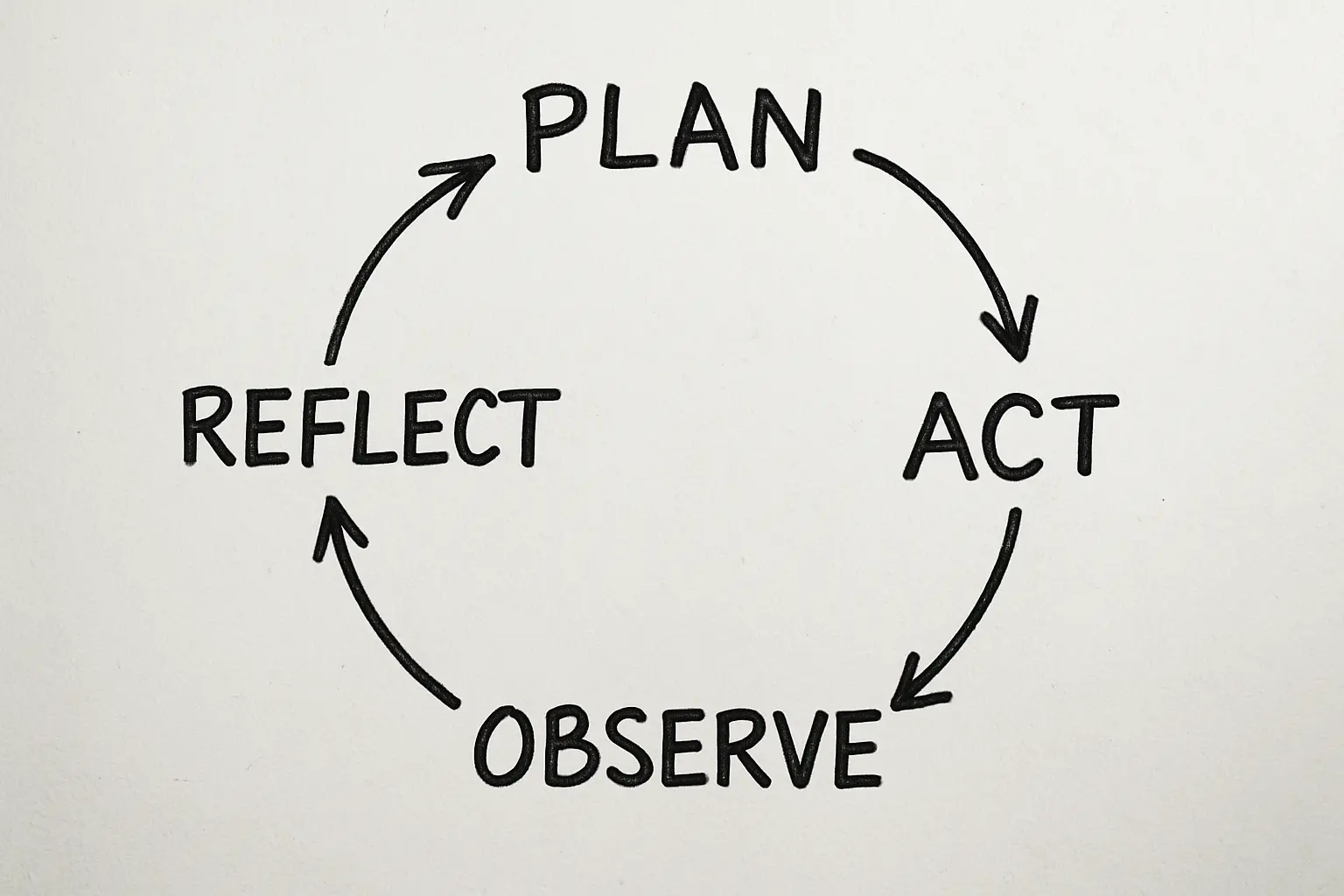
The two models that recur across UK education dissertations are Lewin’s original spiral of planning, acting, observing and reflecting, and Kemmis and McTaggart’s four-moment cycle, which names the same four moments but frames each cycle as feeding directly into the next iteration’s plan. Neither is “more correct” than the other, but your methodology chapter needs to name which one you used and why, rather than describing a generic “cycle of reflection” with no citation — a marker reading an action research dissertation looks for this framing early, because it signals whether you understand the design or are using the word loosely to describe ordinary reflective teaching practice.
Step 4: Plan the first cycle
Decide, and write down before you start, exactly what change you will make to your practice, what data you will collect to judge its effect, and over what timeframe. Most education dissertations mix data types within a cycle — a teacher’s own field notes or reflective journal, samples of pupil work, a short pupil questionnaire or exit ticket, and sometimes an observation from a mentor or peer — because triangulating your own perception of what happened against an independent data source is what gives an action research finding credibility, rather than relying solely on your own account of your own intervention.
Step 5: Act and observe
Implement the planned change and collect the data you specified, exactly as planned where possible — and where the plan has to change mid-cycle because of a real classroom constraint (a pupil absence, a timetable clash, an assembly that eats the lesson), record that deviation rather than quietly smoothing it out of the write-up. Real classroom disruption to a plan is normal in this design and, reported honestly, reads as authentic practitioner research rather than a flaw.
Step 6: Reflect, and let the reflection actually change the next cycle
This is the step markers use to judge whether the design was genuinely cyclical or only cosmetically so. A weak write-up states what happened in cycle one and then describes cycle two as though it were planned from the start. A strong write-up shows the reasoning: “the pupil questionnaire after cycle one showed most pupils found the paired-reading pairs mismatched by ability, so cycle two changed the pairing method to same-ability pairs and added a five-minute teacher-modelled example before pupils began” — the second cycle has to be visibly a response to the first, not a second, unrelated attempt.
Step 7: Run at least a second cycle — and be honest if the timetable only allows a partial one
The spiral is the point of the design; a single plan-act-observe-reflect pass with no revision is closer to a small evaluation than an action research cycle. Most undergraduate and PGCE placements only allow time for one full cycle plus a partial or planned-but-untested second cycle, and that is a legitimate, common limitation to name directly in your methodology and limitations sections rather than disguising a single cycle as a completed spiral.
Step 8: Address validity on action research’s own terms, not a quantitative study’s terms
Action research cannot claim the kind of generalisability a large-sample survey claims, and trying to defend it that way is a common weak spot. Instead, address the criteria the design actually offers: whether the change genuinely improved your practice or pupils’ outcomes in this specific context (sometimes called practical or catalytic validity), and whether you checked your own interpretation against another source — a mentor’s observation, a pupil’s own account, or a second data type that either confirms or complicates your reading of events. Naming this kind of triangulation explicitly, and being honest about the limits of researching your own practice with your own pupils, is what a rigorous action research methodology chapter looks like.
Step 9: Handle the specific ethical tension of researching your own pupils
Beyond the standard gatekeeper, DBS and consent process every UK education dissertation goes through — covered in full in our guide to writing an education dissertation methodology chapter — action research adds a specific wrinkle: you hold a position of authority over the pupils whose data you are collecting, as their actual teacher, not an outside researcher. State in your ethics application how you managed this power imbalance — commonly, by making clear to pupils (and parents, for younger children) that participation in the research activity is separate from ordinary classroom participation and assessment, and that opting out carries no academic consequence.
Step 10: Write the discussion around what changed in your practice
An action research discussion chapter is not primarily about what the data showed in the abstract — it is about what you now understand differently about your own teaching, and what you would do differently again in a third cycle if you had one. Many dissertations at this stage frame their reflection against an established learning theory; if you have not yet chosen one, our comparison of eight education dissertation theoretical frameworks covers which theories pair naturally with a practitioner-enquiry design.
What a weak action research proposal looks like, and how to fix it
The proposal stage is where most action research dissertations either earn or lose their supervisor’s confidence, and the same three weaknesses recur. First, a focus stated as an outcome rather than a question — “improving pupil engagement in maths” rather than “does starting each maths lesson with a low-stakes retrieval quiz improve on-task behaviour in my Year 8 set 3 class” — which leaves no way to judge afterwards whether the intervention worked. Second, no baseline: without measuring or describing the starting position before cycle one begins, there is nothing for cycle one’s data to be compared against, and “improvement” becomes an assertion rather than a finding. Third, a plan for only one cycle with no stated intention to revise, which is not action research at all but a single-intervention evaluation wearing the label. Fixing all three before your proposal is submitted is far cheaper than fixing them after data collection has already started.
How action research differs from a straightforward intervention evaluation
An intervention evaluation asks whether a single, fixed change produced an effect, measured once, at the end. Action research asks a subtly different question: how does practice improve through repeated, deliberate cycles of trying, observing and adjusting. The distinction matters for how you write the methodology — an evaluation methodology defends why the intervention is a fair test; an action research methodology defends why the specific cycle model was followed and how each cycle’s plan was genuinely shaped by the previous one’s findings, which is a different kind of justification and needs different literature to support it.
A worked Harvard reference for an action research source
Kemmis and McTaggart’s cycle is most commonly cited from their chapter in the Sage Handbook of Qualitative Research: Kemmis, S. and McTaggart, R. (2005) ‘Participatory action research: communicative action and the public sphere’, in Denzin, N.K. and Lincoln, Y.S. (eds.) The Sage Handbook of Qualitative Research. 3rd edn. Thousand Oaks: Sage, pp. 559–603. Cite the specific edition you actually consulted, since page numbers shift between editions.
Frequently asked questions
Is action research the same as a case study?
No — a case study can be purely observational, describing a single setting in depth without the researcher deliberately intervening. Action research always involves the researcher making a planned change to their own practice and cycling through the effects of that change, which is what distinguishes it structurally.
How many cycles does a PGCE dissertation need?
There is no fixed number set nationally — check your handbook — but most undergraduate and PGCE timescales realistically support one completed cycle plus a second cycle that is planned and partially implemented, which is an accepted and common outcome, not a failure of the design.
Can you do action research if you are not currently teaching your own class?
It is harder without an ongoing placement, because the design depends on you making and observing a change in your own practice over time — students without a current placement more often choose a case study or small-scale survey design instead.
Do you need a control group for action research?
No — action research does not compare your class against a separate control group; it compares your own practice before and after the change, within the same group, which is a fundamentally different logic from an experimental design and does not need to be defended as though it were one.
How do you analyse the data from an action research cycle?
Most education dissertations analyse qualitative action research data — field notes, pupil work, questionnaire responses — through thematic analysis; see our guide to thematic analysis, phase by phase for the six-phase process most markers expect to see evidenced.
What if your intervention does not improve anything?
Report it as a genuine finding rather than reframing the data to suggest success — a null or negative result, honestly analysed and reflected on, is a legitimate and markable outcome in action research; the value examiners look for is in the quality of your reflection on why it did not work, not in the intervention having succeeded.
Should the dissertation be written in first person?
Action research is one of the few designs where first person is often expected, precisely because you are both the researcher and the practitioner whose practice is being studied — but this still varies by department, so confirm your own module handbook’s position rather than assuming it.
What goes in the results chapter of an action research dissertation?
Structure it cycle by cycle rather than by data type — present what happened in cycle one, what it led you to change, then what happened in cycle two — since the whole point of the design is the link between cycles, not a single combined results section; our general guide to writing a dissertation results chapter covers the underlying principle of organising results around your research questions.
Do you need ethics approval for action research on your own class?
Yes — researching your own pupils still needs your university’s ethics approval and your placement school’s gatekeeper permission, exactly as any other education dissertation does, even though you already have routine access as their teacher. Access for teaching is not the same as access for research.
Can two students on the same placement do separate action research projects?
Yes, provided each project focuses on a distinct aspect of practice and collects its own data — but check with your placement school and both universities’ ethics processes, since a school hosting two concurrent studies on overlapping pupil groups may want the two research plans coordinated to avoid over-surveying the same children.
Tesify’s dissertation builder can keep each cycle’s plan, data and reflection organised as its own linked section, so the connection between what cycle one showed and what cycle two changed stays visible in the final write-up rather than getting lost across separate documents. Start structuring your dissertation with Tesify — free to try.