Category: Step-by-Step Guides

  • How to Reference in Harvard Style: The Complete UK Guide for Dissertations (2026)

    How to Reference in Harvard Style: The Complete UK Guide for Dissertations (2026)

    Harvard referencing is the most-used citation system in UK higher education and the least standardised. There is no single Harvard authority, no governing body and no definitive manual — which is why the guide your friend at another university swears by can be confidently, markably wrong for your department. This guide gives you the version most UK departments actually mean, the changes that landed in 2025 and now bind you in 2026, and a procedure you can follow chapter by chapter.

    One instruction before any of it: find your own module handbook or library referencing guide and keep it open. Everything below tells you what is normal and where the variation lives. Your handbook tells you what is required.

    Step 1: Work out which Harvard you have been asked for

    Most UK departments that say “Harvard” mean Cite Them Right, the author–date guide by Richard Pears and Graham Shields published by Bloomsbury, now in its 13th edition. Cite Them Right Online states that its referencing styles reflect the latest guidance from that 13th edition, and a large share of UK university libraries subscribe to it and point students straight there.

    But a substantial minority of universities maintain their own named variant. The University of Leeds says so directly: “The University uses a variation of the Harvard referencing style called Leeds Harvard.” Anglia Ruskin, Coventry, Bath and others publish their own house Harvards too. These are not cosmetic differences — they change punctuation, capitalisation, the order of elements and whether an accessed date is required.

    Expected output: one sentence you can say out loud — “my department uses Cite Them Right Harvard” or “my department uses [University] Harvard” — plus the URL of the guide that proves it. If your handbook only says “Harvard”, ask your supervisor in writing which guide the markers use, because the answer determines everything that follows.

    Step 2: Learn the four changes the 13th edition made

    This is the step almost nobody does, and it is the reason so much online Harvard advice is now out of date. The 13th edition changed conventions that had been stable for years, so a template you copied from a blog in 2023 will produce references that look wrong to a marker reading in 2026.

    UK university libraries have published the differences; the Open University Library set them out plainly in October 2025:

    1. Place of publication has been removed from citations to most source types, including books, films and maps. The old London: Routledge pattern is gone; it is now just the publisher.
    2. Paragraph numbers may be included in in-text citations where they help — optional, and useful for sources with no page numbers.
    3. Capitalisation has split. Use title case for titles of works when you mention them in your running text, and sentence case for titles in the reference list. Previous advice was to reproduce the title as given.
    4. New source types were added, including guidance on AI-generated material and on working with AI tools as part of an assignment.

    The transition matters as much as the changes. The University of the Highlands and Islands library told its students that academics will accept both the 12th and 13th edition styles during the 2025/26 academic year, that nobody would be penalised for either “provided their referencing is clear, accurate, and consistent” — and that from 2026/27 onwards all students will be expected to follow the 13th edition. Other institutions have set their own switchover dates. If you are submitting a dissertation in the 2026/27 session, assume 13th edition unless your handbook says otherwise.

    Expected output: a decision recorded at the top of your notes — 12th or 13th edition — and consistency with it across every entry. Mixing the two is the failure markers actually penalise.

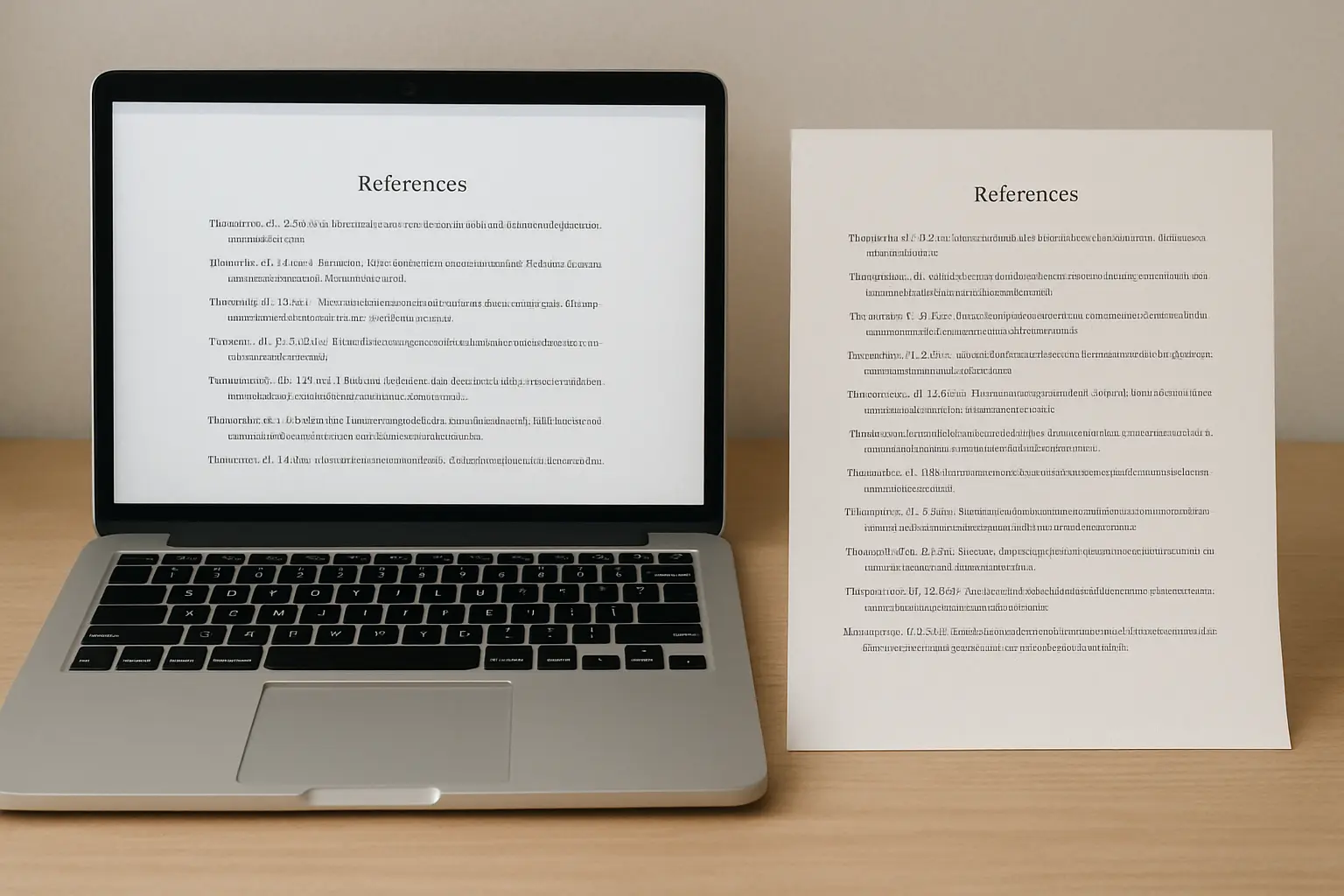
    Two university library referencing guides open side by side showing different Harvard formats
    Two universities, two Harvards. This is why “I checked a Harvard guide” is not the same as checking yours.

    Step 3: Get the in-text citation right, because it is most of the work

    Harvard is an author–date system: the citation in your text carries the surname and the year, and the reference list carries everything else. Three patterns cover nearly every sentence you will write.

    Citation in brackets, when the source is doing the work and the author is not the subject of your sentence: Attendance and attainment appear to be linked (Stone and Collins, 2012).

    Author in the sentence, when you want to foreground whose claim it is: Biggs and Smith (2012) argue that constructive alignment changes what assessment measures. This is the more analytical construction and undergraduate dissertations generally use it too little.

    Several sources at once, when you are establishing that a position is well supported: (Richards, 2007; Graham, 2009; Elston, 2011; Chan, 2012).

    Add a page number whenever you quote directly, and whenever you attribute a specific claim to a specific place in a long work. Leeds Harvard puts the rule simply: include page numbers in your citation if you quote directly from the text.

    The multiple-author rule is where students most often guess. For Cite Them Right Harvard, Newcastle University Library states it precisely: use et al. in the in-text citation where the reference has four or more authors, and in the reference list record all authors, using et al. only where there are ten or more. Note that these are two different thresholds for two different places, and that the threshold is exactly the sort of thing a local variant may change.

    Expected output: a rule you can apply without looking anything up — brackets or sentence, page number if quoting, et al. at your guide’s stated threshold.

    Step 4: Build the reference list from four patterns

    Almost everything you cite is a book, a chapter in an edited book, a journal article or a webpage. Learn these four shapes and the rest are variations. The examples below follow Cite Them Right conventions as published in UK university library guides.

    Source type Pattern
    Book Author, Initial(s). (Year) Title in sentence case. Edition. Publisher.
    Chapter in an edited book Author, Initial(s). (Year) ‘Chapter title’, in Editor (ed.) Book title. Publisher, pp. x–y.
    Journal article Author, Initial(s). (Year) ‘Article title’, Journal Name, volume(issue), pp. x–y. DOI or URL.
    Webpage Author or organisation (Year) Title. Available at: URL (Accessed: day month year).

    Worked out in full, using the examples published by the University of the West of Scotland’s library guide:

    Book: Speight, J.G. (2019) Global climate change demystified. 2nd edn. Wiley.

    Chapter: Venn, A. (2019) ‘Social justice and climate change’, in T. M. Letcher (ed.) Managing global warming: an interface of technology and human issues. Academic Press, pp. 711–728.

    Journal article: Culloty, E., Murphy, P., Brereton, P., Suiter, J., Smeaton, A. and Zhang, D. (2019) ‘Researching visual representations of climate change’, Environmental Communication, 13(2), pp. 179–191. https://doi.org/10.1080/17524032.2018.1533877

    Webpage: Sneed, A. (2019) The reason Antarctica is melting: shifting winds, driven by global warming. Available at: https://www.scientificamerican.com/article/the-reason-antarctica-is-melting-shifting-winds-driven-by-global-warming/ (Accessed: 23 July 2020).

    Read the book example again and notice what is absent: no place of publication. That single omission is the fastest way to tell whether a reference was written to the current edition or copied from an old template.

    Four details carry most of the marks that get lost here. The article title takes quotation marks and the journal title takes italics — not the other way round, which is the single most common inversion. Page ranges are given in full, not truncated to the first page. A DOI is preferred to a bare URL where one exists, because it does not rot. And an accessed date belongs on web sources whose content can change, not on a journal article with a DOI.

    Expected output: a reference list in one alphabetical sequence by author surname, with no numbering, no bullet points, and no separate sections for books and websites unless your handbook asks for them.

    Step 5: Handle the four sources that break the pattern

    A source with no author. Use the organisation as author where there is one. Where there is genuinely none, the title takes the author position — do not write “Anon.” unless your guide tells you to.

    A source with no date. Use (no date). Do not guess a year from a copyright footer; a website’s footer year is the year the site was updated, not the year the page was written.

    A source you found quoted in another source. This is secondary referencing, and the honest form names both: Bourdieu (1984, cited in Smith, 2019, p. 44), with only the source you actually read — Smith — appearing in the reference list. Markers notice when a dissertation’s reference list is full of classic works the student plainly did not open. If a source matters to your argument, find it and read it.

    Generative AI output. The 13th edition added guidance for this, and separately your university will have an assessment rule about whether such use is permitted at all and how to declare it. Referencing an AI output and being allowed to use it are two different questions; answer the permission question from your own academic integrity policy first.

    Expected output: no placeholder text anywhere. Every awkward source resolved before submission week, when there is no time to resolve anything.

    A student adding a citation while drafting rather than leaving the bibliography until the end
    Cite as you draft. Every “(REF)” you leave behind is a job for the night before the deadline.

    Step 6: Automate the clerical layer and check the judgement layer

    Formatting citations is mechanical work that no marking criterion rewards, and it is the easiest part of a dissertation to hand to software. A reference manager holds your library and inserts formatted citations — our comparison of Zotero, Mendeley and EndNote covers which suits a dissertation-scale project. A generator formats individual entries from a DOI or URL, which our guide to the AI Harvard referencing generator works through, including the free options.

    Two things stay yours whatever you use. Select your institution’s exact variant in the tool’s style list where it exists, and check a sample of the output against your handbook once, early — a tool set to the wrong Harvard produces consistently wrong references, which is worse than inconsistently wrong ones because you stop looking. And verify that every entry corresponds to something you actually opened; a missing or fabricated citation is a misconduct question, not a formatting one, and it is also the kind of gap that surfaces when you run a similarity self-check before submission.

    If your bibliography keeps drifting out of step with your chapters, the structural fix is to stop treating it as a separate document. Tesify builds your bibliography from what your text actually cites as you write, in your chosen style, so cited-but-not-listed and listed-but-not-cited stop being possible. Everything stays 100% written by you, and it is free to start.

    Expected output: a bibliography that regenerates correctly after every edit, and a twenty-minute manual check against the handbook in your final week rather than a five-hour rebuild.

    Step 7: Run the pre-submission referencing pass

    Give this an hour, once, when the writing is finished.

    1. Match the two lists. Every in-text citation appears in the reference list; every reference list entry is cited somewhere in the text. Nothing else on this list catches more marks.
    2. Check the alphabetical order and that entries beginning with the same surname are ordered by year.
    3. Check five entries in detail against your handbook — one of each source type. If all five are right, the pattern is right.
    4. Check the odd sources individually — reports, government publications, theses, translated works, lecture material. This is where automated metadata guesses.
    5. Confirm what counts towards the word limit. Departments differ sharply on whether in-text citations and the reference list are included, as our survey of undergraduate dissertation word counts found, and the answer changes how much room your chapters actually have.

    And one exclusion: if you are writing a law dissertation, most of this page does not apply to you. UK law schools overwhelmingly require footnoted OSCOLA rather than any author–date system, and the workflow is different from the first sentence — start with our OSCOLA guide instead.

    Expected output: a reference list you would be comfortable having a marker open at random.

    Frequently asked questions

    Is there one official Harvard referencing style?

    No. Harvard is a family of author–date conventions with no governing body. In the UK most departments mean Cite Them Right, but some universities maintain their own named variant — Leeds, for example, states that it uses “a variation of the Harvard referencing style called Leeds Harvard”. Your library guide is the authority for you.

    What is Cite Them Right and which edition is current?

    It is the author–date referencing guide by Richard Pears and Graham Shields, published by Bloomsbury, and the current edition is the 13th. Cite Them Right Online states that its styles reflect the latest guidance from that edition.

    Do I still include the place of publication for a book?

    Not under the 13th edition, which removed place of publication from most source types including books, films and maps. A book reference now ends with the publisher. If your department is still on the 12th edition, keep the place — and either way, be consistent.

    When do I use et al.?

    In Cite Them Right Harvard, Newcastle University Library states that et al. is used in in-text citations where a reference has four or more authors, while the reference list records all authors and uses et al. only where there are ten or more. Local variants may set different thresholds, so check yours.

    Does my reference list count towards my word limit?

    It depends entirely on your department, and practice across UK universities genuinely diverges — some count in-text citations, some exclude footnotes and bibliography entirely. Find your own inclusion rule before you allocate words to chapters.

    How many references should a dissertation have?

    There is no set number, and any figure quoted as a rule is somebody’s estimate. What markers assess is whether the literature you engage with is sufficient and appropriate for the argument you are making.

    How do I reference something I read about in another book?

    As a secondary reference, naming both: (Bourdieu, 1984, cited in Smith, 2019, p. 44), with only Smith in your reference list because Smith is what you read. Use it sparingly — markers read a long run of secondary citations as evidence the primary sources were never opened.

    Is it cheating to use a referencing generator?

    No. Formatting punctuation is clerical work and no marking criterion rewards doing it by hand. What integrity requires is that the sources are real, that you used them, and that ideas taken from them are attributed — none of which a generator changes.

    What is the difference between a reference list and a bibliography?

    A reference list contains only works you cited. A bibliography may also include works you read that informed your thinking without being cited. Most UK dissertations ask for a reference list; check whether yours wants both.

    My department says “Harvard” and nothing else. What should I do?

    Ask your supervisor which guide the markers use and get the answer in writing, then follow it exactly. Where no answer is forthcoming, use Cite Them Right 13th edition and be rigorously consistent — consistency is the criterion every variant shares.

  • How to Write a Dissertation Abstract: The UK Guide, With a Worked Example (2026)

    How to Write a Dissertation Abstract: The UK Guide, With a Worked Example (2026)

    A UK dissertation abstract is normally 200 to 300 words, written last, and built by taking the main point from each chapter and redrafting those points into a single paragraph that can be read on its own. Your department’s handbook sets the exact length and, less obviously, decides how much of it your methods are allowed to occupy.

    That last clause is the part almost every online guide gets wrong, because it assumes there is one standard abstract shape. There is not. Below is the procedure, the place where UK institutions genuinely contradict each other, and a full worked example you can measure your own against.

    Step 1: Find your own specification before you write a word

    Three published UK sources, three different numbers, and none of them is wrong.

    Source What it specifies Scope
    University of Manchester, Guidance for the Presentation of Taught Dissertations for UG and PGT Provision “A short (no more than 300 words) abstract of a dissertation must be provided” Undergraduate and postgraduate taught dissertations
    University of Southampton Library, dissertation guide “The average abstract is about 200 words, but you should adjust this figure to match the context” General study-skills guidance
    Oxford Brookes University, academic development resources “An abstract is normally only 200-300 words” General study-skills guidance

    Manchester’s document is a presentation requirement with a submission checklist attached; the other two are guidance about the genre. If your department has published a figure, that figure is not advice. Where your handbook is silent, 250 words is a safe target: it sits inside every range above and reads as deliberate rather than as an under-run.

    Expected output: a word target written at the top of your draft, and the page number of the document it came from. If you cannot find one, ask your supervisor and get the answer in writing — the same discipline that applies to the dissertation word limit itself and what counts towards it, which is a separate rule and frequently a different answer.

    Step 2: Write it last, from finished chapters

    Oxford Brookes puts the instruction plainly: “Write your abstract last”, because it provides an overview that requires the full text to be complete first.

    The reason is not scheduling. An abstract written before the discussion exists describes the dissertation you intended to write, and intentions drift. Findings turn out weaker than expected, a research question narrows in week nine, a chapter gets cut. An abstract drafted early and never revisited is one of the easiest inconsistencies for a marker to spot, because it is the first thing they read and the last thing you touched.

    If you wrote a dissertation proposal, its summary paragraph is a useful skeleton and nothing more: a proposal summary is written in the future tense about work you have not done, while an abstract reports what actually happened.

    Expected output: the abstract drafted after your conclusion is written, in the final week rather than the final hour.

    Step 3: Build it from seven moves, in order

    Southampton’s dissertation guide sets out the elements in sequence: “Context – Relevant research background”; “Objective statement/research question – What your research aims to do”; “Methodology – How your research was carried out”; “Results – What your methodology produced”; “Discussion – Interpretation of your results”; “Implications/future research – If relevant”; and “Conclusion – The takeaway or answer to the question”.

    The practical method is Brookes’s: “A quick way to structure your abstract is to take the main point from each section of your text e.g. introduction, methods, results, discussion and conclusion.” Write one sentence per move, in order, without editing. That gives you seven sentences and roughly 250 words.

    Two of those moves are consistently under-spent. The results sentence should contain an actual finding, not a promise of one — “the findings are discussed in relation to the literature” tells a reader nothing. And the conclusion sentence should answer the research question the second sentence posed, closing the loop within the paragraph.

    Expected output: seven sentences in order, each doing one job, before any cutting begins.

    Two university handbooks open side by side showing conflicting abstract requirements
    Two documents, two abstract specifications. On this question, one of them is sometimes the same university.

    Step 4: Decide how much space the methods get — this is genuinely contested

    Here is the disagreement that generic advice hides, and it is visible inside a single UK document.

    Manchester’s taught-dissertation guidance tells students on all programmes except MRes that the abstract must be “short (not more than 300 words), with emphasis on major observations and deductions rather than on methods”. Six lines further down, the same document tells MRes students that theirs “must be a short summary of the research presented in the dissertation (not more than 300 words), including a brief rationale for the study, details of the methods employed, a summary of the results, and an indication of the wider implications of the research”.

    One institution, one page, two opposite instructions about the same 300 words. Brookes takes a third position — “Don’t describe the detail of what you did in your research, instead focus on the key finding(s)” — while Southampton’s seven-move model gives methodology a slot of its own.

    The logic is about the reader. A research-degree abstract is read by people judging whether the method is sound; a taught dissertation abstract is read by markers who already have your methods chapter open. Which reader you are writing for is decided by your programme, not by a template.

    The safe construction, where your handbook is silent: name the design in one clause and spend the recovered words on the finding. “Using a cross-sectional online survey of 142 undergraduates…” identifies the method without narrating it. Everything else about justifying that design belongs in the methodology chapter, where it is assessed.

    Expected output: a deliberate decision, recorded, about whether your abstract is method-light or method-inclusive — and a handbook line or supervisor email behind it.

    Step 5: Cut it to length by removing hedges, not content

    Southampton’s advice is blunt: “Pare anything superfluous. Edit ruthlessly once you have that first draft. Treat adverbs with suspicion.” Three cuts reliably recover fifty to eighty words without losing a single fact.

    1. Remove the throat-clearing. “This dissertation aims to explore the extent to which…” becomes “This study examines whether…”. “It is important to note that” can always go.
    2. Remove double hedges. “The results appear to suggest that there may possibly be a relationship” is four hedges on one claim. One is enough.
    3. Remove signposting. “The first chapter reviews the literature, the second sets out the methodology…” describes the document rather than the research. A table of contents already does that job.

    What you must not cut is the finding. An abstract trimmed until it says only what the study was about, and never what it showed, has been cut in exactly the wrong place.

    Expected output: a paragraph inside your stated limit, counted with the same inclusion rule your department uses.

    Step 6: Keep four things out of it

    Manchester’s requirement is that the abstract “must be designed to be read independently of the rest of the dissertation and references to the dissertation and other literature will not normally be included”. That single sentence rules out most of what students are tempted to put in.

    • Citations. No in-text references, even where a framework is central to your study. Name the approach in words — “reflexive thematic analysis” — and let the reference appear where it belongs, formatted to your department’s variant of Harvard referencing: Braun, V. and Clarke, V. (2006) ‘Using thematic analysis in psychology’, Qualitative Research in Psychology, 3(2), pp. 77–101.
    • Cross-references to your own document. “As discussed in Chapter 4” breaks the stand-alone requirement immediately.
    • New material. Anything in the abstract must appear in the dissertation. It is not a place to add a caveat you forgot.
    • Undefined abbreviations. A reader meeting your acronym for the first time in a stand-alone paragraph has no way to decode it. Spell it out or drop it.

    Expected output: an abstract containing no brackets, no chapter numbers and no acronyms you have not spelled out.

    A student writing the dissertation abstract after the chapters are finished
    Written last, from finished chapters — which is the only way the findings sentence can contain a finding.

    Step 7: Put it in the right place, with the right pages around it

    The abstract is a preliminary page and its position is prescribed, not stylistic. Manchester’s order is: title page, contents page including any list of tables and figures, abstract, declaration, then the copyright and intellectual property statement, with optional items such as acknowledgements coming after the compulsory pages.

    Two details from the same document catch people out. “The final word count, including footnotes and endnotes, MUST be inserted at the bottom of the contents page” — a requirement that lives nowhere near the section on word limits. And the submission checklist carries a real sanction: “If any section is missing, out of order or not correct the dissertation may be rejected”, with the school able to accept an incorrect version for examination while withholding the result until a properly completed one is supplied.

    Check your own regulations for the equivalent list. This is the cheapest part of a dissertation to get right and one of the few where a mistake has an administrative consequence rather than a marking one.

    Expected output: preliminary pages in your department’s prescribed order, with anything it requires on the contents page actually on it.

    A worked example, 248 words

    An illustrative abstract for a fictional undergraduate project, method-light in the Manchester taught style, with the seven moves marked so you can see the joins. The bracketed labels would not appear in a submitted abstract.

    [Context] Hybrid timetabling became a permanent feature of many UK undergraduate programmes after 2021, but its effect on the study habits of commuting students has received limited attention. [Question] This study examined whether commuting distance is associated with self-reported engagement in synchronous online teaching, and how commuting students describe their reasons for attending or not attending. [Method] A cross-sectional online survey of 142 second- and third-year students at a single post-1992 institution was combined with eight semi-structured interviews analysed using reflexive thematic analysis. [Results] Students travelling more than 45 minutes each way reported significantly lower attendance at synchronous online sessions than those travelling less, and reported comparable attendance at on-campus sessions. Interview accounts identified three themes: the cost of an unproductive gap between timetabled sessions, an expectation that recorded material would substitute for live attendance, and a reluctance to participate verbally from a shared home environment. [Discussion] The quantitative pattern is consistent with a scheduling explanation rather than a motivational one, and the interview data suggest that recording policy shapes attendance more directly than travel time alone. [Implications] Timetabling that clusters a commuting cohort’s sessions, and a clearly communicated recording policy, may address the observed gap more effectively than attendance monitoring. [Conclusion] Commuting distance predicts disengagement from online rather than in-person teaching, and the mechanism appears to be practical rather than attitudinal.

    No citations, no chapter references, a number in the results sentence, and a final sentence that answers the second one. It would survive being read by someone who never opens the dissertation, which is the test.

    One last check before you submit: read the abstract immediately after the conclusion and ask whether it claims anything the conclusion does not support. Overclaiming here is the most common inconsistency in submitted undergraduate work, because the abstract is written in a burst of relief and the conclusion was written carefully three days earlier. If the chapters are finished and it is the summarising that has stalled, you can draft and tighten it in Tesify from your own chapters, to your department’s stated limit. Every word stays 100% written by you, and it is free to start.

    Frequently asked questions

    How long should a dissertation abstract be?

    Normally 200 to 300 words. Manchester requires “no more than 300 words” for undergraduate and postgraduate taught dissertations; Oxford Brookes describes 200–300 as normal; Southampton puts the average at about 200. Your own handbook overrides all three, and 250 words is a sensible target where it is silent.

    Does the abstract count towards the dissertation word limit?

    It depends on your department, and this is one of the most commonly misread rules in UK assessment. Some departments exclude preliminary pages entirely, others count everything except appendices. Find your inclusion rule before you allocate words, because it also changes how much room your chapters have.

    Should the abstract include my methods?

    UK guidance genuinely disagrees. Manchester tells taught-dissertation students to write “with emphasis on major observations and deductions rather than on methods”, and MRes students at the same institution to include “details of the methods employed”. Where your handbook is silent, name the design in one clause and spend the words on the finding.

    Can I cite sources in an abstract?

    Normally no. Manchester states that “references to the dissertation and other literature will not normally be included”, because the abstract has to be readable on its own. Name a framework in words rather than citing it.

    When should I write my abstract?

    Last. Oxford Brookes says to “write your abstract last” because it summarises a text that has to exist first. An abstract drafted early describes the dissertation you planned rather than the one you submitted.

    What tense should a dissertation abstract use?

    Mixed, and consistently so: present tense for what the study does, past tense for what you did and what you found. “This study examines… A survey of 142 students was conducted… Students travelling further reported…” is the standard pattern.

    Is an abstract the same as an executive summary?

    No. An abstract summarises the research for a reader deciding whether to read on. An executive summary, common in business and management projects, is longer, addressed to a practitioner audience and usually leads with recommendations. Some programmes require one instead — check which word your handbook uses.

    Does the abstract need keywords?

    Only if your department asks for them. Where they are required they are listed separately beneath the abstract, and they are not normally counted within its word limit.

    Where does the abstract go in a dissertation?

    Among the preliminary pages, after the contents page and before the declaration in Manchester’s prescribed order. Position is a formatting requirement rather than a preference, and a submission checklist can reject work whose preliminary pages are out of order.

    What is the most common mistake in a dissertation abstract?

    Describing what the dissertation is about without ever stating what it found. An abstract that ends with “the implications are discussed” has used its most valuable sentence to say nothing. Put a finding in it.