
A growing number of UK nursing programmes let final-year students complete their whole dissertation as a systematic review of existing research, rather than collecting new data from patients or staff. It suits nursing particularly well because the Health Research Authority has barred standalone undergraduate research needing NHS ethics approval since September 2021 — a systematic review sidesteps that bar entirely, since your “data” are already-published studies. Here is the process, step by step, from checking it is allowed to writing the discussion chapter.
Step 1: Confirm your programme actually accepts a full systematic review as the dissertation
Not every nursing programme does — some require a primary-data project or an intervention proposal, and treat a systematic review as only one possible literature chapter within a larger structure. Check your module handbook before committing a whole dissertation plan to this route, and if it is ambiguous, ask your supervisor directly whether “systematic review” as a design is acceptable as a stand-alone submission, or only as your literature review chapter with a smaller empirical or service-improvement component alongside it.
Step 2: Build a focused, answerable question
Most nursing systematic reviews are built on a PICO question — Population, Intervention, Comparison, Outcome — or PICo for qualitative evidence (Population, Interest, Context). “What are the effects of X” is too broad to search or screen consistently; “in adults with type 2 diabetes (P), does structured group education (I) compared with usual care (C) improve HbA1c at 12 months (O)” is searchable and screenable. If you need a starting question, our fifty nursing dissertation topics in PICO format are already written this way, each with a check for whether the literature actually exists to answer it.

Step 3: Write a protocol chapter before you search anything
A protocol states your question, your inclusion and exclusion criteria, your planned databases and search terms, and your planned method of quality appraisal and synthesis — decided and written down before you start screening, so that later exclusion decisions cannot be quietly reshaped to fit whatever you have already found. Postgraduate and doctoral systematic reviews are often registered with PROSPERO before searching begins; undergraduate dissertations are not normally expected to register there, but writing the equivalent chapter yourself, and dating it, does the same job of protecting the review from post-hoc bias — and gives your methodology chapter its backbone.
Step 4: Run and document the search strategy
This is the chapter markers scrutinise hardest, because it is the one part of a systematic review dissertation that is fully auditable: a marker can rerun your exact string and see what you saw. You need named databases (CINAHL and MEDLINE are the two nursing markers expect as a minimum, with Cochrane Library where your question involves an intervention), a documented Boolean search string with truncation, explicit inclusion and exclusion criteria stated before screening, and a record of how many results each database returned before and after deduplication. Our nursing dissertation search strategy guide works through building and evidencing all of this in detail.
Step 5: Screen with a PRISMA flow diagram
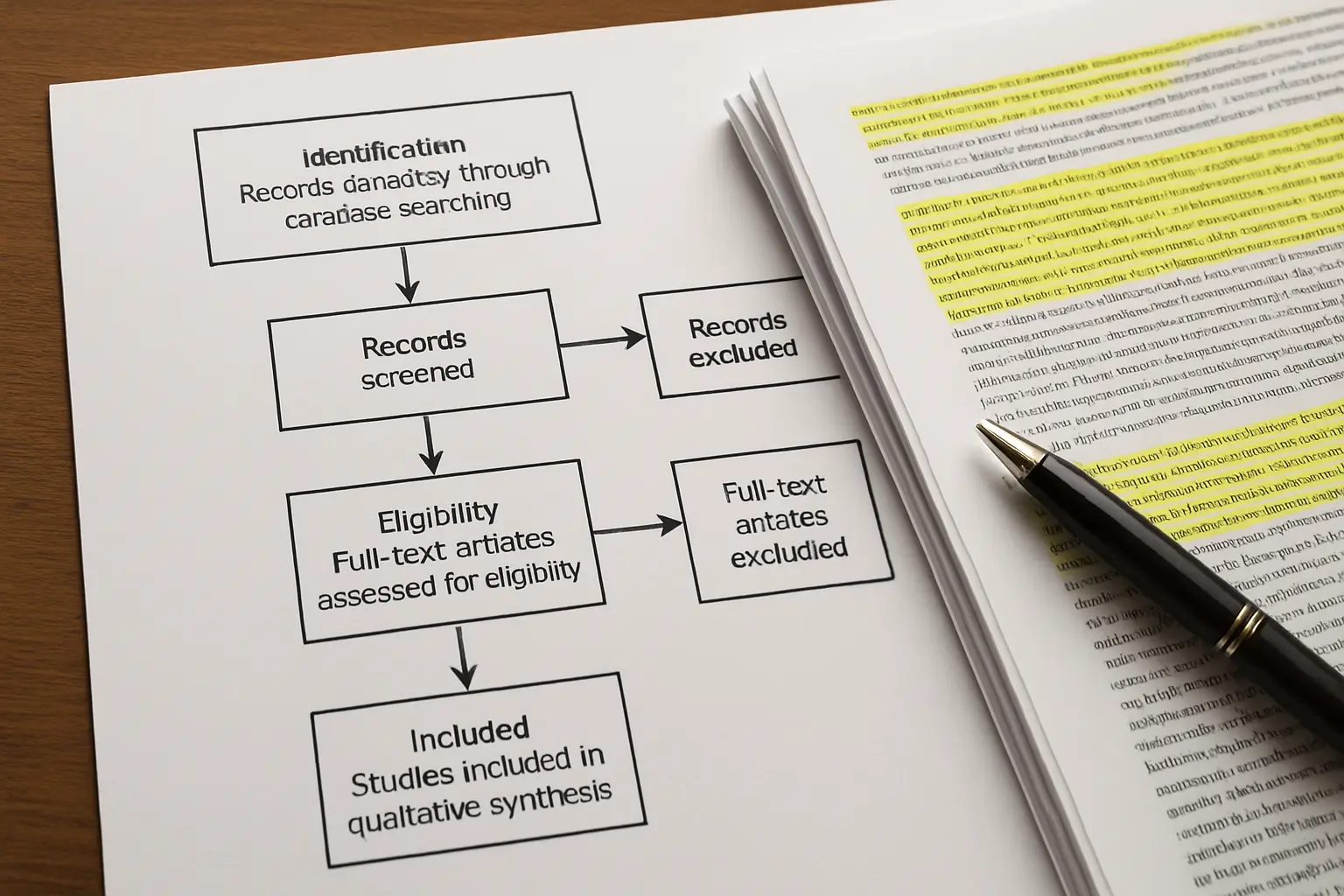
PRISMA 2020 — the reporting standard from Page and colleagues, published in the BMJ in 2021 — sets out the flow diagram every systematic review dissertation should include, in four stages. Identification: the total records found across all databases, plus any from other sources, before duplicates are removed, then the number of duplicates removed. Screening: titles and abstracts screened against your inclusion criteria, with a count of how many were excluded at this stage. Eligibility: the remaining records assessed as full texts, with the number excluded at this stage and — this is the detail examiners look for — the specific reason each excluded study did not meet your criteria, not just a total. Included: the final set of studies that go into your synthesis. A dissertation that states only a final count of included studies, with no diagram and no exclusion reasons, has not actually evidenced a systematic method — it has asserted one.
Step 6: Appraise the quality of what you found
Not every study that meets your inclusion criteria is equally trustworthy, and a systematic review dissertation has to say so explicitly rather than treating all included studies as equal evidence. A CASP (Critical Appraisal Skills Programme) checklist, matched to the study design of each included paper, is the tool UK nursing markers expect to see applied and reported — normally as a summary table showing each study against the checklist’s criteria, not just a sentence claiming “all studies were appraised for quality”. Our CASP checklist guide for nursing dissertations covers which of the free CASP tools fits which design.
Step 7: Synthesise — usually narratively, not statistically
Most undergraduate nursing systematic reviews use narrative synthesis: grouping included studies by outcome or theme, comparing their findings and methodological strength side by side, and drawing conclusions about the overall weight and consistency of the evidence — because a formal meta-analysis needs enough clinically and statistically comparable studies to pool, which an undergraduate-scale review with a handful of included papers rarely has. State this choice explicitly in your methodology rather than leaving a marker to wonder why no meta-analysis appears: “narrative synthesis was chosen because the included studies varied too widely in outcome measures and follow-up periods to permit statistical pooling” is a defensible methodological sentence; silence on the point reads as an omission.
Step 8: Write the discussion around the strength and consistency of the evidence, not a study-by-study recap
The most common structural mistake in this dissertation type is a discussion chapter that simply repeats each included study in turn — “Smith (2021) found X; Jones (2022) found Y” — without ever standing back to say what the body of evidence as a whole supports. Organise the discussion by theme or outcome, state where the studies agree, where they conflict and why (different populations, different intervention doses, different follow-up lengths), and be explicit about the overall strength of the evidence base — small sample sizes across the included studies, short follow-up, or a geographic bias toward one healthcare system are all legitimate, expected limitations to name rather than gloss over.
Step 9: Check your reporting against the PRISMA checklist, not just the flow diagram
PRISMA 2020 is more than the flow diagram — it is a full checklist of reporting items covering the title, abstract, introduction, methods, results, discussion and other information (funding, registration, protocol availability) that a fully transparent systematic review should state somewhere in the write-up. Undergraduate markers do not usually expect every item ticked, but working through the checklist against your own draft before submission catches the gaps that are easy to miss under deadline pressure: did you state your eligibility criteria in one place rather than scattering them across two chapters; did you name every database searched and the date of the search, not just “online databases”; did you report the number of reviewers who did the screening (many undergraduate reviews are screened by one person, which is a limitation to state, not to hide).
Common design mistakes examiners flag in this dissertation type
Three problems recur across nursing systematic review dissertations more than any others. First, a search strategy that is described in prose (“I searched the main nursing databases for relevant articles”) rather than documented as an auditable string with dates and result counts — this is the single fastest way to lose marks in the methodology chapter, because it cannot be checked or reproduced. Second, inclusion and exclusion criteria that shift after screening has started, usually because the initial criteria returned too few or too many results — the correct response is to state in the write-up that criteria were piloted and refined before the main screening began, not to quietly apply different rules partway through and never mention it. Third, a synthesis that reads as a list of abstracts rather than an argument: each included study gets a paragraph summarising what it found, but the paragraphs never talk to each other, and the chapter never states what the collected evidence, taken together, actually shows.
A worked Harvard reference for a systematic review source
Most UK nursing programmes use Harvard referencing rather than a specialist system, so a journal article included in your review is cited in-text as (Smith, 2021) and in the reference list as: Smith, J. (2021) ‘Title of the study in sentence case’, Journal Name, 14(2), pp. 112–128. The PRISMA statement itself is cited as: Page, M.J. et al. (2021) ‘The PRISMA 2020 statement: an updated guideline for reporting systematic reviews’, BMJ, 372, n71.
Frequently asked questions
Can an undergraduate nursing dissertation be a full systematic review, or only a literature review chapter?
It depends entirely on your programme — some accept a full systematic review as the whole submission, others require it as one chapter within a larger project. This is the first thing to confirm with your module handbook or supervisor, before building a plan around it.
How many studies should be included in an undergraduate systematic review?
There is no fixed number, and it depends on how much research exists on your question — a well-defined PICO question in a niche area might yield six to ten eligible studies; a broader question could yield thirty or more. What matters to markers is that your search was systematic and your exclusions are justified, not that you hit a target count.
Do you need ethics approval for a systematic review dissertation?
Almost never, because you are analysing already-published research rather than collecting data from people. Most nursing programmes still require a short ethics self-declaration confirming no primary data collection took place.
What is the difference between a systematic review and a literature review for a nursing dissertation?
A systematic review follows a documented, reproducible protocol — a defined search strategy, explicit inclusion criteria, a PRISMA flow diagram and formal quality appraisal. A narrative literature review can be more selective and does not need the same auditable method. See our literature review vs systematic review guide if you are still deciding which your dissertation actually needs.
Can you combine a systematic review with routine NHS data?
Some nursing dissertations pair a systematic review of the intervention evidence with a short section using published, anonymised routine statistics to frame the scale of the problem in England — our guide to NHS and public health datasets for a UK health dissertation covers what is actually available at that level, without needing NHS research ethics approval.
What software helps manage the references for a systematic review?
A reference manager becomes essential once you are screening dozens or hundreds of records — most nursing students use Zotero or Mendeley to deduplicate search results and keep the studies you exclude at each PRISMA stage organised, not just the ones you keep.
How long should the systematic review dissertation be?
This is set at module level, not nationally, so check your own handbook — but expect the search strategy, PRISMA diagram, appraisal table and synthesis to occupy proportionally more of the word count than in a primary-data dissertation, since the “results” of a systematic review are the included studies themselves.
Can one person screen all the studies, or do you need a second reviewer?
Published systematic reviews normally use two independent reviewers for screening, to reduce bias in which studies get included. An undergraduate dissertation is nearly always screened by one person because there is no second reviewer available — this is a real limitation of the design, and stating it plainly in your limitations section reads as methodological awareness, not as a confession of weakness.
What happens if your search returns almost no eligible studies?
Talk to your supervisor before the deadline, not after — a genuinely narrow evidence base is itself a finding worth reporting (“this review found only three studies meeting the criteria, indicating a significant gap in the primary research”), but it usually means the PICO question needs broadening (a wider population, a longer date range, related outcome measures) rather than abandoning the systematic method altogether.
Tesify’s dissertation builder can hold your protocol, your search log and your PRISMA counts in one place as you screen, and format the reference list to Harvard automatically as you add each included study. Try the automatic bibliography free — it will not decide what to include or exclude for you, because that judgement has to be yours and defensible when your supervisor questions it.