
A business dissertation proposal gets rejected for two reasons far more often than any other: it has no named theoretical anchor, or it assumes access to company data the student has not actually secured. Fix both and the rest of the proposal is largely mechanical. Here is the structure, a worked example built around employee retention and flexible working, and a full Harvard reference for it.
Step 1: State the Business Problem, Not Just the Topic
A topic is “flexible working.” A business problem is a specific, current tension a named or generic organisation actually faces: rising voluntary turnover since hybrid policies were rolled back, a mismatch between what a company’s engagement survey shows and its retention numbers, or a sector where flexible-working expectations have shifted faster than policy. Open with the problem, in one paragraph, before naming your research question.
The test for whether a problem statement is specific enough: could a reader who has never met you guess roughly what your methodology will look like from this paragraph alone? If not, the problem is still a topic wearing a problem’s clothing.
Step 2: Ground the Proposal in One Named Theory
Supervisors reject proposals that promise to “explore” a topic with no theoretical lens, because there is no way to judge in advance whether the eventual analysis will be rigorous. Pick one theory that is a recognised fit for your problem and name it in the proposal itself, not just in a later literature review. For an employee-retention topic, two defensible anchors are:
- The Theory of Planned Behaviour (Ajzen, 1991) — models an employee’s intention to leave as a function of their attitude toward leaving, subjective norms, and perceived behavioural control, useful where the proposal focuses on individual decision-making.
- The Resource-Based View (Barney, 1991) — frames retained talent as a source of sustained competitive advantage when it is valuable, rare, inimitable and non-substitutable, useful where the proposal focuses on organisational strategy rather than individual psychology.
Choosing between them changes your whole methodology: TPB points toward a survey of employees’ attitudes and intentions; RBV points toward an evaluation of the organisation’s HR practices against the VRIN criteria. State which lens you are using and why in the proposal’s second or third paragraph.
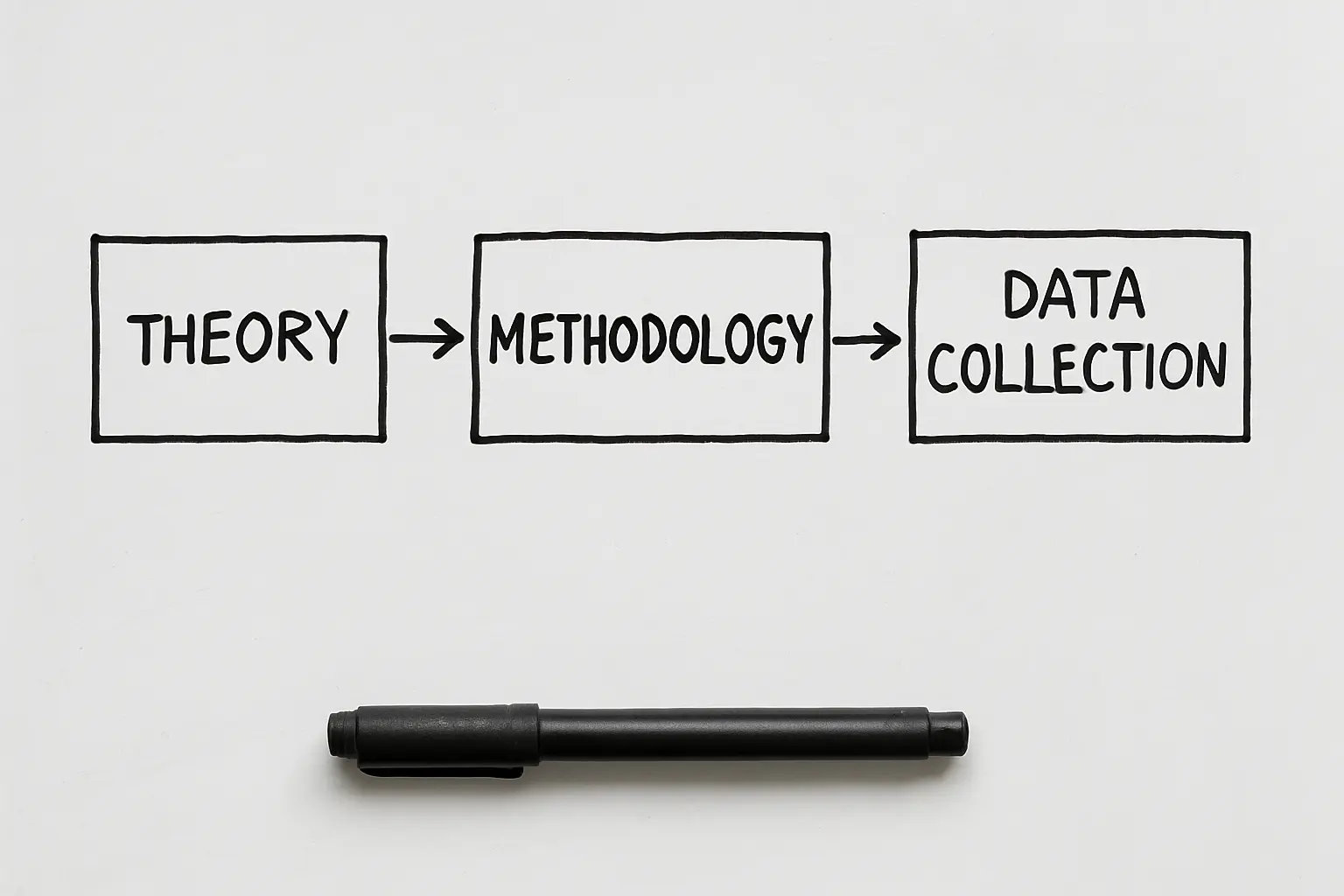
Both theories are defensible starting points, but they are not interchangeable window-dressing — a common proposal fault is naming a theory in the introduction and then never actually structuring the methodology or analysis plan around it. If you name TPB, your objectives and instrument should visibly measure attitude, subjective norms and perceived behavioural control as distinct constructs, not just “employee opinions” in general.
Step 3: Write the Aim, Research Questions and Objectives
One aim, two to four research questions, and three to five objectives that map directly onto your eventual chapters. Our guide to the abstract, keywords and introduction of a business dissertation covers how these same elements get compressed later into your final abstract — writing them precisely now saves a rewrite later.
Step 4: Prove Feasibility — the Section Most Proposals Skip
A business dissertation proposal that names a company but has not confirmed access is the single most common reason supervisors send proposals back. State explicitly: whether you already have a contact inside the organisation, whether a non-disclosure agreement will be required and who signs it, whether you are relying on the company’s public financial and strategic disclosures instead of primary access, and what your fallback is if access falls through close to your data-collection window. Our guide to writing your dissertation on your placement company covers the access, NDA and ethics considerations in more depth where the company is your own placement employer specifically.
Supervisors read this section as a proxy for how realistic the whole plan is. A proposal that spends three confident paragraphs on theory and one vague sentence on access reads as though the hard part has been left for later — reverse that balance and the proposal reads as though it could actually be executed on the stated timeline.
Step 5: Outline the Methodology in Proportion to the Proposal’s Length
A proposal does not need the full methodology chapter — it needs enough to show the design is feasible and defensible: the design (survey, case study, mixed methods), the sample and how it will be accessed, the analysis approach, and the instrument if one exists already (state whether you are using a published, validated instrument or designing your own).
| Element | TPB-anchored example | RBV-anchored example |
|---|---|---|
| Design | Cross-sectional online survey | Single case study, document analysis + interviews |
| Sample | Employees across departments, target ~100 responses | HR leadership and line managers, 6–8 interviews |
| Instrument | Adapted TPB questionnaire, existing validated items | Semi-structured interview guide built around VRIN criteria |
| Analysis | Multiple regression on turnover intention | Thematic analysis against the RBV framework |
Whichever survey platform you propose, check it can actually deliver what your sample size needs — our guide to what response rate a business dissertation survey will actually get uses published benchmark figures to work backwards from your target usable sample to the distribution list size you will need.
Step 6: A Fully Worked Example Proposal Extract
Illustrative, not a real study — built around the TPB anchor above:
Working title: Understanding Voluntary Turnover Intention in Hybrid-Working Employees: A Theory of Planned Behaviour Perspective
Aim: To examine how attitude, subjective norms and perceived behavioural control predict turnover intention among employees working under hybrid arrangements.
Objectives:
- To critically review the Theory of Planned Behaviour and its prior application to employee turnover research.
- To design and validate a survey instrument adapted from existing TPB-based turnover studies.
- To collect and statistically analyse survey data from employees at [named or generic organisation].
- To identify which TPB component most strongly predicts turnover intention in this sample, and its implications for retention policy.
Feasibility: Access has been agreed in principle with [organisation]’s HR team via a placement contact; a formal data-sharing agreement is being finalised with the university’s placement office. A fallback anonymous open-recruitment survey via professional networks is prepared if company access is delayed past [date].
Step 7: Reference the Theory Correctly — a Worked Harvard Example
Every named theory needs a citation to its originating source, not a secondary textbook alone. A worked Harvard reference-list entry for the Ajzen source used above:
Ajzen, I. (1991) ‘The theory of planned behavior’, Organizational Behavior and Human Decision Processes, 50(2), pp. 179–211.
And the in-text citation form: “Turnover intention can be modelled using the Theory of Planned Behaviour (Ajzen, 1991), which identifies attitude, subjective norms and perceived behavioural control as its three antecedents.” If your department uses a different edition or a secondary source you actually read rather than the original 1991 article, cite the source you opened, not the one you did not.

Step 8: State Your Ethics Position, Even for Low-Risk Designs
Most undergraduate business dissertation proposals involving employee surveys or interviews are low-risk but still require departmental ethics approval — state how informed consent will be obtained, how responses will be anonymised, and how any organisational confidentiality obligations (particularly where a company has been named) will be respected in the final write-up. Where the organisation is also your placement employer, state explicitly how you will separate your role as an employee from your role as a researcher in the consent process, since this dual relationship is exactly what ethics panels flag first.
Step 9: Attach a Realistic Timeline
A one-line-per-milestone timeline (ethics submission, data collection window, analysis, first draft, supervisor review, final submission) reassures a supervisor the plan is achievable, not just theoretically sound. Build in slack around data collection specifically — this is where business dissertations most often slip, because company access rarely runs exactly to the proposed schedule.
| Milestone | Illustrative target |
|---|---|
| Ethics application submitted | Week 2 |
| Ethics approval expected | Week 4–5 |
| Data collection window | Weeks 6–9 (with a 2-week buffer built in) |
| Analysis complete | Week 11 |
| First full draft to supervisor | Week 13 |
| Final submission | Week 16 |
What Makes Supervisors Reject a Business Dissertation Proposal?
- No named theory. “This study will explore employee retention” gives a supervisor nothing to evaluate the eventual rigour against.
- Assumed company access. Naming an organisation without confirming access, an NDA route, or a fallback is the single most common reason for a proposal being sent back.
- A methodology mismatched to the theory. Proposing thematic interview analysis while anchoring the whole study in a quantitative TPB framework signals the theory was chosen after the method, not before.
- No fallback plan. Every proposal involving a named organisation needs a stated Plan B for what happens if that access falls through.
- Objectives that do not map to chapters. If a reader cannot tell which chapter each objective will be addressed in, the proposal has not actually been planned yet, only described.
- A timeline with no buffer. Scheduling data collection to finish the week analysis begins leaves zero room for the access delays that are close to routine in company-based research.
Once your theory, questions and feasibility are settled, Tesify drafts your full proposal and dissertation chapters from the plan you specify. Everything stays 100% written by you, and it is free to start.
Frequently Asked Questions
How long should a business dissertation research proposal be?
Most UK business schools ask for 1,000–2,000 words; check your own department’s exact requirement before you start, since it varies noticeably by institution.
Do I need to name a real company in my proposal?
No — a generic or anonymised organisation is acceptable and often safer if access is not yet fully confirmed. If you do name a real company, be ready to show your access route.
Can I change my theoretical framework after the proposal is approved?
Minor refinement as your literature review develops is normal, but a full change of theoretical lens usually needs supervisor sign-off, since it reshapes your entire methodology.
What if my company access falls through after the proposal is approved?
This is exactly what your stated fallback plan is for — a proposal without one leaves you with no approved Plan B if the primary route collapses close to your data-collection window.
Should I use TPB or RBV for a retention-focused business dissertation?
It depends on your research question: TPB suits individual-level psychological questions about intention to leave; RBV suits organisational-level questions about talent as a strategic resource. Choose the one that actually matches what you want to measure.
Do I need a validated survey instrument for a business dissertation?
Wherever one exists for your construct, yes — using or adapting a validated instrument (with citation) is stronger evidence of methodological rigour than a self-designed questionnaire with no prior validation.
What referencing style do UK business dissertations use?
Almost always Harvard; our complete UK guide to Harvard referencing covers the full format for journal articles, books and organisational reports.
How is a business dissertation proposal different from the generic UK proposal format?
The structure (background, aim, objectives, methodology, ethics, timeline) is the same as any UK dissertation proposal — our general guide to writing a dissertation proposal covers that shared mechanics. What is different for business is the extra weight placed on a named theoretical framework and, for company-based topics, a credible access and feasibility plan.
How much of the proposal should be about ethics?
Usually one short paragraph is enough for a low-risk employee survey or interview design, but it must be specific — naming the consent process, anonymisation method, and any dual-relationship issue if the organisation is also your placement employer, rather than a generic statement that “ethics will be followed.”