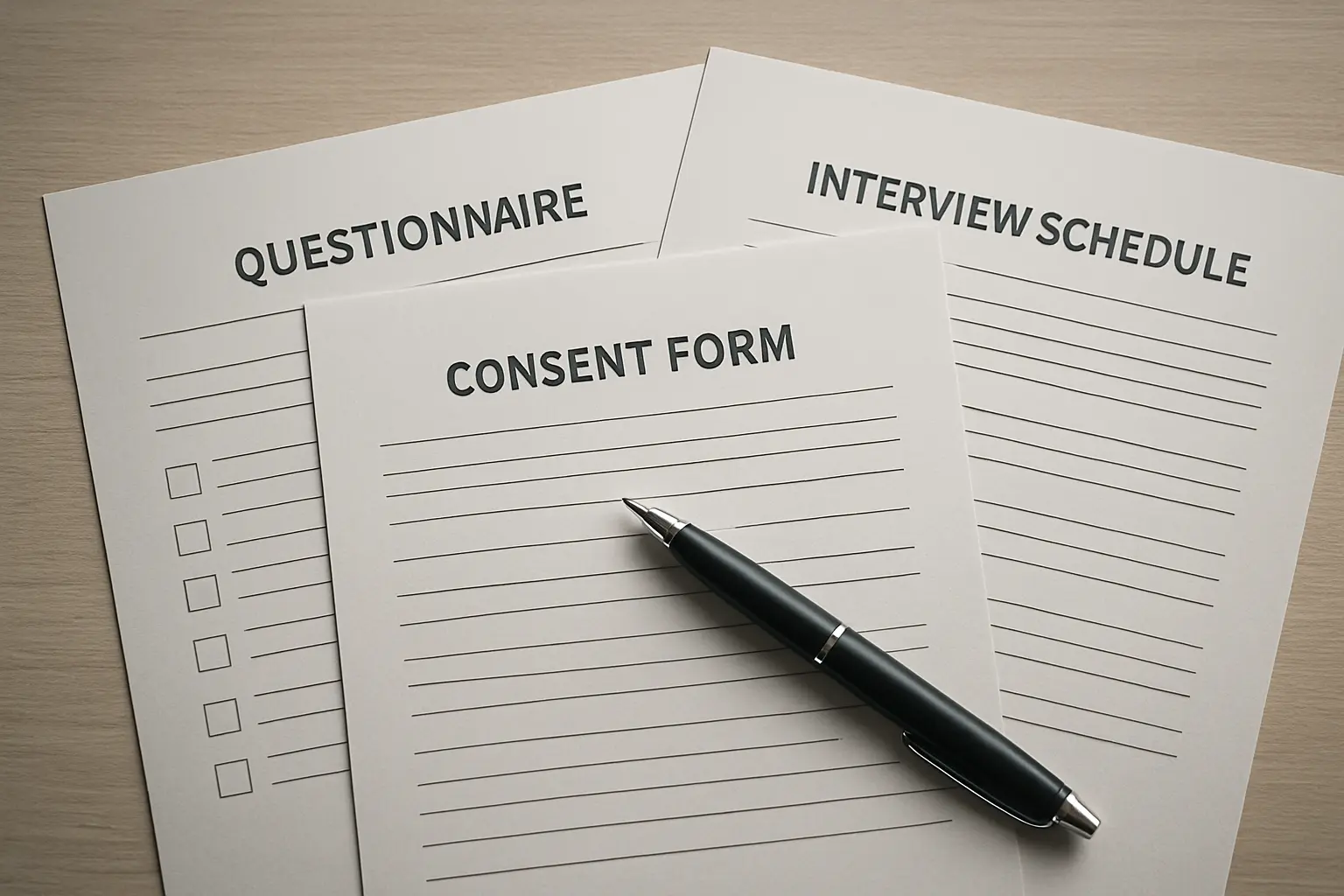
Ethics committees reject undergraduate applications for boring reasons. Not because the project is unethical, but because the questionnaire has no consent page, the interview schedule is a list of eight topics rather than questions, or the debrief does not say who to contact. Both documents have a standard shape, and you can build yours from the templates below in an afternoon.
Two complete templates follow — a self-completion questionnaire and a semi-structured interview schedule — with the wording that ethics reviewers look for, plus the question-writing faults that make data unusable after you have already collected it. Your own department’s ethics form governs; this is what is normal.
The questionnaire template

A dissertation questionnaire has six parts in this order. Parts 1 and 2 are not optional and are the ones most often missing.
Part 1: Participant information
Study title: [Title]
Researcher: [Name], [Course], [Department], [University]. Email: [address]
Supervisor: [Name]. Email: [address]You are invited to take part in a study about [topic in one plain sentence]. Please read this before deciding.
What is the study about? [Two sentences, no jargon.]
Why have I been invited? [State the eligibility criteria plainly.]
What will I have to do? Complete an online questionnaire taking approximately [X] minutes.
Do I have to take part? No. Participation is voluntary and you may stop at any time without giving a reason.
Can I withdraw afterwards? You may withdraw your responses until [date or point], after which responses are anonymised and cannot be identified for removal.
Will my answers be confidential? [State what is collected, how it is stored, who sees it, and when it is destroyed.]
What are the risks? [State them honestly, however small, and name a support source if the topic is sensitive.]
What happens to the results? They will form part of an undergraduate dissertation and will not be published in identifiable form.
Ethical approval: This study has been approved by [committee], reference [number].
Part 2: Consent
Separate tick boxes, not one blanket statement. Reviewers check for this.
□ I confirm I have read and understood the participant information.
□ I understand my participation is voluntary and I may withdraw at any time.
□ I understand my responses will be stored and reported anonymously.
□ I am [age threshold] years of age or older.
□ I agree to take part in this study.
Part 3: Screening
One or two questions that confirm eligibility, placed before anything else, with a routing instruction. “Are you currently employed in an organisation of fewer than 250 employees? Yes / No. If No, please close the survey. Thank you for your interest.“
Part 4: Demographics
Ask only what you will actually analyse. Every unused demographic question is data you had no reason to collect, which is an ethics problem as well as a wasted question. Offer “Prefer not to say” on anything sensitive, and use open numeric entry for age rather than bands unless you have a reason to band.
Part 5: The main measures
Group items by construct, one instruction line per block, and keep the response scale consistent within a block. If you are using a published scale, reproduce it exactly — changing the wording invalidates the published reliability, and licence terms may forbid alteration. Which scales you may actually use is a real constraint, covered in our guide to which psychology scales you can use in an undergraduate dissertation.
Part 6: Debrief
Thank you for taking part. This study examined [the real purpose, including anything withheld earlier and why]. If any of the questions raised concerns for you, you can contact [named support service and its public contact details]. If you would like a summary of the findings, or wish to withdraw your responses before [date], contact [researcher email], quoting [participant code if used].
The semi-structured interview schedule template
The commonest undergraduate mistake here is submitting a topic list. An interview schedule is questions, in words you will actually say, with planned probes underneath.
Before recording: confirm the participant information has been read, take consent, confirm permission to record, remind them they can decline any question or stop at any time.
Opening (2–3 minutes). “To start, could you tell me a bit about your role and how long you have been doing it?”
Purpose: settles the participant and gives you context. Not analysed in depth.Warm-up (5 minutes). “How would you describe the way [the practice] works day to day where you are?”
Probes: “Can you give me an example?” · “Has that changed at all?”Core question 1 (10 minutes). “Think of a time when [the phenomenon] happened. Can you walk me through what happened?”
Probes: “What were you thinking at that point?” · “Who else was involved?” · “What happened next?”Core question 2 (10 minutes). “What do you think makes the difference between [the practice] working well and not working well?”
Probes: “Could you say more about that?” · “Can you think of a case where it went the other way?”Core question 3 (10 minutes). “If you could change one thing about how [the practice] is handled, what would it be, and why that one?”
Probes: “What would get in the way of that?” · “Who would need to agree?”Closing (3 minutes). “Is there anything important about this that I have not asked you about?”
This question routinely produces the most useful data in the interview. Never cut it for time.After recording: thank them, restate the withdrawal deadline, give the debrief sheet.
Three structural notes. Four to six core questions is right for a 45-minute undergraduate interview; eight is too many and produces thin answers to all of them. Probes are written in advance because you will not invent good ones under pressure. And the schedule is a guide, not a script — following an interesting answer is the point of semi-structured interviewing, which is why the word “semi” is there.
Eight question faults that ruin data
| Fault | Bad | Better |
|---|---|---|
| Double-barrelled | “Is the training useful and well delivered?” | Split into two questions |
| Leading | “How much did the new system improve your work?” | “What effect, if any, has the new system had on your work?” |
| Loaded | “Do you agree that management failed to consult staff?” | “How would you describe the consultation before the change?” |
| Assuming | “How often do you use the portal?” | Screen first: “Do you use the portal?” |
| Vague quantifier | “Do you use it regularly?” | “How many times in the last seven days?” |
| Jargon | “Rate your psychological safety.” | “How comfortable do you feel raising a concern with your manager?” |
| Closed where you need depth | “Did it work?” | “What happened when you tried it?” |
| Hypothetical | “What would you do if…?” | “Tell me about a time when…” |
The last row is worth dwelling on. Hypothetical questions produce what people believe they would do, which is a different thing from what they did. Asking for a specific past instance is the single largest improvement available to most undergraduate interview schedules.
Pilot it, and change something
Run the questionnaire past two or three people who resemble your sample and time them. Run the interview schedule once, in full, with a friend. You are checking three things: whether any question is misread, whether the length matches what your participant information promised, and whether the answers you get are the kind you could actually analyse. If the pilot changes nothing, you almost certainly did not watch closely enough.
Note that a pilot with real participants may itself need ethical approval, and that approval has to be in place before any data collection begins — our guide to ethics approval for an undergraduate dissertation covers what counts. Where and how you host the questionnaire is a separate decision with data-protection consequences, covered in which survey platform you can actually use. Realistic expectations about who replies are set out in our analysis of survey response rates and the sample size they leave you.
Where these documents go in the dissertation
The blank questionnaire and the interview schedule go in appendices, along with the participant information sheet, the consent form and the ethics approval. The methodology chapter describes them and justifies the choices — why these constructs, why this scale, why semi-structured rather than structured — without reproducing them. Our guides to the methodology chapter for business and management and for education show how much detail belongs in the chapter itself, and our guide to dissertation structure by subject shows where the appendices sit.
If your instrument is ready and the write-up is what is left, Tesify drafts your methodology chapter around the instrument you actually used. Everything stays 100% written by you, and it is free to start.
Frequently asked questions
How many questions should an undergraduate dissertation questionnaire have?
Short enough that it takes what you promised. Ten to twenty-five substantive items is typical, and a questionnaire that overruns its stated completion time is both a data problem and an ethics one.
How many interviews do I need?
Six to twelve is common for an undergraduate qualitative project, and depth matters more than count. Our guide to sample size for an undergraduate dissertation covers how to justify the number you achieve.
Can I write my own scale instead of using a published one?
You can, but you lose the published reliability and validity evidence and will have to discuss that as a limitation. For a construct with a well-validated short measure, using it is almost always the better choice.
Do I need consent if the survey is anonymous?
Yes. Anonymity concerns what you store; consent concerns whether the person agreed to take part at all. Both are required.
Should the interview schedule go in the appendix or the methodology?
The full schedule goes in an appendix. The methodology describes its structure, explains the question types and justifies the format.
How long should a semi-structured interview be?
Thirty to sixty minutes suits most undergraduate projects. Longer interviews generate transcription work that is easy to underestimate — budget roughly four to six hours of transcription per hour of audio if you are doing it by hand.
Can I record on my phone?
Usually only if your ethics application says so and the file is transferred to university-approved storage promptly and then deleted from the device. State your actual plan in the application rather than a plan you will not follow.
What if someone asks to withdraw after I have started analysing?
This is exactly why your participant information states a withdrawal deadline. Set one that is realistic, state it clearly, and honour requests made before it.