
Your supervisor’s feedback says “significant revision needed” and your submission deadline has not moved. Before you rewrite anything, it helps to know exactly which objections examiners raise most often on business and management dissertations — because most resubmissions fix the wrong problem, polish the prose, and miss the structural issue that actually triggered the referral. Knowing the six patterns below before you open your document again saves the hours most students lose editing sentences instead of structure.
The objections that actually sink a business dissertation
These are not proofreading issues. Each one is a structural problem an examiner can spot within the first few pages of a chapter, and each one requires more than a light edit to fix:
- A title or research question that is too vague to test. “An investigation into marketing strategy” promises nothing an examiner can check against your findings — a defensible title names the organisation type, the specific practice, and what “success” would look like. Our guide to getting a business dissertation research proposal approved covers how to build a title and question a supervisor will actually sign off on the first time.
- No demonstrated company-access feasibility. A proposal that assumes interview access to five senior managers, with no evidence that access was actually secured or even sought, reads as a plan built on hope rather than a workable design.
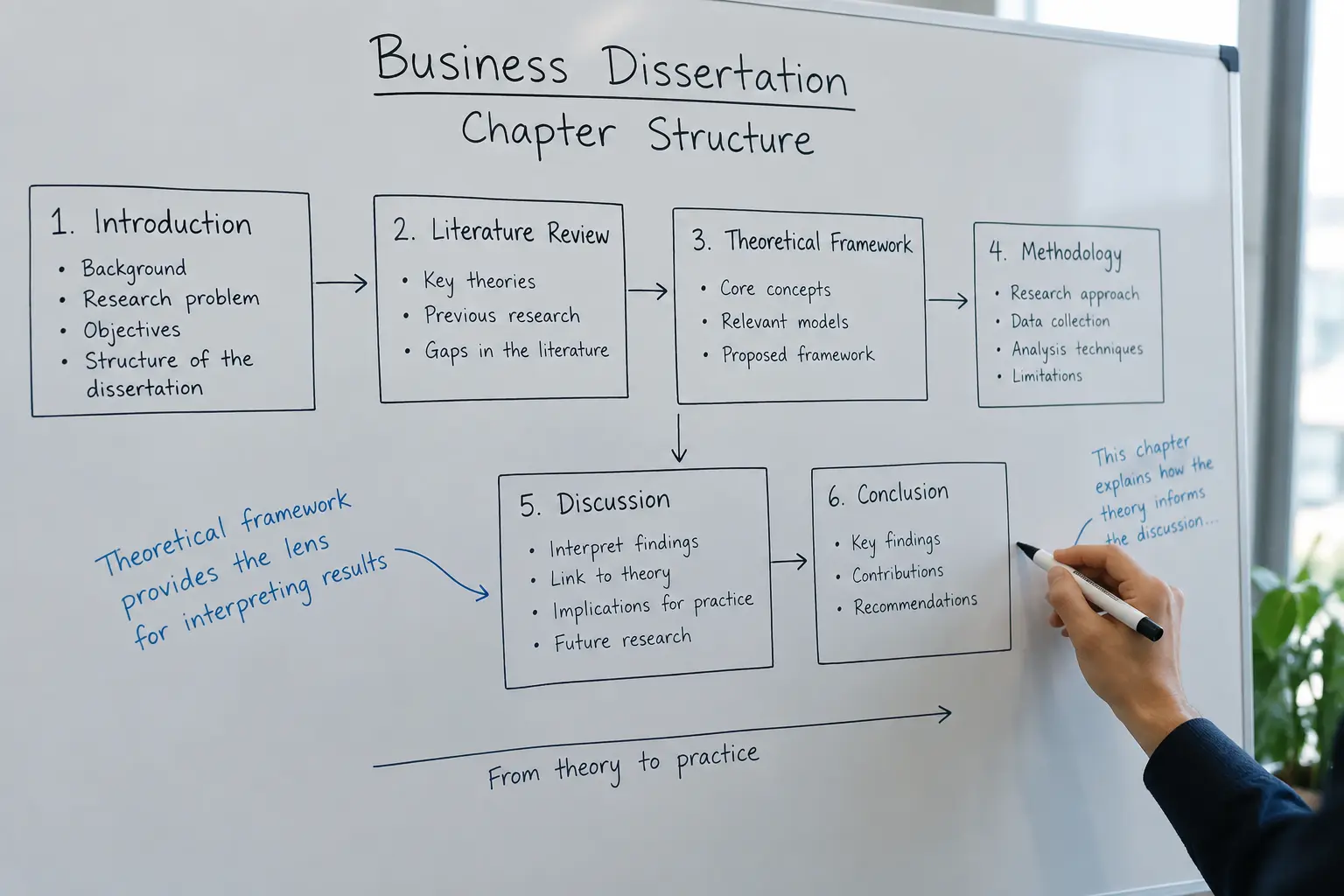
- A weak or missing theory-practice link. Naming a theoretical framework in Chapter 2 and never returning to it in the discussion is a gap examiners frequently flag — the theory has to do work in your analysis, not just appear once.
- A literature review that lists rather than synthesises. “Smith (2020) found X. Jones (2021) found Y.” repeated for pages is a summary, not a review — a strong review groups sources by theme or debate and states where they agree, disagree, or leave a gap.
- Methodology that does not match the research questions. A qualitative research question answered with a survey (or vice versa) is a mismatch examiners catch immediately, regardless of how well either method is executed on its own terms. Our guide to writing the methodology chapter of a business dissertation covers how to justify a method choice against your specific question.
- Findings not explicitly tied back to the objectives. A results chapter that reports data without stating which objective each finding addresses leaves the marker to do that connecting work themselves — and they will mark you down for making them do it.

Which chapter each objection actually lives in
| Objection | Where it shows up | What the fix actually requires |
|---|---|---|
| Vague title/research question | Introduction, and every chapter after it | Rewrite the question as a testable claim before touching anything else |
| No access feasibility shown | Methodology chapter | Evidence of an actual access route, or a redesigned, more realistic data-collection plan |
| Weak theory-practice link | Discussion chapter (root cause: theoretical framework chapter) | Reorganise the discussion under the framework’s own categories |
| Literature review lists rather than synthesises | Literature review chapter | Regroup by theme or debate, not by author |
| Methodology mismatched to questions | Methodology chapter | Re-justify the method choice against the actual research question, or change the method |
| Findings not tied to objectives | Results/findings chapter | Label each finding with the objective it addresses |
Knowing which chapter genuinely owns each objection stops you from over-editing a chapter that was never the problem — a common, time-wasting mistake under deadline pressure.
Why this happens under deadline pressure
Every one of these objections is a structural decision made early — in your proposal, your literature review plan, your methodology design — that compounds silently until a marker or supervisor finally names it. By the time you are staring at feedback that says “the link between your framework and your findings needs strengthening,” you are not looking at a typo fix; you are looking at restructuring how two chapters talk to each other, with the clock running.
The fix: work backwards from the objection, not forwards from the feedback
Rewriting reactively — taking each comment and patching the nearest sentence — treats symptoms. The faster, more defensible fix is to identify which of the six structural objections above your feedback actually maps to, then rebuild that specific connection deliberately:
- Re-state your title and research questions as testable claims. If a marker could not write down, in one sentence, what your findings would need to show to answer your question, rewrite the question first.
- Re-read your theoretical framework chapter and mark every place it should reappear. Your discussion chapter should return to the framework’s own terms explicitly, not just imply a connection.
- Re-group your literature review by theme, not by source. If you can delete an author’s name from a paragraph and the sentence still makes sense as a claim about the field, you are synthesising; if the sentence collapses without the name, you are still just listing.
- Check every methodology decision against your actual research question. Does your data collection method genuinely let you answer what you are asking, or does it just describe what you did?
- Label each finding with the objective it answers. A single added subheading or sentence per finding (“This addresses Objective 2”) does more for your mark than another page of description.
This is exactly the kind of structural rewrite Tesify is built to help with — not by guessing at generic advice, but by working through your specific dissertation section by section with you, so the theory-practice link, the objectives-findings connection and the rest are rebuilt properly rather than patched. If your theoretical framework itself is the weak link, see how another discipline compares its own competing frameworks in our guide to theoretical frameworks for an education dissertation for a sense of what a well-justified framework choice looks like.
A worked example (illustrative)
An illustrative, labelled example: a dissertation on employee engagement in a retail SME receives feedback that its theoretical framework (Herzberg’s two-factor theory) “disappears after Chapter 2.” The fix is not adding a sentence mentioning Herzberg in the conclusion — it is going back into the discussion chapter and explicitly organising the findings under the framework’s own categories (hygiene factors vs motivators), so each finding is discussed in the theory’s terms rather than described in isolation and then vaguely connected at the end. This single structural change, applied consistently across the discussion chapter, is what actually answers the examiner’s objection — and it is a change that takes real, focused rewriting time, not a quick pass with a highlighter. Budgeting that time honestly against your resubmission deadline, rather than assuming a light edit will satisfy the examiner a second time, is itself part of managing a referral well.
Start your rewrite with the structure, not the sentences
Whichever objection your feedback points to, the highest-value first move is always structural: check your title against your findings, check your framework against your discussion, check your methods against your questions, check your findings against your objectives. Tesify walks you through each of these connections deliberately, chapter by chapter, so your resubmission fixes the actual structural gap an examiner named — not just the paragraph nearest to where the comment was left.
Objection-handling FAQ
Is it normal to be asked to revise a business dissertation?
A referral or request for revision is a routine part of the assessment process at many UK universities, not an unusual outcome — check your own department’s regulations for exactly what a revision request means at your institution and what the resubmission deadline and process involve.
Does using Tesify to help restructure my dissertation count as academic misconduct?
Every Tesify draft is 100% written by you, guided section by section through the platform — you remain the author throughout. Check your own university’s academic integrity policy on AI tool use and disclose your use of any tool exactly as that policy requires.
Will Tesify write my theoretical framework connection for me?
Tesify guides you through building the connection between your framework and your findings yourself, prompting you to make the theory do analytical work rather than sit unused — it does not fabricate the connection independently of your own data and reasoning.
How do I know which objection my feedback actually maps to?
Read your supervisor’s or examiner’s comments against the six objections above and match each comment to the closest one — most feedback, even when phrased generally, points to one of these six structural issues rather than being a genuinely novel problem.
Can a strong methodology chapter save a weak literature review?
No — examiners assess each chapter’s own coherence and how the chapters connect to each other; a strong methodology does not compensate for a literature review that fails to establish the gap your study addresses.
What if my access to my case-study company falls through?
Talk to your supervisor immediately about a fallback design (a different organisation, a documentary/secondary-data approach, or a narrower scope) rather than continuing with a project whose access has not actually materialised.
Is my dissertation more likely to be referred if I choose an ambitious topic?
Ambition is not the risk factor — vagueness is. A precisely defined, testable question in an ambitious area is safer than a vague question in a conservative one, since examiners assess whether your design can actually answer the question you set, not how bold the topic sounds.
Does Tesify check my dissertation is free of academic misconduct?
Tesify’s role is helping you write your own dissertation properly structured and in your own words, guided section by section — check your own university’s own required checks and disclosure process for anything beyond that.
How long does a structural rewrite like this usually take?
This varies hugely by how many objections your feedback raises and how much of each chapter needs restructuring versus rewording — working through the objections in the order above, rather than randomly, is what keeps the process as fast as your specific situation allows.
Should I contact my supervisor before starting a structural rewrite?
Yes — confirm with your supervisor which objection they see as most urgent and whether your resubmission timeline allows for a full chapter restructure or only a more targeted fix, before committing significant time to any one approach.
Can I get referred more than once on the same dissertation?
Check your own university’s regulations, since resubmission processes and any cap on attempts vary by institution — this is exactly the kind of detail your student handbook or programme regulations will state precisely.
Does a referral affect my final degree classification?
This depends entirely on your institution’s own marking and progression regulations — check your handbook or ask your programme office directly rather than assuming a blanket rule, since practice differs significantly across UK universities.
What is the single biggest reason business dissertations get sent back?
There is no published national ranking, but a theoretical framework that is named once and never returns to shape the discussion is a frequent culprit — and the one that takes the most deliberate, page-by-page rewriting to fix properly. Our guide to writing a business dissertation abstract and introduction is worth revisiting too, since a resubmission’s opening pages should reflect the restructured argument, not the original draft’s framing.
Tesify has helped over 9,000 students write more than 15,000 dissertation chapters, and every draft is 100% written by you, guided section by section. Start your business dissertation resubmission with Tesify and rebuild the structural connections your feedback actually pointed to.