
Your business dissertation is finished, the abstract is due tomorrow, and what you have drafted reads like a book report: what you did, chapter by chapter, with no organisation named, no practical recommendation stated, and none of the keywords a marker or a future employer skimming your LinkedIn would actually search for. A business dissertation abstract that only summarises method loses marks on the “practical contribution” criterion most UK business schools grade separately from academic rigour — and it is fixable in under an hour once you know what has to be in it.
Tesify’s AI editor can tighten a drafted abstract against exactly this checklist in minutes — but the checklist itself is what actually earns the marks, so here it is in full first.
What a generic abstract guide will not tell you
Our own general guide to writing a UK dissertation abstract covers the universal mechanics every subject shares — length (200 to 300 words, written last), structure (aim, method, key finding, implication), and the disagreement between universities about whether to describe your methods at all. None of that is business-specific, and repeating it here would not help you. What is missing from a generic abstract template, and specific to business and management dissertations, is what follows.
State the organisational context, even anonymised
A business dissertation abstract needs to name the kind of organisation or sector the research actually concerns — “a UK SME in the retail sector”, “a mid-size logistics firm”, “the hospitality sector post-pandemic” — even where the specific company is anonymised in the body for confidentiality. An abstract that only names the academic variables (“this study examines the relationship between X and Y”) without any organisational or sector anchor reads as detached from the practical setting business dissertations are meant to engage with, and markers assessing practical relevance notice the omission immediately.
State a managerial implication, not just an academic finding
Most dissertation abstract templates end on the academic finding: “results showed a significant positive relationship between X and Y.” A business dissertation abstract needs one further sentence translating that finding into what a manager or decision-maker should actually do with it — “suggesting that SMEs should prioritise X when allocating limited training budgets” or “indicating that firms in this sector may benefit from restructuring Y before implementing Z.” This single sentence is frequently the entire difference between an abstract that reads as academically competent and one that reads as genuinely business-relevant, and it is the sentence most students forget to write because it comes after the “real” finding, when the word count is already tight.
Choose keywords a business reader actually searches for
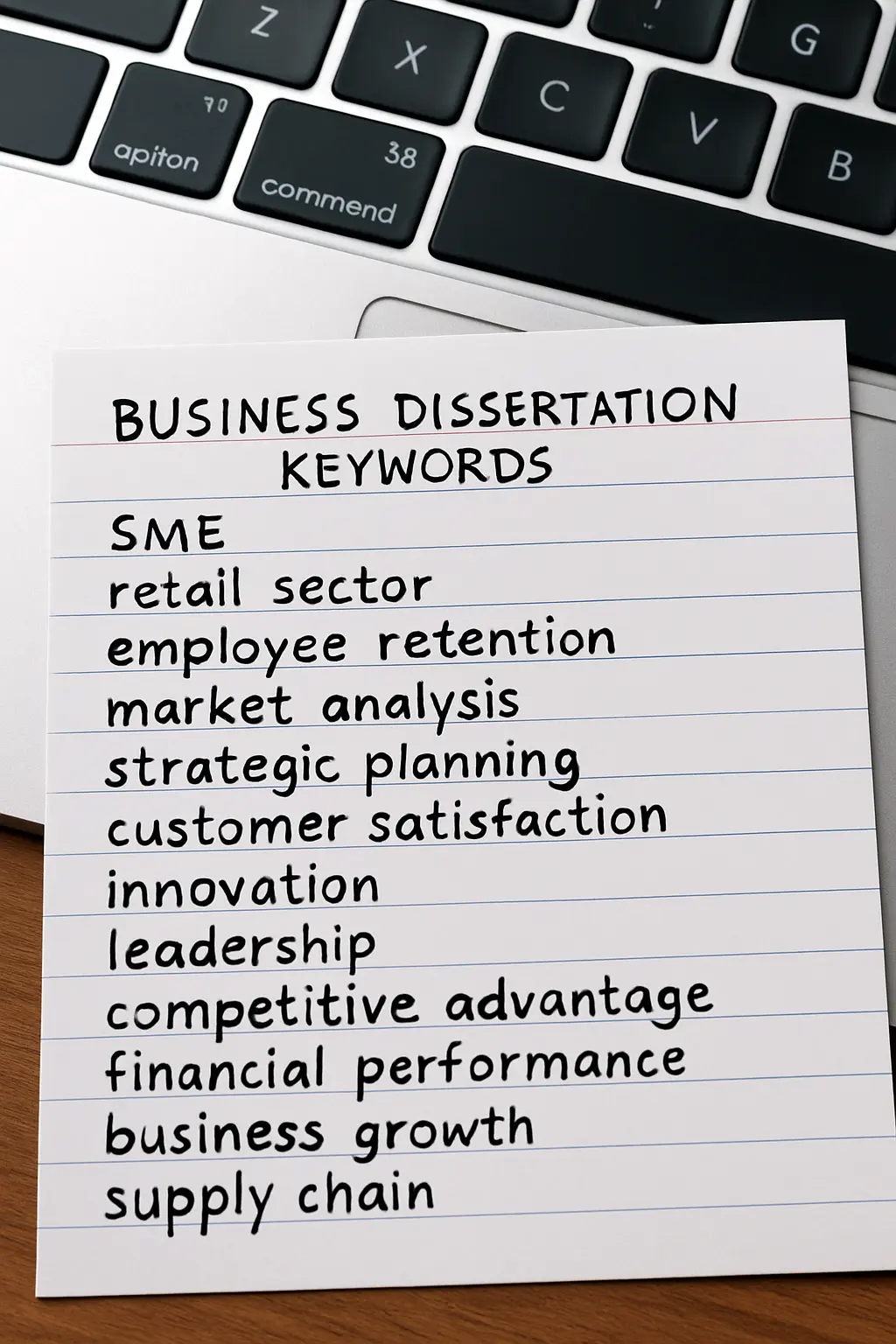
Beyond your named theoretical framework (theory of planned behaviour, SERVQUAL, the resource-based view, or whichever your dissertation applies), business dissertation keywords should include the sector or industry studied, the organisational level examined (SME, multinational, public sector), and the practical function affected (HR, operations, marketing, supply chain). A dissertation on employee retention in UK SMEs, for instance, benefits from keywords covering “employee retention”, “SME”, “UK”, and the specific mechanism studied (flexible working, line management, reward structure) — rather than only the academic construct name, which is how most students default to writing keywords and how most abstracts end up sounding identical to every other dissertation using the same framework.
What a weak business abstract looks like, sentence by sentence
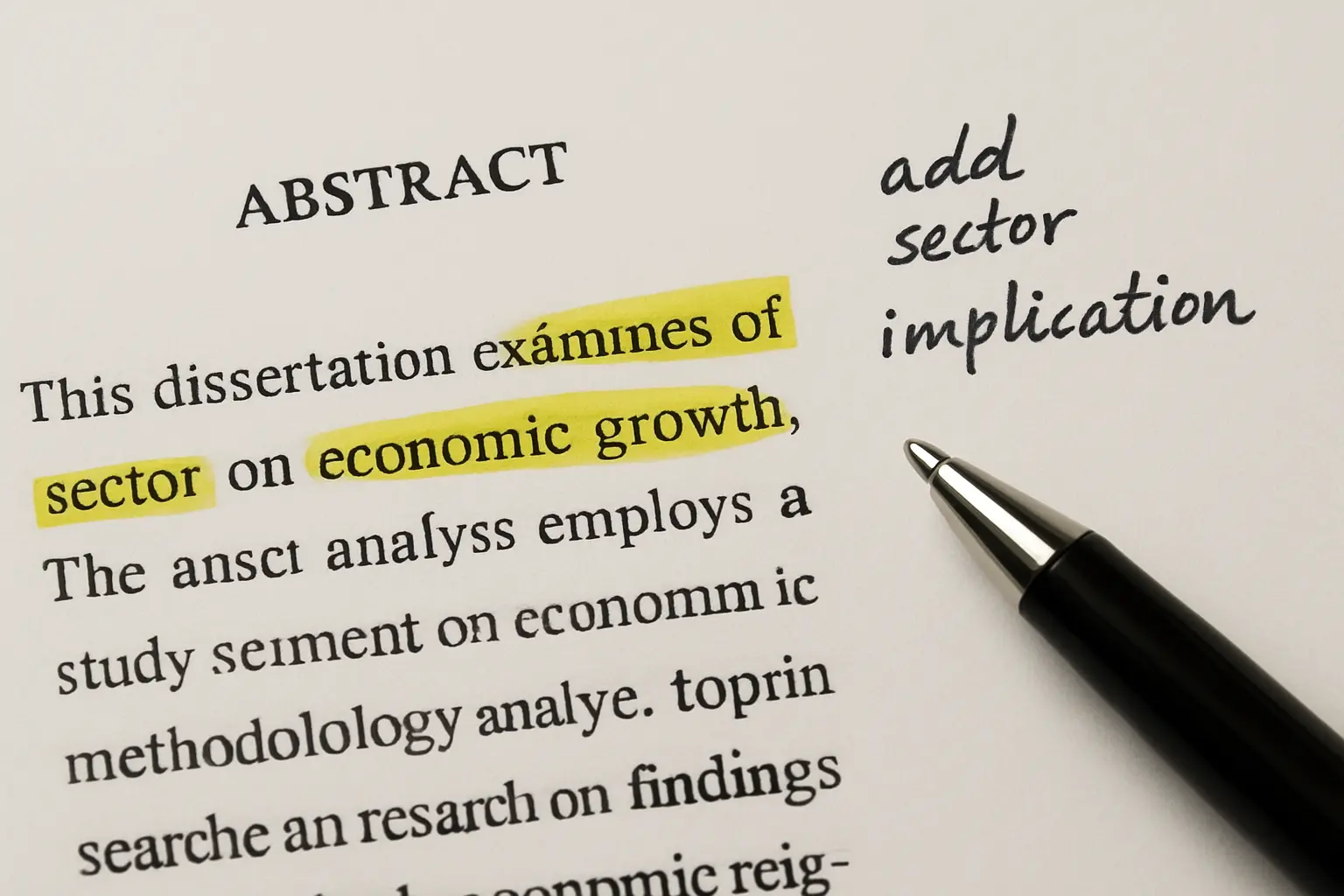
“This dissertation explores employee motivation using self-determination theory. A survey was conducted with 80 participants. The results were analysed using SPSS. The findings are discussed in relation to the literature.” Every sentence here is accurate and every sentence is empty of business content: no organisation, no sector, no practical implication, no keyword beyond the theory name itself. Compare it with: “This dissertation examines how autonomy-supportive management, drawing on self-determination theory, affects employee retention in UK hospitality SMEs. A survey of 80 employees across twelve independent hotels found autonomy-supportive practices significantly predicted retention intention, suggesting that SME hospitality managers with limited budgets for pay increases may achieve comparable retention gains through low-cost changes to supervisory style.” Same study, same word count range, dramatically more business content. Notice, too, that the second version never uses the phrase “the results were analysed using SPSS” — the software you used to analyse data belongs in the methodology chapter, not the abstract, which has no room for it once the organisational, sector and managerial content are properly included.
The introduction needs the same business anchor, expanded
The abstract compresses your business relevance into one sentence; the introduction is where you actually build the case for it across a page or two. A business dissertation introduction that opens on an abstract theoretical debate (“motivation has long been studied in organisational psychology…”) is starting in the wrong place — start instead with the practical problem: a named industry trend, a genuine tension managers in your sector face, or a statistic about the scale of the issue (staff turnover cost, customer churn rate, the proportion of SMEs citing a specific challenge), then move from that concrete problem to the academic gap your dissertation addresses. This ordering — practical problem first, academic gap second — is what separates an introduction that reads as business research from one that reads as psychology or sociology research that happens to use a business example.
A second worked example, for a different function
Take a dissertation on supply chain resilience. A weak introduction opening: “Supply chain resilience is an important topic in operations management literature.” A stronger one: “UK manufacturers reported significant disruption to component supply following recent global shocks, forcing many to rebuild sourcing strategies with little established guidance on which resilience measures actually reduce recovery time. This dissertation examines which supplier diversification strategies UK SME manufacturers adopted in response, and which were associated with faster recovery, addressing a gap in the literature that has largely studied resilience at the multinational rather than SME scale.” The second version states a real, current pressure, names the population precisely (UK SME manufacturers, not “firms” generally), and states exactly what gap the dissertation fills — everything the abstract will later need to compress into one sentence is already present here in fuller form.
What the introduction’s final paragraph needs to do
A business dissertation introduction should close by previewing the practical contribution alongside the academic one — a single paragraph stating what the dissertation will argue, who specifically stands to use the findings (a named type of manager, function or decision), and how the remaining chapters are organised. This closing paragraph is where markers look to confirm that the practical relevance stated in the opening has actually been carried through into a concrete plan, rather than left as an opening hook that the rest of the introduction quietly drops in favour of pure literature summary.
Keeping the abstract, introduction and conclusion consistent
A surprisingly common weakness in business dissertations is an abstract and introduction that promise one practical implication, and a conclusion chapter that lands on a different, more hedged one after the data came in — which is a normal, honest outcome of research, but only if the abstract is revised to match once the dissertation is finished. Treat the abstract as the very last thing you finalise, after the conclusion is written, specifically so the managerial implication it states is the one your data actually supports, not the one you expected to find when you first drafted the introduction.
Where this connects to the rest of your dissertation
The abstract’s organisational anchor and managerial implication should echo language you have already used in your methodology and discussion chapters — see our guide to writing the methodology chapter of a business or management dissertation for how to justify the sector and sample choice that the abstract later needs to summarise in one line. If your dissertation is built around a specific placement employer, our guide to writing a dissertation on your placement company covers how to describe that organisation in the abstract without breaching confidentiality obligations.
Frequently asked questions
How long should a business dissertation abstract be?
The same general range as any UK dissertation abstract — typically 200 to 300 words — but check your own department’s stated limit, since business schools sometimes set a tighter cap for a structured abstract with labelled sections.
Should the abstract name your specific theoretical framework?
Yes — naming the framework (the theory of planned behaviour, the resource-based view, SERVQUAL) is both good practice and good for searchability, since it is one of the first things a marker or a future reader scans for to place your dissertation within the literature.
Can you write the abstract before the rest of the dissertation is finished?
Not meaningfully — an abstract summarises what you actually found and concluded, so a draft written before your results and discussion chapters exist will need substantial rewriting anyway; write it last, even if you sketch a placeholder version early for your own orientation.
Does using Tesify’s AI editor on your abstract count as academic misconduct?
Editing your own drafted abstract for clarity, structure and consistency is standard proofreading-adjacent support most UK universities permit — the line is between editing your own content and having the tool generate the substantive findings or argument, which must stay yours. Check your own department’s specific AI-use policy, since these vary.
Is Tesify free to try on a single chapter like the abstract?
Yes — Tesify has a free plan you can use on a single section like an abstract before deciding whether to use it across the rest of your dissertation.
What if your dissertation covers a public-sector or non-profit organisation instead of a business?
The same principle applies with the sector adjusted — name the type of organisation (a local authority, an NHS trust, a charity) and state the practical implication for whoever manages that kind of organisation, rather than assuming “business” language has to mean a private-sector firm.
Should you include limitations in the abstract?
Briefly, if space allows and your department’s template expects it — a single clause acknowledging scope (“within a single sector” or “based on a convenience sample”) is enough; a full limitations discussion belongs in your discussion chapter, not the abstract.
Do markers actually read the abstract carefully, or skim it?
Both — it is usually the first thing read in full attention (since it frames how the marker approaches the rest of the dissertation) and the thing referred back to fastest if a marker needs to remind themselves what the study was about while writing feedback, which is exactly why a vague, keyword-free abstract costs more than its short length would suggest.
Should the keywords list overlap with your chapter headings?
Not necessarily — chapter headings are structural (introduction, methodology, findings), while keywords should describe the content and population studied, so the two lists usually look quite different even in a well-written dissertation.
Your abstract is the one paragraph almost everyone who touches your dissertation actually reads in full — your supervisor, your second marker, and, if the dissertation ever informs a job application, a hiring manager skimming your CV. Try Tesify’s AI editor free and make that paragraph earn its place.