Tag: dissertation writing

  • Write My Dissertation With AI: What That Can Honestly Mean in 2026

    Write My Dissertation With AI: What That Can Honestly Mean in 2026

    You have a research question, a folder of sources, possibly a spreadsheet of results, and a document that is still mostly headings. Six weeks left, or three, and every writing session ends with the same two paragraphs rewritten. That is the search behind “write my dissertation with AI”, and it deserves a straight answer rather than a sales page.

    The straight answer: nothing can write it for you and leave you with a degree you can keep. Something can get it written far faster than you are managing alone. The difference between those two sentences is the whole subject, and it is worth ten minutes before you type your question into anything. If you want to start now, Tesify is free to begin — but read the workflow first, because using it well is what makes the difference.

    What “write it for me” actually costs

    Two options sit behind that phrase and both fail, for different reasons.

    Paying a person. Selling, arranging or advertising these services to students in England has been a criminal offence since 2022 — and yet, as of December 2025, the Crown Prosecution Service and the Department for Education both confirmed no offence had reached a first hearing in a magistrates’ court. The enforcement record is empty, which tells you the industry is not going anywhere and that the risk sits entirely on your side. The seller risks a fine that has never yet been imposed; you risk the degree. The full map is in our guide to legitimate and criminal dissertation help.

    Pasting a chatbot’s output. This fails on the product, not just the ethics. A general model has never read your sources, does not know what your data showed, cannot see your supervisor’s feedback, and invents citations that look flawless and do not exist. A marker’s first move with an unfamiliar reference is to look it up, and a fabricated one is found in about thirty seconds. Beyond that, you cannot discuss work you did not think through — and being able to explain your own argument is what every conversation with your supervisor tests.

    The reframe that actually helps

    Students in this position rarely lack the ability to write, or the material. What they lack is a structure that converts a pile of reading and results into an ordered sequence of small writing tasks. “Write chapter four” is not a task; it is a fog. “Write 300 words stating what the interviews showed about workload, using the three extracts already chosen” is a task, and you can do it in twenty minutes.

    Turning the fog into the task list is mechanical work, entirely legitimate to delegate, and it is the single highest-value thing a tool can do for you. Everything below is built on that.
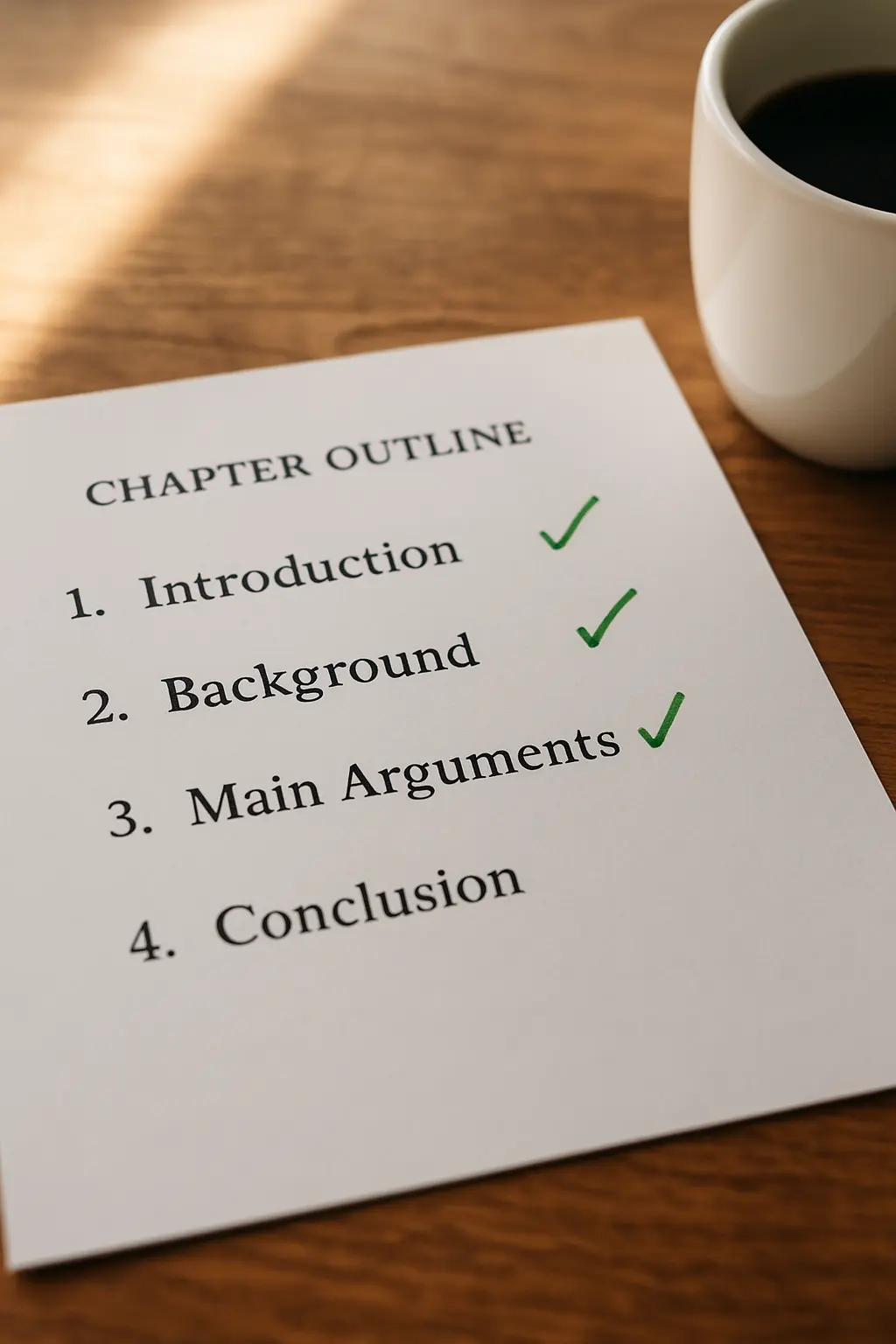
    A dissertation broken into a numbered chapter skeleton with each section's job noted
    Every section with a one-line statement of its job. This page is what turns six weeks of dread into thirty finishable pieces of work.

    Chapter by chapter: what you can hand over, and what you cannot

    Introduction

    Hand over: the conventional shape — context, problem, gap, aims, questions, structure — and a critique of whether your draft actually delivers each. Keep: the claim about why your question matters. Write this chapter last, whatever order the document is in.

    Literature review

    Hand over: reorganising a review you have drafted, checking whether topic sentences match their paragraphs, and suggesting thematic groupings for studies you have read and summarised. Keep, absolutely: deciding what the literature says, judging quality, choosing what matters, and every citation. Never accept a reference from a tool you have not opened and read. The full boundary, with a model declaration, is in our guide to writing a literature review with AI, honestly.

    Methodology

    Hand over: the architecture and the prompts — philosophy, approach, design, sampling, instruments, analysis, ethics — and whether you have justified each decision rather than merely described it. Keep: the justifications. Our walkthrough of the methodology chapter has the structure you can lift, and this is often the fastest chapter to finish because you already know what you did.

    Results

    Hand over: table and figure formatting, and the conventional reporting sentence for a given test — the exact APA construction is set out in our guide to running and reporting a t-test. Keep: the analysis, and every number. Never let a tool near your data values.

    Discussion

    Hand over: a structural check that each finding is interpreted against the literature and that your limitations are specific rather than boilerplate. Keep: the interpretation itself. This chapter is where the marks concentrate and where delegation is most visible, because generic discussion prose reads as generic immediately.

    Bibliography

    Hand over the lot. Formatting citations is clerical work nobody awards marks for and everybody deducts marks over. An automatic bibliography that generates from what your text actually cites removes the cited-but-not-listed problem entirely — see our guide to the AI Harvard referencing generator.

    The one test that settles every case

    Forget “is AI allowed” as your organising question, because the answer varies by institution, by department and sometimes by module. Ask this instead:

    Could you sit with your supervisor, be stopped at any paragraph, and explain why it says what it says?

    If yes, you wrote your dissertation, whatever tools were on the desk. If no, you did not, and no policy wording rescues that. This test also happens to be what a marker applies, which is why it is the one worth optimising for.
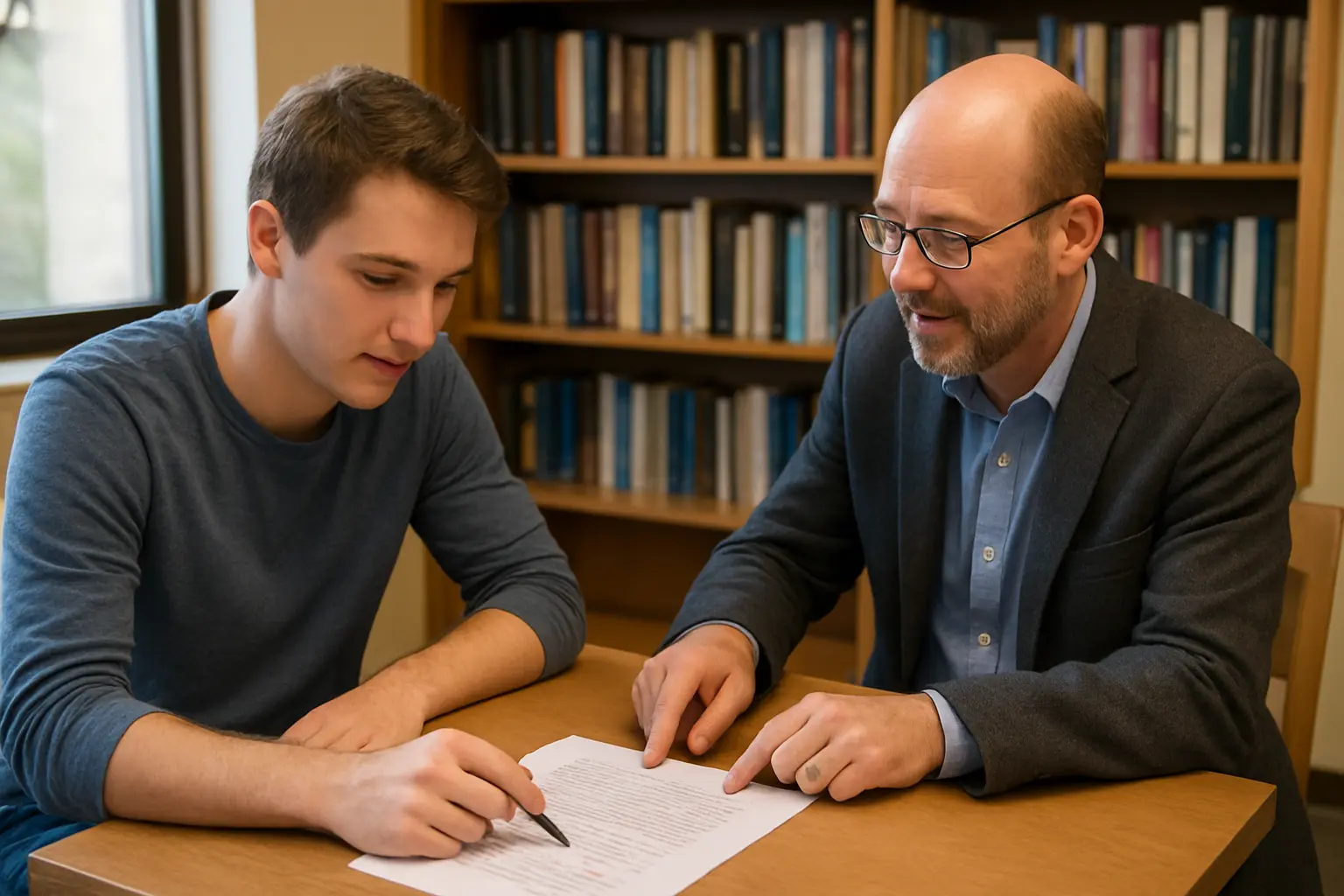
    A supervision meeting discussing a draft the student can explain and defend
    This meeting is the real assessment of authorship. Everything else is administration.

    How Tesify is built for this

    Tesify is a dissertation workspace rather than a chatbot, and the difference is that it holds the whole project. It builds the chapter structure for your project, works from your research questions, sources and findings, drafts with you section by section instead of producing a finished essay, maintains the bibliography in your citation style as you cite, and checks your drafts before your university does.

    The design commitment is the important part: everything stays 100% written by you. Tesify handles structure, formatting and momentum; the reading, the reasoning and the words are yours, which is the only configuration that survives the supervisor test. More than 9,000 students have used it across more than 15,000 chapters, and you can start free.

    It also does not need to be your only tool. A general chatbot is genuinely useful for explanation and critique, and a reference manager holds your library — the sensible combination is set out in our comparison of the best AI tools for dissertation writing.

    Tonight, if you are behind

    1. Build the skeleton. Every chapter, every section, one line saying what each section has to achieve. An hour, and the fog becomes a list.
    2. Write the methodology. You already know what you did and the structure is conventional. Having one finished chapter changes your relationship to the whole project more than any amount of planning.
    3. Spend the good hours where the marks are. Analysis and discussion outweigh a perfect introduction. Timebox by weight, not by document order.
    4. Fix the bibliography once, automatically, instead of five times by hand at 2am.
    5. Tell your supervisor where you actually are. Being three weeks behind is a solvable problem; being three weeks behind and silent for a month is a worse one.

    None of this requires you to be more disciplined than you have been. It requires the work to be broken into pieces small enough to start. Open your dissertation in Tesify and build the skeleton tonight — it is free to start, and the chapter you finish tomorrow is the one that changes the next six weeks.

    Frequently asked questions

    Can AI write my whole dissertation for me?

    It can generate text that looks like a dissertation, and that text will contain invented citations, no engagement with your data, and nothing you can defend in a supervision meeting. It cannot produce work that is honestly yours, which is what you are being assessed on.

    Is using AI to write a dissertation cheating?

    It depends entirely on what you use it for and what your institution permits. Structure, formatting, referencing and critique of your own writing are widely accepted; submitting generated text as your own work is not. Read your academic integrity policy and the assessment brief, and follow any declaration requirement.

    How much does Tesify cost?

    You can start free and build real chapters before deciding whether you need anything more. There is no charge to try the workflow on your actual dissertation.

    Will my university know I used Tesify?

    There is nothing to hide. Tesify supports your writing rather than replacing it, so what you submit is your own work. If your department asks you to declare tool use, declare it — a use you can state openly is a use you have already vetted.

    Is my unpublished research safe?

    Your work in Tesify is yours: it is not published or shared into any public database, and you can export it. Keep your own exported backup as a habit with any tool you use.

    What if I only have three weeks left?

    Three weeks of structured, prioritised writing produces far more than most students believe, and far more than any ghost-writer working without your data could. Build the skeleton, write the methodology first, and give the good hours to analysis and discussion.

    Can it help if I have not collected my data yet?

    Yes — the introduction, literature review and methodology can all be drafted before your results exist, and having them written is what makes the analysis period survivable. Check that your ethics approval is in place before you collect anything.

    Does it write in British English?

    Yes, and you should check the final draft for consistency regardless of what you write in. UK departments expect British spelling and conventions unless your handbook says otherwise.

    What if my supervisor has stopped replying?

    Chase once by email, then contact your department’s dissertation coordinator or postgraduate office — supervision is an institutional obligation, not a personal favour. Keep writing while you wait rather than treating silence as permission to stall.

    Will using AI make my writing sound generic?

    It will if you let a tool generate your prose. It will not if the tool handles structure and formatting while you write the sentences, which is the workflow described here and the reason it survives a supervision meeting.
  • Your Dissertation Timeline: A 12-Week Plan That Survives Real Life (2026)

    Your Dissertation Timeline: A 12-Week Plan That Survives Real Life (2026)

    Most dissertation plans fail in the same way. They allocate weeks to writing chapters, which is the part you control, and no time at all to ethics approval, participant recruitment, a supervisor’s annual leave or the print shop’s queue — which is where the weeks actually disappear. Then week six arrives, nothing has moved, and the plan gets abandoned rather than adjusted.

    This is a twelve-week plan built the other way round: the fixed-duration external dependencies go in first, the writing flows around them, and the buffers sit where the delays really happen. If you would rather have the chapter structure built for you than build it yourself, Tesify does that free.

    Three rules before the weeks

    Work backwards from submission, not forwards from today. Put the deadline on the page first, then subtract binding and printing, then the final proofread, then the last supervisor read. What remains is your actual writing window, and it is always shorter than it felt.

    Start the slowest thing first. Ethics approval and recruitment have durations you do not control. Everything you can do while waiting — literature, methods, instruments — should be scheduled into the waiting.

    Plan in deliverables, not hours. “Work on lit review, Tuesday” is unfalsifiable and will not happen. “Draft the 600 words on measurement debates, Tuesday” either happened or it did not. This matters more than any other item on this page.

    The twelve weeks

    Week Main deliverable Running in parallel
    1 Question fixed and agreed with supervisor; chapter skeleton built Start reading; set up reference manager
    2 Ethics application submitted Literature search run and logged
    3 Literature review first draft (half) Ethics under review; build instruments
    4 Literature review first draft complete Approval expected; recruitment materials ready
    5 Data collection opens; methodology chapter drafted Recruitment chasing
    6 Data collection continues; methodology to supervisor Analysis plan written before data arrives
    7 Data collection closes; cleaning and preparation Revise literature review on feedback
    8 Analysis run; results drafted
    9 Results chapter complete; discussion started Results to supervisor
    10 Discussion and conclusion drafted Introduction written last
    11 Buffer week — full draft assembled; abstract written Bibliography and formatting check
    12 Proofread, print, bind, submit two days early

    Why the plan front-loads the things that are not writing

    Ethics goes in week two, not week five. Approval must be in place before you approach a single participant, retrospective approval is generally unavailable, and data collected without it is unusable however good your intentions. A low-risk departmental review often takes days to a few weeks, and every round of requested revisions restarts the clock. Our guide to ethics approval for an undergraduate dissertation covers what triggers review and what goes in the application — and note that if your project involves NHS patients or staff as participants, the answer is a redesign rather than a longer wait.

    The literature review is drafted during the ethics wait. This is the single biggest efficiency in the plan. Those three weeks are otherwise dead time, and the review is the chapter least dependent on anything else. Run and log your searches properly at the start using the databases mapped in our guide to where to search for dissertation literature, because reconstructing a search log in week eleven is the most avoidable job in the whole project.

    Data collection gets three weeks, not one. Recruitment is slower than everyone expects, and your target sample should have been decided in advance rather than discovered — the reasoning belongs in your methods, as set out in our guide to sample size for an undergraduate dissertation.

    The analysis plan is written in week six, before the data exists. Deciding your analysis in advance stops you fishing through your results for something significant, and it means week eight is execution rather than decision-making.

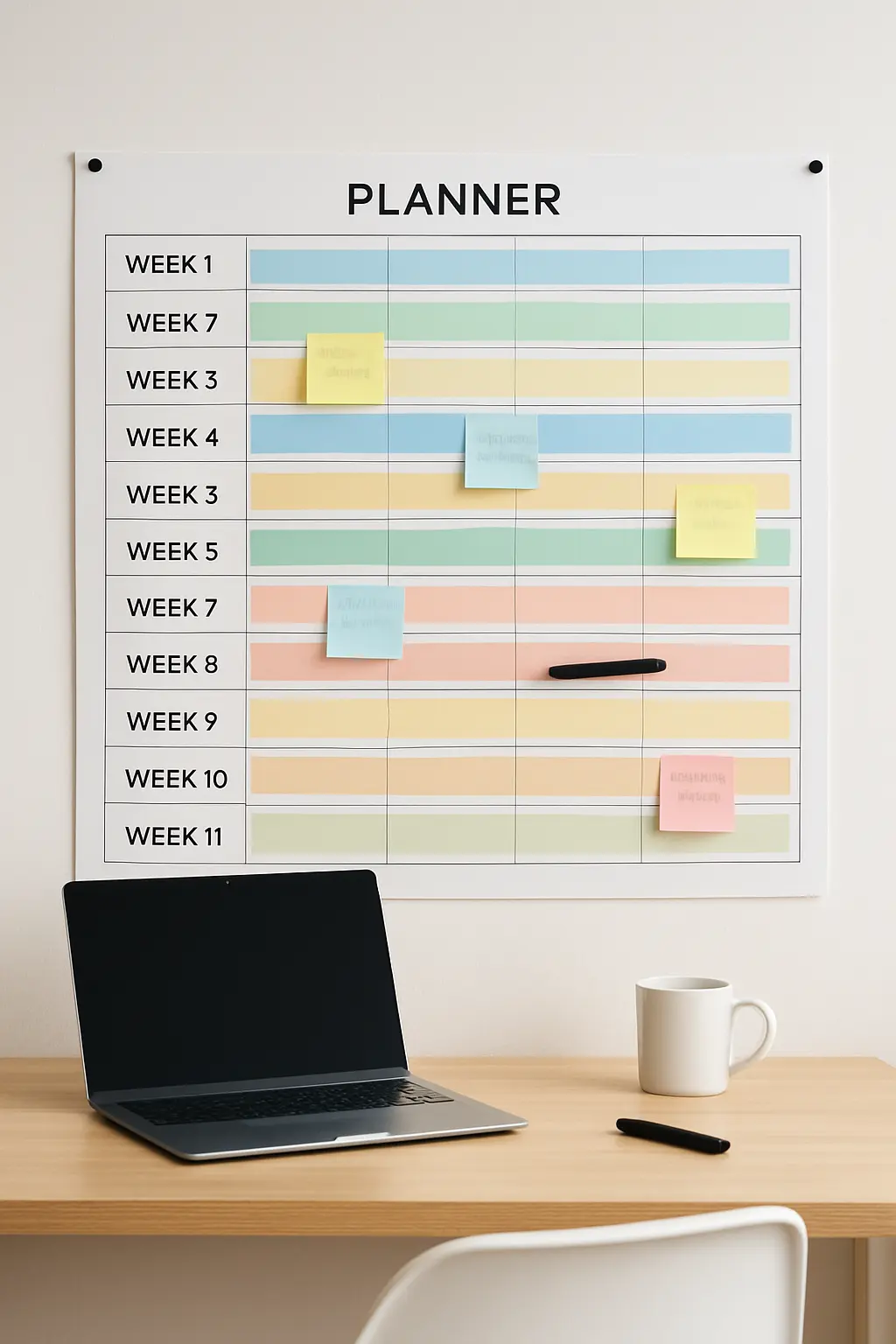
    A weekly plan with specific finishable tasks and deliberate slack days
    Specific enough to be finishable, with the empty days planned rather than borrowed from later.

    The five things that break timelines

    1. Ethics revisions. Assume one round. If it comes back clean, you have gained a week.
    2. Recruitment stalling. Have a second recruitment route agreed with your supervisor before you need it.
    3. Supervisor availability. Ask in week one when they are away and what their turnaround time is. Two weeks of annual leave in August is normal and it is only a crisis if you did not know.
    4. Analysis surprises. An assumption fails, a variable is not what you thought. Week eight has slack for exactly this, and the fallback routes are in our guide to what to do when your statistical assumptions fail.
    5. Printing and binding. Print shops have queues in submission week, and a bound copy requirement discovered on the last afternoon has ruined otherwise finished dissertations. Check your submission format in week one.

    The buffer rules

    Week eleven is a buffer, and the rule is that you do not spend it in advance. A plan with no slack does not survive one bad week; a plan with a fortnight of slack invites the whole schedule to drift into it. One protected week plus a deliberate two-day early submission is about right.

    Two more habits protect the plan. Schedule at most five working days a week — you will use the sixth, but it should be recovered time rather than allocated time. And if a deliverable slips, move it and re-plan the same evening rather than letting the plan quietly become fiction, which is how most abandoned schedules actually end.

    Printing and binding, the final stage students forget to plan for
    The last stage of the project is a queue you do not control. Find out your submission format in week one.

    If you are already behind: the six-week version

    Compress by cutting scope, not by cutting stages, and talk to your supervisor before you commit to any of this.

    Weeks 1–2: skeleton built, methodology written first because you already know what you did, data collection opened immediately if ethics is already approved. Weeks 3–4: literature review drafted to a narrower scope — fifteen sources understood properly beats forty skimmed — and analysis run as soon as collection closes. Week 5: results and discussion, which is where the marks are. Week 6: introduction, abstract, bibliography, proofread, submit.

    If your project has not started at all and the deadline is close, the honest options are an extension through your institution’s extenuating circumstances process — which has evidence requirements and a deadline of its own — or a redesign to a literature-based project that needs no participants and no approval clock. Both are better than the third option, and if you are being tempted towards buying a dissertation, read what that actually costs in our guide to legitimate versus criminal dissertation help first.

    Make the plan do some work for you

    A timeline is only useful if it converts into tasks small enough to start on a tired Tuesday. That conversion — chapters into sections, sections into a one-line statement of what each has to achieve — is what turns a plan into progress.

    Tesify builds that structure for your dissertation and drafts it with you section by section, keeping the bibliography formatted as you cite. More than 9,000 students have used it across more than 15,000 chapters, everything stays 100% written by you, and it is free to start. Which other tools are worth adding is covered in our comparison of the best AI tools for dissertation writing.

    Frequently asked questions

    How long does an undergraduate dissertation take?

    Most UK undergraduate dissertations run across one or two semesters, and twelve concentrated weeks is a realistic working window for the bulk of it. The variable is not the writing but the approvals and data collection in front of it.

    When should I start my dissertation?

    As soon as you have a supervisor and a workable question. The specific thing to start early is the ethics application, because its duration is the one you cannot compress.

    How many words a day should I write?

    Between 500 and 1,000 words of drafting is sustainable for most students alongside other commitments, and two thirds of full-time undergraduates are also in paid employment. Plan by deliverable rather than by word count, and expect editing to take as long as drafting.

    Should I write the chapters in order?

    No. Write the methodology early because you already know what you did, and the introduction last because it has to describe a dissertation that exists. The literature review can be drafted before your data collection has even opened.

    What if I miss my own deadlines?

    Move them and re-plan the same evening. A plan that is adjusted stays useful; a plan that is quietly ignored stops being a plan. Tell your supervisor if you have slipped by more than a week.

    Do I need a Gantt chart?

    Only if your department asks for one, which some do as part of a proposal. A wall planner or a simple table works just as well for actually running the project.

    How much time should I leave for proofreading?

    At least a full week, and read the whole thing once on paper. Add a separate pass reading only the bibliography and citations, which is where the cheapest marks are lost.

    Can I get an extension?

    Extensions run through your institution’s extenuating circumstances process, which generally covers illness, bereavement and crisis rather than ordinary deadline pressure. It has evidence requirements and its own deadline, so read the policy before you need it.

    What if my supervisor is on leave when I need feedback?

    Ask in week one when they are away and plan around it. If you cannot reach them for an extended period, contact your department’s dissertation coordinator — supervision is an institutional obligation.

    How early should I submit?

    Two days early. Upload systems fail, files corrupt and print shops have queues, and none of those are accepted as reasons for a late submission.

  • Best AI Tools for Writing a Dissertation in 2026: An Honest Comparison for UK Students

    Best AI Tools for Writing a Dissertation in 2026: An Honest Comparison for UK Students

    Most “best AI tools” lists are feature dumps that ignore the only question that matters at undergraduate level: which jobs can you hand over without handing over your authorship. So this comparison is organised by job rather than by brand, because a tool that is perfectly safe for one task is a misconduct case in another. Table first, then the verdict.

    Category The job it does Typical cost Risk to your authorship Verdict for a dissertation
    Dissertation workspaces (Tesify) Chapter structure, drafting scaffolding, automatic bibliography, self-checking, in one place Free to start Low — built around you writing The default
    General chatbots Explaining concepts, critiquing your own prose, rubber-ducking an argument Free tier, paid upgrades High if used to generate submitted text Useful, narrowly
    Referencing and bibliography tools Extracting metadata and formatting citations consistently Free tiers widely available Negligible — clerical work Use one, always
    Language and grammar editors Correcting expression in text you wrote Free tier, paid upgrades Low if it edits, higher if it rewrites Fine within your policy
    Paraphrasing and “humanising” tools Rewording existing text Free tier, paid upgrades Very high Avoid

    The shortlist, ranked

    1. A dissertation workspace — the only category built for the actual problem

    The reason general tools disappoint on a dissertation is scale. A chatbot has no memory of your chapter two when you are writing chapter four, no idea what your research questions were, and no way to keep a bibliography synchronised across 10,000 words. What stalls students is not sentence-level writing but the shape of the thing: which chapter comes next, what each section has to achieve, where the argument has a hole.

    Tesify is built for that. It structures the dissertation chapter by chapter, drafts with you from your own research questions, sources and findings, maintains the bibliography in your citation style as you cite, and checks your drafts before your university does. More than 9,000 students have used it across more than 15,000 chapters, and it is free to start.

    Who it suits: anyone writing a full dissertation rather than a 2,000-word essay. Where it falls short: it is not a general-purpose assistant — if you want something to explain Bayesian statistics or write your CV, use a chatbot.

    2. A referencing tool — the cheapest marks on the list

    Citation formatting is clerical work that universities do not award marks for and do penalise you for getting wrong. Automating it is uncontroversial, and no institution requires you to declare a formatting tool. Pair a reference manager for your library with automatic formatting inside your draft; the trade-offs between the managers are in our comparison of Zotero, Mendeley and EndNote, and the drafting-side workflow is covered in our guide to the AI Harvard referencing generator.

    Where it falls short: generated entries inherit whatever errors the source metadata carried, so one checking pass against your handbook is still yours to do.

    3. A general chatbot — excellent at three things, dangerous at a fourth

    Used well, a chatbot is a patient tutor: explain heteroscedasticity, tell me what this reviewer’s comment probably means, critique the logic of this paragraph I wrote, suggest what is missing from this outline. All four of those operate on your material or your understanding.

    Where it falls short, decisively: references. General-purpose models produce citations that look impeccable — plausible authors, real-sounding journal, well-formed volume and pages — for papers that do not exist, and attach real authors to work they never wrote. In a literature review this is the fastest route to a misconduct meeting, because a marker’s first instinct with an unfamiliar reference is to look it up. Never accept a citation from a tool you have not personally opened and read. The full workable boundary is set out in our guide to using AI in a literature review, honestly.

    4. A language editor — legitimate, with a line

    Correcting grammar, punctuation and awkward phrasing in text you wrote is among the most widely accepted uses, and many institutions treat it much as they treat proofreading. The line is between editing your expression and restating your argument: the moment a tool is producing the ideas rather than tidying them, you have crossed from proofreading into authorship. Check whether your institution requires you to declare the use, because several do.

    5. Paraphrasing and “humanising” tools — the category to avoid

    These promise to reword text so it reads differently, and they are marketed at exactly the anxiety this whole subject generates. Three reasons not to. Rewording someone else’s text without citing it is still plagiarism — synonym-swapping with the source’s structure intact is patchwriting, which markers catch by reading. Tools sold specifically to evade detection are a service whose only purpose is concealment, and paying for concealment is not a good position to be in if you are ever asked. And the output is usually worse: mangled academic terminology and sentences that no longer say anything precise.

    A module handbook's AI-use clause, the rule that overrides any tool review
    Every recommendation on this page is subordinate to one document, and it is not this one.

    The recommendation

    Use a dissertation workspace for the writing, an automatic bibliography for the referencing, and a general chatbot for explanation and critique of your own work. Skip the paraphrasers entirely. That combination covers every job an undergraduate dissertation actually presents, leaves your authorship unambiguous, and costs nothing to try.

    If you buy exactly one thing, do not buy anything until you have checked what your university already provides. Institutions increasingly license tools centrally, and your library or IT pages will say so — although provision is still a minority experience, as the survey data in our roundup of UK student AI use shows.

    The rule that overrides every review, including this one

    Your module handbook and each assignment brief are the authority on what you may use. UK institutions have taken meaningfully different positions on generative AI, departments differ from their own university’s default, and two modules on the same course can carry different rules.

    So before you adopt anything: find your institution’s academic integrity policy, find the assessment brief’s AI statement, and if there is not one, ask in writing. Where declaration is required, write it specifically — “AI was used” invites suspicion, whereas naming what you used it for demonstrates you understood the boundary. And keep your working: drafts with version history, dated notes and annotated PDFs are what protects a student who is wrongly queried.

    How to judge any tool in five minutes

    1. Who is the author of the output? If the answer is the tool, stop.
    2. Would you show your supervisor the tool openly? Legitimate tools survive daylight; services that advertise discretion are telling you something.
    3. What happens to your text? Your dissertation is unpublished research. Read the provider’s current documentation on storage, access and training use — the terms page, not the marketing page.
    4. Does it invent sources? Test it: ask for five references on your topic and try to find them. What you learn in ten minutes will shape how you use it for six months.
    5. Does it promise an outcome? “Guaranteed 2:1” is not a feature claim, it is a warning. Where that shades into something criminal to sell in England is mapped in our guide to legitimate versus criminal dissertation help.
    A student drafting a chapter from their own notes and sources
    The configuration that works: your notes, your sources, your sentences — and the mechanical work handed off.

    What none of them will do

    No tool will read your literature for you, decide what your data mean, or defend your argument in a supervision meeting. Those are the parts that carry the marks, and every hour a tool saves you on formatting is only worth something if you spend it there.

    Nor will any tool tell you what your university’s similarity software will say. Self-checking is worth doing before submission for the honest reason — finding the quotation you forgot to mark — and consumer results are directional only; our plagiarism checker comparison covers what a self-check can and cannot establish.

    Start your dissertation in Tesify free — structure, drafting support, automatic bibliography and self-checking in one place, with every word still written by you.

    Frequently asked questions

    What is the best AI tool for writing a dissertation?

    For the whole job — structure, drafting, bibliography and checking across tens of thousands of words — a purpose-built dissertation workspace beats a general chatbot, because chatbots have no memory of your project and cannot maintain a reference list. Use a chatbot alongside it for explanation and critique.

    Is it allowed to use AI to write a dissertation?

    Assistance is widely permitted and generation of submitted text usually is not, but the rules are set by your institution and often by the individual module. Read your academic integrity policy and the assessment brief, declare what you are asked to declare, and never submit text you could not explain.

    Are there free AI tools for dissertation writing?

    Yes. Tesify is free to start, most reference and bibliography tools have capable free tiers, and the major chatbots have free tiers. Check what your university licenses centrally before paying for anything.

    Will my university detect AI use?

    Detection tools exist, are probabilistic and are contested, so this is the wrong question to organise your behaviour around. Universities increasingly assess authorship through assessment design — orals, drafts, supervised work — and the durable protection is being able to discuss your own argument.

    Can AI write my literature review?

    Not defensibly. Deciding what the literature says, judging study quality and choosing what matters to your argument are the intellectual content of the chapter. Delegate those and you have commissioned a review rather than written one — and the fabricated-citation problem makes it detectable as well as wrong.

    Are paraphrasing tools against the rules?

    Rewording a source without citing it is plagiarism regardless of how it was reworded, and tools marketed specifically for evading detection are difficult to explain to a panel. Cite properly and paraphrase from your own understanding instead.

    Is my dissertation safe if I write it in an online tool?

    Read the provider’s current terms on storage, access and whether your text may be used for training. Your dissertation is unpublished research, so this is a reasonable question to ask of anything. Keep your own exported backup as a habit whichever tool you use.

    Should I tell my supervisor I am using AI?

    Yes, and it is usually a productive conversation rather than a risky one. Supervisors would far rather advise you on a legitimate workflow early than discover an ambiguous one at submission.

    Does using an AI tool need to go in my methodology chapter?

    Tools used in your research process — analysis software, transcription, screening support — belong in your methods. Writing support is usually handled by a declaration rather than the methods chapter, but follow whatever format your department specifies.

    What if my department bans AI entirely?

    Then that is the rule, and it applies to you regardless of what any tool’s marketing says. Reference managers and spellcheckers are almost never covered by such bans, but check the wording rather than assuming, and ask your module leader if it is ambiguous.

  • Your Data Is Analysed and the Results Chapter Is Blank: How to Write It This Week (2026)

    Your Data Is Analysed and the Results Chapter Is Blank: How to Write It This Week (2026)

    The analysis is done. There is a folder of output, a set of tables you cannot bring yourself to look at, and a chapter heading with nothing underneath it. Two weeks ago the problem was getting the data; now the problem is that nobody ever taught you how to turn output into prose — and this is the chapter that, with the discussion, carries roughly 40% of your word count and most of the analytical credit. You can start building the chapter in Tesify tonight, free; first, here is why it will not start.

    The reason it will not start

    You are trying to write the chapter from your output. A results chapter is written from your research questions.

    Statistical software and coding software both produce material in the order the software works, which has nothing to do with the order your argument needs. Open the output folder and you are looking at a list of procedures. Open your methods chapter’s list of research questions and you are looking at a chapter outline — because your results chapter has exactly one job: to answer, in order, each question you said you would answer, with the evidence that answers it.

    That single reframe removes most of the paralysis, because it converts an unbounded writing task into a fixed number of small ones.

    The cost of getting this chapter wrong

    Two failure modes, and both are expensive.

    The narrated-output chapter. Every table reproduced, every number restated in a sentence, no signal about which finding matters. It is long, it feels thorough, and it reads to a marker as an inability to distinguish the important from the incidental. It also consumes the words the discussion needed.

    The chapter that leaks its discussion. Findings interpreted as they appear, so that by the time you reach the discussion there is nothing left to say and you restate. This is the more common of the two, and the harder to repair late, because unpicking interpretation from reporting means rewriting both chapters.

    The proportion matters as well. Results and discussion take roughly 20% each of a typical empirical dissertation, as our breakdown of undergraduate dissertation word counts sets out. A results chapter that has swollen to a third of the dissertation has taken those words from the chapter that earns more of them.

    Figures arranged in the order of the research questions they answer
    Sort the output by question before you write a word. What is left over is an appendix.

    Step 1: Sort the output into three piles

    Print or list every piece of output you have and put each item into one of three piles.

    1. Answers a research question. This is your chapter, and it is usually smaller than you fear — three questions might need five tables.
    2. Describes the sample. Response rates, demographics, missing data, reliability figures. This is the short opening section, not the body.
    3. Everything else. Exploratory runs, checks you did and abandoned, alternative specifications. This goes in an appendix, or nowhere.

    The third pile is where most over-length results chapters come from, and cutting it is not hiding anything: an analysis you ran, did not preregister and do not report as answering a question belongs in an appendix with a line in the text saying it is there.

    Expected output: a numbered list of sections, one per research question, with the specific tables or themes that belong in each.

    Step 2: Write the sample section first, because you already know it

    It is the easiest thing in the chapter and it breaks the blank page. How many people you approached, how many responded, who they were, what was missing, and any reliability or assumption checks. Facts you already have, in the past tense.

    If your achieved sample fell short of your target, this is where you say so and where you carry the consequence forward — the honest construction, including the sensitivity analysis that replaces a post-hoc power calculation, is set out in our guide to sample size for an undergraduate dissertation. Stating the shortfall in the results chapter and revisiting it in the discussion is a mark of competence, not a confession.

    Expected output: 300–500 words on the desk, before you have interpreted anything.

    Step 3: One sentence per table, then the table

    This is the rule that turns output into a chapter. Each table or figure gets one sentence of prose before it that says what it shows, and one sentence after it, at most, that points at the specific value the reader should notice. Nothing else.

    The University of Manchester’s Academic Phrasebank describes exactly this convention for quantitative work: results are presented with “tables and figures, and writers comment on the significant data shown in these”, and “more elaborate commentary on the results is normally restricted to the Discussion section”. Its worked phrasings are the ones to imitate — “Table 1 shows an overview of…”, “As can be seen from the table (above), the X group reported significantly more Y than…”, and the summarising move “The most striking result to emerge from the data is that…”.

    Two things this rule prevents. It stops you retyping the table into prose, which is the single commonest padding in an undergraduate dissertation. And it stops the table from arriving unannounced, which is what makes a results chapter feel like a report dump.

    Expected output: a chapter whose prose can be read on its own and still makes sense, with every table introduced.

    A results table annotated with the single sentence that will introduce it in the chapter
    Write the sentence in the margin first. If you cannot say what the table shows in one line, the table is doing too much.

    Step 4: Report the numbers in the conventional form

    Reporting conventions are not decoration; they are how a marker checks your analysis quickly. The Phrasebank’s own example gives the shape: “There was a significant difference in X, t(11) = 2.906, p<0.01” — test statistic, degrees of freedom, value, then significance, in that order and in one bracketed string.

    Three habits raise the mark on this alone. Give an effect size alongside every significance test, because a p value tells a reader whether an effect is detectable and not whether it is large. Report exact p values where your handbook allows it rather than only thresholds. And report a non-significant result in exactly the same form as a significant one — “No significant differences were found between…” is a finding, written as a finding. The mechanics for individual tests, including how the output maps to the reported string, are worked through in our guide to running and reporting an independent-samples t-test in SPSS, and what to do when a test’s assumptions are not met is in our guide to failed statistical assumptions.

    If your work is qualitative, the equivalent conventions are structural. The Phrasebank describes qualitative results as highlighting themes with supporting excerpts, which in practice means: name the theme, state how it presents across the dataset, then give one or two illustrative extracts with a participant identifier. The full sequence, and where analysis stops being coding, is in our guide to doing a thematic analysis. The one rule that transfers from the quantitative side without modification: an extract is evidence for a claim you have already made in your own words, never a substitute for making it.

    Step 5: Hold the line between results and discussion

    The test is simple and you can apply it to any sentence you have written. If the sentence could be checked against your data, it belongs in results. If it requires the literature, an explanation, or a judgement about importance, it belongs in the discussion.

    “Attendance was lower among students travelling more than 45 minutes” is a result. “This suggests that practical constraints rather than motivation explain disengagement” is a discussion. The second sentence is more interesting, which is exactly why it migrates into the results chapter if you let it.

    Some departments explicitly combine the two into a single “findings and discussion” chapter, particularly in qualitative and case-study work. That is a legitimate structure and it is a decision your handbook makes, not you. If it does combine them, the discipline still applies inside each section: report first, interpret second, visibly.

    Step 6: Read the chapter backwards against your questions

    Take your list of research questions and, for each one, find the sentence in the results chapter that answers it. If you cannot find one, the chapter has reported around the question without landing on it — the commonest reason a marker writes “descriptive” in the margin. Write the missing sentence.

    Then check the reverse: every section in the chapter should map to a question. A section that maps to nothing is pile three, and it belongs in the appendix.

    Expected output: a one-to-one mapping between questions and answers, which is also the skeleton of your discussion and your conclusion.

    Writing it with Tesify, concretely

    The mechanical part of this chapter is real and it is where the week goes: holding a fixed structure while you fill it, keeping table numbering and cross-references consistent, and making sure the claims in the chapter still match the abstract and the conclusion when you have finished moving things around.

    That is the division of labour Tesify is built for. You give it your research questions and your own findings; it holds the chapter structure, keeps the bibliography built from what your text actually cites, and keeps the document consistent as it grows, so the chapter you finish on Thursday still agrees with the introduction you wrote in March. Every word is written by you — the analysis, the interpretation and the judgement about what matters are the assessed parts and they stay yours.

    Open your results chapter in Tesify now. It is free to start, and the first thing it will ask you for is the list you built in Step 1.

    Frequently asked questions

    How long should a dissertation results chapter be?

    About 20% of the total on a conventional empirical dissertation, with the discussion taking a similar share. On a 10,000-word limit that is roughly 2,000 words. Your handbook’s allocation, where it gives one, overrides the convention.

    What is the difference between results and discussion?

    A results statement can be checked against your data; a discussion statement requires the literature, an explanation or a judgement about importance. The Academic Phrasebank puts the same line as “more elaborate commentary on the results is normally restricted to the Discussion section”.

    Should I include every table my software produced?

    No. Include the output that answers a research question or describes the sample; put the rest in an appendix with a sentence in the text saying it is there. A results chapter is a selection, and making the selection is part of what is being assessed.

    How do I report a non-significant result?

    In exactly the same form as a significant one, without apology. “No significant differences were found between…” is a finding. What you must not do is run further tests until something reaches significance, which is an integrity question rather than a writing one.

    Do I interpret findings in the results chapter?

    Only to the extent of pointing at what the reader should notice. Save explanation and comparison with the literature for the discussion — unless your department requires a combined findings-and-discussion chapter, in which case still report before you interpret within each section.

    How do I write up qualitative findings?

    Name the theme, state how it presents across your dataset in your own words, then give one or two illustrative extracts with participant identifiers. Extracts support a claim you have made; they do not make it for you.

    Is it cheating to use an AI tool to write my results chapter?

    It depends entirely on what the tool does and what your department permits. A tool that holds structure, formats citations and checks consistency while you write the words is a different thing from one that generates findings, and only the second misrepresents authorship. Read your assessment brief’s AI statement, disclose what it asks you to disclose, and keep the interpretation yours.

    How much does Tesify cost?

    It is free to start, which is the tier most students finish a dissertation on. Paid options exist for longer projects; you do not need one to build a results chapter this week.

    Is my unpublished data safe in a writing tool?

    Your work stays yours, it is not published or shared into any public database, and you can export it. Separately, and regardless of tool: report anonymised or pseudonymised data in your chapter, keep identifiable material out of any document you sync, and follow the conditions of your own ethics approval.

    My results are not what I hypothesised. Is that a problem?

    No. A well-designed study reporting an unexpected or null result is a pass; the marks are in the design, the analysis and the honesty of the reporting. What costs marks is a discussion that pretends the prediction was confirmed.

    Where do tables and figures actually go?

    Inline, immediately after the sentence that introduces them, unless your handbook says otherwise. Numbered sequentially, with a caption above tables and below figures at most institutions, and listed on the list of tables or figures in your preliminary pages.

  • How to Write a Dissertation Abstract: The UK Guide, With a Worked Example (2026)

    How to Write a Dissertation Abstract: The UK Guide, With a Worked Example (2026)

    A UK dissertation abstract is normally 200 to 300 words, written last, and built by taking the main point from each chapter and redrafting those points into a single paragraph that can be read on its own. Your department’s handbook sets the exact length and, less obviously, decides how much of it your methods are allowed to occupy.

    That last clause is the part almost every online guide gets wrong, because it assumes there is one standard abstract shape. There is not. Below is the procedure, the place where UK institutions genuinely contradict each other, and a full worked example you can measure your own against.

    Step 1: Find your own specification before you write a word

    Three published UK sources, three different numbers, and none of them is wrong.

    Source What it specifies Scope
    University of Manchester, Guidance for the Presentation of Taught Dissertations for UG and PGT Provision “A short (no more than 300 words) abstract of a dissertation must be provided” Undergraduate and postgraduate taught dissertations
    University of Southampton Library, dissertation guide “The average abstract is about 200 words, but you should adjust this figure to match the context” General study-skills guidance
    Oxford Brookes University, academic development resources “An abstract is normally only 200-300 words” General study-skills guidance

    Manchester’s document is a presentation requirement with a submission checklist attached; the other two are guidance about the genre. If your department has published a figure, that figure is not advice. Where your handbook is silent, 250 words is a safe target: it sits inside every range above and reads as deliberate rather than as an under-run.

    Expected output: a word target written at the top of your draft, and the page number of the document it came from. If you cannot find one, ask your supervisor and get the answer in writing — the same discipline that applies to the dissertation word limit itself and what counts towards it, which is a separate rule and frequently a different answer.

    Step 2: Write it last, from finished chapters

    Oxford Brookes puts the instruction plainly: “Write your abstract last”, because it provides an overview that requires the full text to be complete first.

    The reason is not scheduling. An abstract written before the discussion exists describes the dissertation you intended to write, and intentions drift. Findings turn out weaker than expected, a research question narrows in week nine, a chapter gets cut. An abstract drafted early and never revisited is one of the easiest inconsistencies for a marker to spot, because it is the first thing they read and the last thing you touched.

    If you wrote a dissertation proposal, its summary paragraph is a useful skeleton and nothing more: a proposal summary is written in the future tense about work you have not done, while an abstract reports what actually happened.

    Expected output: the abstract drafted after your conclusion is written, in the final week rather than the final hour.

    Step 3: Build it from seven moves, in order

    Southampton’s dissertation guide sets out the elements in sequence: “Context – Relevant research background”; “Objective statement/research question – What your research aims to do”; “Methodology – How your research was carried out”; “Results – What your methodology produced”; “Discussion – Interpretation of your results”; “Implications/future research – If relevant”; and “Conclusion – The takeaway or answer to the question”.

    The practical method is Brookes’s: “A quick way to structure your abstract is to take the main point from each section of your text e.g. introduction, methods, results, discussion and conclusion.” Write one sentence per move, in order, without editing. That gives you seven sentences and roughly 250 words.

    Two of those moves are consistently under-spent. The results sentence should contain an actual finding, not a promise of one — “the findings are discussed in relation to the literature” tells a reader nothing. And the conclusion sentence should answer the research question the second sentence posed, closing the loop within the paragraph.

    Expected output: seven sentences in order, each doing one job, before any cutting begins.

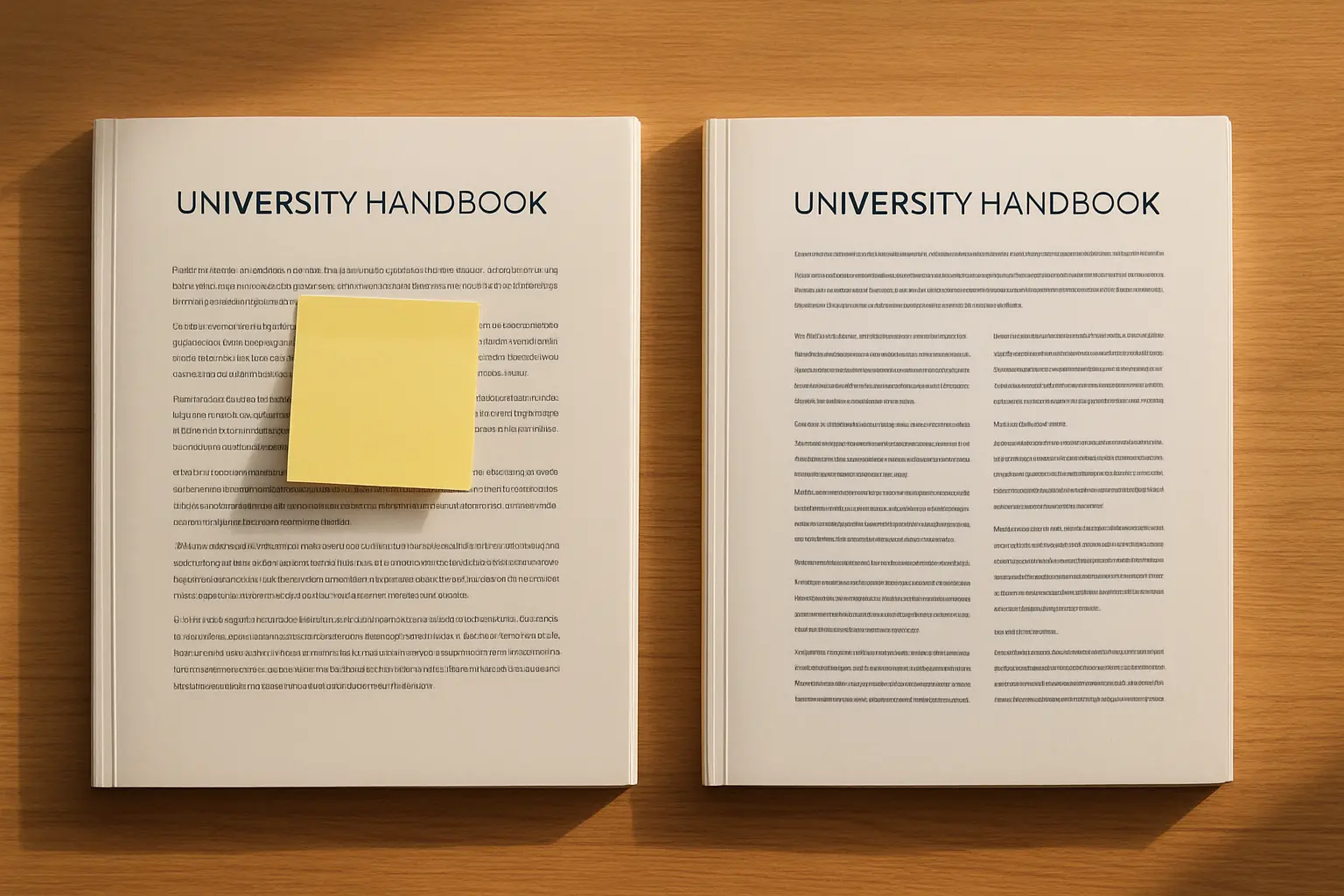
    Two university handbooks open side by side showing conflicting abstract requirements
    Two documents, two abstract specifications. On this question, one of them is sometimes the same university.

    Step 4: Decide how much space the methods get — this is genuinely contested

    Here is the disagreement that generic advice hides, and it is visible inside a single UK document.

    Manchester’s taught-dissertation guidance tells students on all programmes except MRes that the abstract must be “short (not more than 300 words), with emphasis on major observations and deductions rather than on methods”. Six lines further down, the same document tells MRes students that theirs “must be a short summary of the research presented in the dissertation (not more than 300 words), including a brief rationale for the study, details of the methods employed, a summary of the results, and an indication of the wider implications of the research”.

    One institution, one page, two opposite instructions about the same 300 words. Brookes takes a third position — “Don’t describe the detail of what you did in your research, instead focus on the key finding(s)” — while Southampton’s seven-move model gives methodology a slot of its own.

    The logic is about the reader. A research-degree abstract is read by people judging whether the method is sound; a taught dissertation abstract is read by markers who already have your methods chapter open. Which reader you are writing for is decided by your programme, not by a template.

    The safe construction, where your handbook is silent: name the design in one clause and spend the recovered words on the finding. “Using a cross-sectional online survey of 142 undergraduates…” identifies the method without narrating it. Everything else about justifying that design belongs in the methodology chapter, where it is assessed.

    Expected output: a deliberate decision, recorded, about whether your abstract is method-light or method-inclusive — and a handbook line or supervisor email behind it.

    Step 5: Cut it to length by removing hedges, not content

    Southampton’s advice is blunt: “Pare anything superfluous. Edit ruthlessly once you have that first draft. Treat adverbs with suspicion.” Three cuts reliably recover fifty to eighty words without losing a single fact.

    1. Remove the throat-clearing. “This dissertation aims to explore the extent to which…” becomes “This study examines whether…”. “It is important to note that” can always go.
    2. Remove double hedges. “The results appear to suggest that there may possibly be a relationship” is four hedges on one claim. One is enough.
    3. Remove signposting. “The first chapter reviews the literature, the second sets out the methodology…” describes the document rather than the research. A table of contents already does that job.

    What you must not cut is the finding. An abstract trimmed until it says only what the study was about, and never what it showed, has been cut in exactly the wrong place.

    Expected output: a paragraph inside your stated limit, counted with the same inclusion rule your department uses.

    Step 6: Keep four things out of it

    Manchester’s requirement is that the abstract “must be designed to be read independently of the rest of the dissertation and references to the dissertation and other literature will not normally be included”. That single sentence rules out most of what students are tempted to put in.

    • Citations. No in-text references, even where a framework is central to your study. Name the approach in words — “reflexive thematic analysis” — and let the reference appear where it belongs, formatted to your department’s variant of Harvard referencing: Braun, V. and Clarke, V. (2006) ‘Using thematic analysis in psychology’, Qualitative Research in Psychology, 3(2), pp. 77–101.
    • Cross-references to your own document. “As discussed in Chapter 4” breaks the stand-alone requirement immediately.
    • New material. Anything in the abstract must appear in the dissertation. It is not a place to add a caveat you forgot.
    • Undefined abbreviations. A reader meeting your acronym for the first time in a stand-alone paragraph has no way to decode it. Spell it out or drop it.

    Expected output: an abstract containing no brackets, no chapter numbers and no acronyms you have not spelled out.

    A student writing the dissertation abstract after the chapters are finished
    Written last, from finished chapters — which is the only way the findings sentence can contain a finding.

    Step 7: Put it in the right place, with the right pages around it

    The abstract is a preliminary page and its position is prescribed, not stylistic. Manchester’s order is: title page, contents page including any list of tables and figures, abstract, declaration, then the copyright and intellectual property statement, with optional items such as acknowledgements coming after the compulsory pages.

    Two details from the same document catch people out. “The final word count, including footnotes and endnotes, MUST be inserted at the bottom of the contents page” — a requirement that lives nowhere near the section on word limits. And the submission checklist carries a real sanction: “If any section is missing, out of order or not correct the dissertation may be rejected”, with the school able to accept an incorrect version for examination while withholding the result until a properly completed one is supplied.

    Check your own regulations for the equivalent list. This is the cheapest part of a dissertation to get right and one of the few where a mistake has an administrative consequence rather than a marking one.

    Expected output: preliminary pages in your department’s prescribed order, with anything it requires on the contents page actually on it.

    A worked example, 248 words

    An illustrative abstract for a fictional undergraduate project, method-light in the Manchester taught style, with the seven moves marked so you can see the joins. The bracketed labels would not appear in a submitted abstract.

    [Context] Hybrid timetabling became a permanent feature of many UK undergraduate programmes after 2021, but its effect on the study habits of commuting students has received limited attention. [Question] This study examined whether commuting distance is associated with self-reported engagement in synchronous online teaching, and how commuting students describe their reasons for attending or not attending. [Method] A cross-sectional online survey of 142 second- and third-year students at a single post-1992 institution was combined with eight semi-structured interviews analysed using reflexive thematic analysis. [Results] Students travelling more than 45 minutes each way reported significantly lower attendance at synchronous online sessions than those travelling less, and reported comparable attendance at on-campus sessions. Interview accounts identified three themes: the cost of an unproductive gap between timetabled sessions, an expectation that recorded material would substitute for live attendance, and a reluctance to participate verbally from a shared home environment. [Discussion] The quantitative pattern is consistent with a scheduling explanation rather than a motivational one, and the interview data suggest that recording policy shapes attendance more directly than travel time alone. [Implications] Timetabling that clusters a commuting cohort’s sessions, and a clearly communicated recording policy, may address the observed gap more effectively than attendance monitoring. [Conclusion] Commuting distance predicts disengagement from online rather than in-person teaching, and the mechanism appears to be practical rather than attitudinal.

    No citations, no chapter references, a number in the results sentence, and a final sentence that answers the second one. It would survive being read by someone who never opens the dissertation, which is the test.

    One last check before you submit: read the abstract immediately after the conclusion and ask whether it claims anything the conclusion does not support. Overclaiming here is the most common inconsistency in submitted undergraduate work, because the abstract is written in a burst of relief and the conclusion was written carefully three days earlier. If the chapters are finished and it is the summarising that has stalled, you can draft and tighten it in Tesify from your own chapters, to your department’s stated limit. Every word stays 100% written by you, and it is free to start.

    Frequently asked questions

    How long should a dissertation abstract be?

    Normally 200 to 300 words. Manchester requires “no more than 300 words” for undergraduate and postgraduate taught dissertations; Oxford Brookes describes 200–300 as normal; Southampton puts the average at about 200. Your own handbook overrides all three, and 250 words is a sensible target where it is silent.

    Does the abstract count towards the dissertation word limit?

    It depends on your department, and this is one of the most commonly misread rules in UK assessment. Some departments exclude preliminary pages entirely, others count everything except appendices. Find your inclusion rule before you allocate words, because it also changes how much room your chapters have.

    Should the abstract include my methods?

    UK guidance genuinely disagrees. Manchester tells taught-dissertation students to write “with emphasis on major observations and deductions rather than on methods”, and MRes students at the same institution to include “details of the methods employed”. Where your handbook is silent, name the design in one clause and spend the words on the finding.

    Can I cite sources in an abstract?

    Normally no. Manchester states that “references to the dissertation and other literature will not normally be included”, because the abstract has to be readable on its own. Name a framework in words rather than citing it.

    When should I write my abstract?

    Last. Oxford Brookes says to “write your abstract last” because it summarises a text that has to exist first. An abstract drafted early describes the dissertation you planned rather than the one you submitted.

    What tense should a dissertation abstract use?

    Mixed, and consistently so: present tense for what the study does, past tense for what you did and what you found. “This study examines… A survey of 142 students was conducted… Students travelling further reported…” is the standard pattern.

    Is an abstract the same as an executive summary?

    No. An abstract summarises the research for a reader deciding whether to read on. An executive summary, common in business and management projects, is longer, addressed to a practitioner audience and usually leads with recommendations. Some programmes require one instead — check which word your handbook uses.

    Does the abstract need keywords?

    Only if your department asks for them. Where they are required they are listed separately beneath the abstract, and they are not normally counted within its word limit.

    Where does the abstract go in a dissertation?

    Among the preliminary pages, after the contents page and before the declaration in Manchester’s prescribed order. Position is a formatting requirement rather than a preference, and a submission checklist can reject work whose preliminary pages are out of order.

    What is the most common mistake in a dissertation abstract?

    Describing what the dissertation is about without ever stating what it found. An abstract that ends with “the implications are discussed” has used its most valuable sentence to say nothing. Put a finding in it.

  • Writing a Dissertation Literature Review with AI, Honestly: A Method for UK Students (2026)

    Writing a Dissertation Literature Review with AI, Honestly: A Method for UK Students (2026)

    You have forty papers, a folder of notes, and a literature review chapter that will not start. The temptation is obvious: paste the topic into a chatbot and ask for a review. That specific shortcut is also the fastest route to an academic misconduct meeting — not because AI is forbidden at most UK universities, but because of what happens to the citations.

    There is a version of this that is defensible, produces a better chapter, and takes less time than staring at the page. It requires being precise about which parts of the job you can delegate and which parts are the job. If you want to start drafting with that structure already in place, you can do it in Tesify.

    First: read your own university’s policy

    UK institutions have taken meaningfully different positions on generative AI, and some departments differ from their own university’s default. Policies typically distinguish between permitted assistive use, use that must be declared, and use that constitutes misconduct — and the boundaries are not the same everywhere.

    So before anything else: find your institution’s academic integrity policy and your module handbook, and find out whether your department requires a declaration. If it does, plan to write one. Nothing on this page overrides what your own regulations say, and “a website said it was fine” is not a defence anyone has ever successfully run.

    The line that actually matters

    Forget the question “is AI allowed”. The useful question is: can you explain and defend every claim in your chapter as your own understanding?

    If your supervisor stops at any paragraph and asks “why did you group these three studies together, and what does this one actually show?”, you need an answer. That test does not care which tool you used. It cares whether the reasoning happened in your head.

    This maps onto a clean division of labour.

    Reasonably delegated

    • Reorganising a chapter you have drafted into a clearer order
    • Tightening sentences that are grammatically tangled
    • Suggesting thematic groupings for studies you have read and summarised
    • Explaining an unfamiliar methodological term so you can go and read properly about it
    • Producing a first outline that you then argue with and rewrite
    • Checking whether your topic sentences actually match the paragraphs beneath them

    Never delegated

    • Deciding what the literature says
    • Judging whether a study is any good
    • Choosing which studies matter to your argument
    • Generating citations or reference lists
    • Summarising a paper you have not read
    • Writing the gap your project fills

    The second list is the intellectual content of a literature review. Delegate any of it and you have not written a review; you have commissioned one.

    Why AI-generated citations end badly

    General-purpose language models produce references that look correct — plausible authors, a real-sounding journal, a well-formed volume and page range — for papers that do not exist. They also attach real authors to work they never wrote, and real papers to findings they never reported.

    This is not a rare glitch, and it is uniquely catastrophic in a literature review because a marker’s first instinct with an unfamiliar reference is to look it up. A fabricated citation is discovered in about thirty seconds, and it reads as either fabrication of sources or citing work you never read. Both are misconduct.

    The rule that removes the risk entirely: never accept a citation from any tool you have not personally opened and read. Not the abstract — the paper. If you cannot produce the PDF, it does not go in your chapter.

    This applies to summaries too. A tool’s account of a study’s findings can be subtly wrong in ways you will not detect unless you have read the source, and a chapter that misreports what three studies found is worse than one that discusses two studies accurately.

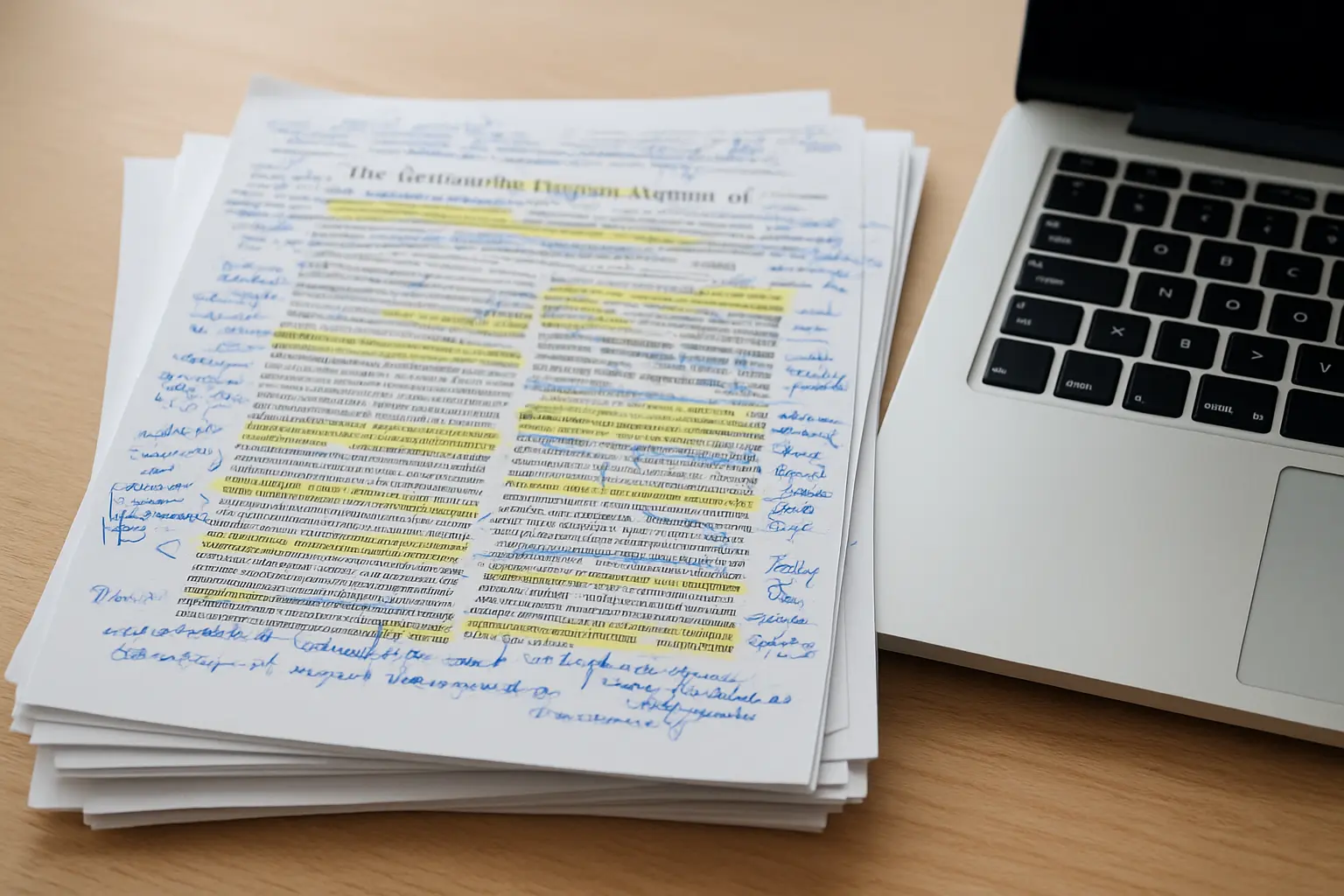
    Annotated journal articles beside a laptop during literature review drafting
    The annotated pile is the evidence that the reading happened — and the thing no tool can produce for you.

    A workflow that survives scrutiny

    1. Search and screen yourself. Use your library databases. Record your search terms and databases as you go — you will need them if your project turns out to require a structured review, and it takes two minutes now versus an afternoon of reconstruction later.
    2. Read and summarise each paper in your own words. Four or five lines each: what they did, what they found, what the limitation is, why it matters to you. This is the step people try to skip, and it is the step the entire chapter is built from.
    3. Group your own summaries into themes. Lay them out and look for disagreements, not topics. The strongest reviews are organised around unresolved questions.
    4. Now use AI on your own material. With your summaries in front of you, ask for a structural critique: is this ordering logical, does each theme lead into the next, where does the argument jump. This is where assistance genuinely helps, because it operates on content you produced.
    5. Write the prose yourself, then edit with help. Draft each paragraph, then use a tool to tighten what you wrote. Editing your sentences is a very different act from generating them.
    6. Verify everything. Every reference opened, every claim traceable to a paper you have read, every quotation checked against the original.

    This produces a better chapter than the shortcut would, for a reason worth noticing: the thematic structure comes from your reading, so it reflects what the literature actually contains rather than what a model predicts a review on your topic usually looks like.

    Where the time actually goes

    Students imagine AI saves them the writing. In practice it saves you the staring — the hour lost to an empty page, the paragraph rewritten six times before you work out what it was supposed to say. That is real time, and reclaiming it is legitimate.

    What it does not save is the reading. There is no version of a literature review where you do not read the literature. Any workflow promising otherwise is describing a chapter that will not survive a supervision meeting, let alone a viva-style discussion of your work.

    Declaring your use

    Where your institution requires a declaration, write it specifically. “AI was used” tells an examiner nothing and invites suspicion. Something like this tells them exactly what happened:

    Generative AI was used to review the structure of drafted chapters and to suggest improvements to sentence-level clarity in text written by the author. It was not used to identify sources, to summarise literature, or to generate content. All sources cited were located through library database searches and read in full by the author.

    A precise declaration is a strength. It demonstrates you understood the boundary rather than hoping nobody would ask.

    How this fits the rest of the chapter

    None of this changes what a literature review has to be. It still has to end by earning your research question, and it still has to be organised by argument rather than by paper. If you are not yet sure which kind of review your department expects — a narrative review inside an empirical dissertation, or a structured review as the dissertation itself — settle that first using our guide to literature reviews versus systematic reviews, because the answer changes how much of the process you need to document.

    If you are earlier than that and still fixing your question, our dissertation topic ideas by subject includes the four feasibility tests worth running before you commit. And if the review is heading towards secondary analysis, the sources an undergraduate can actually access are listed in our guide to UK data sources by subject.

    What Tesify does differently

    Tesify is built around the division of labour described above. It works from your material — your sources, your notes, your findings — and helps you produce structure and momentum rather than substituting for your reading and your judgement. The argument, the evidence and the conclusions stay 100% written by you, which is the only version that survives a conversation with your supervisor.

    More than 9,000 students have used it to get a stalled chapter moving. It is not a way to avoid writing a dissertation; it is a way to stop losing days to the blank page.

    Start your literature review in Tesify.

    Frequently asked questions

    Is using AI to write my dissertation cheating?

    It depends on your institution’s policy and on what you use it for. Using a tool to edit prose you wrote is treated very differently from submitting generated text as your own work. Read your academic integrity policy, follow any declaration requirement, and never submit writing you could not explain and defend.

    Can Turnitin detect AI-written text?

    Detection tools exist and are used by some UK institutions, but their reliability is contested and false positives are a documented concern. This is the wrong question to organise your behaviour around. The durable protection is being able to explain your own argument, produce your reading notes, and show the sources you cited — which no detection outcome can undermine.

    What if I am wrongly accused of using AI?

    Keep your working. Drafts with version history, dated notes, annotated PDFs and your search records collectively demonstrate a genuine process. Students who keep their materials are in a strong position; students who cannot show any working are not, regardless of what they actually did.

    Can I use AI to summarise papers I do not have time to read?

    No. This is the specific practice that produces misreported findings and citations of work you have not read. If time is short, narrow your scope and read fewer papers properly — a review of fifteen well-understood studies beats a review of forty misunderstood ones.

    Is it acceptable to use AI to improve my English if I am an international student?

    Language support is among the most widely accepted uses, and many institutions treat it similarly to proofreading. Check whether yours requires a declaration, and keep the edits at the level of expression rather than letting a tool restate your argument for you.

    Will my supervisor be able to tell?

    Supervisors who have read your previous work notice shifts in voice, and they notice when a chapter cannot be discussed in a meeting. The reliable signal is not stylistic — it is whether you can answer questions about your own reasoning. That is also exactly what the process described here protects.

    What about the data privacy of my unpublished work?

    Ask this of any tool before uploading a chapter. Your dissertation is unpublished research, and you should know where it is stored, who can access it, and whether it may be used for training, by reading the provider’s current documentation rather than a third-party summary.