Tag: academic writing

  • Your Paragraphs Describe, They Do Not Argue: How to Rebuild Them (2026)

    Your Paragraphs Describe, They Do Not Argue: How to Rebuild Them (2026)

    Your chapter is the right length, every claim has a citation, and the feedback still says “descriptive”. The problem is almost never your research. It is that your paragraphs stop one sentence too early — at the evidence, instead of at what the evidence means. That missing sentence is where the marks are, and this is how to put it back.

    Start rebuilding your chapters in Tesify — free tier, your words, structure held in one place.

    What it costs to leave the paragraphs as they are

    This is not a stylistic preference. On the published undergraduate marking criteria at named UK universities, the word that appears in the 2:2 band again and again is descriptive, and the word in the band above it is critical. Nothing else separates them as consistently — we set out the actual band descriptors in how much of your dissertation mark is for writing, and the short version is that on some rubrics the prose requirement is literally identical for a 2:1 and a first, while the analysis requirement is not.

    Hull says where the marks sit, in a sentence that ought to be printed on every dissertation handbook. The interpretation step is “where you answer the question ‘So what?’”, and “These are the parts of your paragraphs that will get you the higher marks in any marking scheme.”

    So a chapter of well-referenced, well-spelled, entirely descriptive paragraphs is a chapter that has done the hard research work and then declined to collect on it.

    The four moves, and the one everybody skips

    Most UK universities teach the same shape under different initials. Oxford Brookes is relaxed about which you use: “There are a number of acronyms for remembering this, such as WEED, PEEL, SEE and TEEL. They all basically convey the same principle.”

    1. Point. The claim this paragraph exists to make. Newcastle: this is “usually the first (in some cases the second) sentence of the paragraph, commonly known as the topic sentence.” Sheffield adds what it should contain — a topic, “the general area under discussion”, plus a controlling idea, “the aspect or perspective on that topic that the paragraph will consider”.
    2. Evidence. The data, the citation, the quotation. This is the part you already do.
    3. Interpretation. Why the evidence supports the point, and what it means for your argument. Sunderland: “In order for your writing to be persuasive you will need to EXPLAIN to your reader how the evidence supports the point. This will involve analysing and evaluating the evidence.” This is the missing sentence.
    4. Link. The connection onward — optional, and contested (see below).

    Note that UK universities do not even agree what the letters stand for. Staffordshire teaches “PEEL stands for Point, Evidence, Explanation, Link. When writing a paragraph ask yourself, does it PEEL?” Newcastle teaches the same acronym as “Point, Evidence, Evaluation, Link”. That is not pedantry — explanation and evaluation are different jobs. Explaining says what the evidence shows; evaluating says how much weight it can bear. A strong paragraph does both, which is why the acronym you were taught is less important than knowing there are two moves hiding in that third letter.

    Newcastle is also honest about the model’s limits: PEEL “is a good starting point, but you may find it too rigid and restrictive for what you need to do, or too clumsy and repetitive in constantly linking back or forward.” Treat it as a diagnostic, not a template.
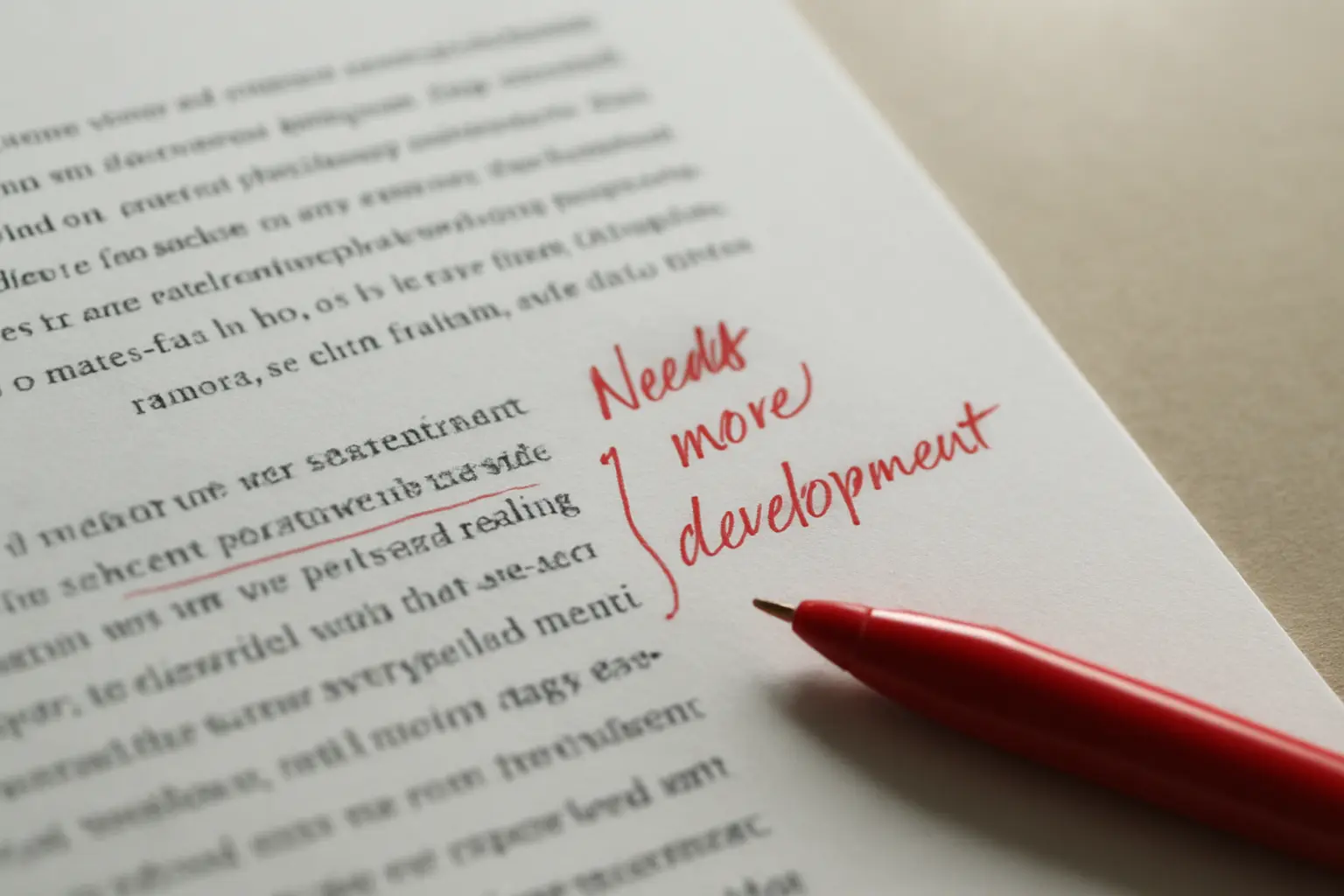
    A draft paragraph that ends on a quotation with no interpretation following it
    The commonest structural fault in an undergraduate chapter: the paragraph ends on the evidence.

    The published test for whether a paragraph describes or argues

    Hull publishes a comparison, adapted from Stella Cottrell, that turns this into something you can actually apply line by line:

    Descriptive writing does this Critical writing does this
    States what happened Identifies the significance of what happened
    Notes the method used Identifies whether a method was suitable or appropriate
    Gives evidence Argues a case according to the evidence
    Gives information Draws conclusions

    Leeds states the same rule as an instruction: “To write critically you will need to not only describe what happened, but also identify the significance of what happened.” And on method specifically: “Rather than simply noting the method used, which is the descriptive approach, a critical writer will show how appropriate that method was.”

    Run a paragraph against the left column. If every sentence lands there, you have found a descriptive paragraph, and you now know exactly which sentence is missing.

    Where paragraphs differ by chapter

    The four-move shape is not uniform across a dissertation, and applying it everywhere is its own mistake.

    Southampton draws the sharpest line: “The results chapter should provide a direct and factual account of the data collected without any interpretation or interrogation of the findings”, whereas “the discussion is rooted in analysis and interpretation, allowing you and your reader to delve beneath the surface.”

    So in a results chapter the interpretation move is deliberately withheld — it is not that your paragraphs should argue there, it is that they should not. The conventions for that chapter are different enough to need their own treatment, which we give in the results chapter guide. In a qualitative findings chapter the balance shifts again, and the ordering matters: our guide to thematic analysis covers how interpretation and quotation sit relative to one another there. And where you are writing up a technical decision, the paragraph has a fixed anatomy of its own — see the worked example in what to do when your statistical assumptions fail.

    The transferable rule is simply: know which job the current chapter gives your paragraphs, and do that job consistently.

    How long should a paragraph be? Nobody agrees

    Students lose hours to this, so it is worth stating plainly that the UK guidance does not converge.

    • The Royal Literary Fund gives a range of “150 – 250” — its published page omits the word “words” — or “between a third and two thirds of a double-spaced A4 page”, warning that a longer paragraph “gets harder and harder to follow” and a shorter one “looks scrappy”.
    • Hull gives “between 200 and 300 words long (they vary more than this but it is a useful guide)”.
    • Warwick counts sentences instead: “between 4 and 7 sentences long”, taking “about 2/5 of the page”, and splits at half a page.
    • Leeds, Staffordshire, Oxford Brookes and Newcastle all decline to give a number. Leeds: “There is no perfect length for a paragraph because this will vary between disciplines and types of assessments.” Newcastle notes that arts, humanities and social sciences “tend to use longer paragraphs than in the sciences”.

    Even the floor is contested — “too short” starts at one sentence for Warwick, one or two for Oxford Brookes, and fewer than three or four for Leeds. The useful conclusion is not a number. It is that a paragraph should be exactly as long as one point plus its evidence plus its interpretation, and if it is running past two thirds of a page you are probably making two points.
    A chapter checked by reading only the first sentence of every paragraph in sequence
    The five-minute audit: read only the first sentence of every paragraph, in order.

    The five-minute audit you can run tonight

    1. Read only the first sentence of every paragraph, in order. Newcastle sets the standard: “You should be able to get the overall gist and structure of an academic text by just reading the first line of each paragraph.” If what you hear is a list of facts rather than a developing argument, your topic sentences are doing the wrong job — Newcastle again: “If the first line of your paragraph is just a descriptive fact or quote from someone else, then they aren’t going to get a sense of your argument.”
    2. Write those first sentences out as a list. Hull recommends exactly this: “writing down a list of your topic sentences is an excellent way to check that your argument flows well from one point to the next.” Leeds suggests highlighting first and last sentences and asking “whether they represent a fair overview of the points that you want to make.”
    3. Find every paragraph that ends on a quotation or a number. Each one is missing its final sentence.
    4. Check your connectors mean what they say. Oxford Brookes: “A favourite linking word is ‘however’ which signals a contrast or contradiction, but if your next sentence doesn’t contain a contrast it will confuse your reader.” Where to source these honestly is covered in where to get your signposting phrases.
    5. Delete openings that look backwards. Leeds: “Generally, you should not start a paragraph by reiterating what you have just talked about. Your first sentence of a paragraph should alert the reader to a change of focus.”

    Doing this without rewriting the whole chapter twice

    The audit above finds the problem in an evening. Fixing it across 10,000 words is the part that defeats people, because every added interpretive sentence changes the paragraph’s length, its connection to the next one, and sometimes the order of the section.

    Rebuild your chapters in Tesify, concretely:

    1. Put your research questions beside the chapter, so every topic sentence can be checked against the question it is supposed to answer.
    2. Draft paragraph by paragraph in one workspace rather than across four documents, so you can see the sequence of points rather than only the paragraph in front of you.
    3. Add the interpretive sentence while the evidence is still on screen — that is the whole intervention, and it is far easier in place than in a later pass.
    4. Let the bibliography reformat itself while you spend your remaining time on the analysis rather than on punctuation in a reference list.

    The words stay 100% yours. That matters here more than anywhere: the interpretive sentence is precisely the sentence a marker is assessing you on, and it is the one you must write. Tesify holds the structure and absorbs the clerical layer so you have the hours to write it. There is a free tier — test the audit on one chapter before you pay for anything.

    Frequently asked questions

    What is the correct structure for a dissertation paragraph?

    One point, evidenced, interpreted, and connected onward. Most UK universities teach it as an acronym — Staffordshire uses PEEL for Point, Evidence, Explanation, Link — and Oxford Brookes notes that “There are a number of acronyms for remembering this, such as WEED, PEEL, SEE and TEEL. They all basically convey the same principle.”

    Which part of the paragraph earns the marks?

    The interpretation. Hull is explicit about it: the explanation step is “where you answer the question ‘So what?’”, and “These are the parts of your paragraphs that will get you the higher marks in any marking scheme.”

    Does the second E in PEEL mean Explanation or Evaluation?

    UK universities disagree. Staffordshire and Sunderland teach it as Explanation; Newcastle teaches the same acronym as Point, Evidence, Evaluation, Link. In practice you need both moves — say what the evidence shows, then judge how much weight it carries.

    How long should an academic paragraph be?

    There is no agreed figure. The Royal Literary Fund gives “150 – 250”, Hull gives “between 200 and 300 words”, and Warwick counts sentences instead: “between 4 and 7 sentences long”. Leeds, Staffordshire, Oxford Brookes and Newcastle all decline to give a number at all.

    Can a paragraph be one sentence?

    Not in academic writing, on the strictest published view. Warwick states it flatly: “One sentence is not a paragraph in academic writing. It is possible to find one sentence paragraphs in magazine articles and novels but good academic style does not have one sentence paragraphs.”

    How do I know if my paragraphs are only describing?

    Use the published test. Hull’s comparison sets “States what happened” against “Identifies the significance of what happened”, and “Gives evidence” against “Argues a case according to the evidence”. If every sentence in a paragraph falls in the left column, the paragraph describes.

    Is the topic sentence really always first?

    Usually, with one common exception. Newcastle puts it as “usually the first (in some cases the second) sentence of the paragraph”. The second-sentence version happens when the first sentence carries a short transition from the previous paragraph.

    What is the fastest way to check a whole chapter?

    Read only the first sentence of each paragraph in order. Newcastle sets the standard the test measures against: “You should be able to get the overall gist and structure of an academic text by just reading the first line of each paragraph.” Leeds suggests highlighting first and last sentences and checking they fairly summarise your points.

    Is a link to the next paragraph compulsory?

    UK guidance splits on this. Staffordshire treats the Link as a required element of PEEL, Hull calls links “optional but it will help your argument flow if you include them”, and Newcastle warns that constant linking can become “too clumsy and repetitive”. Use one when the connection is real.

    Why do my quotations weaken my paragraphs?

    Because a quotation is evidence, not argument, and a paragraph that ends on one has stopped before its most valuable sentence. Follow every quotation with your own reading of why it matters — that interpretive sentence is the one carrying the marks.

    Is it academic misconduct to use an AI tool while writing paragraphs?

    It depends entirely on what the tool does and what your university permits. A tool that rewrites your sentences for you is treated as misconduct at several UK universities. A drafting workspace where you write the words yourself is a different thing — but read your own regulations, because they vary, and disclose where your institution asks you to.

    Is Tesify free, and what happens to my unpublished work?

    There is a free tier you can test on a single chapter before paying anything. On confidentiality, the sensible standard for any tool is to check what its terms say about retention and training before you paste in unpublished data or participant material, and to anonymise transcripts first.

  • Where Should You Get Your Signposting Phrases? Five Sources Compared (2026)

    Where Should You Get Your Signposting Phrases? Five Sources Compared (2026)

    Your paragraphs do not connect, and you have gone looking for the words that will connect them. There are five places UK students get signposting language from, and they are not equally safe — one of them is a named academic-misconduct risk at several universities. Here they are compared, with a verdict.

    The comparison

    Source Cost What it actually gives you Where it falls short Safe?
    Academic Phrasebank (University of Manchester) Free on the web; paid PDF and Kindle editions Categorised model phrases by rhetorical function, with an explicit statement that reuse is not plagiarism Harvested from postgraduate dissertations, so some phrasing is grander than an undergraduate document needs Yes, with adaptation
    Your own university’s signposting guidance Free A categorised list plus, usually, a warning about overuse in the same document Shorter than the Phrasebank; quality varies a great deal between institutions Yes
    Generic linking-word lists (open web) Free A long undifferentiated list of words No categorisation by function, no guidance on when not to use one; encourages sprinkling Yes, but low value
    AI paraphrasing and rewriting tools Free tiers and paid plans Rewritten sentences, sometimes with connectors inserted Named as academic misconduct in several UK regulations; alters your meaning without telling you Check your regulations first
    Published articles in your own field Free via your library The conventions your markers actually read, at the right level and in the right discipline Slow, and you have to notice the moves rather than just read past them Yes

    The verdict, stated plainly

    Use the Academic Phrasebank as your default, cross-checked against your own university’s guidance, and read three articles in your field to calibrate. Do not use a paraphrasing tool to generate connective tissue — the risk is real and asymmetric, and it does not solve the problem you actually have.

    The rest of this page explains why, and why the fix for disconnected paragraphs is usually not a word at all.

    1. The Academic Phrasebank — the default, and it licenses its own reuse

    The Academic Phrasebank is the most widely recommended academic phrase resource in UK higher education, and its signposting page is the single most useful thing on it. It opens with the best available description of what signposting is for:

    “Previewing what is to follow in a paper or dissertation is like showing a map to a driver; it enables them to see where they are going. So it is useful to think of a preview section as a ‘road map’ for the reader. It must be accurate, but it must be easy to follow.”

    The phrases are grouped by the job they do rather than dumped in a list. Reintroducing a topic: “As discussed above, …”, “As previously stated, …”, “As was mentioned in the previous chapter, …”. Moving between sections: “Turning now to …”, “Having defined what is meant by X, I will now move on to discuss …”, “So far this paper has focused on X. The following section will discuss …”. Summarising a section before you leave it: “The previous section has shown that …”, “Thus far, the thesis has argued that …”.

    Crucially, it settles the plagiarism question about itself. The Phrasebank states that its items “are mostly content neutral and generic in nature; in using them, therefore, you are not stealing other people’s ideas and this does not constitute plagiarism.” It attaches one condition, and it matters: “In most cases, a certain amount of creativity and adaptation will be necessary when a phrase is used.”

    It also publishes the boundary, drawn from a survey of 45 academics at two British universities. A phrase you can safely reuse “should not have a unique or original construction; should not express a clear point of view of another writer; may be up to nine words in length; beyond this ‘acceptability’ declines”. That nine-word ceiling is the most concrete guidance on borrowed phrasing published anywhere in UK higher education.

    One caveat for undergraduates. The corpus the phrases came from “consisted of 100 postgraduate dissertations completed at the University of Manchester”. The material transfers, but it was harvested a level above you, and a few formulations will sound inflated in a 10,000-word undergraduate dissertation. Adapt down.

    2. Your own university’s guidance — and the warning it prints next to the list

    Most UK universities publish a signposting page, and the good ones do something the open-web lists never do: they categorise by function, and then they tell you to stop.

    Newcastle University publishes the most complete taxonomy encountered — two families, signposting of order (listing, referring forward, referring backward, transitioning) and signposting of relations (addition, similarity, illustration, contrast, cause and effect, summary, reformulation, emphasis) — each with a gloss on what the category is for. Its framing is the clearest statement of why this matters: “These words may not seem important, but they’re really the glue that holds a piece of writing together. Without signposting language, writing can lose direction, become confused and read like a series of unrelated points.” And then the instruction that the category structure exists to serve: “There are different kinds of links and relationships, so you need to choose a signposting word that does the right job.”

    York divides the same territory by scale, into “major signposting” and “linking words and phrases”. Portsmouth separates connectives from transition signals: “Connectives link sentences, phrases and ideas, in order to take your reader through what you are saying. Transition terms are a type of connective, but they are used more specifically for indicating some kind of change or development.” Hull states the purpose: “By making explicit how points are connected to each other you make it easier for your reader to follow your arguments.”

    A draft page where linking words have been dropped onto the front of every paragraph
    The failure mode the lists themselves warn about: a connector at the front of every paragraph, doing no work.

    3. Why the lists come with their own warning attached

    Here is the structural point that most advice on this topic misses. The same institutions that publish the big connector lists publish, in the same document, the warning not to work through them mechanically.

    Hull runs a long categorised list and then closes it: “Don’t overdo it. Only use signposts when they add clarity to your work. Some students try to put a signposting word into every sentence which can actually obscure meaning.” It gives the test that actually works: “Only use a word like ‘consequently’ if you really mean that the following sentence is a true consequence of the previous one!”

    Newcastle, having published the most exhaustive taxonomy of the lot, ends with: “Use deliberately — You don’t need to use a signposting word in every sentence, so before you do ask yourself if it helps make the meaning clearer, or just bogs down the writing.”

    Portsmouth is blunter about the motive: “You should not try too hard to make your writing look more academic by using words and phrases purely to appear more academic.” Bradford College reduces it to a line: too many signposts and linking words “can be almost as bad as having none.”

    The underlying distinction, from a UK EAP teaching resource, is the one worth carrying: “a text is cohesive if its elements are linked together, and coherent if it makes sense. These are not necessarily the same thing. That is, a text may be cohesive (i.e. linked together), but incoherent (i.e. meaningless).” And the consequence: “a text which is poorly organised is not going to be made more coherent simply by ‘peppering it’ with discourse markers.”

    That is why a source that only emits connectors — which is exactly what a generic list and a rewriting tool both do — cannot fix the problem. It supplies cohesion where you needed coherence.

    There is one measured pattern worth knowing about yourself. Loughborough University London summarises published research by Granger and Tyson, Lei, and Appel and Szeib finding that second-language writers tend to overuse connectors while first-language writers tend to underuse them. If you are writing in your second language, the sprinkling failure is statistically the one to watch for; if English is your first language, you may need more signposting than instinct suggests, not less.

    4. AI paraphrasing tools — where the real risk sits, and where UK policy splits

    Students reach for a rewriting tool when a paragraph will not flow, and this is the one option on the table that can cost you a degree rather than a mark.

    Several UK universities name it directly. Sheffield Hallam: “It is also an act of plagiarism to use paraphrasing software to reword the work of others without clear attribution of the original source.” Swansea: “If a student submits a software-generated paraphrase as part of their work, they are claiming that they were the author of that paraphrase. This is considered Academic Misconduct.” Loughborough’s Regulation XVIII lists paraphrasing and translation software alongside generative AI as a misconduct category. Nottingham comes closest to naming the specific move students make — rewording text specifically so it stops matching in similarity software — and names products, QuillBot and Wordtune among them.

    But UK universities are not uniform on this, and pretending otherwise would be false. Warwick’s library publishes a page about QuillBot that carries no prohibition at all, describing it neutrally as helping with paraphrasing text. Two UK universities, one product, opposite postures. Your own institution’s regulations are the only ones that govern you — read them before you open the tool, not after.

    If you are unsure where the line sits generally, our guides to what happens if you are accused of academic misconduct and to the AI tools a UK dissertation writer can actually use cover the wider question.

    A passage pasted into an online rewriting tool, the route that turns a phrasing problem into a misconduct one
    The rewriting tool is the one option here that converts a writing problem into a conduct problem.

    5. Published articles in your field — the slow option that calibrates the other four

    Open three articles from the journals your literature review cites most and read only the first sentence of each section and each paragraph. You are looking for what those writers do at the joints, and you will find that the moves are narrower and plainer than any list implies.

    This is also the only source that tells you what your discipline expects, which no general resource can. It settles related register questions at the same time — whether your field writes in the first person, for instance, which we cover in can you use “I” in a UK dissertation.

    Two places where this advice does not apply

    Everything above concerns your chapters. Two sections run on different rules.

    • The abstract. Signposting comes out. An abstract that says the first chapter reviews the literature and the second sets out the methodology describes the document rather than the research, and the contents page already does that job — see how to write a dissertation abstract.
    • The results chapter. Its conventions are about reporting numbers, not about connecting arguments, and the Phrasebank has a separate set of moves for it; our results chapter guide works through those.

    Where Tesify fits

    The honest position: no tool supplies coherence, because coherence is a property of your argument rather than of your vocabulary. What a tool can do is stop you losing the thread across 10,000 words written over four months.

    Write your dissertation in Tesify: hold the whole structure in one workspace so you can see whether section two actually follows from section one, draft the transitions in place rather than bolting them on at the end, and keep the bibliography formatting itself. It is a drafting workspace, not a rewriter — the words stay 100% yours, which is precisely the distinction the regulations quoted above turn on. There is a free tier.

    Frequently asked questions

    Where should I get signposting phrases from?

    The University of Manchester’s Academic Phrasebank first, then your own university’s signposting guidance. The Phrasebank gives categorised model phrases and states plainly that using them “does not constitute plagiarism”, because the items are “mostly content neutral and generic in nature”.

    Is using phrases from the Academic Phrasebank plagiarism?

    No, and it says so itself: the items “are mostly content neutral and generic in nature; in using them, therefore, you are not stealing other people’s ideas and this does not constitute plagiarism.” It does add a condition — “In most cases, a certain amount of creativity and adaptation will be necessary when a phrase is used.”

    How long a borrowed phrase is acceptable?

    The Phrasebank’s own guidance, drawn from a survey of 45 academics at two British universities, sets the ceiling at about nine words: a reusable phrase “may be up to nine words in length; beyond this ‘acceptability’ declines”. It should also “not have a unique or original construction” and “not express a clear point of view of another writer”.

    Was the Academic Phrasebank built from undergraduate writing?

    No, and it is worth knowing. The corpus the phrases were taken from “consisted of 100 postgraduate dissertations completed at the University of Manchester”. The phrases transfer well to undergraduate work, but they were harvested at a level above yours, so some will sound grander than your document needs.

    Can I use QuillBot or a paraphrasing tool for connectors?

    This is genuinely risky and UK universities disagree about it. Sheffield Hallam states that “It is also an act of plagiarism to use paraphrasing software to reword the work of others without clear attribution of the original source.” Warwick’s library, by contrast, describes QuillBot neutrally with no prohibition attached. Check your own regulations before you touch one.

    Why does my writing sound worse after I add linking words?

    Because cohesion and coherence are different things. As one UK EAP teaching resource puts it, “a text is cohesive if its elements are linked together, and coherent if it makes sense. These are not necessarily the same thing.” Connectors create cohesion; only a real logical sequence creates coherence.

    How many signposting words should a paragraph have?

    Fewer than you think. Hull warns that “Some students try to put a signposting word into every sentence which can actually obscure meaning.” Newcastle asks you to “ask yourself if it helps make the meaning clearer, or just bogs down the writing.” Bradford College puts it most sharply: too many “can be almost as bad as having none.”

    Do second-language writers use more connectors than native speakers?

    The published research suggests so. Loughborough University London summarises work by Granger and Tyson, Lei, and Appel and Szeib finding that second-language writers tend to overuse connectors while first-language writers tend to underuse them. If English is your second language, the overuse pattern is the one to watch for.

    What is the difference between signposting and linking words?

    Scale. York divides them into “major signposting” and “linking words and phrases” — the first orients the reader to whole sections, the second joins sentences. Newcastle splits the same territory into signposting of order and signposting of relations.

    Should my abstract contain signposting?

    No — the abstract is the one place where it should come out. An abstract that lists what each chapter does describes the document rather than the research, and a contents page already does that job. Everything on this page applies to the chapters, not to the abstract.

    Is it enough to just vary my connectors?

    No. Swapping “however” for “nevertheless” changes nothing if the logical relationship is wrong in the first place. Hull gives the real test: “Only use a word like ‘consequently’ if you really mean that the following sentence is a true consequence of the previous one!”

    What should I do if a paragraph will not connect to the next one?

    Treat it as a structural signal rather than a vocabulary problem. If no connector honestly fits between two paragraphs, they are usually in the wrong order, or a third paragraph is missing between them. Reaching for a stronger linking word hides the gap instead of closing it.

  • How Much of Your Dissertation Mark Is for Writing? The Published UK Criteria (2026)

    How Much of Your Dissertation Mark Is for Writing? The Published UK Criteria (2026)

    No UK university publishes a national standard for how much of a dissertation mark is awarded for writing, and at least three publish undergraduate criteria that contain no writing category at all. That is the finding. Below are the actual published band descriptors from named UK universities, what they reward, and the one thing they agree on — which is not grammar.

    What the published criteria actually say, band by band

    Every document in this table was opened and its undergraduate scope confirmed from the document itself. The wording is quoted as published.

    Institution and document First 2:1 2:2
    Royal Holloway, Criminology and Sociology dissertation handbook “have an incisive and fluent style, with no significant errors of spelling, punctuation or grammar” “have a fluent style, with few errors of spelling, punctuation or grammar” “have a straightforward style, and may include some errors of spelling, punctuation or grammar”
    University of Edinburgh, School of Social and Political Science “the discussion should move beyond a mainly descriptive account of the results, to develop its own comments, points and interpretations” “Referencing and the quality of the writing should be without major blemish” “The data will be presented accurately, if rather descriptively… The quality of writing, referencing and presentation should be acceptable”
    UCL, Institute of Archaeology “style and word choice show fluency with ideas & flashes of verve” “style & word choice rarely detract from conveying of ideas” “style and word choice sometimes detract from conveying of ideas”
    Newcastle University, English Literature, Language and Linguistics “Style and expression are of a high academic standard, polished and fluent, with a strong command of discipline-specific vocabulary” “May present some problems of style and expression, but these do not interfere with the communication of the argument” “may present problems of style and expression that affect the communication of the argument”
    University of Nottingham, School of Sociology and Social Policy “Source material is treated critically… The argument is well structured and clear, with no significant confusion” “critical appraisal is underdeveloped. Analysis lacks depth”

    The pattern: the band boundary is criticality, not correctness

    Read down those columns and one thing is consistent. The prose descriptors move in small increments — fluent, then fluent with few errors, then straightforward. The analytical descriptors move in jumps.

    Keele makes this unmissable. In its generic undergraduate assessment criteria, the writing clause is word-for-word identical in the first-class and upper-second bands: “Clearly structured, robust and persuasive arguments, lucidly written, uses clear and accurate expression”. The same sentence appears in both. Only the critical-analysis clause differs. On that rubric, prose quality cannot move you from a 2:1 to a first, because the rubric asks the same of both.

    Nottingham states the same logic explicitly, and it is the single most useful sentence in any of these documents: “It may be helpful to see the lower second class as the starting point… Achieving a higher result requires something extra — and this will usually be found in the quality of analysis and criticism, in the presentation of a sustained and coherent argument…”

    The word markers reach for when that something extra is missing is descriptive. It appears in band after band. Edinburgh’s 2:2: data “presented accurately, if rather descriptively”. Edinburgh’s fail band: “failure to analyse or discuss the implications of the data in anything more than a thin and descriptive way”. Newcastle’s 2:2: “more descriptive than analytical”. Nottingham’s third: “Source material is treated uncritically, and analysis is flawed or non-existent.” Nottingham’s geography criteria describe a 2:2 dissertation as “pedestrian or lacking in imagination and critical insight… Satisfactory, but not stylish or perceptive.”

    A returned dissertation chapter carrying a marker's handwritten comment beside a descriptive passage
    The commonest single word in the 2:2 band descriptors examined is “descriptive”.

    The weightings, where any exist at all

    Almost no UK undergraduate dissertation rubric publishes a percentage for writing. Two that do something close:

    Institution and document What is published Effective weight for presentation
    University of Manchester, Department of Mathematics, Undergraduate Project Guide 2019/20 “there is a total of 90 marks for the dissertation. Half of these marks are allocated to communication of ideas (introduction, 10 marks; presentation, 15 marks and accuracy of argument, 20 marks) and half the marks awarded for comprehension (choice of content, 25 marks and understanding of material, 20 marks). The last 10 marks are for the oral presentation.” 15 of 90 marks
    University of Cambridge, Computer Science and Technology, Part II project assessment “Introduction and preparation (30 marks) / Implementation and contribution (45 marks) / Evaluation and conclusions (25 marks)” — with the rider that candidates “who fail to adhere to the prescribed structure… will not receive high marks for presentation.” No allocation; enforced by penalty

    Note what the Manchester breakdown really shows: half the available marks sit under the heading communication of ideas, of which presentation is one component alongside the introduction and the accuracy of the argument. Read carelessly, that looks like half the degree is for writing. Read properly, it means the department treats structuring and expressing an argument as inseparable from having one.

    The three that decline to mark writing at all

    This is where the sector genuinely splits, and it is not a matter of emphasis.

    SOAS excludes it by policy. Its marking criteria policy states that “The minimum core criteria intentionally do not include standards concerning the presentational aspects of the work, such as spelling and punctuation in written assignments… Such additional criteria are not standard to all modules”. That is a deliberate institutional decision, not an omission.

    Bristol’s level 6 criteria — level 6 being third-year undergraduate — contain no category for spelling, grammar, style, referencing or presentation. The only writing-adjacent row reads “High-level academic skills consistently applied” at 70 to 79 against “Academic skills consistently applied” at 50 to 59.

    Brunel’s undergraduate grade descriptors likewise carry no referencing, spelling or presentation bullet. Writing appears only as “an excellent ability to communicate clearly and concisely” at A against “an ability to communicate clearly and concisely” at B.

    Against those, UCL’s Institute of Archaeology scores three separate presentation dimensions — writing, visuals and referencing. Two published UK undergraduate rubrics, opposite decisions about whether presentation is assessable at all.

    Why there is no national figure, in the sector’s own words

    The absence is documented rather than merely observed. Three institutions state it directly.

    • Durham, on its Common Awards provision: the assessment guidance pages “do not provide distinct assessment guidelines or marking criteria for dissertations, pointing people instead to the generic guidance for ‘Essays and other written assignments’”, and institutions “are free… to design their own procedures for marking dissertations.”
    • Manchester, in its university marking scheme: “Faculties and Schools will publish more detailed marking criteria.”
    • Cambridge, in its project assessment guidance: “These marking guidelines are not a detailed mark scheme. Part II projects are different for every student, and so marking necessarily relies upon the informed judgement of the Examiners.”

    Edinburgh adds the warning that matters most to you as a student: “Not all assignments use these criteria… some assignments will instead use different, bespoke criteria developed by the Course Organiser.” The university-level document you find first may not be the one your dissertation is marked against.

    The divergence runs inside single institutions as well as between them. Nottingham’s own quality manual prints several incompatible schemes side by side as examples. Royal Holloway runs two unrelated undergraduate dissertation schemes in different departments. Edinburgh’s social and political science school uses a three-criterion rubric for undergraduate coursework and a different scheme for the undergraduate dissertation.

    Two universities' dissertation criteria side by side, weighting written communication differently
    Two published UK undergraduate rubrics can disagree about whether presentation is assessable at all.

    Even the scales do not match

    Among the documents examined, the marking instruments themselves differ in kind: continuous zero to 100 marking; categorical marking where only a few marks are available within each band; a 16-point letter scale; a 24-point scale; and letter grades with no percentages printed at all. Referencing expectations differ too — the rubrics examined variously mark against Harvard, against APA, against departmental guidelines, and against the standards set out in a specific handbook.

    The practical consequence: comparing your marking criteria with a friend’s at another university tells you almost nothing, and a mark of 68 does not mean the same thing in two places. Our guide to degree classification statistics covers what happens to those marks once they reach an exam board, and who marks your dissertation and how it is moderated covers who applies the criteria.

    What to do with this

    1. Get the criteria for your specific module, not the university-level scheme. Edinburgh’s warning above is the reason.
    2. Find the word that changes between the 2:1 and the first band. On most of these rubrics it is a word about analysis, not about prose. That tells you where the marks are.
    3. Take “descriptive” seriously as a diagnosis. If your chapter reports what was found and stops, it is sitting in the 2:2 band descriptor on four of the five rubrics above, however clean the sentences are.
    4. Do not conclude that writing does not matter because your rubric omits it. Criticality is realised in sentences — an interpretation that is not written down is not marked.

    Two sentence-level decisions that markers do notice, and that no rubric explains, are covered separately: whether you can use “I” and what tense each chapter takes. And on the question of how much reading your bibliography should show, our guide to how many references a dissertation should have works from the same kind of published criteria.

    Writing so the analysis is visible

    The gap these rubrics describe is not a vocabulary gap. It is the difference between a chapter that reports and a chapter that argues — and it is fixed at the point where you write the sentence after the evidence, not at the proofreading stage.

    Draft your dissertation in Tesify: keep your research questions beside the chapter so every section can be checked against what it is supposed to answer, and keep the bibliography formatting itself so the clerical marks look after themselves. The analysis stays 100% yours — that is the part no rubric will give you credit for outsourcing. There is a free tier.

    Frequently asked questions

    How many marks does writing quality carry in a UK dissertation?

    There is no sector-wide figure, and almost no UK department publishes one. The clearest published weighting found is the University of Manchester’s undergraduate mathematics project guide, which allocates 15 of 90 marks to presentation. Most rubrics assign no percentage to writing at all — they fold it into holistic band descriptors.

    Do all UK universities mark writing quality?

    No, and this is the sharpest disagreement in the data. SOAS excludes it by policy: its minimum core criteria “intentionally do not include standards concerning the presentational aspects of the work, such as spelling and punctuation in written assignments”. Bristol’s and Brunel’s undergraduate criteria contain no spelling, grammar, referencing or presentation category either.

    What actually separates a first from a 2:1?

    Across the rubrics examined it is criticality rather than prose. Keele is the clearest case: its writing clause is word-for-word identical in the first-class and upper-second bands — “Clearly structured, robust and persuasive arguments, lucidly written, uses clear and accurate expression”. Only the critical-analysis clause changes between the two.

    What does “descriptive” mean when a marker writes it?

    It means your sentences report what was found or said without stating what it means. Edinburgh’s social and political science criteria draw the line at exactly this point: a first-class dissertation “should move beyond a mainly descriptive account of the results, to develop its own comments, points and interpretations.”

    Where does the 2:2 band usually lose its marks?

    At analysis, not at grammar. Nottingham’s sociology criteria describe a 2:2 as work where “The treatment, however, is dependent on the sources, and critical appraisal is underdeveloped. Analysis lacks depth”. Newcastle’s language and linguistics criteria describe the same band as “more descriptive than analytical”.

    Do style and expression ever change the band on their own?

    Rarely alone, but they are described as a threshold effect. Newcastle’s bands turn on whether the prose gets in the way: a 2:1 “May present some problems of style and expression, but these do not interfere with the communication of the argument”, while a 2:2 “may present problems of style and expression that affect the communication of the argument.”

    Is there a national UK standard for dissertation marking?

    No. Durham’s Common Awards guidance states that its assessment pages “do not provide distinct assessment guidelines or marking criteria for dissertations”, and that institutions “are free… to design their own procedures for marking dissertations.” Manchester likewise devolves it: “Faculties and Schools will publish more detailed marking criteria.”

    Do two UK universities ever use the same marking scale?

    Often not even the same kind of scale. The documents examined use continuous 0 to 100 marking, categorical marking with only a few permitted marks per band, a 16-point letter scale, a 24-point scale, and letter grades with no percentages printed at all. Comparing your criteria with a friend’s at another university is close to meaningless.

    Which referencing style do the criteria assume?

    Whichever your department has chosen, and they differ. Among the rubrics examined, one marks against Harvard, another against APA, another against its own departmental guidelines, and another simply against the standards set out in its handbook. There is no default you can assume.

    Does presentation get its own marks in science and engineering?

    Sometimes it is enforced by penalty rather than by allocation. Cambridge’s computer science project assessment gives presentation no separate marks, but states that candidates “who fail to adhere to the prescribed structure… will not receive high marks for presentation.” The requirement is real even where the weighting is invisible.

    Should I ask my department for its marking criteria?

    Yes, and it is a reasonable request — these are published documents. Ask for the criteria for your specific dissertation module rather than the university-level scheme, because the two often differ and the module-level one is what your marker uses.

    If the criteria do not mention writing, can I stop worrying about it?

    No. Even rubrics with no writing category reward “an excellent ability to communicate clearly and concisely”, and the criticality that every band descriptor turns on is realised in sentences. Writing is how analysis becomes visible to a marker; a rubric that never names it still marks it indirectly.

  • Can You Use “I” in a UK Dissertation?

    Can You Use “I” in a UK Dissertation?

    Sometimes — and no national rule decides it. UK universities publish flatly opposite defaults. The University of Leeds tells students that academic arguments are “not usually presented in the first person”. The University of Cambridge’s Computer Laboratory tells its dissertation writers that “Writing in the first person singular is preferred.” Your department’s handbook is the tie-breaker, and this page explains how to read it.

    Why do two UK universities give opposite answers?

    Because the convention is genuinely moving, and different disciplines are at different points on the journey. This is not a case of one institution being out of date and another being current. Both statements are live guidance, published now, by named UK universities.

    The University of Leeds, in its library guidance on tense and voice, states the traditional position and the reason behind it: “Academic arguments are not usually presented in the first person (using I, me or we), but use the third person (it is, they are, etc). This sounds more objective, using logic and reasoning to persuade, rather than using emotional or personal perspectives.”

    The University of Cambridge’s Computer Laboratory, in its guidance on writing a dissertation, states the opposite default just as plainly: “The general preference nowadays is to write in the first person, although there is still some debate.” It then commits: “Writing in the first person singular is preferred, but remember that you are writing a scientific document not a child’s diary.”

    The University of Hull’s library guidance explains why both can be true at once, and gives the variable that actually predicts the answer: “There is considerable academic debate about whether the first or third person should be used in when writing up research projects. The move is towards more use of the first person — after all, the work, analysis and conclusions are your own and taking yourself out of those processes can sometimes make for awkward writing. This varies by discipline however, with the hard sciences mostly resisting the move to write in the first person and the humanities and social sciences being more accepting.”

    Nor are these two outliers. The University of Reading tells students that “For most subject areas the writing is expected to be objective. For this the first person (I, we, me, my) should be avoided.” The University of Nottingham is more specific about the mechanism: “Try to avoid using the words ‘I/me’ or ‘we/us’. You can usually avoid these by using the passive voice rather than the active voice.” On the other side, the University of Aberdeen tells its students plainly that a blanket prohibition is a myth: “Some students are told (and we have also seen this advice on some websites): Never Ever Use the First Person. People who believe this categorically are probably unaware of the wide variety of academic writing styles that exist.” Aberdeen also cites the evidence — in Ken Hyland’s study of 240 published journal articles, “most of them used the first person – although there were differences in how various disciplines used it.”

    So the honest answer to “can I use I?” is: your discipline has a default, your department may override it, and neither is a universal rule you can look up once.

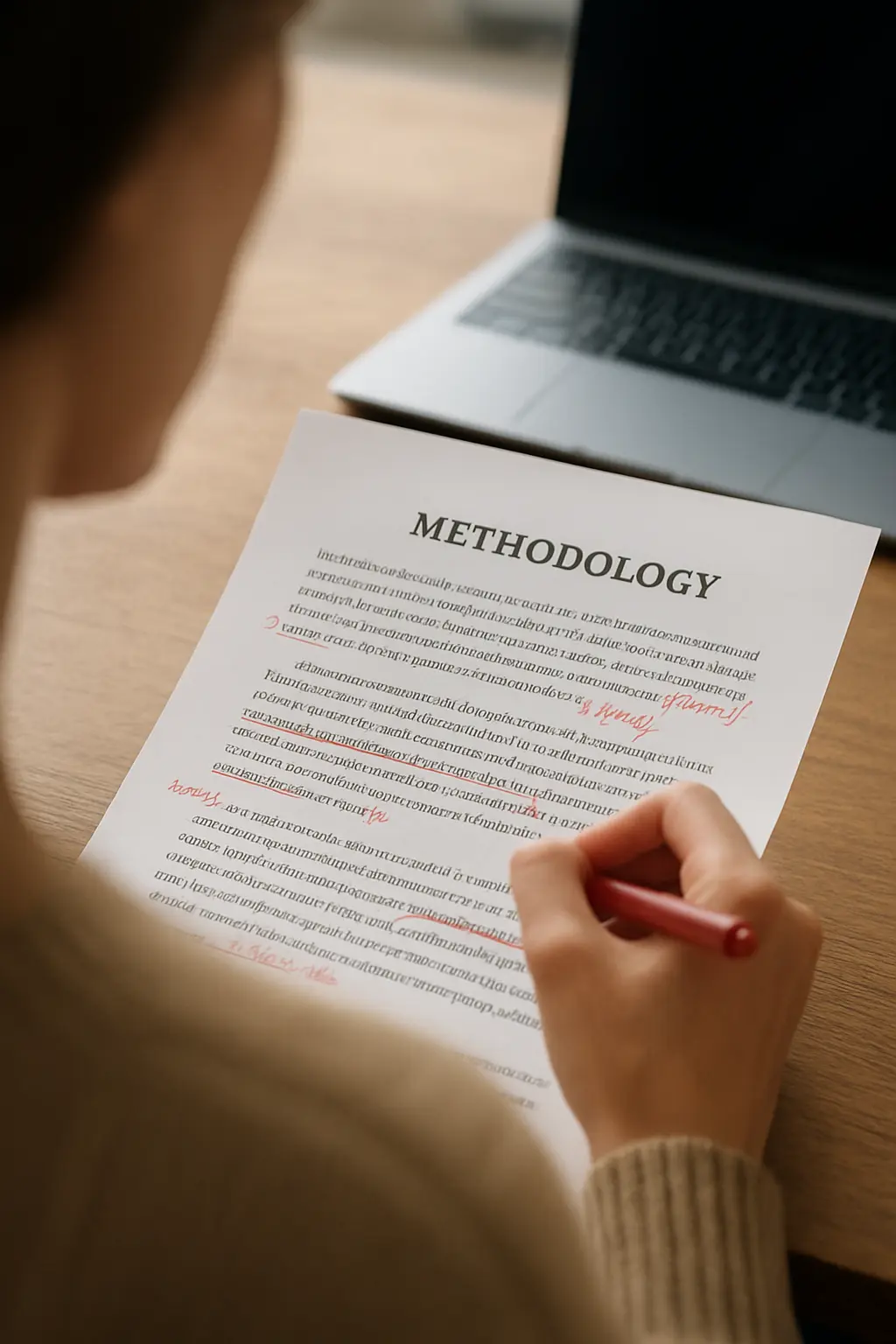
    A methodology page annotated where an agentless passive has been changed to an active sentence
    The pronoun question and the voice question are related but separate, and the methodology chapter is where they come apart.

    What does your own department actually require?

    Work through these in order and stop at the first one that gives you an answer.

    1. The dissertation module handbook. Not the general university writing guide — the handbook for the specific module the dissertation is assessed under. Where a rule exists, this is where it lives.
    2. The marking criteria for the module. Occasionally the band descriptors name a register expectation directly.
    3. Recent journals in your field. Open three articles from the journals your literature review cites most. Count how many use “I” or “we” in the introduction. This is the best proxy for your discipline’s default.
    4. Your supervisor, in writing. Leeds gives exactly this instruction about voice, and it applies equally to person: “Always check with your department to see what form of writing would be most appropriate for your subject area.” Ask by email so the answer is on record.

    One warning. Guidance written for research degrees is not guidance for you — a thesis presentation policy and an undergraduate module handbook are different documents with different audiences, and the first is not evidence about the second.

    Which sections normally take the first person, and which do not?

    Even departments that discourage “I” across the dissertation usually carve out exceptions. Leeds states one explicitly: the third-person rule “may not apply, however, if you are asked to write a reflective report based on your own thoughts and experiences. This is a more personal style of writing and can usually be written using the first person.”

    The practical pattern in UK undergraduate dissertations looks like this.

    • Reflexivity and positionality statements — first person, nearly always. These sections exist to state who you are in relation to your participants, and they cannot be written impersonally without becoming absurd. If you are writing one, see our guidance on thematic analysis, which sets out what a positionality paragraph has to do beyond listing your identity.
    • Methodology — passive by convention. This is covered below, and it is the strongest convention on this page.
    • Results — impersonal, because the data is the subject. “Attendance declined across the three conditions” needs no pronoun. Our guide to the results chapter covers the reporting conventions in detail.
    • Introduction and discussion — the contested ground. This is where “I argue” versus “it is argued” actually gets decided, and where your department’s default matters most.
    • Abstract — follow the abstract’s own conventions, which are tighter than the rest of the document; see how to write a dissertation abstract.

    If not “I”, then what?

    Departments that forbid the first person rarely say what to use instead, and students fill the gap badly. There are three substitutes, and only two of them are any good.

    The impersonal construction. “It is argued that…”, “This dissertation examines…”, “The analysis presented here suggests…”. The Academic Phrasebank models this directly with “In the section that follows, it will be argued that …”. Note the trick in the second and third examples: the document or the analysis becomes the grammatical subject, so the sentence stays active and readable without a pronoun.

    The agentless passive. “Twelve interviews were conducted.” Correct, conventional in methods, and the subject of the next section.

    “The researcher”, or “the present author”. Contested, and our advice is to avoid it — but you should know that some UK departments require exactly this. The University of Sunderland’s academic register guidance instructs students to “Use the 3rd person e.g. ‘the author’, ‘the student’, ‘the researcher’”. Against that, APA’s seventh edition rules it out in terms: “Do not refer to yourself or your coauthors in the third person as ‘the author(s)’ or ‘the researcher(s)’.”

    So this is a third live disagreement, not a settled point of style. Where you have a free choice, prefer one of the first two constructions: “The researcher conducted twelve interviews” is a first-person act wearing a third-person costume, it adds two words, and it adds no objectivity. Where your department names “the researcher”, use it — a handbook instruction beats a style manual you are not being marked against.

    Is the passive voice the same question as the first person?

    No, and conflating them is the commonest confusion on this topic. Hull notes the correlation while treating them separately: “generally, 1st person = active, 3rd person = passive”. But “The data show a marked decline” is active and contains no pronoun at all, so the two decisions come apart.

    Leeds gives the balanced position on voice: “Most verbs can be used in either an active or passive form. It is usually appropriate to use a mixture of passive and active forms within academic writing.” On why the passive persists: “The passive voice is more formal than the active voice. It is often used in academic writing as it is seen as more impersonal and therefore more objective. However, it is not always easy to read and it may add unnecessary words.” Hull is more directive: “our advice is to use the active voice whenever you can.”

    The methodology chapter is the exception that everyone agrees on. The University of Manchester’s Academic Phrasebank gathers its methods material under the heading “Describing the process: verbs used in the passive”, and every model it gives is an agentless passive — “Data were collected using semi-structured interviews in …”, “Ethical approval was obtained from …”, “The procedures of this study were approved by …”. If you write your methods this way you are following the mainstream UK convention, whatever your department says about “I” elsewhere. Our methodology chapter guide works through the section in full.

    A reflective research diary kept alongside a dissertation draft, where first person is expected
    Reflective and reflexive writing is the one place where UK guidance converges on the first person.

    What does the most-used UK phrase resource actually model?

    Worth knowing, because it undercuts the idea that “I” is inherently unacademic. The University of Manchester’s Academic Phrasebank is the most widely recommended academic phrase resource in UK higher education, and its own signposting models are written in the first person: “In the following pages, I will present …” and “Having defined what is meant by X, I will now move on to discuss …”.

    It offers impersonal alternatives alongside them — “In the section that follows, it will be argued that …” — but it does not treat the first person as an error. A resource that UK universities point their own students towards models both. That is the clearest available evidence that this is a convention question, not a correctness question.

    How do you use “I” without sounding like a diary?

    Cambridge’s warning — “you are writing a scientific document not a child’s diary” — is the real risk, and it is easy to manage. Three rules.

    1. Use “I” for research acts and argumentative moves, not for feelings. “I selected a purposive sample” and “I argue that the effect is confined to first-year students” are fine. “I was really surprised by the results” is not, unless you are in a reflective section that asks for it.
    2. Do not open every paragraph with it. A first-person dissertation should still have the data, the literature and the argument in subject position most of the time. If “I” is the first word of six consecutive paragraphs, the chapter has become a narrative of your process rather than an argument.
    3. Keep the hedging. First person does not license stronger claims. “I found that X causes Y” overclaims in exactly the way “It was found that X causes Y” does. The pronoun changes who is speaking, not how much the data supports.

    And whichever you choose, be consistent. Switching between “I”, “we”, “the researcher” and the passive across five chapters is far more visible to a marker than any single choice among them, and it is one of the things a second marker picks up immediately — see who marks your dissertation and how it is moderated.

    Fixing it across a whole draft

    If you have written 9,000 words and then discovered your handbook rules one way or the other, the repair is a single deliberate pass, not a find-and-replace. Converting “I” into an impersonal construction changes sentence structure, and a careless conversion leaves sentences that are vague about who did what — which is worse than the pronoun ever was.

    Draft and revise your dissertation in Tesify: keep one register decision applied across every chapter, run a consistency pass over person and voice before submission, and let the bibliography look after itself while you concentrate on the argument. The words stay 100% yours — Tesify handles the clerical layer, not the thinking. There is a free tier, so you can test the consistency pass on one chapter before committing.

    Frequently asked questions

    Can I use “I” in a UK dissertation?

    Sometimes, and it depends on your department rather than on any national rule. UK universities publish opposite defaults: Leeds says academic arguments are “not usually presented in the first person”, while Cambridge’s Computer Laboratory says “Writing in the first person singular is preferred.” Your module handbook outranks both.

    Is using “I” unprofessional or informal?

    No. Formality lives in vocabulary, hedging and sentence structure, not in pronouns. “I argue that the effect is confined to first-year students” is more formal than “Basically the effect was only really there in first years.” A dissertation can be entirely first-person and entirely formal.

    Should I write “the researcher” instead of “I”?

    It depends on your department, and UK practice is split. Sunderland instructs students to “Use the 3rd person e.g. ‘the author’, ‘the student’, ‘the researcher’”, while APA’s seventh edition says “Do not refer to yourself or your coauthors in the third person as ‘the author(s)’ or ‘the researcher(s)’.” Where you have a free choice, an impersonal construction reads better than inventing a character.

    Can I use “we” if I am the only author?

    Avoid it. Cambridge’s Computer Laboratory is blunt: “The use of “we” by a single author is outrageously pretentious.” The exception is the inclusive “we” that means writer and reader together, which some disciplines accept in reasoning steps.

    Which sections most often allow the first person?

    Reflective and reflexive sections, wherever they appear. Leeds makes the exception explicit: the third-person rule “may not apply, however, if you are asked to write a reflective report based on your own thoughts and experiences.” Qualitative positionality statements are the commonest place a UK undergraduate is required to write as “I”.

    Does the first person weaken objectivity?

    That is the traditional argument, and Leeds states it: the third person “sounds more objective, using logic and reasoning to persuade.” The counter-argument is Hull’s: “the work, analysis and conclusions are your own and taking yourself out of those processes can sometimes make for awkward writing.” Both are published UK positions.

    Is the first person the same question as the active voice?

    No, though they are related. Hull notes the correlation — “generally, 1st person = active, 3rd person = passive” — but you can write actively without “I”: “The data show a decline” is active and impersonal. Treat them as two separate decisions.

    Should my methodology chapter use the passive?

    By convention, largely yes, and this is the one section where the passive is genuinely the norm. The Academic Phrasebank’s methods material is built on agentless passives under the heading “Describing the process: verbs used in the passive”, with models such as “Data were collected using semi-structured interviews in …” and “Ethical approval was obtained from …”.

    Does my discipline decide this?

    Largely. Hull records the pattern: the move towards the first person “varies by discipline however, with the hard sciences mostly resisting the move to write in the first person and the humanities and social sciences being more accepting.” Check published articles in your own field as well as your handbook.

    What if my handbook says nothing at all?

    Then follow your discipline’s journals and ask your supervisor in writing, so the answer is on record. Leeds gives the same instruction for voice: “Always check with your department to see what form of writing would be most appropriate for your subject area.” A one-line email prevents a whole-draft rewrite.

    Will I lose marks for getting this wrong?

    Rarely on its own, but inconsistency is penalised. Switching between “I”, “we”, “the researcher” and the passive across five chapters reads as carelessness, and it is the kind of thing a second marker notices immediately. Pick one and hold it.

    Can I change my mind late in the draft?

    Yes, but do it as a deliberate pass rather than chapter by chapter. Converting “I” to an impersonal construction changes sentence structure, not just pronouns, so budget an afternoon and re-read for sentences that have become vague about who did what.

  • How to Choose the Right Tense for Each Dissertation Chapter (2026)

    How to Choose the Right Tense for Each Dissertation Chapter (2026)

    There is no single tense for a dissertation, and the UK guidance genuinely conflicts. The working rule is simple — the past for what you did and found, the present for what is still true — but four separate sections have named UK universities publishing opposite instructions. Here is the rule per chapter, where the disagreements are, and how to settle them for your own document.

    Step 1: Learn the one rule that covers most of the dissertation

    Before the chapter-by-chapter detail, there is a single question that resolves most sentences: is this something that happened, or something that is still true?

    Things that happened take the past. You collected the data, you ran the analysis, Smith conducted a study in 2019. Things that are still true take the present. A theory holds, a table shows, a finding implies something for practice.

    The University of Hull states the resulting default: “The majority of your dissertation or research report will be written in the past tense.” That is your baseline. Expected output of this step: you can classify any sentence in your draft in under two seconds.

    Hull is also unusually candid about why the rest of this page is necessary at all: “Tenses can be tricky to master. Even well respected journals differ in the guidance they give their authors for their use.” That is a UK university telling you, in its own guidance, that no settled answer exists.

    Step 2: Set the tense for your literature review — the section where guidance actually conflicts

    This is the hardest section, and it is hard because two named UK universities give opposite instructions.

    1. The University of Warwick states that in a thesis “the literature review usually describes research in the present tense (unless it is based on historical information, which is usually recounted in the simple past).”
    2. The University of Suffolk publishes a per-section table that assigns the past simple to the literature review “To discuss the findings of earlier studies.”

    Both are live guidance from UK universities. Neither is wrong. The way out is to stop asking “what tense does a literature review take?” and start asking a better question, which the University of Manchester’s Academic Phrasebank supplies:

    “For general reference to the literature, the present perfect tense (have/has + verb participle) tends to be used. For reference to specific studies carried out in the past, the simple past tense is most commonly used. This is normally the case where a specific date or point in time in the past forms a part of the sentence.”

    So the variable is not the chapter — it is the scope of the claim. Three tenses, three jobs:

    • Present perfect for the state of a whole field. “Several studies have examined the relationship between commuting time and attendance.”
    • Simple past for one study at one point in time. “Ahmed (2021) surveyed 340 first-year students at two post-1992 universities.”
    • Present for what a writer argues, and for knowledge treated as current. The Phrasebank adds the rule that surprises most students: “When referring to the words or ideas of writers, the present tense is often used if the ideas are still relevant, even if the author is no longer alive.” “Durkheim argues” is correct.

    Expected output: a literature review in which the tense changes with the scope of each sentence, deliberately, rather than drifting. Warwick’s warning applies: “Try not to flit back and forth between past and present tenses, however, and keep the tense used broadly consistent.” If you are still deciding what kind of review you are writing, our guide to literature reviews and systematic reviews settles that first.

    A literature review page being corrected where a general claim and a specific study need different tenses
    In a literature review the tense is set by the scope of the claim, not by the chapter it sits in.

    Step 3: Put the methodology in the simple past

    This is the easiest section and the one with the most agreement behind it.

    Hull: the methodology “is one of the easiest sections when it comes to tenses as you are explaining to your reader what you did. This is therefore almost exclusively written in the past tense.” Leeds: “If you are writing about an experiment you carried out or a method you used then use the past tense.” Suffolk assigns the past simple “To detail your research”.

    The Academic Phrasebank confirms it from the other direction, noting of its own methods material that “for most of the functional categories in this section, the verbs are written in the simple past tense” — and every model phrase it gives is a past-tense agentless passive: “Data were collected using semi-structured interviews in …”, “Ethical approval was obtained from …”.

    Expected output: a methodology chapter with no present-tense verbs except where you are describing an instrument that still exists. Our methodology chapter guide covers the section’s content; this step covers only its tense.

    Step 4: Report results in the past, and point at tables in the present

    Your findings happened, so they take the past. But the table is on the page in front of the reader right now, so it takes the present. Hull captures both halves: results “should be written in the past tense”, and yet “you will occasionally switch to present tense to write things like ‘Table 3.4 shows that …’ but generally, stick to the past tense.”

    Warwick puts the emphasis differently, calling analysis of results “a combination of past and present tenses”, and Suffolk assigns the present simple specifically “To refer to figures, charts, tables, or other sections of the paper”.

    In practice the split runs along one line:

    • Past — what the participants did and what you measured. “Attendance declined across all three conditions.”
    • Present — what the document does. “Table 4 shows the distribution by year group.”

    Our guide to the results chapter works through what goes in the chapter and in what order; the tense split above is the only grammatical rule it needs.

    Step 5: Move to the present for the discussion

    At the discussion the document changes job — from reporting what happened to arguing what it means — and the tense changes with it.

    Hull: the discussion “will primarily be written in the present tense as you are generally discussing or making conclusions about the relevance of your findings at the present time.” Warwick agrees: the discussion chapter “adopts the present tense to talk about the significance of the findings.”

    You will still reach back into the past to name a specific finding before interpreting it, and that is correct: “Attendance declined most sharply among commuting students. This suggests that timetabling, rather than motivation, drives the effect.” Past for the finding, present for the claim. Expected output: a discussion in which every interpretive sentence is present-tense.

    Step 6: Decide the abstract and the conclusion, knowing that UK guidance disagrees

    These are the two sections where you will find flatly contradictory instructions, so decide deliberately rather than by instinct.

    The abstract. Hull: “Mostly use the present tense, i.e. ‘This is the current state of affairs and this is why this study is needed.’” Leeds Beckett, in its undergraduate dissertation guidance: “Write in the past tense.” Two UK universities, one short section, opposite instructions. The workable answer is a deliberate mixture rather than either extreme, and because the abstract has several other conventions attached to it, we treat it separately in how to write a dissertation abstract.

    The conclusion. Hull groups it with the discussion in the present tense. Warwick states the opposite: “In the conclusion, the simple past tense is used to describe what was done in the essay.” Both defensible — a conclusion that summarises what the dissertation did leans past; a conclusion that states what the findings mean leans present. Pick according to which your conclusion actually is, and hold it.

    Worth knowing before you go looking for a tie-breaker: the Academic Phrasebank’s pages on reporting results, discussing findings and writing conclusions name no tense at all. The most-recommended UK phrase resource declines to rule on the three sections where universities disagree most. That is a reasonable signal that no authority is going to settle it for you.

    A final consistency pass through a dissertation draft checking that each chapter holds one tense
    Tense is checked section by section, because the correct answer changes at every chapter boundary.

    Step 7: Run a consistency pass, section by section

    Markers rarely penalise a single tense slip. They do notice a chapter that drifts. Run this pass late, once the content is stable.

    1. Take one section at a time, not the whole document. The correct tense changes at chapter boundaries, so reading straight through hides the switch you are looking for.
    2. Ask the Step 1 question of every verb. Did it happen, or is it still true?
    3. Check your citing sentences separately. These drift most, because you wrote them over several months.
    4. Delete the rare tenses. Warwick: “The present perfect continuous, past perfect simple/continuous and future perfect tenses are very rarely used in academic writing.” If a sentence needs one, it is usually doing too much and should be split.
    5. Read the first sentence of every paragraph in one pass. If the tense jumps between neighbouring paragraphs without the topic changing, you have found the drift.

    Expected output: each section holds one dominant tense, with deliberate exceptions you could justify aloud.

    A worked paragraph, with the citation formatted correctly

    All three literature-review tenses in one paragraph, with a Harvard in-text citation and its reference-list entry formatted to the version most UK departments mean:

    “Research on commuting and attendance has developed considerably over the past decade (present perfect: the state of the field). Ahmed (2021) surveyed 340 first-year students across two post-1992 universities and found that journey time predicted seminar attendance more strongly than prior attainment (simple past: one study, one point in time). Ahmed argues that this reflects a structural constraint rather than a motivational one (present: the writer’s position, still current).”

    The matching reference-list entry: Ahmed, S. (2021) ‘Commuting distance and seminar attendance in UK higher education’, Journal of Further and Higher Education, 45(3), pp. 312–328.

    If your citations are not yet in this shape, fix that before the tense pass — our complete Harvard referencing guide covers the version UK departments actually ask for.

    Holding it consistent across 10,000 words

    Tense drift is not a knowledge problem. You know the rule by now. It is a problem of writing five chapters over four months and losing the thread of which decision you made in October.

    Draft your dissertation in Tesify: keep the whole document in one workspace so a chapter written in March reads consistently with one written in December, run the consistency pass section by section, and let the bibliography format itself while you concentrate on the argument. The writing stays 100% yours — Tesify handles the clerical layer. There is a free tier, so you can run the pass on one chapter first.

    Frequently asked questions

    What tense should a dissertation be written in?

    There is no single tense. The working default across UK guidance is the simple past for what you did and found, and the present for what is still true — established knowledge, what your tables show, and what your findings mean. Hull puts the default plainly: “The majority of your dissertation or research report will be written in the past tense.”

    What tense should the literature review use?

    This is the one section where UK guidance openly conflicts. Warwick says the literature review “usually describes research in the present tense”; Suffolk’s table assigns the past simple “To discuss the findings of earlier studies.” The Academic Phrasebank splits the difference by scope rather than by section, and that is the most useful rule of the three.

    What is the present perfect for?

    General reference to a body of work rather than to one study. The Academic Phrasebank states it directly: “For general reference to the literature, the present perfect tense (have/has + verb participle) tends to be used. For reference to specific studies carried out in the past, the simple past tense is most commonly used.”

    What tense should the methodology chapter be in?

    The simple past, with more agreement behind it than any other section. Hull calls it “almost exclusively written in the past tense”, Leeds says “If you are writing about an experiment you carried out or a method you used then use the past tense”, and the Academic Phrasebank notes of its own methods material that “the verbs are written in the simple past tense”.

    What tense should the results chapter use?

    Past tense for what you found, present tense for what the table does. Hull says the results section “should be written in the past tense”, while noting you “will occasionally switch to present tense to write things like ‘Table 3.4 shows that …’”. Warwick disagrees on emphasis, calling it “a combination of past and present tenses”.

    What tense should the discussion chapter use?

    Mostly the present. Hull explains why: the discussion “will primarily be written in the present tense as you are generally discussing or making conclusions about the relevance of your findings at the present time.” Warwick agrees that the discussion “adopts the present tense to talk about the significance of the findings.”

    What tense should the conclusion use?

    UK guidance contradicts itself here. Hull groups the conclusion with the discussion in the present tense. Warwick states the opposite: “In the conclusion, the simple past tense is used to describe what was done in the essay.” Follow your handbook, and if it is silent, pick one and stay consistent.

    Can I write about a dead author in the present tense?

    Yes, and it is the convention. The Academic Phrasebank: “When referring to the words or ideas of writers, the present tense is often used if the ideas are still relevant, even if the author is no longer alive.” “Durkheim argues” is correct in 2026.

    Should I ever use the future tense?

    Rarely, and mainly in a proposal rather than a dissertation. A proposal describes work not yet done; a dissertation reports work that is finished. Signposting is the common exception — “the following section will discuss …” is standard.

    Which tenses should I simply avoid?

    Warwick names them: “The present perfect continuous, past perfect simple/continuous and future perfect tenses are very rarely used in academic writing.” If a sentence needs one, it is usually a sign the sentence is doing too much and should be split.

    Do markers actually penalise tense errors?

    A single slip, almost never. Inconsistency across a chapter, yes — it reads as carelessness and it is exactly what a second marker notices. Marking criteria rarely name tense, but they routinely name fluency and accuracy of expression, which is where it lands.

    How do I check tense consistency before submission?

    Read one section at a time asking a single question of every verb: is this something that happened, or something that is still true? Do it section by section rather than page by page, because the correct answer changes at chapter boundaries and reading straight through hides the switch.

  • Your Data Is Analysed and the Results Chapter Is Blank: How to Write It This Week (2026)

    Your Data Is Analysed and the Results Chapter Is Blank: How to Write It This Week (2026)

    The analysis is done. There is a folder of output, a set of tables you cannot bring yourself to look at, and a chapter heading with nothing underneath it. Two weeks ago the problem was getting the data; now the problem is that nobody ever taught you how to turn output into prose — and this is the chapter that, with the discussion, carries roughly 40% of your word count and most of the analytical credit. You can start building the chapter in Tesify tonight, free; first, here is why it will not start.

    The reason it will not start

    You are trying to write the chapter from your output. A results chapter is written from your research questions.

    Statistical software and coding software both produce material in the order the software works, which has nothing to do with the order your argument needs. Open the output folder and you are looking at a list of procedures. Open your methods chapter’s list of research questions and you are looking at a chapter outline — because your results chapter has exactly one job: to answer, in order, each question you said you would answer, with the evidence that answers it.

    That single reframe removes most of the paralysis, because it converts an unbounded writing task into a fixed number of small ones.

    The cost of getting this chapter wrong

    Two failure modes, and both are expensive.

    The narrated-output chapter. Every table reproduced, every number restated in a sentence, no signal about which finding matters. It is long, it feels thorough, and it reads to a marker as an inability to distinguish the important from the incidental. It also consumes the words the discussion needed.

    The chapter that leaks its discussion. Findings interpreted as they appear, so that by the time you reach the discussion there is nothing left to say and you restate. This is the more common of the two, and the harder to repair late, because unpicking interpretation from reporting means rewriting both chapters.

    The proportion matters as well. Results and discussion take roughly 20% each of a typical empirical dissertation, as our breakdown of undergraduate dissertation word counts sets out. A results chapter that has swollen to a third of the dissertation has taken those words from the chapter that earns more of them.

    Figures arranged in the order of the research questions they answer
    Sort the output by question before you write a word. What is left over is an appendix.

    Step 1: Sort the output into three piles

    Print or list every piece of output you have and put each item into one of three piles.

    1. Answers a research question. This is your chapter, and it is usually smaller than you fear — three questions might need five tables.
    2. Describes the sample. Response rates, demographics, missing data, reliability figures. This is the short opening section, not the body.
    3. Everything else. Exploratory runs, checks you did and abandoned, alternative specifications. This goes in an appendix, or nowhere.

    The third pile is where most over-length results chapters come from, and cutting it is not hiding anything: an analysis you ran, did not preregister and do not report as answering a question belongs in an appendix with a line in the text saying it is there.

    Expected output: a numbered list of sections, one per research question, with the specific tables or themes that belong in each.

    Step 2: Write the sample section first, because you already know it

    It is the easiest thing in the chapter and it breaks the blank page. How many people you approached, how many responded, who they were, what was missing, and any reliability or assumption checks. Facts you already have, in the past tense.

    If your achieved sample fell short of your target, this is where you say so and where you carry the consequence forward — the honest construction, including the sensitivity analysis that replaces a post-hoc power calculation, is set out in our guide to sample size for an undergraduate dissertation. Stating the shortfall in the results chapter and revisiting it in the discussion is a mark of competence, not a confession.

    Expected output: 300–500 words on the desk, before you have interpreted anything.

    Step 3: One sentence per table, then the table

    This is the rule that turns output into a chapter. Each table or figure gets one sentence of prose before it that says what it shows, and one sentence after it, at most, that points at the specific value the reader should notice. Nothing else.

    The University of Manchester’s Academic Phrasebank describes exactly this convention for quantitative work: results are presented with “tables and figures, and writers comment on the significant data shown in these”, and “more elaborate commentary on the results is normally restricted to the Discussion section”. Its worked phrasings are the ones to imitate — “Table 1 shows an overview of…”, “As can be seen from the table (above), the X group reported significantly more Y than…”, and the summarising move “The most striking result to emerge from the data is that…”.

    Two things this rule prevents. It stops you retyping the table into prose, which is the single commonest padding in an undergraduate dissertation. And it stops the table from arriving unannounced, which is what makes a results chapter feel like a report dump.

    Expected output: a chapter whose prose can be read on its own and still makes sense, with every table introduced.

    A results table annotated with the single sentence that will introduce it in the chapter
    Write the sentence in the margin first. If you cannot say what the table shows in one line, the table is doing too much.

    Step 4: Report the numbers in the conventional form

    Reporting conventions are not decoration; they are how a marker checks your analysis quickly. The Phrasebank’s own example gives the shape: “There was a significant difference in X, t(11) = 2.906, p<0.01” — test statistic, degrees of freedom, value, then significance, in that order and in one bracketed string.

    Three habits raise the mark on this alone. Give an effect size alongside every significance test, because a p value tells a reader whether an effect is detectable and not whether it is large. Report exact p values where your handbook allows it rather than only thresholds. And report a non-significant result in exactly the same form as a significant one — “No significant differences were found between…” is a finding, written as a finding. The mechanics for individual tests, including how the output maps to the reported string, are worked through in our guide to running and reporting an independent-samples t-test in SPSS, and what to do when a test’s assumptions are not met is in our guide to failed statistical assumptions.

    If your work is qualitative, the equivalent conventions are structural. The Phrasebank describes qualitative results as highlighting themes with supporting excerpts, which in practice means: name the theme, state how it presents across the dataset, then give one or two illustrative extracts with a participant identifier. The full sequence, and where analysis stops being coding, is in our guide to doing a thematic analysis. The one rule that transfers from the quantitative side without modification: an extract is evidence for a claim you have already made in your own words, never a substitute for making it.

    Step 5: Hold the line between results and discussion

    The test is simple and you can apply it to any sentence you have written. If the sentence could be checked against your data, it belongs in results. If it requires the literature, an explanation, or a judgement about importance, it belongs in the discussion.

    “Attendance was lower among students travelling more than 45 minutes” is a result. “This suggests that practical constraints rather than motivation explain disengagement” is a discussion. The second sentence is more interesting, which is exactly why it migrates into the results chapter if you let it.

    Some departments explicitly combine the two into a single “findings and discussion” chapter, particularly in qualitative and case-study work. That is a legitimate structure and it is a decision your handbook makes, not you. If it does combine them, the discipline still applies inside each section: report first, interpret second, visibly.

    Step 6: Read the chapter backwards against your questions

    Take your list of research questions and, for each one, find the sentence in the results chapter that answers it. If you cannot find one, the chapter has reported around the question without landing on it — the commonest reason a marker writes “descriptive” in the margin. Write the missing sentence.

    Then check the reverse: every section in the chapter should map to a question. A section that maps to nothing is pile three, and it belongs in the appendix.

    Expected output: a one-to-one mapping between questions and answers, which is also the skeleton of your discussion and your conclusion.

    Writing it with Tesify, concretely

    The mechanical part of this chapter is real and it is where the week goes: holding a fixed structure while you fill it, keeping table numbering and cross-references consistent, and making sure the claims in the chapter still match the abstract and the conclusion when you have finished moving things around.

    That is the division of labour Tesify is built for. You give it your research questions and your own findings; it holds the chapter structure, keeps the bibliography built from what your text actually cites, and keeps the document consistent as it grows, so the chapter you finish on Thursday still agrees with the introduction you wrote in March. Every word is written by you — the analysis, the interpretation and the judgement about what matters are the assessed parts and they stay yours.

    Open your results chapter in Tesify now. It is free to start, and the first thing it will ask you for is the list you built in Step 1.

    Frequently asked questions

    How long should a dissertation results chapter be?

    About 20% of the total on a conventional empirical dissertation, with the discussion taking a similar share. On a 10,000-word limit that is roughly 2,000 words. Your handbook’s allocation, where it gives one, overrides the convention.

    What is the difference between results and discussion?

    A results statement can be checked against your data; a discussion statement requires the literature, an explanation or a judgement about importance. The Academic Phrasebank puts the same line as “more elaborate commentary on the results is normally restricted to the Discussion section”.

    Should I include every table my software produced?

    No. Include the output that answers a research question or describes the sample; put the rest in an appendix with a sentence in the text saying it is there. A results chapter is a selection, and making the selection is part of what is being assessed.

    How do I report a non-significant result?

    In exactly the same form as a significant one, without apology. “No significant differences were found between…” is a finding. What you must not do is run further tests until something reaches significance, which is an integrity question rather than a writing one.

    Do I interpret findings in the results chapter?

    Only to the extent of pointing at what the reader should notice. Save explanation and comparison with the literature for the discussion — unless your department requires a combined findings-and-discussion chapter, in which case still report before you interpret within each section.

    How do I write up qualitative findings?

    Name the theme, state how it presents across your dataset in your own words, then give one or two illustrative extracts with participant identifiers. Extracts support a claim you have made; they do not make it for you.

    Is it cheating to use an AI tool to write my results chapter?

    It depends entirely on what the tool does and what your department permits. A tool that holds structure, formats citations and checks consistency while you write the words is a different thing from one that generates findings, and only the second misrepresents authorship. Read your assessment brief’s AI statement, disclose what it asks you to disclose, and keep the interpretation yours.

    How much does Tesify cost?

    It is free to start, which is the tier most students finish a dissertation on. Paid options exist for longer projects; you do not need one to build a results chapter this week.

    Is my unpublished data safe in a writing tool?

    Your work stays yours, it is not published or shared into any public database, and you can export it. Separately, and regardless of tool: report anonymised or pseudonymised data in your chapter, keep identifiable material out of any document you sync, and follow the conditions of your own ethics approval.

    My results are not what I hypothesised. Is that a problem?

    No. A well-designed study reporting an unexpected or null result is a pass; the marks are in the design, the analysis and the honesty of the reporting. What costs marks is a discussion that pretends the prediction was confirmed.

    Where do tables and figures actually go?

    Inline, immediately after the sentence that introduces them, unless your handbook says otherwise. Numbered sequentially, with a caption above tables and below figures at most institutions, and listed on the list of tables or figures in your preliminary pages.

  • How to Write a Dissertation Abstract: The UK Guide, With a Worked Example (2026)

    How to Write a Dissertation Abstract: The UK Guide, With a Worked Example (2026)

    A UK dissertation abstract is normally 200 to 300 words, written last, and built by taking the main point from each chapter and redrafting those points into a single paragraph that can be read on its own. Your department’s handbook sets the exact length and, less obviously, decides how much of it your methods are allowed to occupy.

    That last clause is the part almost every online guide gets wrong, because it assumes there is one standard abstract shape. There is not. Below is the procedure, the place where UK institutions genuinely contradict each other, and a full worked example you can measure your own against.

    Step 1: Find your own specification before you write a word

    Three published UK sources, three different numbers, and none of them is wrong.

    Source What it specifies Scope
    University of Manchester, Guidance for the Presentation of Taught Dissertations for UG and PGT Provision “A short (no more than 300 words) abstract of a dissertation must be provided” Undergraduate and postgraduate taught dissertations
    University of Southampton Library, dissertation guide “The average abstract is about 200 words, but you should adjust this figure to match the context” General study-skills guidance
    Oxford Brookes University, academic development resources “An abstract is normally only 200-300 words” General study-skills guidance

    Manchester’s document is a presentation requirement with a submission checklist attached; the other two are guidance about the genre. If your department has published a figure, that figure is not advice. Where your handbook is silent, 250 words is a safe target: it sits inside every range above and reads as deliberate rather than as an under-run.

    Expected output: a word target written at the top of your draft, and the page number of the document it came from. If you cannot find one, ask your supervisor and get the answer in writing — the same discipline that applies to the dissertation word limit itself and what counts towards it, which is a separate rule and frequently a different answer.

    Step 2: Write it last, from finished chapters

    Oxford Brookes puts the instruction plainly: “Write your abstract last”, because it provides an overview that requires the full text to be complete first.

    The reason is not scheduling. An abstract written before the discussion exists describes the dissertation you intended to write, and intentions drift. Findings turn out weaker than expected, a research question narrows in week nine, a chapter gets cut. An abstract drafted early and never revisited is one of the easiest inconsistencies for a marker to spot, because it is the first thing they read and the last thing you touched.

    If you wrote a dissertation proposal, its summary paragraph is a useful skeleton and nothing more: a proposal summary is written in the future tense about work you have not done, while an abstract reports what actually happened.

    Expected output: the abstract drafted after your conclusion is written, in the final week rather than the final hour.

    Step 3: Build it from seven moves, in order

    Southampton’s dissertation guide sets out the elements in sequence: “Context – Relevant research background”; “Objective statement/research question – What your research aims to do”; “Methodology – How your research was carried out”; “Results – What your methodology produced”; “Discussion – Interpretation of your results”; “Implications/future research – If relevant”; and “Conclusion – The takeaway or answer to the question”.

    The practical method is Brookes’s: “A quick way to structure your abstract is to take the main point from each section of your text e.g. introduction, methods, results, discussion and conclusion.” Write one sentence per move, in order, without editing. That gives you seven sentences and roughly 250 words.

    Two of those moves are consistently under-spent. The results sentence should contain an actual finding, not a promise of one — “the findings are discussed in relation to the literature” tells a reader nothing. And the conclusion sentence should answer the research question the second sentence posed, closing the loop within the paragraph.

    Expected output: seven sentences in order, each doing one job, before any cutting begins.

    Two university handbooks open side by side showing conflicting abstract requirements
    Two documents, two abstract specifications. On this question, one of them is sometimes the same university.

    Step 4: Decide how much space the methods get — this is genuinely contested

    Here is the disagreement that generic advice hides, and it is visible inside a single UK document.

    Manchester’s taught-dissertation guidance tells students on all programmes except MRes that the abstract must be “short (not more than 300 words), with emphasis on major observations and deductions rather than on methods”. Six lines further down, the same document tells MRes students that theirs “must be a short summary of the research presented in the dissertation (not more than 300 words), including a brief rationale for the study, details of the methods employed, a summary of the results, and an indication of the wider implications of the research”.

    One institution, one page, two opposite instructions about the same 300 words. Brookes takes a third position — “Don’t describe the detail of what you did in your research, instead focus on the key finding(s)” — while Southampton’s seven-move model gives methodology a slot of its own.

    The logic is about the reader. A research-degree abstract is read by people judging whether the method is sound; a taught dissertation abstract is read by markers who already have your methods chapter open. Which reader you are writing for is decided by your programme, not by a template.

    The safe construction, where your handbook is silent: name the design in one clause and spend the recovered words on the finding. “Using a cross-sectional online survey of 142 undergraduates…” identifies the method without narrating it. Everything else about justifying that design belongs in the methodology chapter, where it is assessed.

    Expected output: a deliberate decision, recorded, about whether your abstract is method-light or method-inclusive — and a handbook line or supervisor email behind it.

    Step 5: Cut it to length by removing hedges, not content

    Southampton’s advice is blunt: “Pare anything superfluous. Edit ruthlessly once you have that first draft. Treat adverbs with suspicion.” Three cuts reliably recover fifty to eighty words without losing a single fact.

    1. Remove the throat-clearing. “This dissertation aims to explore the extent to which…” becomes “This study examines whether…”. “It is important to note that” can always go.
    2. Remove double hedges. “The results appear to suggest that there may possibly be a relationship” is four hedges on one claim. One is enough.
    3. Remove signposting. “The first chapter reviews the literature, the second sets out the methodology…” describes the document rather than the research. A table of contents already does that job.

    What you must not cut is the finding. An abstract trimmed until it says only what the study was about, and never what it showed, has been cut in exactly the wrong place.

    Expected output: a paragraph inside your stated limit, counted with the same inclusion rule your department uses.

    Step 6: Keep four things out of it

    Manchester’s requirement is that the abstract “must be designed to be read independently of the rest of the dissertation and references to the dissertation and other literature will not normally be included”. That single sentence rules out most of what students are tempted to put in.

    • Citations. No in-text references, even where a framework is central to your study. Name the approach in words — “reflexive thematic analysis” — and let the reference appear where it belongs, formatted to your department’s variant of Harvard referencing: Braun, V. and Clarke, V. (2006) ‘Using thematic analysis in psychology’, Qualitative Research in Psychology, 3(2), pp. 77–101.
    • Cross-references to your own document. “As discussed in Chapter 4” breaks the stand-alone requirement immediately.
    • New material. Anything in the abstract must appear in the dissertation. It is not a place to add a caveat you forgot.
    • Undefined abbreviations. A reader meeting your acronym for the first time in a stand-alone paragraph has no way to decode it. Spell it out or drop it.

    Expected output: an abstract containing no brackets, no chapter numbers and no acronyms you have not spelled out.

    A student writing the dissertation abstract after the chapters are finished
    Written last, from finished chapters — which is the only way the findings sentence can contain a finding.

    Step 7: Put it in the right place, with the right pages around it

    The abstract is a preliminary page and its position is prescribed, not stylistic. Manchester’s order is: title page, contents page including any list of tables and figures, abstract, declaration, then the copyright and intellectual property statement, with optional items such as acknowledgements coming after the compulsory pages.

    Two details from the same document catch people out. “The final word count, including footnotes and endnotes, MUST be inserted at the bottom of the contents page” — a requirement that lives nowhere near the section on word limits. And the submission checklist carries a real sanction: “If any section is missing, out of order or not correct the dissertation may be rejected”, with the school able to accept an incorrect version for examination while withholding the result until a properly completed one is supplied.

    Check your own regulations for the equivalent list. This is the cheapest part of a dissertation to get right and one of the few where a mistake has an administrative consequence rather than a marking one.

    Expected output: preliminary pages in your department’s prescribed order, with anything it requires on the contents page actually on it.

    A worked example, 248 words

    An illustrative abstract for a fictional undergraduate project, method-light in the Manchester taught style, with the seven moves marked so you can see the joins. The bracketed labels would not appear in a submitted abstract.

    [Context] Hybrid timetabling became a permanent feature of many UK undergraduate programmes after 2021, but its effect on the study habits of commuting students has received limited attention. [Question] This study examined whether commuting distance is associated with self-reported engagement in synchronous online teaching, and how commuting students describe their reasons for attending or not attending. [Method] A cross-sectional online survey of 142 second- and third-year students at a single post-1992 institution was combined with eight semi-structured interviews analysed using reflexive thematic analysis. [Results] Students travelling more than 45 minutes each way reported significantly lower attendance at synchronous online sessions than those travelling less, and reported comparable attendance at on-campus sessions. Interview accounts identified three themes: the cost of an unproductive gap between timetabled sessions, an expectation that recorded material would substitute for live attendance, and a reluctance to participate verbally from a shared home environment. [Discussion] The quantitative pattern is consistent with a scheduling explanation rather than a motivational one, and the interview data suggest that recording policy shapes attendance more directly than travel time alone. [Implications] Timetabling that clusters a commuting cohort’s sessions, and a clearly communicated recording policy, may address the observed gap more effectively than attendance monitoring. [Conclusion] Commuting distance predicts disengagement from online rather than in-person teaching, and the mechanism appears to be practical rather than attitudinal.

    No citations, no chapter references, a number in the results sentence, and a final sentence that answers the second one. It would survive being read by someone who never opens the dissertation, which is the test.

    One last check before you submit: read the abstract immediately after the conclusion and ask whether it claims anything the conclusion does not support. Overclaiming here is the most common inconsistency in submitted undergraduate work, because the abstract is written in a burst of relief and the conclusion was written carefully three days earlier. If the chapters are finished and it is the summarising that has stalled, you can draft and tighten it in Tesify from your own chapters, to your department’s stated limit. Every word stays 100% written by you, and it is free to start.

    Frequently asked questions

    How long should a dissertation abstract be?

    Normally 200 to 300 words. Manchester requires “no more than 300 words” for undergraduate and postgraduate taught dissertations; Oxford Brookes describes 200–300 as normal; Southampton puts the average at about 200. Your own handbook overrides all three, and 250 words is a sensible target where it is silent.

    Does the abstract count towards the dissertation word limit?

    It depends on your department, and this is one of the most commonly misread rules in UK assessment. Some departments exclude preliminary pages entirely, others count everything except appendices. Find your inclusion rule before you allocate words, because it also changes how much room your chapters have.

    Should the abstract include my methods?

    UK guidance genuinely disagrees. Manchester tells taught-dissertation students to write “with emphasis on major observations and deductions rather than on methods”, and MRes students at the same institution to include “details of the methods employed”. Where your handbook is silent, name the design in one clause and spend the words on the finding.

    Can I cite sources in an abstract?

    Normally no. Manchester states that “references to the dissertation and other literature will not normally be included”, because the abstract has to be readable on its own. Name a framework in words rather than citing it.

    When should I write my abstract?

    Last. Oxford Brookes says to “write your abstract last” because it summarises a text that has to exist first. An abstract drafted early describes the dissertation you planned rather than the one you submitted.

    What tense should a dissertation abstract use?

    Mixed, and consistently so: present tense for what the study does, past tense for what you did and what you found. “This study examines… A survey of 142 students was conducted… Students travelling further reported…” is the standard pattern.

    Is an abstract the same as an executive summary?

    No. An abstract summarises the research for a reader deciding whether to read on. An executive summary, common in business and management projects, is longer, addressed to a practitioner audience and usually leads with recommendations. Some programmes require one instead — check which word your handbook uses.

    Does the abstract need keywords?

    Only if your department asks for them. Where they are required they are listed separately beneath the abstract, and they are not normally counted within its word limit.

    Where does the abstract go in a dissertation?

    Among the preliminary pages, after the contents page and before the declaration in Manchester’s prescribed order. Position is a formatting requirement rather than a preference, and a submission checklist can reject work whose preliminary pages are out of order.

    What is the most common mistake in a dissertation abstract?

    Describing what the dissertation is about without ever stating what it found. An abstract that ends with “the implications are discussed” has used its most valuable sentence to say nothing. Put a finding in it.