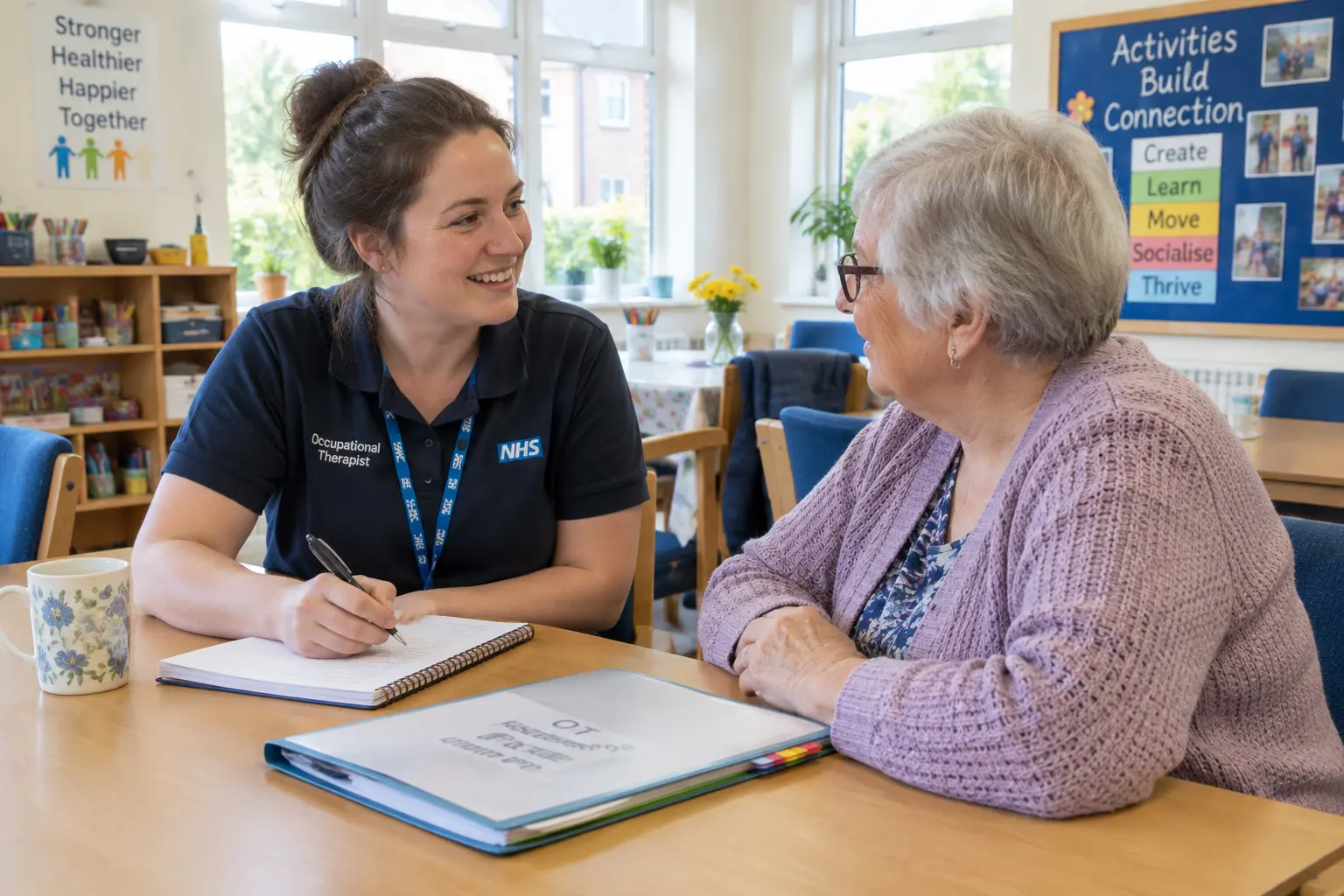
Direct answer: Most undergraduate occupational therapy dissertations cannot recruit NHS patients directly, because the Health Research Authority has not accepted standalone undergraduate applications for NHS ethics review since 1 September 2021. Your realistic populations are community, education, charity and social-care client groups reached through staff gatekeepers, or published case data analysed at a distance.
What does “population” actually mean in an occupational therapy dissertation?
Your population is the defined group your research question is about — not a vague label like “OT patients”, but a named group with boundaries: age range, diagnosis or need, care setting, and the practical route by which you could reach them. A dissertation that names its population precisely (“adults over 65 attending a community falls-prevention group”) is easier to defend at your ethics panel than one that names a specialism (“stroke rehabilitation”) without saying where those people are, who holds the gatekeeper relationship, and how consent would actually be sought.
Your setting is where that population is found — an NHS community team, a school, a day centre run by a charity, a care home, or a workplace. Setting and population are decided together, because access almost always runs through the setting’s gatekeeper, not through the individual participant alone.
Why can’t most undergraduate OT dissertations recruit NHS patients directly?
Since 1 September 2021 the Health Research Authority (HRA) has not accepted standalone research applications from undergraduate students for NHS Research Ethics Committee review or HRA and Health and Care Research Wales (HCRW) Approval. On undergraduate courses the supervisor always takes the chief investigator role, and that does not lift the bar — it applies to standalone research at undergraduate level. The HRA’s own suggested alternatives include contributing to a project that a supervisor designs and leads, and health or social care research that does not involve patients, service users or NHS staff as participants. A lone undergraduate dissertation recruiting NHS service users or NHS staff as participants is therefore not a workable design.
This is not unique to occupational therapy — it applies across undergraduate health and allied-health dissertations on this site, and our guide to ethics approval for an undergraduate dissertation walks through the review tiers and triggers in full — but it lands differently in OT because so much of the discipline’s everyday population (stroke survivors in acute rehabilitation, people recovering from hip fracture, children referred for sensory processing assessment) sits inside NHS or NHS-commissioned pathways. The practical answer is not to abandon a clinically relevant population, but to reach it through a route the HRA bar does not close: the perspectives of staff working outside the NHS, published service data, documentary analysis, or a non-NHS setting such as a charity, school or care home that runs its own governance process.
Which client groups can you realistically study as an undergraduate?
Five routes come up repeatedly in UK undergraduate OT dissertations, roughly in order of how straightforward access tends to be:
- Older adults in community or voluntary-sector settings — a falls-prevention group, a memory café, a lunch club run by a charity such as Age UK. These sit outside NHS ethics governance and usually have their own, lighter approval process through the organisation itself.
- Staff, not service users, as your actual participants — interviewing or surveying occupational therapists, OT assistants or support workers employed outside the NHS (in a charity, school, care home or independent practice) about their practice with a client group (for example, how OTs in a dementia charity assess falls risk) reaches the clinical population indirectly and without primary patient contact. NHS staff recruited as participants fall under the same HRA bar as NHS patients. Our questionnaire and interview schedule templates cover the consent and screening sections a staff-interview design needs.
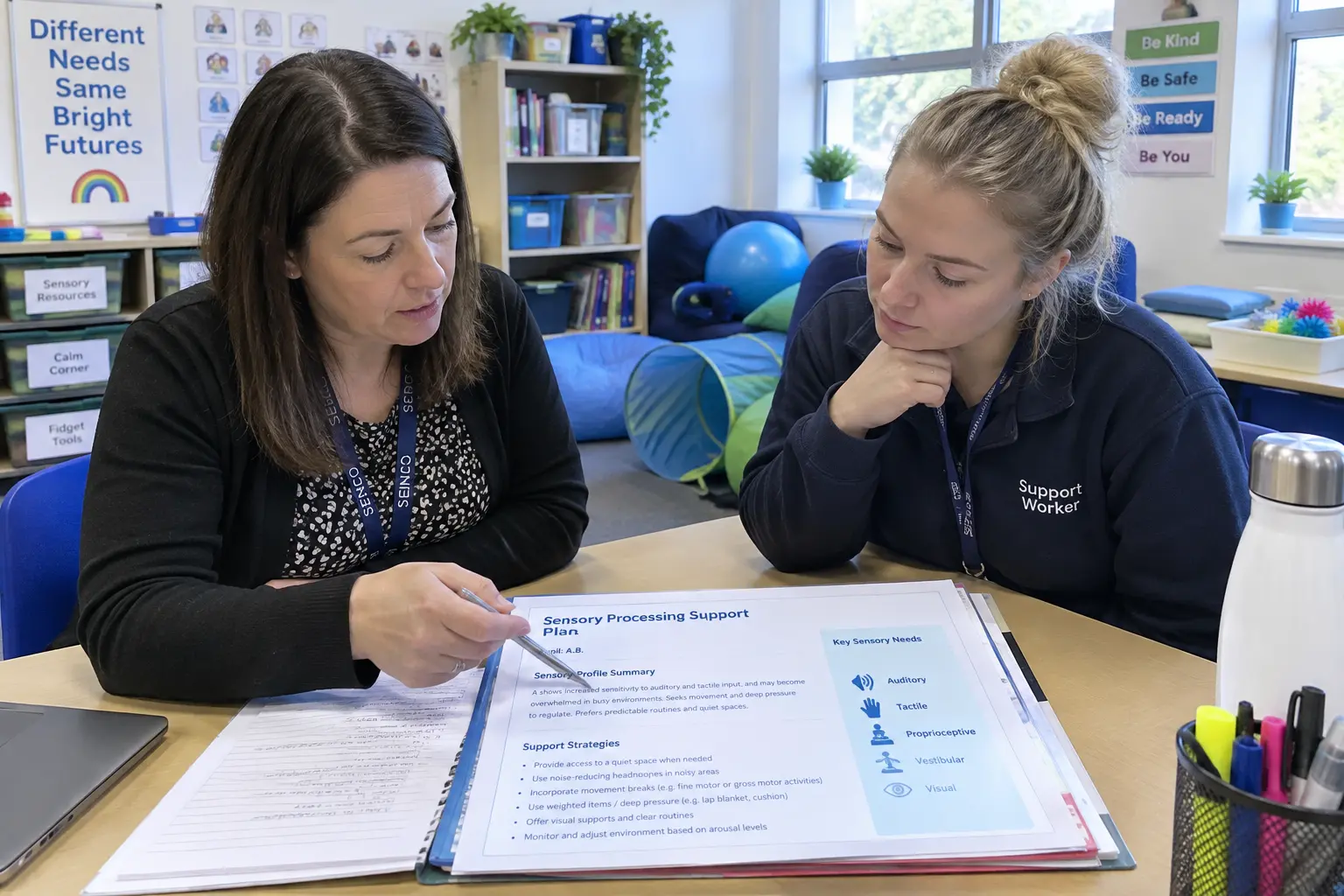
- Children in mainstream or special educational needs (SEN) settings, via school staff as gatekeepers — a study of sensory-processing strategies used in a primary school SEN unit, consented through the headteacher and parents, not through NHS paediatric services.
- People with physical or learning disabilities supported by a charity or voluntary organisation — access runs through the organisation’s own safeguarding and consent procedures rather than an NHS pathway, though capacity and vulnerability considerations (see below) still apply in full.
- Documentary or secondary analysis of an existing clinical population — using published outcome data, case reports, or the NHS and public health datasets available for a UK health dissertation, about, for example, stroke survivors’ return-to-work outcomes, without recruiting any new participants at all.
A mental-health-service-user population is the hardest of these to reach directly as an undergraduate, given the added ethics sensitivity around capacity and risk on top of the HRA bar — most undergraduate OT dissertations that touch mental health do so through non-NHS staff perspectives or secondary data rather than direct recruitment.
Consent and capacity: what changes by client group?
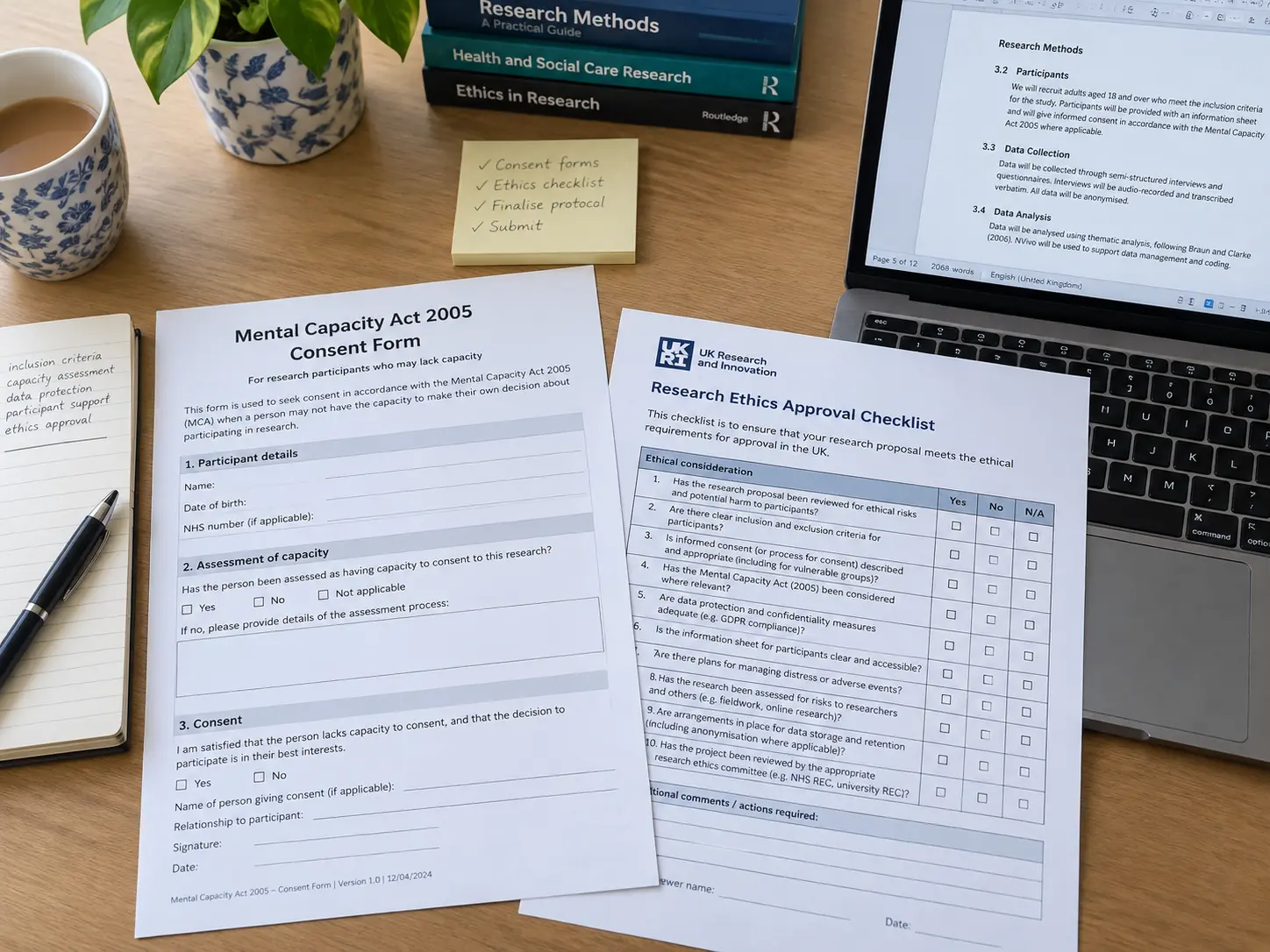
The Mental Capacity Act 2005 sets out that capacity is decision-specific and time-specific — a person can have capacity to consent to a conversation about their daily routine while lacking capacity for a different, more complex decision, and capacity can fluctuate. This matters directly for OT dissertation populations, because several of the groups OT researchers most want to study — people with dementia, some people with learning disabilities, some people recovering from acute stroke — may have fluctuating or contested capacity.
Three practical consequences follow for an undergraduate design:
- Capacity is assessed for the specific decision to participate, not assumed from a diagnosis. A dementia diagnosis does not itself mean someone lacks capacity to consent to a short interview about their own routine.
- Where capacity is in doubt, an undergraduate design should not proceed with primary recruitment — this is exactly the situation the HRA bar and most university ethics panels push toward a staff-perspective, documentary, or secondary-data design instead.
- Consultee involvement (family, an independent consultee, or a nominated representative) is a formal Mental Capacity Act process, not something an undergraduate dissertation can set up in the time available — it belongs to funded or doctoral-level research with the infrastructure to support it, not to a 12-week dissertation project.
For children, consent works differently again: Gillick competence lets a child who understands what is being asked consent for themselves, but in practice a school-based undergraduate project will still go through parental consent and headteacher gatekeeping as the primary route, with the child’s own assent sought alongside it.
Choosing a setting: NHS, social care, charity, education or workplace?
Once you have a candidate population, work through the setting question in this order, because each answer closes or opens different consent routes:
| Setting | Typical gatekeeper | Consent route | Realistic for an undergraduate? |
|---|---|---|---|
| NHS clinical service | Service lead / R&D department | HRA/NHS REC approval | No — closed to standalone undergraduate research since Sept 2021 |
| Charity or voluntary organisation | Service manager / trustees | Organisation’s own governance + university ethics | Yes, with time to build the relationship |
| School or education setting | Headteacher / SENCo | School governance + parental consent | Yes, common route for child-population OT dissertations |
| Care home (private or independent) | Registered manager | Home’s own policy + university ethics; capacity applies in full | Yes, but expect a longer lead time to negotiate access |
| Workplace (staff as participants) | Line manager / professional lead | University ethics + employer permission — staff, not patients | Yes for non-NHS employers, and usually the fastest route to a clinically relevant answer; NHS staff as participants fall under the HRA bar |
A worked example (illustrative)
An illustrative, labelled example: a student interested in falls prevention in older adults defines their population as “adults aged 65+ attending a voluntary-sector falls-prevention exercise group in one UK city”, not “older adults at risk of falls” in the abstract. The setting is the charity that runs the group, not an NHS falls clinic. The gatekeeper is the group’s coordinator, who introduces the study and facilitates opt-in consent from members who wish to take part. Where a participant’s cognitive status is uncertain, the student’s supervisor and university ethics panel would expect the design to fall back to staff interviews about how the group supports members with early cognitive change, rather than direct data collection from that sub-group. This keeps the population specific, the setting realistic, and the consent route inside what an undergraduate project can actually deliver in one academic year.
What do RCOT’s professional standards expect of a student researcher?
The Royal College of Occupational Therapists (RCOT) publishes its Professional Standards for Practice, Conduct and Ethics as the profession’s reference point for how OT practitioners — and by extension OT students on placement or conducting research — are expected to act toward the people they work with. Your dissertation’s ethics section should name RCOT’s standards as the professional reference point for your field, alongside the university’s own ethics policy and, where the Mental Capacity Act applies, that legislation directly. Check your own department’s research ethics handbook for the specific RCOT sections it asks you to cite, since guidance documents are periodically updated and the exact wording your marker expects should come from what your handbook currently references.
Common mistakes when defining your population
- Naming a clinical population without a route to it. “People recovering from stroke” is not a population you can defend until you have said which setting, which gatekeeper, and which consent route makes it reachable.
- Assuming a diagnosis settles the capacity question. Capacity is decision-specific; a diagnosis of dementia, learning disability or acute illness does not by itself tell you whether someone can consent to your particular study.
- Treating a charity or school as a lighter-touch shortcut around ethics. Non-NHS settings still require full university ethics approval and often their own safeguarding process on top — the difference is which process applies, not whether one does.
- Leaving the population vague until the proposal is nearly due. Gatekeeper relationships in OT-relevant settings (a school, a charity, a care home) typically take weeks to establish; population and setting need deciding early, not fixed after the literature review is written.
Frequently asked questions
Can I interview NHS occupational therapists for my undergraduate dissertation?
Not through the NHS. The HRA treats research with NHS staff as participants as needing its approval, and it no longer accepts standalone undergraduate applications. Occupational therapists employed outside the NHS, for example in charities, schools, care homes or independent practice, can usually be interviewed with university ethics approval and the organisation’s permission — agree the recruitment route with your supervisor before contacting anyone.
Does the Mental Capacity Act apply outside the NHS?
Yes. The Mental Capacity Act 2005 applies wherever a decision about participation is being made in England and Wales, regardless of whether the setting is NHS, charity, care home or school — capacity is about the person and the decision, not about who runs the building.
Can I study children with sensory processing needs for my dissertation?
Yes, usually through a school setting with headteacher and parental consent, and child assent sought alongside it. This is a well-established undergraduate route in OT and education-adjacent dissertations on this site.
What if my ideal population is genuinely NHS-only?
Reframe the research question around the views of staff working outside the NHS, secondary/published data, or a service evaluation report rather than primary patient recruitment. The population you care about can often still be studied — just not by recruiting its members directly.
Is a care home the same as an NHS setting for ethics purposes?
No. Most UK care homes are privately or charitably run, with their own governance route rather than NHS REC approval, though university ethics approval and full Mental Capacity Act consideration still apply in full.
How many participants do I need?
This depends on your design rather than your population as such — see our guide on sample size for an undergraduate dissertation for the reasoning behind small, purposive qualitative samples versus larger survey samples.
Can I use Gillick competence instead of parental consent for a child population?
In practice, most undergraduate school-based projects still route through parental consent and school gatekeeping as the primary mechanism, with the child’s own assent sought in addition — a project relying on Gillick competence alone, without institutional gatekeeping, is unlikely to be approved at undergraduate level.
Should I name RCOT’s standards in my ethics section?
Yes — naming the profession’s own published standards alongside your university’s ethics policy strengthens your methodology chapter and shows the marker you have grounded your consent and capacity decisions in the discipline’s own reference points, not just generic research-methods textbooks.
Can Tesify help me write the population and ethics sections of my OT dissertation?
Tesify is used to write dissertations end to end, including the methodology and ethics sections, with every draft 100% written by you through the platform — it does not source or vet an OT-specific gatekeeper relationship for you, but it can help you structure and draft the population, setting and consent reasoning once you have worked out the access route with your supervisor.
What is the single biggest reason OT population sections lose marks?
Naming an aspirational population (a clinical group you would like to study) without naming the realistic setting, gatekeeper and consent route that would actually let you reach it — markers check for the second part at least as closely as the first.
Tesify has helped over 9,000 students write more than 15,000 dissertation chapters, and every draft is 100% written by you, guided section by section. Start your occupational therapy dissertation with Tesify and work through your methodology chapter with the population, setting and consent decisions mapped out properly from the start.