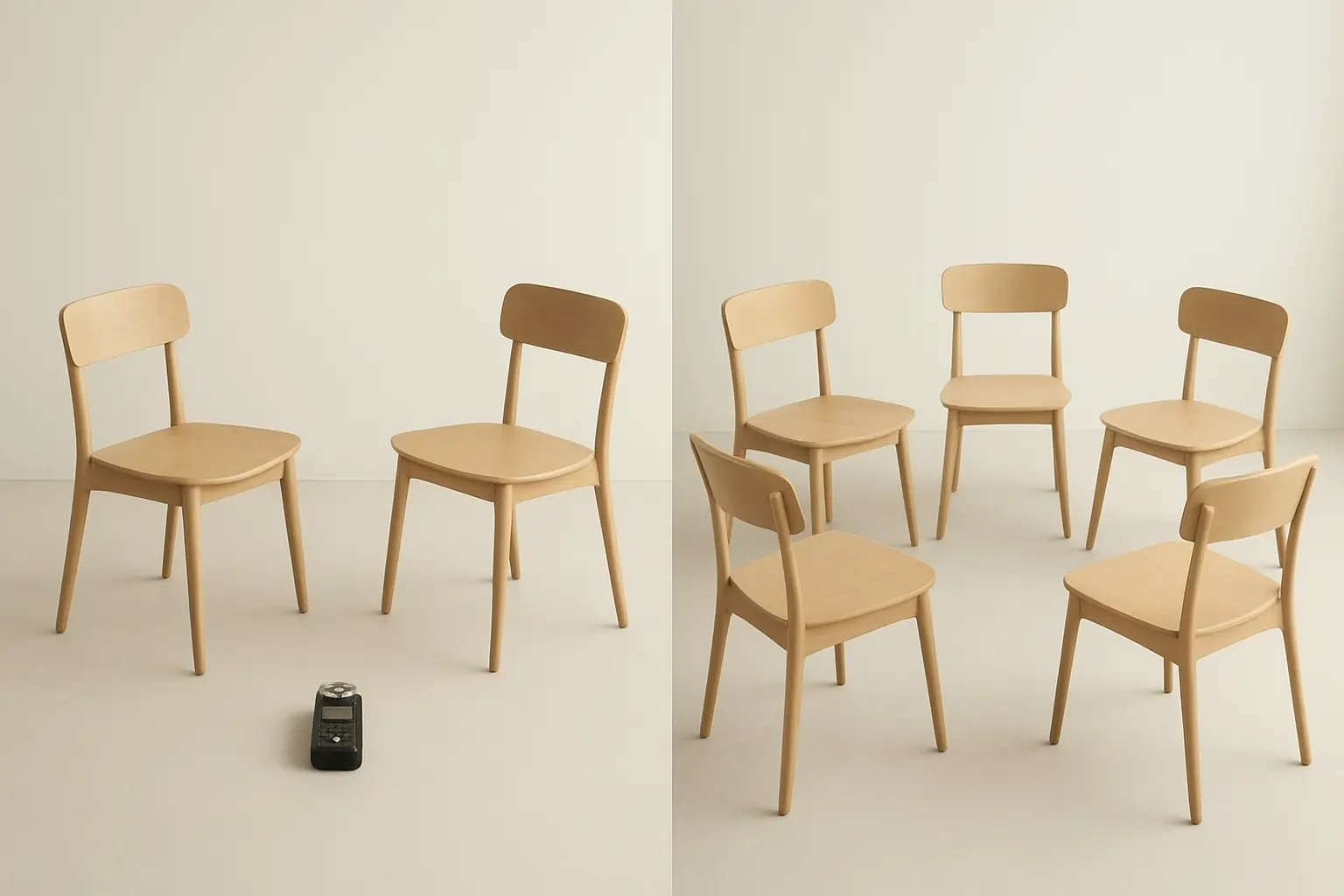
| One-to-one interviews | Focus groups | |
|---|---|---|
| Best for | Individual decision-making, purchase journeys, sensitive brand attitudes, B2B buyer behaviour | Brand perception, social influence on consumption, reactions to concepts/ads shown to the group |
| Typical sample | 8–15 individual interviews | 3–5 groups of 6–8 participants each |
| Session length | 30–60 minutes | 60–90 minutes |
| Recruitment difficulty | Lower — one person, one diary slot | Higher — coordinating 6–8 people’s availability |
| What you lose | Social dynamics, how consumers influence each other | Depth on any one individual’s private reasoning; groupthink risk |
| Transcription/coding load | Lower per session, more sessions | Higher per session (multiple overlapping voices), fewer sessions |
Which should most marketing dissertations use?
If your question is about how individual consumers reach a decision, use interviews; if your question is about how consumers influence and respond to each other around a brand, product or campaign, use focus groups. Most undergraduate marketing dissertations asking “why do consumers choose X” or mapping a purchase journey are better served by interviews, because the social pressure inside a group setting genuinely changes what people say about their own private reasoning. Focus groups earn their extra recruitment cost specifically when the social dynamic is part of what you are studying — brand community, word-of-mouth, or live reactions to a concept shown to the room.
A worked illustration of the choice: a dissertation asking “why do students switch from one streaming service to another” is an individual-decision question — interviews. A dissertation asking “how does a university friendship group’s opinion of a fashion brand form and spread” is a social-influence question — focus groups, because the phenomenon being studied only exists in the group setting.
When interviews are the right choice
Interviews suit questions about an individual’s decision process: what led them to switch brands, how they evaluated competing options, what a specific advert or campaign meant to them personally. They also suit sensitive or high-involvement topics (financial products, health-adjacent purchases, luxury spending) where participants are unlikely to speak candidly in front of strangers. In B2B marketing dissertations, interviews are close to the only workable option, since the target population (senior buyers, procurement managers) is small, hard to gather in one room, and used to one-to-one professional conversations.
When focus groups are the right choice
Focus groups suit questions where the social interaction itself is the data: how a brand is talked about among peers, how group opinion shifts when one participant pushes back, or live reactions to a stimulus (an advert, packaging concept, or social media post) shown to everyone at once. They are efficient for reach — one 90-minute session gathers six to eight perspectives — but that efficiency is exactly what dilutes individual depth; a dominant participant can visibly steer the room’s answers, which the moderator has to manage rather than the analysis fixing afterwards.
How should you sample participants for either method?
Marketing dissertations almost always use purposive sampling — deliberately recruiting people who have the experience your question needs (recent purchasers of the product category, members of the brand’s target segment, or a specific demographic your research question names) rather than a random sample. State your selection criteria explicitly: for the streaming-service example, “must have actively switched primary streaming provider within the last six months” is a workable, checkable criterion; “interested in streaming” is not. For focus groups specifically, consider whether participants should already know each other (a genuine friendship group, useful for studying real social influence) or be strangers (reduces pre-existing group dynamics that could distort a brand-perception study) — state and justify which you chose.
A worked interview guide (marketing-specific)
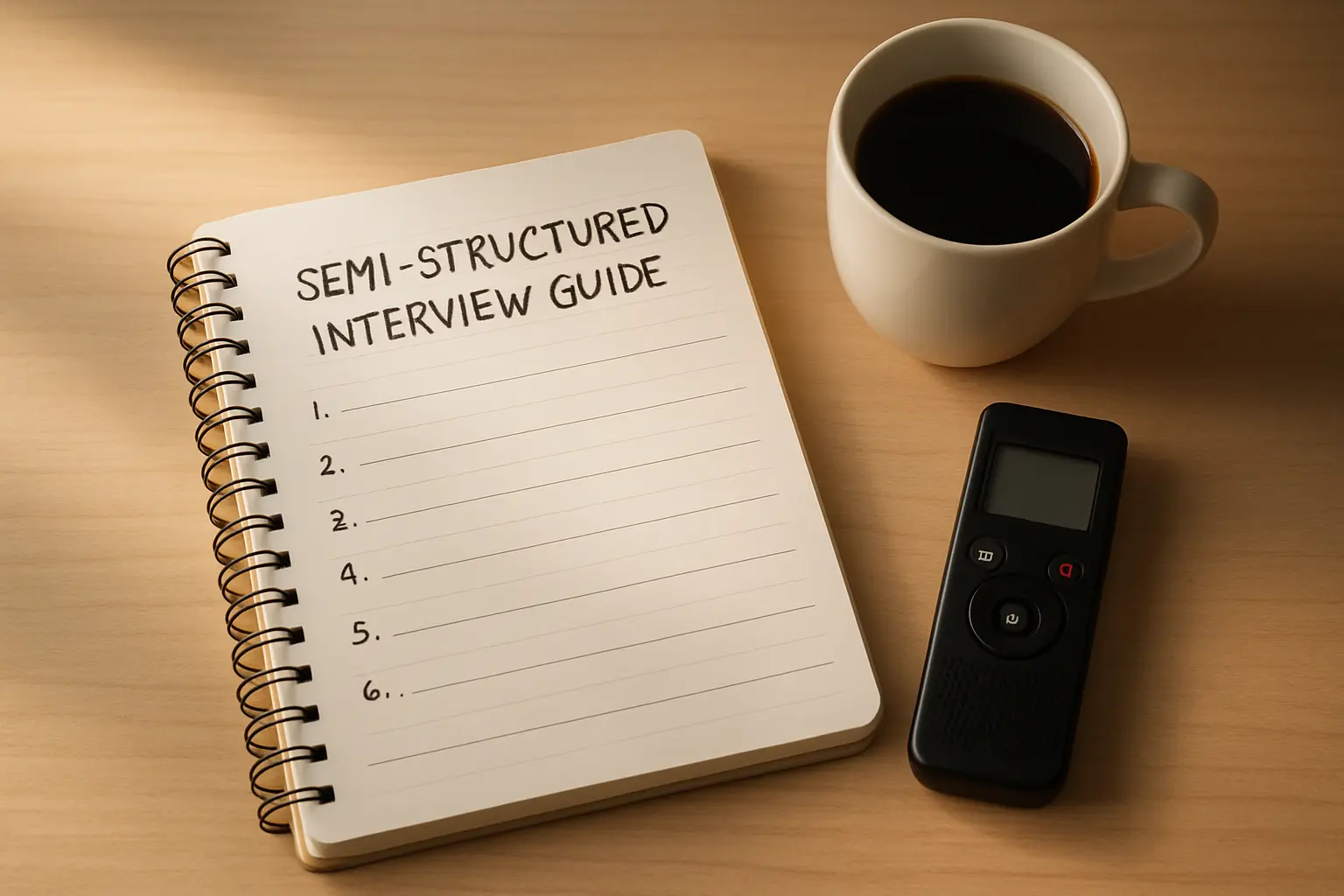
A semi-structured interview guide for a purchase-decision study, illustrative and adapted to your own topic:
- Warm-up: “Tell me about the last time you bought [product category].” (Establishes a concrete episode to anchor the rest of the interview, rather than asking about attitudes in the abstract.)
- Decision process: “Walk me through what happened between first thinking about it and actually buying.” Probe: “What almost stopped you?”
- Brand comparison: “What other options did you consider, and why did you rule them out?”
- Information sources: “Where did you look for information or reassurance before deciding?”
- Post-purchase: “How do you feel about the choice now, looking back?”
- Close: “Is there anything about this decision I haven’t asked about that mattered to you?”
Each question is open, and every probe exists to get the participant back into the concrete episode rather than generalising (“I usually just…”) — generalised answers are far weaker data for a marketing dissertation than one detailed, specific account.
A worked focus group guide (marketing-specific)
A structure for a brand-perception focus group, illustrative:
- Warm-up round: each participant names one brand they feel strongly about, positive or negative, and why (gets everyone talking before the topic narrows).
- Free association: “When I say [brand name], what comes to mind?” — captured quickly, no discussion yet, to avoid anchoring the group on the first answer given.
- Stimulus reaction: show the concept/advert/packaging; ask for first reactions before any group discussion, then open the floor.
- Comparison: “How does this compare with [competitor]?” — deliberately invites disagreement, which is often the most useful data in the transcript.
- Close: ask if anyone’s view changed during the discussion, and why — this question specifically captures the social-influence effect that is the whole reason to run a group rather than separate interviews.
A moderator’s job in a focus group is different from an interviewer’s: managing turn-taking, drawing out quieter participants by name, and gently interrupting a participant who is starting to dominate — skills worth practising in a pilot session before your real fieldwork.
How does this connect to the rest of your methods chapter?
Whichever you choose, the underlying instrument-design principles are the same ones covered in questionnaire and interview schedule templates for an undergraduate dissertation — participant information, consent, and the question-fault checklist apply to both interviews and focus groups equally; this guide adds the marketing-specific content and the choice between the two formats. Once your sessions are recorded and transcribed, how to do a thematic analysis for your dissertation covers the six-phase coding process for either data type. If you have not yet settled your theoretical framework, theoretical frameworks for a marketing dissertation can help your interview or focus group questions map cleanly onto the constructs your chosen theory actually uses.
What are the practical trade-offs a marketing dissertation actually hits?
Recruitment is the biggest practical difference: filling eight individual interview slots is far easier than coordinating one group of eight people’s availability, room booking and no-show risk — budget for over-recruiting focus groups by at least one or two spare participants per session. Transcription is the second: a one-to-one interview transcribes cleanly; a focus group recording has overlapping speech, and you will need a seating chart or voice-recognition discipline during the session to reliably attribute quotes to the right participant afterwards. If your timeline is tight, interviews are usually the lower-risk choice purely on logistics, independent of which better answers your research question.
A third, less obvious trade-off is location. Interviews can often happen wherever suits the participant — a quiet corner of a café, a video call, their own office for a B2B study — while a focus group needs a bookable room large enough for the whole group plus a recording setup that reliably picks up every voice, which on some campuses means booking weeks in advance. Factor room availability into your timeline before committing to a focus-group design against a fixed submission date. A fourth trade-off worth weighing at the proposal stage: interviews generate more individually attributable quotations, which some markers reward for depth, while focus groups generate richer interaction data (agreement, disagreement, who changed their mind) that a purely quote-by-quote write-up can undersell if you do not explicitly discuss the group dynamic itself.
Can you use both in the same dissertation?
Yes, and it is a common and well-regarded design: focus groups first to surface the language and themes consumers actually use (which then sharpens your interview questions), or interviews first to identify individual variation, followed by a focus group to see how those individual views play out socially. State the sequencing and its rationale explicitly in your methodology chapter rather than presenting it as two unrelated methods bolted together.
How does Tesify help with this chapter?
Tesify can help draft your interview or focus group guide from your research questions, and turn coded transcripts into a structured findings chapter once your fieldwork is done.
Frequently asked questions
How many interviews or focus groups do I need for a marketing dissertation?
Eight to fifteen individual interviews, or three to five focus groups, is typical at undergraduate level — the right number depends on when you reach saturation (new sessions stop producing new themes) rather than a fixed target, but plan around these ranges for your timeline and ethics application.
Can I run focus groups online instead of in person?
Yes, video-call focus groups are now a well-established and often more practical option, particularly for geographically spread participants, though moderating turn-taking is harder on video and a slightly smaller group (4–6 rather than 6–8) usually works better online.
Do focus groups need more ethics approval than interviews?
The core requirements (informed consent, right to withdraw, data protection) are the same, but focus group consent forms should also cover confidentiality between participants specifically — you can promise your own confidentiality, but you cannot guarantee what a fellow participant does with what they heard in the room, and this needs to be stated to participants.
Should I pay participants for focus groups?
Many UK marketing dissertations offer a small incentive (a shopping voucher is common) for focus groups given the higher time commitment, though this varies by department policy and budget; check your ethics application guidance on what is acceptable.
What if my focus group has a dominant participant who takes over?
Manage it live where possible — direct a question specifically to a quieter participant by name, or say “let’s hear from some others on this” — and note the dynamic in your reflexivity/limitations discussion if it affected the data, rather than presenting the transcript as if every voice had equal airtime.
Is one method more “rigorous” than the other for a dissertation?
No — rigour comes from choosing the method that fits your research question and executing it well (clear guide, careful recruitment, systematic analysis), not from the format itself. A poorly matched method executed perfectly is still the wrong choice for your question.
How long should I budget for transcription?
As a rough guide, one hour of interview or focus group audio typically takes four to six hours to transcribe manually, more for a focus group with overlapping speech; AI transcription tools can cut this substantially but still need a careful human check against the recording, especially for accents, background noise and cross-talk.
Should I run a pilot session before my real fieldwork?
Yes — a single pilot interview or a small pilot focus group catches confusing questions, timing problems and (for groups) moderation difficulties before you commit your full recruited sample, and most supervisors expect to see a pilot mentioned in the methodology chapter.
What if participants in a focus group already know each other well?
This is called a “friendship pairing” or natural-group design, and it is a deliberate, defensible choice when your question is about how opinions genuinely spread within existing social networks — just be aware that established group dynamics (who normally defers to whom) will show up in the data, and note this in your methodology rather than treating the group as a blank slate of strangers.