
The Journal of Business Logistics (published since 1979, now by Wiley on behalf of the Council of Supply Chain Management Professionals) and the International Journal of Physical Distribution & Logistics Management (Emerald, established in 1970 under an earlier title) are the two flagship peer-reviewed outlets a UK logistics or supply chain dissertation should search first, both accessible through a university library subscription.
| Source | Publisher / since | Access | Best for |
|---|---|---|---|
| Journal of Business Logistics | Wiley for CSCMP; published since 1979, quarterly | University library subscription | Flagship US/global logistics and SCM theory and empirical research |
| International Journal of Physical Distribution & Logistics Management | Emerald; established 1970 under an earlier title | University library subscription | Physical distribution, marketing-channel and SCM operations research |
| Supply Chain Management: An International Journal | Emerald | University library subscription | Broader SCM strategy, sustainability and relationship-management research |
| ABI/INFORM Collection | ProQuest | University library subscription | Broad business and management database indexing logistics alongside other business disciplines |
| Business Source Complete | EBSCO | University library subscription | Broad business database with full text for many management journals |
| CIPS (Chartered Institute of Procurement & Supply) resources | Professional body | Some open; full resources via membership | Practitioner-facing procurement and supply chain standards, not primary research evidence |
Why start with the two named journals
Searching these two titles directly — rather than only running a keyword search across a general database — ensures you have seen the flagship, highest-quality logistics and SCM research before broadening out. The Journal of Business Logistics tends toward theory-building and empirical SCM research with a strong North American and global authorship base; the International Journal of Physical Distribution & Logistics Management covers the operational, physical-distribution and marketing-channel side of the discipline more directly. A dissertation that cites both, rather than one, demonstrates it has covered the field’s core literature rather than a single school of thought within it.
Broadening the search: general business databases
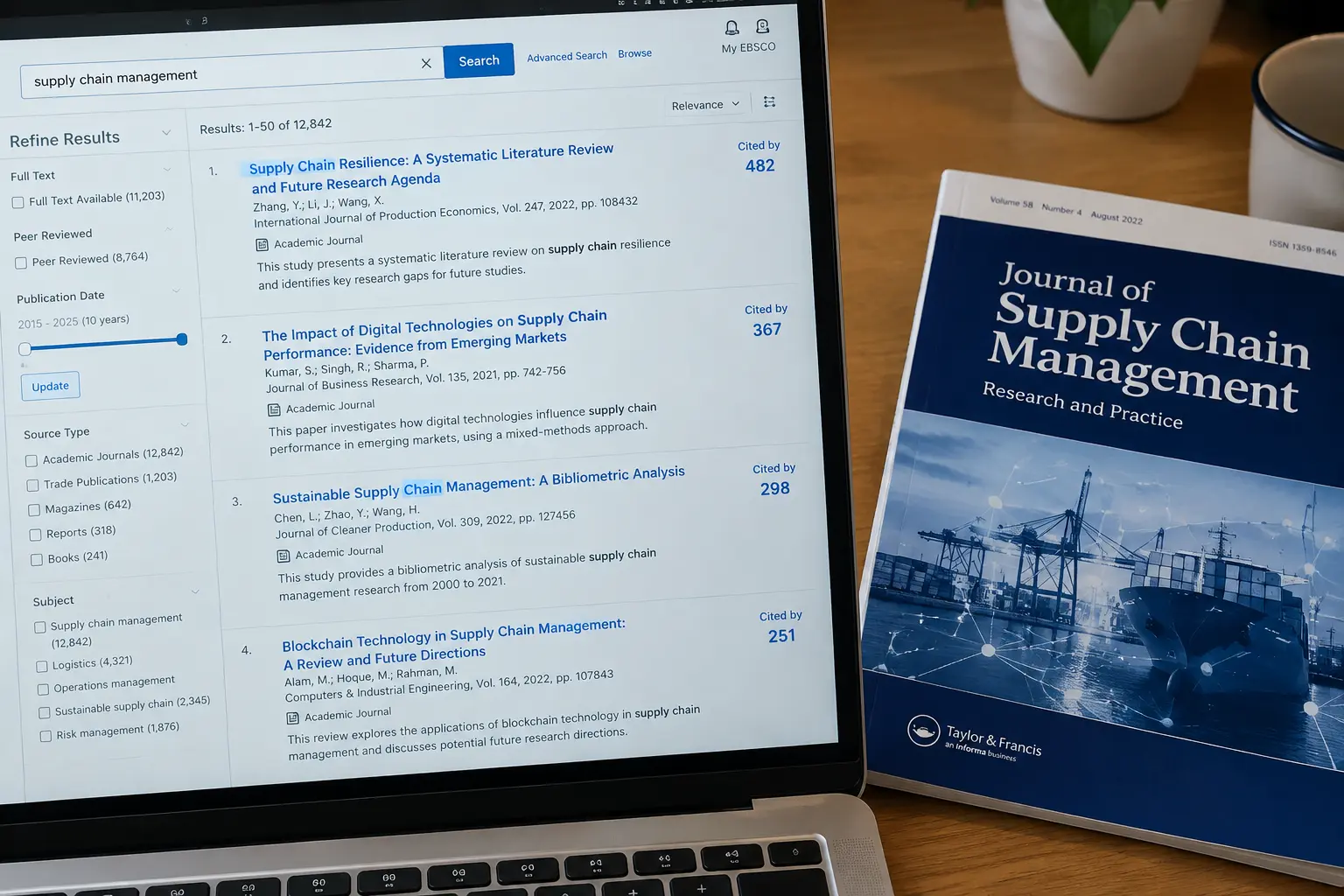
ABI/INFORM (ProQuest) and Business Source Complete (EBSCO) both index logistics and supply chain literature alongside the wider business and management field, and both are standard university library subscriptions — check your own library’s database list rather than assuming one specific platform, since institutional subscriptions vary. Our guide to where finance students get dissertation data covers several of the same general business databases from a different angle, worth reading if your logistics dissertation also touches financial or company-performance data.
Assessing the quality of what you find
Not every source in your reference list carries equal weight, and a dissertation that treats a peer-reviewed Journal of Business Logistics article the same as an unrefereed conference abstract or a company white paper is not demonstrating critical appraisal. As you search, note against each source: whether it is peer-reviewed, the study design (survey, case study, systematic review, conceptual/theoretical piece), and the sample or context (which country, which industry sector, how many firms or respondents). This detail is far easier to capture as you go than to reconstruct later when writing your discussion chapter, and it is exactly the evidence an examiner looks for when judging whether your literature review is a synthesis rather than a list.
Professional body resources: use with care
CIPS (the Chartered Institute of Procurement & Supply) publishes practitioner-facing standards, qualifications frameworks and practice guidance for the procurement and supply chain profession. These are useful for grounding your dissertation in current UK professional practice and standards, but they are not primary research evidence — cite CIPS material for what the profession itself says about its own standards, and cite the peer-reviewed journals above for the research evidence base your analysis actually rests on.
Setting up access to each source, step by step
- Journal of Business Logistics: access via Wiley Online Library through your university library’s single sign-on — search your library catalogue by journal title if it is not immediately visible on the database homepage.
- International Journal of Physical Distribution & Logistics Management: access via Emerald Insight, again through your institutional login — some universities license Emerald journals under a package name rather than by individual title, so check with your librarian if a direct search does not surface it.
- Supply Chain Management: An International Journal: also on Emerald Insight, usually under the same institutional package as IJPDLM.
- ABI/INFORM and Business Source Complete: both listed on your library’s databases A–Z list; set up saved searches and citation alerts once you have found your core search terms, so new literature surfaces automatically as your dissertation progresses.
- CIPS resources: start with the material CIPS publishes openly, and ask your course lead or library whether any member-only resources are available to you before assuming you need to join individually.
A worked example of a documented search strategy (illustrative)
An illustrative, labelled example of how a methodology chapter might document this: “Literature was searched across the Journal of Business Logistics, the International Journal of Physical Distribution & Logistics Management, and ABI/INFORM for records published between January 2016 and March 2026. Search terms combined the supply chain concept (e.g. ‘supply chain resilience’ OR ‘supply chain disruption’) with the sector or context (e.g. ‘UK manufacturing’) using the Boolean operator AND. Inclusion criteria were: peer-reviewed, English language, published within the last ten years. Records were screened by title and abstract, then full text, against these criteria, and a flow diagram recorded the number of records identified, screened, excluded and included at each stage.” This level of stated detail — named databases, dates, terms, Boolean logic, inclusion criteria — is what turns a reference list into a defensible, reproducible search strategy a marker can actually evaluate.
A worked citation example
Harvard-style journal reference template: Author, A. (Year) ‘Article title’, Journal of Business Logistics, Volume(Issue), pp. start–end page. In-text: (Author, Year). For an Emerald journal such as the International Journal of Physical Distribution & Logistics Management, the format is identical — the publisher does not change the citation style, only where you access the full text. See our full guide to referencing in Harvard style for volume/issue formatting and DOI conventions.
Building a documented search strategy
State in your methodology chapter which databases and journals you searched, your search terms, your date range, and your inclusion criteria — a dissertation that cites only sources found through a single general keyword search, with no stated strategy, reads as less rigorous than one with a documented, reproducible process. Our guide to writing the search strategy section of a dissertation (written for nursing, but directly transferable) covers exactly this documentation.
How this differs from a general business dissertation’s sources
A generic business or management dissertation can often get by searching one or two broad databases. A logistics or supply chain dissertation benefits from naming the field’s own flagship journals explicitly, because the discipline is narrow enough that examiners in this area know exactly which titles carry the strongest research — citing JBL and IJPDLM by name, rather than only citing whatever a keyword search on ABI/INFORM happened to surface, signals that you know the field’s own literature landscape, not just how to run a database search.
Common mistakes when sourcing logistics literature
- Searching only a general database. ABI/INFORM or Business Source Complete alone will miss recent articles not yet fully indexed, or will bury flagship-journal articles among thousands of unrelated business results — search the named journals directly as well.
- Treating CIPS material as research evidence. Professional-body standards and research findings are different source types; cite each for what it actually is.
- Citing only one flagship journal. Relying on JBL or IJPDLM alone, rather than both, misses half the field’s core literature.
- Not checking access before your search day. Confirm your university library’s subscriptions to these specific titles in week one, since not every institution subscribes to every logistics-specific journal.
- Not considering analysis software alongside your sources. Once you have your data, our guide to data analysis software for a dissertation compares the tools you may need for a quantitative supply chain analysis, even though it was written for accounting.
Frequently asked questions
Is the Journal of Business Logistics freely accessible?
No — it requires a university library subscription via Wiley Online Library; check your own institution’s subscriptions before assuming access.
What is the difference between JBL and IJPDLM?
Both are flagship logistics/SCM journals, but JBL (Wiley, for CSCMP) leans toward theory-building and empirical SCM research with a global authorship base, while IJPDLM (Emerald) covers physical distribution, marketing-channel and operational SCM research more directly — search both for comprehensive coverage.
Should I use ABI/INFORM or Business Source Complete?
Check which your university library subscribes to — many institutions hold both, and searching both where available broadens your coverage beyond what either alone would surface.
Can I cite CIPS as a research source?
Cite CIPS material when discussing professional standards, qualifications or practice guidance, not as a substitute for peer-reviewed research evidence on a supply chain question.
How many sources should a logistics dissertation literature review cite?
There is no fixed number — breadth, range and synthesis matter more than a target count; a well-documented search across the sources above, appraised critically, is what markers actually assess.
Does Supply Chain Management: An International Journal differ from the other two?
Yes — it tends toward broader SCM strategy, sustainability and inter-organisational relationship research, complementing rather than duplicating JBL’s and IJPDLM’s more operational and empirical focus.
Is Google Scholar enough for a logistics dissertation search?
No — it is a useful supplement for finding a specific known paper, but it does not offer the systematic, documented search functionality (saved strategies, exact field searching) a dissertation’s methodology chapter needs.
What citation style do logistics dissertations normally use?
Check your own department’s handbook — Harvard is common across UK business schools, but some use APA; the underlying bibliographic details (author, year, title, journal, volume, issue, pages) are the same regardless of the style applied.
Can Tesify help me build my logistics dissertation’s literature review?
Tesify is used to write dissertations end to end, including literature review and methodology sections, with every draft 100% written by you through the platform — it does not run the database searches for you, but it can help you structure and write up a search strategy once you have run it.
What is the single biggest mistake in a logistics dissertation’s source list?
Relying on a single general database search and missing the flagship, field-specific journals — JBL and IJPDLM — that a marker will expect to see cited.
Should I use a reference manager for a logistics dissertation?
Yes — searching across five or six sources produces enough records that a reference manager (Zotero, Mendeley or EndNote) becomes necessary to avoid duplicate entries and lost citations; set this up alongside your database access in your first term.
Are conference papers acceptable sources for a logistics dissertation?
Peer-reviewed journal articles carry more weight, but conference proceedings (often indexed in Business Source Complete or Emerald) can be legitimate for very recent developments not yet published in journal form — note the source type explicitly when you cite one.
How current do my sources need to be?
Check your own department’s expectations, but a supply chain or logistics dissertation discussing a fast-moving area (resilience, digitalisation, sustainability) should weight recent sources (the last five to ten years) more heavily, while foundational theoretical works can be older — state your date range and rationale in your methodology chapter either way.
Do I need to search both Emerald journals separately, or does one search cover both?
Search them separately by name even if your library groups Emerald titles under one platform — a single generic Emerald keyword search can miss relevant articles that a targeted, journal-specific search catches, particularly when a term is common across many business disciplines Emerald also publishes.
Tesify has helped over 9,000 students write more than 15,000 dissertation chapters, and every draft is 100% written by you, guided section by section. Start your logistics or supply chain dissertation with Tesify and work through your literature review with a properly sourced, documented search strategy from the start.