
| Scale | Items | Dimensions | Response format | Access |
|---|---|---|---|---|
| Teachers’ Sense of Efficacy Scale (TSES), long form — Tschannen-Moran & Woolfolk Hoy (2001) | 24 items | Three: efficacy for student engagement, instructional strategies, classroom management | 9-point scale (1 = Nothing, 3 = Very Little, 5 = Some Influence, 7 = Quite a Bit, 9 = A Great Deal) | Published in the original journal article; free to use for academic research with citation |
| TSES, short form — Tschannen-Moran & Woolfolk Hoy (2001) | 12 items | Same three factors as the long form, four items each | Same 9-point scale as the long form | Published alongside the long form; free to use for academic research with citation |
| Teacher Efficacy Scale — Gibson & Dembo (1984) | 30 items originally, reduced to 16 in the authors’ own factor analysis | Two: Personal Teaching Efficacy and General Teaching Efficacy | 6-point Likert scale | Published in the original journal article; free to use for academic research with citation |
These three scales were compared on the criteria that matter most for a UK education dissertation: how well-established and widely cited the instrument is (so your choice is defensible to a marker), how many items your participants realistically have time to complete, how the dimensions map onto your specific research question, and whether the scale is genuinely free to use for a student dissertation.
What each dimension actually measures
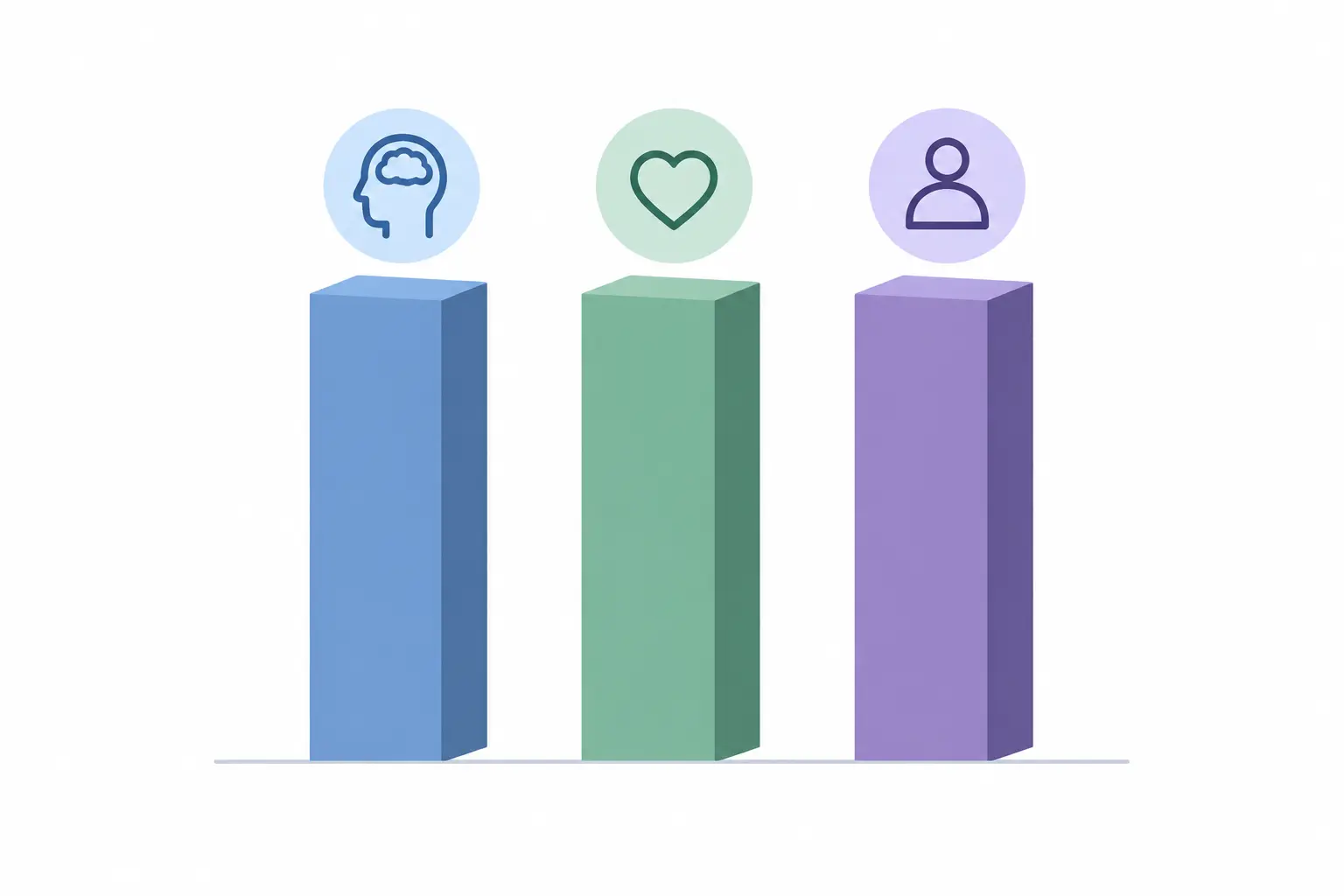
Before choosing a scale, it helps to know what its dimensions let you say. The TSES’s three factors map onto genuinely distinct classroom jobs: efficacy for student engagement captures a teacher’s belief in their ability to motivate disengaged students and foster a value for learning; efficacy for instructional strategies captures belief in one’s ability to use varied assessment strategies and adjust lessons when students are confused; efficacy for classroom management captures belief in one’s ability to control disruptive behaviour and establish routines. A research question about behaviour management specifically is better served by the classroom-management subscale alone than by a combined total score, which is one of the practical advantages of TSES’s three-factor structure over Gibson and Dembo’s two-factor, more general personal/general split.
Ranked shortlist
1. TSES short form — the practical default for most undergraduate dissertations
Twelve items, four per factor, is short enough to sit inside a wider questionnaire without exhausting participants, while still capturing all three of the dimensions the long form measures. This is the version most UK undergraduate education dissertations should reach for first unless there is a specific reason to want the finer-grained detail of the 24-item long form. Where it falls short: with only four items per factor, subscale reliability can run slightly lower than the long form’s, which is worth acknowledging as a limitation if your sample is also small.
2. TSES long form — better for a taught master’s dissertation wanting finer detail
The 24-item version gives more items per factor (eight each), which generally improves subscale reliability and gives you more to say if your dissertation analyses the three dimensions separately rather than as a single combined efficacy score. Where it falls short: at 24 items, it adds meaningfully to your questionnaire’s total length, which matters if you are also including other instruments and want to protect your response rate.
3. Gibson & Dembo Teacher Efficacy Scale — useful mainly for comparing against older literature
If your literature review engages heavily with pre-2000 teacher efficacy research, using this scale keeps your own data directly comparable to that older body of work, since it operationalises Bandura’s original two-part efficacy/outcome-expectancy distinction (personal teaching efficacy and general teaching efficacy) rather than the three-factor structure TSES introduced later. Where it falls short: TSES has become the more widely used and more contemporarily cited instrument in UK education research since 2001, so choosing Gibson & Dembo without a specific comparative reason may read as a dated choice to a marker familiar with the field’s current instruments.
Our recommendation
For most UK undergraduate education dissertations measuring teacher self-efficacy, the TSES short form is the strongest default: it is well-established, its three-factor structure maps cleanly onto distinct, discussable research questions (engagement, instructional strategies, classroom management), and twelve items is a realistic ask of a teacher-participant’s time. Move to the TSES long form if your dissertation is a taught master’s project with room in your questionnaire and you want stronger subscale-level reliability, and reach for Gibson & Dembo only where your research question specifically requires comparability with older teacher-efficacy literature.
How this differs from the theoretical-framework decision
Choosing a self-efficacy scale is a different decision from choosing a theoretical framework, even though both often involve Bandura’s work: the framework explains why you expect self-efficacy to relate to your outcome of interest, while the scale is the instrument you actually use to measure it. If you have not yet settled on your theoretical framework, our comparison of theoretical frameworks for an education dissertation covers Bandura’s self-efficacy theory alongside seven others, at the level of what each framework explains rather than which instrument operationalises it — use that piece to choose your framework, and this one to choose your measurement tool once self-efficacy is confirmed as your construct.
Where a self-efficacy survey fits inside your wider methodology
A validated scale like TSES is normally one instrument inside a wider methodology chapter that also has to justify your overall design, your sampling strategy, and how you gained access to schools and teachers as participants. If you have not yet written that chapter, our step-by-step guide to writing the methodology chapter of an education dissertation covers gatekeeper access, DBS checks, and consent under BERA 2024 in the order markers expect to see them decided. If your project is built around your own teaching practice specifically, rather than surveying other teachers, our guide to action research as your education dissertation covers a design where a self-report efficacy measure like this one could sit inside a pre/post cycle rather than a one-off survey. And if licensing or cost is a concern with any psychological instrument, not just this one, our comparison of which psychology scales you can actually use as an undergraduate covers the broader landscape of free versus restricted instruments.
Using the scale correctly in your methodology chapter
Name the exact version you used (long or short form), cite Tschannen-Moran and Woolfolk Hoy (2001) directly rather than a secondary source that merely mentions the scale, and report the response format and scoring method (mean score per subscale, or a combined total) exactly as the original authors specify. Illustrative example: “Teacher self-efficacy was measured using the 12-item short form of the Teachers’ Sense of Efficacy Scale (Tschannen-Moran and Woolfolk Hoy, 2001), rated on a 9-point scale from 1 (Nothing) to 9 (A Great Deal), with a mean score calculated for each of the three subscales.” This level of specificity is what separates a methodology chapter that reads as competent from one that merely gestures at “a validated efficacy scale.”
Check the original scoring instructions carefully before analysis rather than assuming a standard approach: confirm directly against Tschannen-Moran and Woolfolk Hoy’s (2001) own scoring guidance whether any items require reverse-coding before you calculate subscale means, and state in your methodology that you checked this, since a marker cannot assume you did.
Frequently asked questions
Do I need permission to use the TSES in my dissertation?
No formal licence or fee is required to use the TSES for academic research; cite the original 2001 journal article and reproduce the items accurately from that source rather than from a secondary summary.
Can I adapt the wording of items for my specific context?
Minor wording adaptations (for example, adjusting “students” to a specific age group) are common in published research, but state clearly in your methodology that you adapted the original wording and explain why, since this is a methodological decision a marker will want justified.
Should I use the long form or short form if I am not sure?
Default to the short form unless you have a specific reason (a taught master’s project with more questionnaire space, or a research question that needs the finer subscale detail) to prefer the long form — the short form is the more commonly used choice in comparable undergraduate dissertations for good reason.
Can I use TSES with primary school and secondary school teachers in the same sample?
The scale itself is general enough to use across phases, but state this explicitly as a feature of your sample and consider whether phase should be a variable in your analysis, since efficacy beliefs can differ systematically between primary and secondary teaching contexts.
Is a 9-point response scale unusual?
It is less common than a 5- or 7-point Likert scale, but it is the scale the original TSES authors specified and validated, so changing it without strong justification would be changing the instrument rather than simply using it.
Can I use TSES with trainee or student teachers rather than qualified staff?
Yes, this is a recognised use in the literature, though efficacy beliefs in trainees are typically less stable and more responsive to recent classroom experience than in experienced teachers — note this as a contextual factor in your discussion rather than treating trainee and experienced-teacher samples as directly equivalent. If your dissertation compares trainees at different points in their placement (for example, early versus late in a PGCE year), say so explicitly in your sampling strategy, since efficacy scores measured at different placement stages are not simply interchangeable data points.
Do I need to report Cronbach’s alpha for the scale in my own sample?
Yes — reporting the reliability of each subscale within your own data, alongside the values reported in the original validation studies, is standard practice and something markers specifically look for when a validated instrument is used.
How is this different from a generic teacher wellbeing or job-satisfaction scale?
Self-efficacy specifically measures a teacher’s belief in their own capability to achieve a specific teaching outcome, which is conceptually distinct from wellbeing or job satisfaction, even though the three constructs are often correlated in the literature — make sure your research question is genuinely about efficacy beliefs before selecting an efficacy-specific instrument.
Can I use TSES alongside a qualitative interview in the same dissertation?
Yes, this mixed-methods pairing is common — a quantitative TSES score can identify teachers with notably high or low efficacy, who are then followed up with a qualitative interview exploring why, provided your methodology chapter justifies the combined design and your timeline allows for both phases.
What sample size do I need for a TSES-based dissertation?
This depends on your analysis plan (correlational, comparative between groups, or purely descriptive) rather than the scale itself — see our general guide to sample size for an undergraduate dissertation for the reasoning, since TSES does not impose its own minimum sample requirement beyond what your statistical test needs.
Writing this section with Tesify
Tesify helps you write up your instrument choice and justification clearly in your methodology chapter, and helps you report reliability statistics for your own sample correctly once your data is in. Over 9,000 students have used Tesify across more than 15,000 dissertation chapters, and every dissertation on the platform is 100% written by you.