Tag: UK universities

  • How Much of Your Dissertation Mark Is for Writing? The Published UK Criteria (2026)

    How Much of Your Dissertation Mark Is for Writing? The Published UK Criteria (2026)

    No UK university publishes a national standard for how much of a dissertation mark is awarded for writing, and at least three publish undergraduate criteria that contain no writing category at all. That is the finding. Below are the actual published band descriptors from named UK universities, what they reward, and the one thing they agree on — which is not grammar.

    What the published criteria actually say, band by band

    Every document in this table was opened and its undergraduate scope confirmed from the document itself. The wording is quoted as published.

    Institution and document First 2:1 2:2
    Royal Holloway, Criminology and Sociology dissertation handbook “have an incisive and fluent style, with no significant errors of spelling, punctuation or grammar” “have a fluent style, with few errors of spelling, punctuation or grammar” “have a straightforward style, and may include some errors of spelling, punctuation or grammar”
    University of Edinburgh, School of Social and Political Science “the discussion should move beyond a mainly descriptive account of the results, to develop its own comments, points and interpretations” “Referencing and the quality of the writing should be without major blemish” “The data will be presented accurately, if rather descriptively… The quality of writing, referencing and presentation should be acceptable”
    UCL, Institute of Archaeology “style and word choice show fluency with ideas & flashes of verve” “style & word choice rarely detract from conveying of ideas” “style and word choice sometimes detract from conveying of ideas”
    Newcastle University, English Literature, Language and Linguistics “Style and expression are of a high academic standard, polished and fluent, with a strong command of discipline-specific vocabulary” “May present some problems of style and expression, but these do not interfere with the communication of the argument” “may present problems of style and expression that affect the communication of the argument”
    University of Nottingham, School of Sociology and Social Policy “Source material is treated critically… The argument is well structured and clear, with no significant confusion” “critical appraisal is underdeveloped. Analysis lacks depth”

    The pattern: the band boundary is criticality, not correctness

    Read down those columns and one thing is consistent. The prose descriptors move in small increments — fluent, then fluent with few errors, then straightforward. The analytical descriptors move in jumps.

    Keele makes this unmissable. In its generic undergraduate assessment criteria, the writing clause is word-for-word identical in the first-class and upper-second bands: “Clearly structured, robust and persuasive arguments, lucidly written, uses clear and accurate expression”. The same sentence appears in both. Only the critical-analysis clause differs. On that rubric, prose quality cannot move you from a 2:1 to a first, because the rubric asks the same of both.

    Nottingham states the same logic explicitly, and it is the single most useful sentence in any of these documents: “It may be helpful to see the lower second class as the starting point… Achieving a higher result requires something extra — and this will usually be found in the quality of analysis and criticism, in the presentation of a sustained and coherent argument…”

    The word markers reach for when that something extra is missing is descriptive. It appears in band after band. Edinburgh’s 2:2: data “presented accurately, if rather descriptively”. Edinburgh’s fail band: “failure to analyse or discuss the implications of the data in anything more than a thin and descriptive way”. Newcastle’s 2:2: “more descriptive than analytical”. Nottingham’s third: “Source material is treated uncritically, and analysis is flawed or non-existent.” Nottingham’s geography criteria describe a 2:2 dissertation as “pedestrian or lacking in imagination and critical insight… Satisfactory, but not stylish or perceptive.”
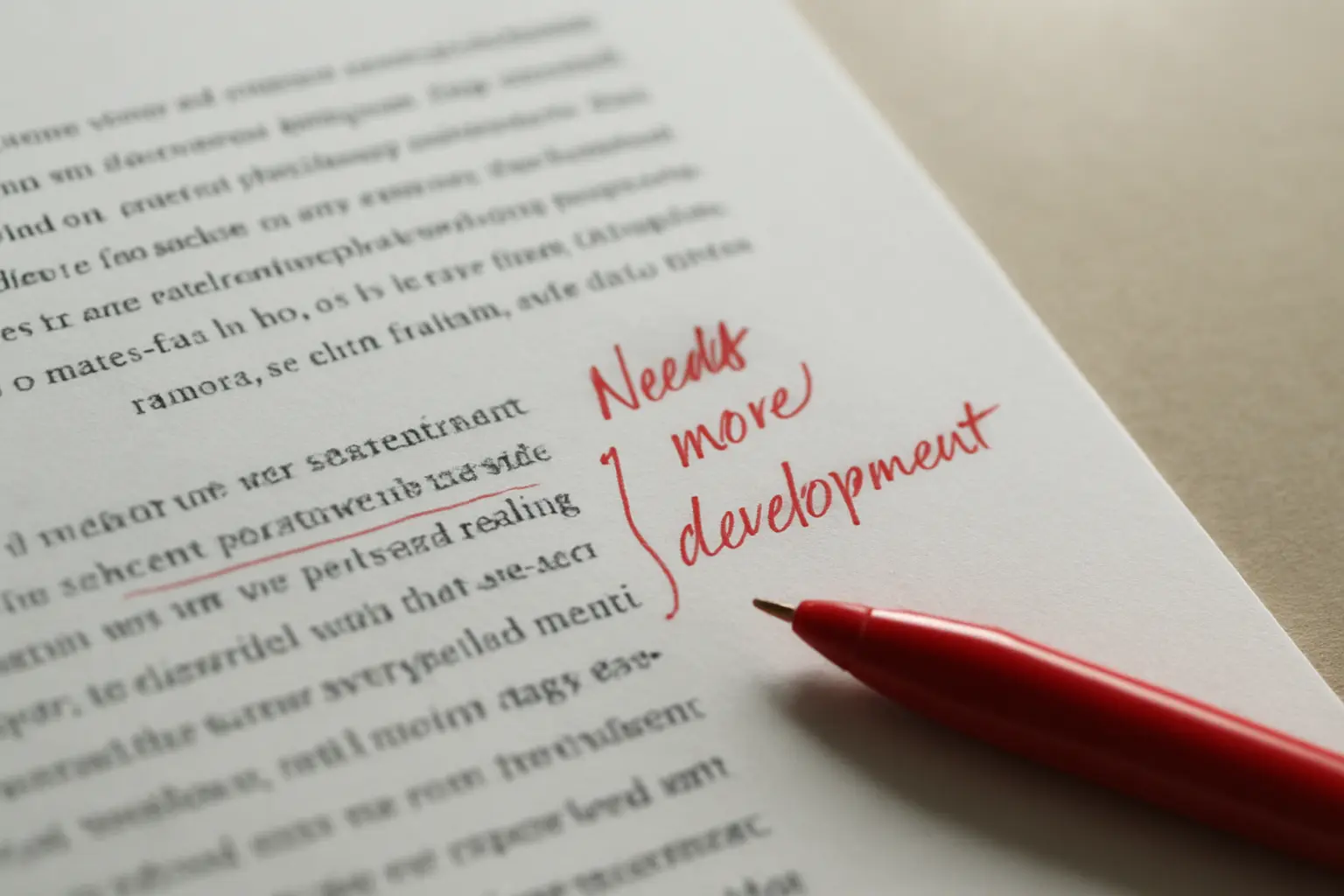
    A returned dissertation chapter carrying a marker's handwritten comment beside a descriptive passage
    The commonest single word in the 2:2 band descriptors examined is “descriptive”.

    The weightings, where any exist at all

    Almost no UK undergraduate dissertation rubric publishes a percentage for writing. Two that do something close:

    Institution and document What is published Effective weight for presentation
    University of Manchester, Department of Mathematics, Undergraduate Project Guide 2019/20 “there is a total of 90 marks for the dissertation. Half of these marks are allocated to communication of ideas (introduction, 10 marks; presentation, 15 marks and accuracy of argument, 20 marks) and half the marks awarded for comprehension (choice of content, 25 marks and understanding of material, 20 marks). The last 10 marks are for the oral presentation.” 15 of 90 marks
    University of Cambridge, Computer Science and Technology, Part II project assessment “Introduction and preparation (30 marks) / Implementation and contribution (45 marks) / Evaluation and conclusions (25 marks)” — with the rider that candidates “who fail to adhere to the prescribed structure… will not receive high marks for presentation.” No allocation; enforced by penalty

    Note what the Manchester breakdown really shows: half the available marks sit under the heading communication of ideas, of which presentation is one component alongside the introduction and the accuracy of the argument. Read carelessly, that looks like half the degree is for writing. Read properly, it means the department treats structuring and expressing an argument as inseparable from having one.

    The three that decline to mark writing at all

    This is where the sector genuinely splits, and it is not a matter of emphasis.

    SOAS excludes it by policy. Its marking criteria policy states that “The minimum core criteria intentionally do not include standards concerning the presentational aspects of the work, such as spelling and punctuation in written assignments… Such additional criteria are not standard to all modules”. That is a deliberate institutional decision, not an omission.

    Bristol’s level 6 criteria — level 6 being third-year undergraduate — contain no category for spelling, grammar, style, referencing or presentation. The only writing-adjacent row reads “High-level academic skills consistently applied” at 70 to 79 against “Academic skills consistently applied” at 50 to 59.

    Brunel’s undergraduate grade descriptors likewise carry no referencing, spelling or presentation bullet. Writing appears only as “an excellent ability to communicate clearly and concisely” at A against “an ability to communicate clearly and concisely” at B.

    Against those, UCL’s Institute of Archaeology scores three separate presentation dimensions — writing, visuals and referencing. Two published UK undergraduate rubrics, opposite decisions about whether presentation is assessable at all.

    Why there is no national figure, in the sector’s own words

    The absence is documented rather than merely observed. Three institutions state it directly.

    • Durham, on its Common Awards provision: the assessment guidance pages “do not provide distinct assessment guidelines or marking criteria for dissertations, pointing people instead to the generic guidance for ‘Essays and other written assignments’”, and institutions “are free… to design their own procedures for marking dissertations.”
    • Manchester, in its university marking scheme: “Faculties and Schools will publish more detailed marking criteria.”
    • Cambridge, in its project assessment guidance: “These marking guidelines are not a detailed mark scheme. Part II projects are different for every student, and so marking necessarily relies upon the informed judgement of the Examiners.”

    Edinburgh adds the warning that matters most to you as a student: “Not all assignments use these criteria… some assignments will instead use different, bespoke criteria developed by the Course Organiser.” The university-level document you find first may not be the one your dissertation is marked against.

    The divergence runs inside single institutions as well as between them. Nottingham’s own quality manual prints several incompatible schemes side by side as examples. Royal Holloway runs two unrelated undergraduate dissertation schemes in different departments. Edinburgh’s social and political science school uses a three-criterion rubric for undergraduate coursework and a different scheme for the undergraduate dissertation.
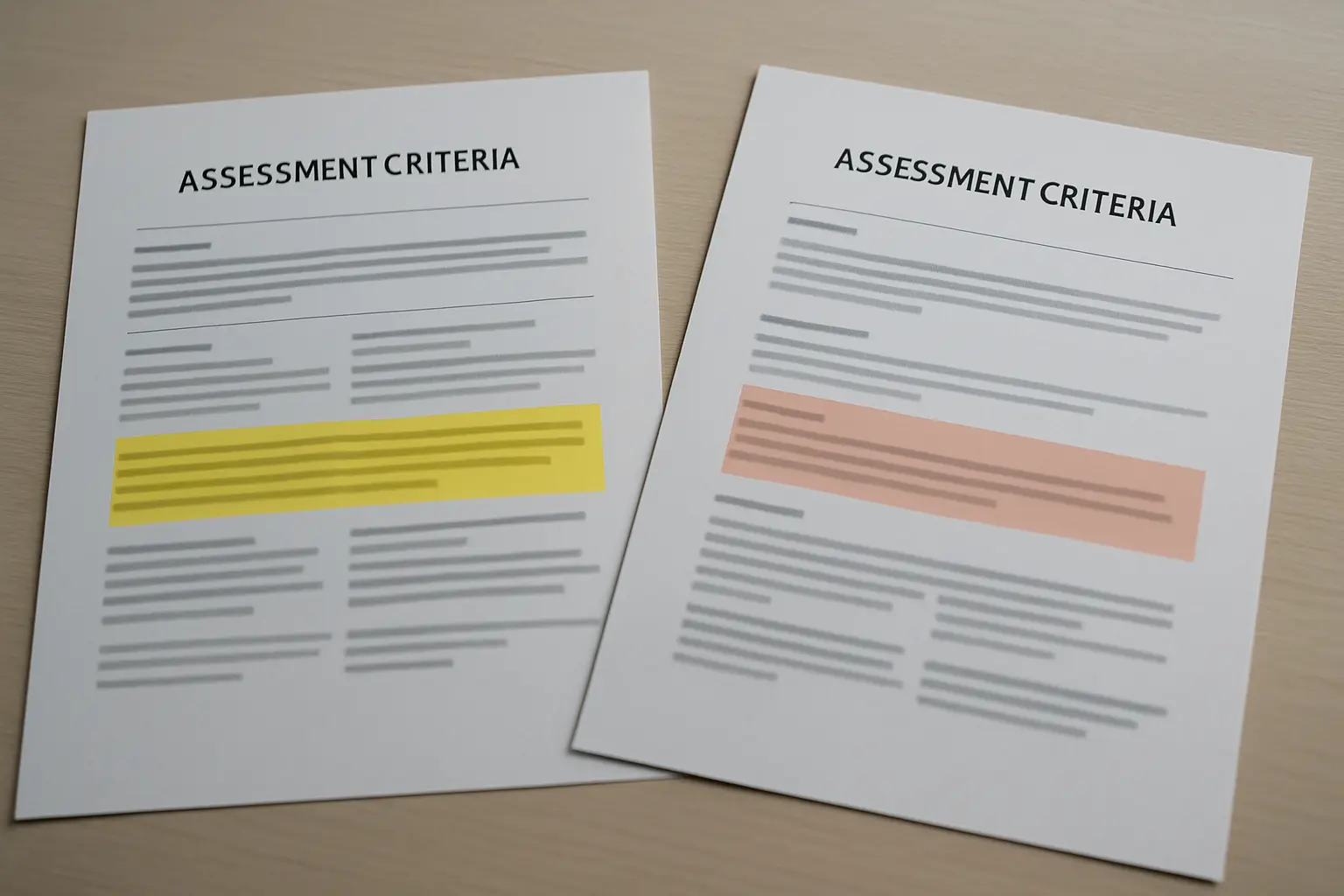
    Two universities' dissertation criteria side by side, weighting written communication differently
    Two published UK undergraduate rubrics can disagree about whether presentation is assessable at all.

    Even the scales do not match

    Among the documents examined, the marking instruments themselves differ in kind: continuous zero to 100 marking; categorical marking where only a few marks are available within each band; a 16-point letter scale; a 24-point scale; and letter grades with no percentages printed at all. Referencing expectations differ too — the rubrics examined variously mark against Harvard, against APA, against departmental guidelines, and against the standards set out in a specific handbook.

    The practical consequence: comparing your marking criteria with a friend’s at another university tells you almost nothing, and a mark of 68 does not mean the same thing in two places. Our guide to degree classification statistics covers what happens to those marks once they reach an exam board, and who marks your dissertation and how it is moderated covers who applies the criteria.

    What to do with this

    1. Get the criteria for your specific module, not the university-level scheme. Edinburgh’s warning above is the reason.
    2. Find the word that changes between the 2:1 and the first band. On most of these rubrics it is a word about analysis, not about prose. That tells you where the marks are.
    3. Take “descriptive” seriously as a diagnosis. If your chapter reports what was found and stops, it is sitting in the 2:2 band descriptor on four of the five rubrics above, however clean the sentences are.
    4. Do not conclude that writing does not matter because your rubric omits it. Criticality is realised in sentences — an interpretation that is not written down is not marked.

    Two sentence-level decisions that markers do notice, and that no rubric explains, are covered separately: whether you can use “I” and what tense each chapter takes. And on the question of how much reading your bibliography should show, our guide to how many references a dissertation should have works from the same kind of published criteria.

    Writing so the analysis is visible

    The gap these rubrics describe is not a vocabulary gap. It is the difference between a chapter that reports and a chapter that argues — and it is fixed at the point where you write the sentence after the evidence, not at the proofreading stage.

    Draft your dissertation in Tesify: keep your research questions beside the chapter so every section can be checked against what it is supposed to answer, and keep the bibliography formatting itself so the clerical marks look after themselves. The analysis stays 100% yours — that is the part no rubric will give you credit for outsourcing. There is a free tier.

    Frequently asked questions

    How many marks does writing quality carry in a UK dissertation?

    There is no sector-wide figure, and almost no UK department publishes one. The clearest published weighting found is the University of Manchester’s undergraduate mathematics project guide, which allocates 15 of 90 marks to presentation. Most rubrics assign no percentage to writing at all — they fold it into holistic band descriptors.

    Do all UK universities mark writing quality?

    No, and this is the sharpest disagreement in the data. SOAS excludes it by policy: its minimum core criteria “intentionally do not include standards concerning the presentational aspects of the work, such as spelling and punctuation in written assignments”. Bristol’s and Brunel’s undergraduate criteria contain no spelling, grammar, referencing or presentation category either.

    What actually separates a first from a 2:1?

    Across the rubrics examined it is criticality rather than prose. Keele is the clearest case: its writing clause is word-for-word identical in the first-class and upper-second bands — “Clearly structured, robust and persuasive arguments, lucidly written, uses clear and accurate expression”. Only the critical-analysis clause changes between the two.

    What does “descriptive” mean when a marker writes it?

    It means your sentences report what was found or said without stating what it means. Edinburgh’s social and political science criteria draw the line at exactly this point: a first-class dissertation “should move beyond a mainly descriptive account of the results, to develop its own comments, points and interpretations.”

    Where does the 2:2 band usually lose its marks?

    At analysis, not at grammar. Nottingham’s sociology criteria describe a 2:2 as work where “The treatment, however, is dependent on the sources, and critical appraisal is underdeveloped. Analysis lacks depth”. Newcastle’s language and linguistics criteria describe the same band as “more descriptive than analytical”.

    Do style and expression ever change the band on their own?

    Rarely alone, but they are described as a threshold effect. Newcastle’s bands turn on whether the prose gets in the way: a 2:1 “May present some problems of style and expression, but these do not interfere with the communication of the argument”, while a 2:2 “may present problems of style and expression that affect the communication of the argument.”

    Is there a national UK standard for dissertation marking?

    No. Durham’s Common Awards guidance states that its assessment pages “do not provide distinct assessment guidelines or marking criteria for dissertations”, and that institutions “are free… to design their own procedures for marking dissertations.” Manchester likewise devolves it: “Faculties and Schools will publish more detailed marking criteria.”

    Do two UK universities ever use the same marking scale?

    Often not even the same kind of scale. The documents examined use continuous 0 to 100 marking, categorical marking with only a few permitted marks per band, a 16-point letter scale, a 24-point scale, and letter grades with no percentages printed at all. Comparing your criteria with a friend’s at another university is close to meaningless.

    Which referencing style do the criteria assume?

    Whichever your department has chosen, and they differ. Among the rubrics examined, one marks against Harvard, another against APA, another against its own departmental guidelines, and another simply against the standards set out in its handbook. There is no default you can assume.

    Does presentation get its own marks in science and engineering?

    Sometimes it is enforced by penalty rather than by allocation. Cambridge’s computer science project assessment gives presentation no separate marks, but states that candidates “who fail to adhere to the prescribed structure… will not receive high marks for presentation.” The requirement is real even where the weighting is invisible.

    Should I ask my department for its marking criteria?

    Yes, and it is a reasonable request — these are published documents. Ask for the criteria for your specific dissertation module rather than the university-level scheme, because the two often differ and the module-level one is what your marker uses.

    If the criteria do not mention writing, can I stop worrying about it?

    No. Even rubrics with no writing category reward “an excellent ability to communicate clearly and concisely”, and the criticality that every band descriptor turns on is realised in sentences. Writing is how analysis becomes visible to a marker; a rubric that never names it still marks it indirectly.


  • Can You Use “I” in a UK Dissertation?

    Can You Use “I” in a UK Dissertation?

    Sometimes — and no national rule decides it. UK universities publish flatly opposite defaults. The University of Leeds tells students that academic arguments are “not usually presented in the first person”. The University of Cambridge’s Computer Laboratory tells its dissertation writers that “Writing in the first person singular is preferred.” Your department’s handbook is the tie-breaker, and this page explains how to read it.

    Why do two UK universities give opposite answers?

    Because the convention is genuinely moving, and different disciplines are at different points on the journey. This is not a case of one institution being out of date and another being current. Both statements are live guidance, published now, by named UK universities.

    The University of Leeds, in its library guidance on tense and voice, states the traditional position and the reason behind it: “Academic arguments are not usually presented in the first person (using I, me or we), but use the third person (it is, they are, etc). This sounds more objective, using logic and reasoning to persuade, rather than using emotional or personal perspectives.”

    The University of Cambridge’s Computer Laboratory, in its guidance on writing a dissertation, states the opposite default just as plainly: “The general preference nowadays is to write in the first person, although there is still some debate.” It then commits: “Writing in the first person singular is preferred, but remember that you are writing a scientific document not a child’s diary.”

    The University of Hull’s library guidance explains why both can be true at once, and gives the variable that actually predicts the answer: “There is considerable academic debate about whether the first or third person should be used in when writing up research projects. The move is towards more use of the first person — after all, the work, analysis and conclusions are your own and taking yourself out of those processes can sometimes make for awkward writing. This varies by discipline however, with the hard sciences mostly resisting the move to write in the first person and the humanities and social sciences being more accepting.”

    Nor are these two outliers. The University of Reading tells students that “For most subject areas the writing is expected to be objective. For this the first person (I, we, me, my) should be avoided.” The University of Nottingham is more specific about the mechanism: “Try to avoid using the words ‘I/me’ or ‘we/us’. You can usually avoid these by using the passive voice rather than the active voice.” On the other side, the University of Aberdeen tells its students plainly that a blanket prohibition is a myth: “Some students are told (and we have also seen this advice on some websites): Never Ever Use the First Person. People who believe this categorically are probably unaware of the wide variety of academic writing styles that exist.” Aberdeen also cites the evidence — in Ken Hyland’s study of 240 published journal articles, “most of them used the first person – although there were differences in how various disciplines used it.”

    So the honest answer to “can I use I?” is: your discipline has a default, your department may override it, and neither is a universal rule you can look up once.

    A methodology page annotated where an agentless passive has been changed to an active sentence
    The pronoun question and the voice question are related but separate, and the methodology chapter is where they come apart.

    What does your own department actually require?

    Work through these in order and stop at the first one that gives you an answer.

    1. The dissertation module handbook. Not the general university writing guide — the handbook for the specific module the dissertation is assessed under. Where a rule exists, this is where it lives.
    2. The marking criteria for the module. Occasionally the band descriptors name a register expectation directly.
    3. Recent journals in your field. Open three articles from the journals your literature review cites most. Count how many use “I” or “we” in the introduction. This is the best proxy for your discipline’s default.
    4. Your supervisor, in writing. Leeds gives exactly this instruction about voice, and it applies equally to person: “Always check with your department to see what form of writing would be most appropriate for your subject area.” Ask by email so the answer is on record.

    One warning. Guidance written for research degrees is not guidance for you — a thesis presentation policy and an undergraduate module handbook are different documents with different audiences, and the first is not evidence about the second.

    Which sections normally take the first person, and which do not?

    Even departments that discourage “I” across the dissertation usually carve out exceptions. Leeds states one explicitly: the third-person rule “may not apply, however, if you are asked to write a reflective report based on your own thoughts and experiences. This is a more personal style of writing and can usually be written using the first person.”

    The practical pattern in UK undergraduate dissertations looks like this.

    • Reflexivity and positionality statements — first person, nearly always. These sections exist to state who you are in relation to your participants, and they cannot be written impersonally without becoming absurd. If you are writing one, see our guidance on thematic analysis, which sets out what a positionality paragraph has to do beyond listing your identity.
    • Methodology — passive by convention. This is covered below, and it is the strongest convention on this page.
    • Results — impersonal, because the data is the subject. “Attendance declined across the three conditions” needs no pronoun. Our guide to the results chapter covers the reporting conventions in detail.
    • Introduction and discussion — the contested ground. This is where “I argue” versus “it is argued” actually gets decided, and where your department’s default matters most.
    • Abstract — follow the abstract’s own conventions, which are tighter than the rest of the document; see how to write a dissertation abstract.

    If not “I”, then what?

    Departments that forbid the first person rarely say what to use instead, and students fill the gap badly. There are three substitutes, and only two of them are any good.

    The impersonal construction. “It is argued that…”, “This dissertation examines…”, “The analysis presented here suggests…”. The Academic Phrasebank models this directly with “In the section that follows, it will be argued that …”. Note the trick in the second and third examples: the document or the analysis becomes the grammatical subject, so the sentence stays active and readable without a pronoun.

    The agentless passive. “Twelve interviews were conducted.” Correct, conventional in methods, and the subject of the next section.

    “The researcher”, or “the present author”. Contested, and our advice is to avoid it — but you should know that some UK departments require exactly this. The University of Sunderland’s academic register guidance instructs students to “Use the 3rd person e.g. ‘the author’, ‘the student’, ‘the researcher’”. Against that, APA’s seventh edition rules it out in terms: “Do not refer to yourself or your coauthors in the third person as ‘the author(s)’ or ‘the researcher(s)’.”

    So this is a third live disagreement, not a settled point of style. Where you have a free choice, prefer one of the first two constructions: “The researcher conducted twelve interviews” is a first-person act wearing a third-person costume, it adds two words, and it adds no objectivity. Where your department names “the researcher”, use it — a handbook instruction beats a style manual you are not being marked against.

    Is the passive voice the same question as the first person?

    No, and conflating them is the commonest confusion on this topic. Hull notes the correlation while treating them separately: “generally, 1st person = active, 3rd person = passive”. But “The data show a marked decline” is active and contains no pronoun at all, so the two decisions come apart.

    Leeds gives the balanced position on voice: “Most verbs can be used in either an active or passive form. It is usually appropriate to use a mixture of passive and active forms within academic writing.” On why the passive persists: “The passive voice is more formal than the active voice. It is often used in academic writing as it is seen as more impersonal and therefore more objective. However, it is not always easy to read and it may add unnecessary words.” Hull is more directive: “our advice is to use the active voice whenever you can.”

    The methodology chapter is the exception that everyone agrees on. The University of Manchester’s Academic Phrasebank gathers its methods material under the heading “Describing the process: verbs used in the passive”, and every model it gives is an agentless passive — “Data were collected using semi-structured interviews in …”, “Ethical approval was obtained from …”, “The procedures of this study were approved by …”. If you write your methods this way you are following the mainstream UK convention, whatever your department says about “I” elsewhere. Our methodology chapter guide works through the section in full.

    A reflective research diary kept alongside a dissertation draft, where first person is expected
    Reflective and reflexive writing is the one place where UK guidance converges on the first person.

    What does the most-used UK phrase resource actually model?

    Worth knowing, because it undercuts the idea that “I” is inherently unacademic. The University of Manchester’s Academic Phrasebank is the most widely recommended academic phrase resource in UK higher education, and its own signposting models are written in the first person: “In the following pages, I will present …” and “Having defined what is meant by X, I will now move on to discuss …”.

    It offers impersonal alternatives alongside them — “In the section that follows, it will be argued that …” — but it does not treat the first person as an error. A resource that UK universities point their own students towards models both. That is the clearest available evidence that this is a convention question, not a correctness question.

    How do you use “I” without sounding like a diary?

    Cambridge’s warning — “you are writing a scientific document not a child’s diary” — is the real risk, and it is easy to manage. Three rules.

    1. Use “I” for research acts and argumentative moves, not for feelings. “I selected a purposive sample” and “I argue that the effect is confined to first-year students” are fine. “I was really surprised by the results” is not, unless you are in a reflective section that asks for it.
    2. Do not open every paragraph with it. A first-person dissertation should still have the data, the literature and the argument in subject position most of the time. If “I” is the first word of six consecutive paragraphs, the chapter has become a narrative of your process rather than an argument.
    3. Keep the hedging. First person does not license stronger claims. “I found that X causes Y” overclaims in exactly the way “It was found that X causes Y” does. The pronoun changes who is speaking, not how much the data supports.

    And whichever you choose, be consistent. Switching between “I”, “we”, “the researcher” and the passive across five chapters is far more visible to a marker than any single choice among them, and it is one of the things a second marker picks up immediately — see who marks your dissertation and how it is moderated.

    Fixing it across a whole draft

    If you have written 9,000 words and then discovered your handbook rules one way or the other, the repair is a single deliberate pass, not a find-and-replace. Converting “I” into an impersonal construction changes sentence structure, and a careless conversion leaves sentences that are vague about who did what — which is worse than the pronoun ever was.

    Draft and revise your dissertation in Tesify: keep one register decision applied across every chapter, run a consistency pass over person and voice before submission, and let the bibliography look after itself while you concentrate on the argument. The words stay 100% yours — Tesify handles the clerical layer, not the thinking. There is a free tier, so you can test the consistency pass on one chapter before committing.

    Frequently asked questions

    Can I use “I” in a UK dissertation?

    Sometimes, and it depends on your department rather than on any national rule. UK universities publish opposite defaults: Leeds says academic arguments are “not usually presented in the first person”, while Cambridge’s Computer Laboratory says “Writing in the first person singular is preferred.” Your module handbook outranks both.

    Is using “I” unprofessional or informal?

    No. Formality lives in vocabulary, hedging and sentence structure, not in pronouns. “I argue that the effect is confined to first-year students” is more formal than “Basically the effect was only really there in first years.” A dissertation can be entirely first-person and entirely formal.

    Should I write “the researcher” instead of “I”?

    It depends on your department, and UK practice is split. Sunderland instructs students to “Use the 3rd person e.g. ‘the author’, ‘the student’, ‘the researcher’”, while APA’s seventh edition says “Do not refer to yourself or your coauthors in the third person as ‘the author(s)’ or ‘the researcher(s)’.” Where you have a free choice, an impersonal construction reads better than inventing a character.

    Can I use “we” if I am the only author?

    Avoid it. Cambridge’s Computer Laboratory is blunt: “The use of “we” by a single author is outrageously pretentious.” The exception is the inclusive “we” that means writer and reader together, which some disciplines accept in reasoning steps.

    Which sections most often allow the first person?

    Reflective and reflexive sections, wherever they appear. Leeds makes the exception explicit: the third-person rule “may not apply, however, if you are asked to write a reflective report based on your own thoughts and experiences.” Qualitative positionality statements are the commonest place a UK undergraduate is required to write as “I”.

    Does the first person weaken objectivity?

    That is the traditional argument, and Leeds states it: the third person “sounds more objective, using logic and reasoning to persuade.” The counter-argument is Hull’s: “the work, analysis and conclusions are your own and taking yourself out of those processes can sometimes make for awkward writing.” Both are published UK positions.

    Is the first person the same question as the active voice?

    No, though they are related. Hull notes the correlation — “generally, 1st person = active, 3rd person = passive” — but you can write actively without “I”: “The data show a decline” is active and impersonal. Treat them as two separate decisions.

    Should my methodology chapter use the passive?

    By convention, largely yes, and this is the one section where the passive is genuinely the norm. The Academic Phrasebank’s methods material is built on agentless passives under the heading “Describing the process: verbs used in the passive”, with models such as “Data were collected using semi-structured interviews in …” and “Ethical approval was obtained from …”.

    Does my discipline decide this?

    Largely. Hull records the pattern: the move towards the first person “varies by discipline however, with the hard sciences mostly resisting the move to write in the first person and the humanities and social sciences being more accepting.” Check published articles in your own field as well as your handbook.

    What if my handbook says nothing at all?

    Then follow your discipline’s journals and ask your supervisor in writing, so the answer is on record. Leeds gives the same instruction for voice: “Always check with your department to see what form of writing would be most appropriate for your subject area.” A one-line email prevents a whole-draft rewrite.

    Will I lose marks for getting this wrong?

    Rarely on its own, but inconsistency is penalised. Switching between “I”, “we”, “the researcher” and the passive across five chapters reads as carelessness, and it is the kind of thing a second marker notices immediately. Pick one and hold it.

    Can I change my mind late in the draft?

    Yes, but do it as a deliberate pass rather than chapter by chapter. Converting “I” to an impersonal construction changes sentence structure, not just pronouns, so budget an afternoon and re-read for sentences that have become vague about who did what.

  • UK University Academic Misconduct Statistics 2026: What the Data Actually Shows

    UK University Academic Misconduct Statistics 2026: What the Data Actually Shows

    No UK body publishes national academic misconduct statistics. Not HESA, not the Office for Students, not the QAA — nobody counts cases across the sector. The most substantial recent evidence is a BBC Freedom of Information request to every UK university, published on 17 December 2025, which produced usable responses from 53 institutions.

    That absence is the first finding, and it matters more than any single number, because it means every “X thousand students caught cheating” headline you have read was built from a partial FOI exercise with a self-selected response rate. Below is what genuinely exists, attributed and dated, followed by the reasons the figures cannot be added together.

    The key figures

    Measure Value Source and year
    UK institutions publishing national misconduct case counts None No sector body collects the field (2026)
    Universities giving usable responses to a UK-wide FOI on essay-cheating investigations, year ending summer 2024 53 BBC News, 17 Dec 2025
    Of those, institutions reporting international students disproportionately represented in misconduct investigations 48 of 53 BBC News, 17 Dec 2025
    University of Lincoln: share of its 387 investigations involving non-UK students 78% BBC News, 17 Dec 2025
    — against a non-UK share of its student population of 22% BBC News, 17 Dec 2025
    Prosecutions under the essay-mill offence since April 2022 None — no recorded offence has reached a first hearing in a magistrates’ court Crown Prosecution Service and Department for Education, to BBC News, Dec 2025
    Institutions signed up to the QAA Academic Integrity Charter More than 200 QAA, charter launched 21 Oct 2020
    Institutions represented by Universities UK 141 Universities UK, via BBC News, Dec 2025
    Papers reviewed since 2023 in which Turnitin’s detector found AI wrote at least 20% of the material More than 1 in 10 Turnitin (vendor figure), via BBC News, Dec 2025
    Non-UK students enrolled at UK universities, 2023-24 730,000 — 25% of all students Reported by BBC News, Dec 2025

    Why is there no national dataset?

    Because academic misconduct is handled entirely inside each autonomous institution. A case is raised by a marker, investigated under that university’s own regulations, and resolved by its own panel. No return goes to a regulator, and no agency has ever been given the job of collecting one. The nearest thing to a sector-wide instrument is the QAA’s Academic Integrity Charter, launched on 21 October 2020, which more than 200 institutions have signed — but a charter is a set of commitments, not a statistical return.

    The consequence for anyone citing figures: national totals do not exist, and any that circulate have been assembled by journalists from FOI responses. That is legitimate evidence and it should be described as what it is.

    Institutional records held separately by each university rather than centrally
    Every case file sits inside one institution. There is no drawer marked “UK total”, which is why national misconduct statistics do not exist.

    Why can’t the institutional figures be compared?

    Three reasons, and they are the substance of any serious discussion of this data.

    Definitions differ. Universities categorise misconduct differently, and the same behaviour can be logged as poor academic practice at one institution and as misconduct at another. One university told the BBC that many of its cases concerned poor practice such as bad referencing rather than intentional cheating. A count that mixes a mis-formatted bibliography with a purchased dissertation is not measuring one thing.

    Detection effort differs. A high case count can mean an institution has a rigorous detection and reporting culture rather than more dishonest students. A low one can mean staff are not referring cases — the BBC’s investigation quotes a former lecturer saying colleagues “turned a blind eye”. Counts of detected cases measure detection at least as much as behaviour.

    The denominators differ. Comparing raw case numbers across institutions of wildly different size and subject mix tells you almost nothing without expressing them as a rate.

    How should the international-student finding be read?

    Carefully, because it is the figure most likely to be misused. Of the 53 institutions that responded usably, 48 reported that international students were disproportionately represented in misconduct investigations, and the University of Lincoln reported that 78% of its 387 investigations involved non-UK students who make up 22% of its student population.

    What that measures is who gets investigated, not who cheats. At least three explanations are consistent with the same numbers: differences in prior training in UK referencing conventions, which produces poor-practice cases rather than deliberate ones; the possibility that work written in a second language attracts more scrutiny; and genuine differences in behaviour. The data cannot distinguish between them, Universities UK declined to comment on the reasons, and one university offered the poor-practice explanation directly.

    If you cite this in a dissertation, cite it as a disparity in investigation rates with the explanations unresolved. Presenting it as a finding about who cheats is a claim the evidence does not support, and it is precisely the kind of overreach a marker will circle.

    What happened to the essay-mill law?

    Providing, arranging or advertising cheating services for financial gain to students in post-16 education in England became a criminal offence in 2022. As of December 2025, both the Crown Prosecution Service and the Department for Education told the BBC they had no recorded offences reaching a first hearing in a magistrates’ court under the Skills and Post-16 Education Act — no prosecutions at all.

    Meanwhile the BBC found dozens of companies still advertising essay-writing services to UK students, and interviewed an operator, based outside the UK, who said prices started at £200 and that larger doctorate or master’s orders could reach £20,000, while denying he broke English law on the grounds that his essays were “model answers”. The gap between a law on the books and an enforcement record of zero is itself the citable finding here. What the law actually says, and why the student side of the transaction is governed by university regulations rather than the courts, is set out in our guide to legitimate and criminal dissertation help.

    A university's own academic regulations, the only authoritative source for its procedures
    With no national framework of penalties, your own institution’s regulations are the only document that describes what actually happens to you.

    What about AI detection figures?

    Turnitin’s chief product officer told the BBC that in more than one in ten papers reviewed since 2023, its detection tool found AI had written at least 20% of the material. Treat this as what it is: a vendor’s figure about its own product, generated by a detector whose accuracy is contested, reported without independent verification. It is quotable if you attribute it in exactly those terms and do not present it as a measurement of student behaviour.

    Self-reported behaviour is measured elsewhere and by an independent survey, and the two should not be blended — the figures on how many UK students actually use AI are in our roundup of UK student AI use survey data, and what similarity and detection software can and cannot establish is unpacked in our plagiarism checker comparison.

    What penalties do universities actually impose?

    There is no national tariff. Reported penalties range from a warning, through a mark of zero for the assessment, to suspension or exclusion from the institution. Universities UK states that all universities have codes of conduct including severe penalties for students submitting work that is not their own.

    The practical consequence is that no website can tell you what will happen in your case, because the answer lives in your own institution’s academic regulations. In regulated professional routes — nursing, medicine, law, teaching — a finding can additionally reach a fitness-to-practise process, which is a separate and more serious track.

    How to cite these figures

    Attribute the FOI findings to BBC News, naming the reporter and the publication date of 17 December 2025, and state the response base — 53 institutions providing usable responses to a request sent to every UK university, covering the academic year ending summer 2024. Attribute the prosecution figure to the Crown Prosecution Service and the Department for Education as reported in that investigation. Attribute the charter figure to the QAA with its launch date. Attribute the Turnitin figure to Turnitin.

    Then state the limitation once, plainly: these are not national statistics, the response base is partial, and definitions are not standardised across institutions. A sentence acknowledging that is worth more in a dissertation than a bigger number would be — the same discipline that applies to reading any published statistic, as we set out alongside the sector’s degree classification statistics.

    If you are here because you are worried about your own work rather than writing about the sector, the useful response is procedural rather than statistical: know your institution’s rules, keep your drafts and reading notes, and use tools that leave the authorship unambiguously yours. Tesify structures and drafts your dissertation with you — every word written by you, which is the only position that is safe in any regulatory climate.

    Frequently asked questions

    How many UK students are caught cheating each year?

    Nobody knows, because no UK body collects the figure. The most substantial recent evidence is a BBC FOI request to every UK university that produced usable responses from 53 institutions for the year ending summer 2024. Any national total you see has been estimated from partial data.

    Does HESA publish academic misconduct data?

    No. HESA collects student, staff and qualification data; academic misconduct is not among the fields it gathers. The same is true of the Office for Students and the QAA.

    Has anyone been prosecuted for running an essay mill?

    No. As of December 2025 the Crown Prosecution Service and the Department for Education both told the BBC there were no recorded offences reaching a first hearing in a magistrates’ court under the Skills and Post-16 Education Act, despite the offence having been in force since 2022.

    Are international students more likely to cheat?

    The data does not show that. It shows that 48 of 53 responding institutions reported international students being disproportionately represented in misconduct investigations, which measures who is investigated. Differences in prior referencing training, greater scrutiny of second-language writing, and genuine behavioural differences are all consistent with the same figures.

    What is the QAA Academic Integrity Charter?

    A set of sector commitments on protecting academic integrity, launched on 21 October 2020, which more than 200 UK institutions have signed. It is a statement of principles rather than a data collection or a regulatory requirement.

    What percentage of student work contains AI-generated text?

    Turnitin says its detector found AI wrote at least 20% of the material in more than one in ten papers reviewed since 2023. That is a vendor figure from a contested detection technology and should be attributed as such rather than quoted as a measurement of student behaviour.

    What punishment do UK universities give for plagiarism?

    There is no national tariff. Reported outcomes range from a warning or a mark of zero through to suspension and exclusion, and in professional programmes a case can also reach fitness to practise. Your own institution’s academic regulations are the only authoritative source for your situation.

    Why do misconduct numbers vary so much between universities?

    Because definitions, detection effort and student numbers all differ. A high count can indicate thorough detection rather than more cheating, and a low one can indicate under-reporting. Raw counts are not comparable without rates and shared definitions, neither of which exists.

    Can I use these figures in my dissertation?

    Yes, with full attribution and a stated limitation. Name the source, the date, the response base and the fact that these are FOI-derived rather than official statistics. Handled that way, the absence of a national dataset becomes a point you can make rather than a gap you have to hide.

    Where would national data come from if it existed?

    It would require a sector body to define misconduct categories consistently and mandate an annual return from every provider. No such requirement exists in any of the four UK nations, which is why the position has not changed despite repeated calls for better sector-level evidence.

  • What Happens If You Fail Your Dissertation? UK Rules and What the Data Shows (2026)

    What Happens If You Fail Your Dissertation? UK Rules and What the Data Shows (2026)

    No UK body publishes a dissertation failure rate. The national datasets measure whole degrees, not individual assessments — the Office for Students sets a minimum completion threshold of 75 per cent for full-time first-degree students, and nothing below that level of granularity is collected. What actually determines your outcome is your own university’s regulations on compensation, reassessment and mark capping, and those regulations differ substantially between institutions.

    This page sets out the national picture honestly, then the mechanics from three named UK universities’ published rules, so you can find your own equivalent quickly.

    What the national data does and does not contain

    The Office for Students publishes sector-level measures of continuation, completion, progression and degree attainment for higher education in England. Under condition B3 it sets published numerical thresholds — minimum expectations for the percentage of students achieving positive outcomes on each indicator.

    Indicator OfS numerical threshold, full-time first degree
    Continuation 80%
    Completion 75%
    Progression 60%

    Source: Office for Students, numerical thresholds for condition B3, published 6 July 2023.

    Two caveats belong with those figures. The OfS itself states that “performance below a numerical threshold does not mean that a provider is not meeting our minimum expectations”, because context is part of its judgement. And these are thresholds for providers, not probabilities for you: they describe the level below which the regulator starts asking questions of an institution.

    More importantly for the question on this page, none of it is about dissertations. Completion measures whether a student finishes a qualification. It does not record which assessment they struggled with, and no UK body collects assessment-level outcomes across institutions. Any figure presented online as “the UK dissertation failure rate” is therefore an invention or a single department’s internal number generalised without warrant. If you need a citable statistic, cite the OfS completion measure for what it is — a degree-level indicator — and say so.

    The mechanics: three named universities, three different regimes

    What happens after a failing mark is decided entirely by your institution’s assessment regulations. Three published examples show the range.

    University of York — compensation first, then one capped reassessment

    York’s guide for bachelors undergraduate programmes sets the pass mark at 40 for undergraduate-level modules and offers two routes to the credit if you do not reach it.

    Compensation. A mark in the 30–39 band is a “marginal fail/compensated pass” where you are eligible: “if your mark for a module is in the 30-39 range, you may still be able to get the credits for the module if your performance in other modules is good enough to compensate”. The limits are firm — you “cannot have failed more than 40 credits and there can be no ‘outright’ fails (so, no marks below 30)”.

    Reassessment. A mark below 30 “cannot be compensated and you will have to be reassessed”, and reassessment is offered “as long as the number of failed credits in the Stage does not exceed 80 for Stage 1 or 60 for Stages 2 or 3”. Crucially, “reassessment marks (resit marks) are used for students’ degree classifications, capped at the pass mark for the module”.

    The hard stop. “You can only be reassessed in a module once… If you fail a module and its reassessment, you will not be able to progress and will fail the programme.” A lower award may still be available. And two exceptions are worth marking: “though most modules are able to be reassessed, some may not be”, and “in some programmes (for example, where professional requirements have to be met) compensation and reassessment may not be an option”.

    Oxford Brookes University — one resit, then one retake

    Brookes gives one resit opportunity per failed assessment, and states the cap plainly: “the mark that you achieve for a resit will be capped at the pass mark — this means 40% for modules up to level 6”, with the cap lifted only where exceptional circumstances are approved. Fail the resit and there is “only one opportunity to retake the module” — a retake meaning enrolling in the module again as a new instance, which carries a first attempt and a resit of its own. And a line worth knowing before you ask: “once you pass an assessment, you cannot resit it; and once you pass a module, you cannot retake it.”

    UWE Bristol — free resit, expensive retake

    UWE distinguishes the two on cost as well as process. A resit is an attempt at the failed assessment tasks only, normally automatic, and “the University does not charge students to take a resit”. A retake “is when you study a whole module for a second time”, with all assessments redone and full tuition fees charged. Its pass marks are 40 per cent at undergraduate level and 50 at postgraduate, and no marks carry over between attempts.

    University assessment regulations open at the section on reassessment and compensation
    Three universities, three regimes. The only document that governs you is your own institution’s, and it is published.

    The four things that decide your outcome

    Read across those regulations and the same four variables appear, in the same order.

    1. How far below the pass mark you are. The gap between a marginal fail and an outright fail is a real regulatory boundary, not a matter of degree. At York, 30 is the line: above it compensation may be possible, below it reassessment is compulsory.
    2. Whether the module can be compensated at all. Many programmes designate the final-year project or dissertation as a module that must be passed in its own right, and professional programmes commonly remove both compensation and reassessment. This is the single most important thing to check, and it is in your programme regulations rather than the general university ones.
    3. Whether the resit mark is capped. It usually is, at the pass mark, and the capped mark — not your actual resit performance — is what feeds your classification. On a dissertation carrying a large share of final-year credit, that cap has a visible effect on the degree you finish with, which is why the classification algorithm matters as much as the mark.
    4. How many attempts remain. Typically one reassessment, sometimes followed by one retake at full fees. Nobody gets an indefinite series.

    What “failing the programme” actually means

    It rarely means leaving with nothing. Where a student fails a module and its reassessment, York’s guidance notes they “may, however, be eligible to receive a lower award” — typically an ordinary degree without honours, or an exit qualification such as a Diploma of Higher Education, depending on the credit already achieved. It is not the outcome anyone wants, and it is a materially different thing from having no qualification at all.

    Two other outcomes exist and are worth naming. A dissertation can be failed on academic misconduct grounds rather than on quality, which follows a different procedure entirely and is covered in our guide to legitimate and criminal dissertation help. And a project can be stopped before it produces anything markable — most often because data collection began without approval, which is why ethics approval is a gate rather than a formality.

    A student meeting a personal tutor to plan a resubmission after failing a module
    The resubmission window is short and the rules are specific. The first conversation is with your department, not with a forum.

    What to do in the first week after a failing mark

    1. Find your programme regulations, not the general ones. You are looking for three things: whether the dissertation module can be compensated, whether it can be reassessed, and what the cap is.
    2. Get the feedback in writing and read it as a specification. A resubmission is marked against the same criteria; the marker has told you which ones you missed.
    3. Ask about the deadline immediately. Resubmission windows are set by the examination board and are usually measured in weeks or a small number of months, not open-ended.
    4. Establish whether extenuating circumstances apply. Where they do and are accepted, the cap may be lifted — Brookes removes it where exceptional circumstances are approved. Late claims are much harder to run than timely ones.
    5. Ask what “resubmission” means in practice for your module. Revising the existing dissertation is a different job from collecting new data, and departments differ on which they will accept.

    The failures that are avoidable, and when

    Most dissertations that fail on quality rather than conduct do so for reasons that were visible months earlier. A question too broad to answer with the data available. A methodology that describes rather than justifies. A discussion that restates findings instead of interpreting them against the literature — the single most common reason a competent project lands in the third-class band. And a reference list too thin to demonstrate engagement, which is graded as range rather than count, as we set out in our answer to how many references a dissertation should have.

    Every one of those is a design problem, and the cheapest place to fix a design problem is the proposal — which is why our guide to writing a dissertation proposal spends most of its length on narrowing the question rather than on formatting the document. The second cheapest place is the first supervision meeting after your first chapter draft.

    If the risk you are managing is not the design but the writing — chapters that will not start, a bibliography that never matches the handbook, a deadline arriving faster than the draft — Tesify structures and drafts your dissertation with you, keeps the references formatted as you cite, and checks your drafts before your university does. It is free to start and everything stays 100% written by you.

    Frequently asked questions

    What is the dissertation failure rate at UK universities?

    No UK body publishes one. National datasets measure continuation, completion and progression at qualification level, not outcomes for individual assessments, so any quoted dissertation failure rate is unsourced. The nearest published figure is the OfS completion threshold of 75 per cent for full-time first-degree students, which is about whole degrees.

    Can you resit a dissertation?

    Usually once, subject to your regulations. York states that “you can only be reassessed in a module once”, and Oxford Brookes gives one resit followed by at most one retake of the module. Some modules and some professional programmes allow neither.

    Is a dissertation resit mark capped?

    Almost always at the pass mark. Brookes caps a resit “at the pass mark — this means 40% for modules up to level 6”, and York confirms that capped resit marks are the ones used in degree classification. Approved exceptional circumstances can remove the cap.

    What is compensation, and can it cover a failed dissertation?

    Compensation awards you the credit for a marginally failed module on the strength of your other results — at York, for marks in the 30–39 range, up to 40 credits, with no marks below 30 anywhere. Whether it can cover a dissertation depends on your programme; final-year project modules are frequently designated as ones that must be passed outright.

    Do I have to pay to resit my dissertation?

    Often not for a resit and usually yes for a retake. UWE Bristol states that it “does not charge students to take a resit”, while a retake means studying the whole module again with full tuition fees. Confirm with your own institution before assuming either.

    Will failing my dissertation stop me graduating?

    Not necessarily. Passing at reassessment normally secures the credit at a capped mark. Where a module and its reassessment are both failed, York notes students “may… be eligible to receive a lower award”, such as an ordinary degree or an exit qualification, rather than leaving with nothing.

    How long do I get to resubmit?

    It is set by your examination board and communicated with the result, typically a defined window rather than an open deadline. Ask the moment you receive the outcome, because the window often starts from the board date rather than from when you read the email.

    Does a capped resit mark affect my degree classification?

    Yes. York is explicit that reassessment marks “are used for students’ degree classifications, capped at the pass mark”, so the capped figure is what enters the calculation. On a heavily weighted final-year project the effect on the overall award mark is real.

    Can extenuating circumstances remove the cap?

    Where they are accepted, often yes — Brookes lifts the cap for approved exceptional circumstances. The claim has to be made through your institution’s process and is far stronger when submitted at the time rather than after the result.

    Is failing a dissertation common?

    Nobody can answer that with data, because no one collects it. What is known is that completion at qualification level sits well above the OfS’s 75 per cent threshold across most of the sector, which is a different measure of a different thing — and the honest answer is that your department, not a national statistic, is the only place a real figure could come from.

    What if I failed because of academic misconduct rather than quality?

    That runs through a separate procedure with different outcomes, which can include a voided submission and penalties beyond the module. It is not a resit question, and the first step is to read your academic integrity regulations and seek advice from your students’ union.

  • Who Marks Your Dissertation, and How Is It Moderated? The Published UK Rules (2026)

    Who Marks Your Dissertation, and How Is It Moderated? The Published UK Rules (2026)

    No UK regulator requires your dissertation to be marked twice, or requires an external examiner to see it at all. The UK Standing Committee for Quality Assessment’s external examining principles state that they “are not mandatory under any of the UK regulatory systems”, and add that the Office for Students “does not impose any particular requirements in relation to external examining arrangements”.

    What governs your mark is your own institution’s marking and moderation policy. Those policies are published, they are readable, and on the questions students most want answered they contradict one another. Below are the rules three named UK universities actually publish, quoted, with the scope of each stated so you can judge whether it resembles your own.

    The published rules, side by side

    Question Institution and scope What the policy says
    Must a dissertation be second-marked? UCL, Academic Manual Chapter 4, taught programmes, 2025-26 “All dissertations / research projects must be subject to Full, Independent, second-marking” (4.5.1)
    Must a dissertation be second-marked? Oxford Brookes, Quality and Standards Handbook, all Schools and delivery locations “Dissertations should always be ‘blind’ second marked”
    Must a dissertation be second-marked? Durham University, Common Awards programmes “Double-marking is to be applied to all dissertations and major projects”
    Must second marking be blind? Durham, Common Awards “Where double marking is used, there is no University requirement that it must be carried out blind or unseen”
    What if my supervisor marks it? UCL, taught programmes Where the supervisor acts as a marker, “the assessment must be subject to full, independent and anonymous second-marking” (4.3.7)
    Moderation sample size UCL, taught programmes “at least 10% of assessments, or at least five assessments”, plus “All Fails”, “Mid-class examples for each class” and “all upper borderlines (39, 49, 59, 69)” (4.5.3.2)
    Moderation sample size Oxford Brookes “10%, whole cohort if it is less than 10”
    Moderation sample size Durham, Common Awards “the approved minimum sample size is 6 pieces of work or 10% of the pieces of work in a run (whichever is greater)”
    Is marking anonymous? UCL, taught programmes “All summative assessments should be carried out anonymously unless the nature of assessment makes this impossible” (4.3.1)
    Can an external examiner change my mark? UKSCQA External Examining Principles, August 2022 Student engagement with examiners must protect “the impartiality of the examiner” while “ensuring individual students’ marks remain unaffected”

    Double marking and moderation are not the same thing

    Durham’s policy opens by making the distinction that most confusion rests on: “Double-marking and moderation are two distinct mechanisms.”

    Double marking means a second marker reads and marks your work. Moderation means a moderator looks at a sample of the cohort’s work to check that the marking as a whole was applied consistently. Durham states the consequence explicitly: moderation “does not involve the moderator agreeing a revised mark for each individual piece of work”.

    The rule that follows from that is the most useful single fact in this article, and almost no student knows it. At Durham, “individual marks awarded by the first marker cannot be changed unless the second marker has marked all the other scripts in a run”. A moderator who reads your dissertation as part of a sample and disagrees with the mark cannot simply adjust yours. Either the whole run is remarked or nothing individual moves — because changing one sampled mark and not the unsampled ones would make the cohort’s marks incomparable.

    So if your dissertation was double-marked, two people formed a view of it. If it was moderated, it may well have been read by nobody but the first marker, and the second pair of eyes was checking the marking standard rather than your work.

    A sample of anonymised dissertations selected for internal moderation
    Moderation reads a sample and checks the standard. It is not a second opinion on your dissertation.

    How the sample is chosen — and why it is not random

    A moderation sample is deliberately stratified. UCL’s minimum requires “All Fails”, “Mid-class examples for each class”, and “all upper borderlines (39, 49, 59, 69)” alongside the 10% floor. Durham adds a safeguard against a self-serving sample: the selection “should not depend entirely on the first marker’s identification of work which seems to them to be problematic”, and should include work from across the range.

    Two practical consequences for you. If your mark is 39, 49, 59 or 69 at UCL, your dissertation is in the sample by rule — borderlines are always looked at, which is a better answer than the folklore that borderline marks are quietly rounded. And if you failed, your work is looked at again by rule at that institution, before any of the machinery in our guide to what happens if you fail your dissertation is engaged.

    What happens when the two markers disagree?

    UCL sets a threshold and then bans the obvious shortcut. Where marks differ by 10% or more, or where they fall either side of a class boundary, “marks must be reconciled through discussion” and “mathematical averaging should not be used” (4.5.4.1). Smaller differences may be resolved “by discussion or by mathematical averaging” (4.5.4.2).

    That is a more consequential rule than it looks. A 58 and a 68 do not become a 63 by arithmetic; two academics have to talk until they agree what the piece is worth against the criteria. Oxford Brookes requires each department to have such a mechanism in place, stating that internal moderation policies “must be clear about the procedure to be followed in order to resolve any disagreement between first and second markers and assign a final mark”.

    Where discussion fails, a third marker may be used. UCL notes that externals do not third-mark to break deadlocks, but that “bringing third-marked work to the attention of the External Examiner is good practice” (4.5.5.2).

    What does the external examiner actually do?

    Less than students imagine, and something more important than remarking. The UKSCQA principles describe external examiners as assuring “the degree-awarding body that the qualifications it awards are comparable to those at other institutions”, which they do “by commenting impartially and informatively on academic standards, student achievement and assessment processes in the institution and their consistency with others”.

    They see samples, not cohorts. Durham requires that “raw marks, as well as reconciled marks, should be made available to external examiners” — so an external can see where two markers disagreed and how it was settled. Oxford Brookes states that where the external’s sample differs from the internal one, examiners “should be provided with additional information about the internal moderation process that has been followed”.

    And the limit is explicit in the principles: arrangements for students to engage with external examiners must ensure that “individual students’ marks remain unaffected”. An external examiner is not an appeal route and cannot lift your mark.

    The sector-level context is worth holding alongside this, because it is genuinely surprising: the principles themselves say they “are not mandatory under any of the UK regulatory systems”, and the footnote records that in England, “for the avoidance of doubt, the OfS does not impose any particular requirements in relation to external examining arrangements”. External examining is a 200-year-old sector convention operated voluntarily by autonomous institutions, not a statutory guarantee.

    An examination board table set with mark sheets before the meeting that ratifies results
    Until the board sits, every mark you have been shown is provisional. That is a statement about process, not about your work.

    Why your mark is provisional until the board meets

    The number your supervisor mentions, and often the number in the virtual learning environment, is a marker’s recommendation. It becomes your mark when a board of examiners ratifies it, in the presence of the external examiner’s report, alongside every other mark on the module.

    This is why a mark can move without anyone having reread your dissertation: a scaling decision applied to a whole run, a reconciliation after moderation showed the cohort was marked harshly, or a regulation about borderline classification. It is also why chasing an individual mark before the board is usually futile, while asking how the moderation and reconciliation process was applied is a legitimate question — and, at most institutions, a procedural ground for an appeal in a way that disagreement with academic judgement is not, as our guide to university procedures and appeal grounds sets out.

    What this means for how you write

    Three of these rules have a direct effect on your drafting, and it is not the effect students expect.

    Write for a reader who does not know you. UCL’s default is anonymity and Brookes requires blind second marking of dissertations, so at least one assessor is reading your work with no memory of your tutorials, your earlier drafts or the conversation in which you explained what you meant. Anything that depends on that context is not on the page.

    Write for a reader working against criteria. Moderation is a check that the criteria were applied consistently, which means the criteria really are the operative document. Marking descriptors reward synthesis over summary rather than counting sources — the evidence for that is in our guide to how many references a dissertation should have.

    Write to the length and the specification. Two markers applying the same criteria to a piece that breaches its word limit or omits a required page are both applying the same penalty. The published variation in limits and inclusion rules is set out in our survey of undergraduate dissertation word counts, and the classification arithmetic that eventually consumes your mark is in our degree classification statistics.

    If the structure is what is stopping the argument reaching a marker who cannot ask you what you meant, you can build the chapters out in Tesify from your own material — 100% written by you, and free to start.

    How to cite these rules

    Cite the institution, the document and its scope, and never generalise from one to the sector. “UCL requires full independent second marking of all dissertations on taught programmes (Academic Manual, Chapter 4, 2025-26)” is defensible; “UK universities double-mark dissertations” is not, because Durham’s Common Awards policy explicitly declines to require blind marking that Oxford Brookes requires. Where you need a sector-level statement, the UKSCQA principles are the right source, and their own non-mandatory status is part of what they say.

    Frequently asked questions

    Is my dissertation double-marked?

    It depends on your institution. UCL requires that “all dissertations / research projects must be subject to Full, Independent, second-marking”, Oxford Brookes says dissertations “should always be ‘blind’ second marked”, and Durham applies double-marking “to all dissertations and major projects” on its Common Awards programmes. No UK-wide rule requires it, so check your own assessment regulations.

    What is the difference between double marking and moderation?

    Durham states that they “are two distinct mechanisms”. Double marking means a second marker marks your work. Moderation means a moderator samples the cohort to check the marking standard, and “does not involve the moderator agreeing a revised mark for each individual piece of work”.

    How big is a moderation sample?

    Commonly a tenth, with a floor. UCL requires “at least 10% of assessments, or at least five assessments” plus all fails and all upper borderlines; Oxford Brookes uses “10%, whole cohort if it is less than 10”; Durham’s Common Awards minimum is “6 pieces of work or 10% of the pieces of work in a run (whichever is greater)”.

    Can a moderator change just my mark?

    Not at Durham, which states that “individual marks awarded by the first marker cannot be changed unless the second marker has marked all the other scripts in a run”. Changing one sampled mark while leaving unsampled ones alone would make the cohort’s marks incomparable.

    Does my supervisor mark my dissertation?

    Often, and where they do a safeguard applies. UCL requires that where the supervisor acts as a marker, the assessment “must be subject to full, independent and anonymous second-marking”.

    Is dissertation marking anonymous?

    Usually by default. UCL states that “all summative assessments should be carried out anonymously unless the nature of assessment makes this impossible”, with coursework marked by candidate number. Supervision inevitably erodes anonymity for the first marker, which is one reason the independent second marker matters.

    What happens if two markers give very different marks?

    At UCL, where marks differ by 10% or more or sit either side of a class boundary, “marks must be reconciled through discussion” and “mathematical averaging should not be used”. Smaller gaps may be averaged.

    Does the external examiner read my dissertation?

    Only if it is in the sample. Externals comment on standards, comparability and assessment processes rather than marking individual students, and the UKSCQA principles require that engagement with them leaves “individual students’ marks remain unaffected”.

    Is external examining legally required?

    No. The UKSCQA principles state that they “are not mandatory under any of the UK regulatory systems”, and note that the Office for Students “does not impose any particular requirements in relation to external examining arrangements”. It is a sector convention that institutions commit to voluntarily.

    Why did my mark change after I was told it?

    Because marks are provisional until an examination board ratifies them. Scaling across a run, reconciliation following moderation, and classification regulations can all move a number without anyone rereading your work.

    Can I ask who marked my dissertation?

    You can ask how it was marked and moderated, and that is the more useful question. Institutions publish their marking and moderation policies, and a request that references the relevant clause — how the sample was selected, whether reconciliation was required — will get a more precise answer than asking for a name.

  • Degree Classification Statistics UK 2026: How Many Students Really Get a First?

    Degree Classification Statistics UK 2026: How Many Students Really Get a First?

    In 2023-24, 28.8 per cent of UK-domiciled, full-time first-degree graduates at English higher education providers were awarded a first-class degree — the third consecutive annual fall, down from 33.3 per cent in 2021-22, yet still nearly double the 15.8 per cent of 2010-11 (Office for Students, sector-level analysis published January 2026).

    That single series is the story of modern UK degree classification: a decade of steep rises, a pandemic peak, and a managed retreat that has so far given back only part of the climb. Every figure below is from the OfS analysis and its accompanying release unless stated otherwise, and each is written to stand alone if quoted.

    The key figures at a glance

    Measure Value Source and year
    First-class degrees, 2023-24 28.8% OfS sector-level analysis (Jan 2026)
    First-class degrees, 2022-23 29.6% OfS (Jan 2026)
    First-class degrees, 2021-22 33.3% OfS (Jan 2026)
    First-class degrees, 2010-11 15.8% OfS (Jan 2026)
    Firsts plus upper seconds, 2023-24 77.2% OfS (Jan 2026)
    Firsts plus upper seconds, 2022-23 77.6% OfS (Jan 2026)
    Modelled firsts for 2023-24 if 2010-11 awarding behaviour had held 17.7% OfS statistical model (Jan 2026)
    Gap between modelled and observed firsts 11.1 percentage points — “nearly 40%” of firsts unexplained OfS (Jan 2026)
    Providers in the sector-level analysis 142 OfS (Jan 2026)

    What does “unexplained” actually mean?

    The OfS builds a statistical model of the graduate population using explanatory variables such as subject mix and entry qualifications, then asks what proportion of firsts those characteristics would predict if awarding behaviour had stayed as it was in 2010-11. For 2023-24 the model predicts 17.7 per cent; the observed figure is 28.8 per cent. The 11.1-point difference is what the regulator labels unexplained — equivalent to nearly four in ten of the firsts actually awarded.

    Unexplained is not a synonym for illegitimate. The OfS itself lists genuine improvements in teaching and learning among the possible causes, alongside factors that would count as inflationary — changes to degree algorithms and assessment practices. The label means the sector’s own data cannot distinguish between those explanations, which is precisely why the regulator keeps publishing the series and warning providers about algorithm design.

    Why do classification algorithms keep coming up?

    Because they are the mechanism through which identical marks can produce different degrees. A classification algorithm decides which module marks count, how years are weighted, whether the best credits are selected and how borderline candidates are lifted. Two universities can take the same transcript and classify it differently, and a rule change — discounting the lowest-scoring credits, widening a borderline zone — raises award rates without a single essay improving. That is why the OfS names algorithm and assessment changes among the possible inflationary causes and directs attention to how providers design them. For a student the practical reading is simple: your degree outcome is governed by a published set of rules, and reading your own institution’s classification algorithm in second year — before module choices are fixed — is worth more than any sector statistic.

    Is the fall since 2021-22 a correction?

    Partially. The combined first-and-upper-second rate fell for a third successive year to 77.2 per cent in 2023-24 — but the decrease from 2022-23 was 0.4 percentage points, smaller than the previous year’s fall, and the rate remains 9.7 percentage points above 2010-11. First-class awards alone remain 13.0 points above 2010-11. On the current trajectory, the sector is retreating from the pandemic peak slowly, and to a plateau well above the pre-2010s baseline rather than back to it.

    A chart showing degree classification trends presented in a lecture theatre
    The shape of the series: steep climb to 2020-21, then three years of managed descent that has returned only part of the rise.

    What do these percentages cover — and what do they not?

    Scope matters when you quote these numbers. The OfS analysis covers UK-domiciled, full-time first-degree graduates at 142 English providers that awarded classified degrees; it excludes part-time and international graduates and does not cover Scotland, Wales or Northern Ireland. UK-wide classification data across all four nations is published separately by HESA in its annual student statistics bulletins, with the 2024/25 release published in January 2026 — if you need a UK-wide or single-nation split, take it from HESA’s own tables rather than applying the England figures to the whole UK.

    One more scope note that students searching this topic often want: classifications end at the taught level. Research degrees are pass/fail examinations — a PhD is never awarded “with first-class honours” — and the outcome architecture at doctoral level looks entirely different, as the data on UK PhD viva outcomes shows.

    Three ways students misread these statistics

    First, treating the sector average as a personal probability. Award rates vary by subject, provider and entry profile; the 28.8 per cent is a description of a population, not odds assigned to you. Second, reading the fall in firsts as marking getting harsher this year in every department — the retreat is a sector-level trend produced by many separate institutional decisions, and your department’s marking may have moved in either direction. Third, assuming the boundary work is spread evenly across assessment. It is not: coursework marks bunch, and the classification is disproportionately decided by the pieces of work that carry the most discriminating weight, which in most degrees means the final-year project.

    What does a first actually take?

    The statistics describe the distribution, not the recipe, but the two connect in one useful way: as the share of firsts and 2:1s has grown, the discriminating work has moved into the final-year project. Coursework averages cluster; the dissertation is where marking criteria still separate bands sharply. The components markers consistently reward are a defensible method — argued, not asserted, in the methodology chaptera literature review that synthesises rather than catalogues, and analysis that answers the question set. Length is not one of the criteria: the word budget is fixed by your department, and as our survey of dissertation word counts across UK universities found, what counts inside it varies sharply by institution.

    It is also worth saying plainly what the data does not support: no published dataset shows that using any particular tool, service or shortcut produces a first. What raises the probability is time on the parts markers weight — design, synthesis, analysis. If drafting speed is what limits your time on those, Tesify can help you structure and draft your dissertation around your own research — 100% written by you — so the hours go where the marks are.

    How to cite these figures

    Attribute the England classification series to the Office for Students’ sector-level analysis of degree classifications (published January 2026, covering 2010-11 to 2023-24), and note the population: UK-domiciled, full-time first-degree graduates in England. Attribute UK-wide totals to HESA’s Higher Education Student Statistics. Do not mix the two in a single sentence without saying so — they differ in both geography and population, and the difference is visible in the numbers.

    Frequently asked questions

    What percentage of UK students get a first-class degree?

    In England, 28.8 per cent of UK-domiciled full-time first-degree graduates received a first in 2023-24 (OfS, January 2026). UK-wide figures including Scotland, Wales and Northern Ireland are published by HESA and differ slightly by nation.

    What percentage get a 2:1 or above?

    77.2 per cent of the same population received a first or upper second in 2023-24, down from 77.6 per cent the year before (OfS, January 2026).

    Are firsts still rising?

    No — the proportion has fallen for three consecutive years, from 33.3 per cent in 2021-22 to 28.8 per cent in 2023-24. It remains far above the 15.8 per cent of 2010-11.

    What is grade inflation, in this context?

    The part of the rise in top degrees that cannot be accounted for by changes in the graduate population. The OfS models expected attainment from entry qualifications and subject mix; awarding above that prediction is labelled unexplained, and in 2023-24 the gap was 11.1 percentage points.

    Does “unexplained” mean universities are handing out unearned firsts?

    Not necessarily. The OfS lists improved teaching and learning among possible causes, alongside algorithm and assessment changes that would be inflationary. The honest reading is that the published data cannot separate the two.

    Was the pandemic the peak of degree inflation?

    The series rose considerably between 2010-11 and 2020-21 under no-detriment policies, and 2021-22’s 33.3 per cent firsts marked the start of the decline. Every year since has fallen, which the OfS describes as significant progress while noting how far above 2010-11 the sector remains.

    Is a 2:2 a bad degree?

    A 2:2 sits below the median in a distribution where 77 per cent receive a 2:1 or above, which is a labour-market disadvantage for schemes that filter at 2:1. It remains an honours degree, and plenty of employers and postgraduate routes accept it, particularly with relevant experience.

    Do postgraduate degrees have classifications like firsts?

    Taught master’s degrees typically use distinction, merit and pass rather than honours classes. Research degrees such as the PhD are pass/fail examinations with corrections categories, not classifications.

    Where can I find classification statistics for a specific university?

    HESA publishes qualifier data by provider, and the OfS complements its sector-level analysis with provider-level reporting. A university’s own annual quality reports sometimes break classifications down further by subject.

    Which subjects award the most firsts?

    Award rates differ substantially by subject, which is exactly why the OfS controls for subject mix in its model rather than comparing raw percentages between disciplines. For subject-level rates, use HESA’s qualifiers tables for the year you need rather than a sector average.

  • Do You Need Ethics Approval for an Undergraduate Dissertation? (2026)

    Do You Need Ethics Approval for an Undergraduate Dissertation? (2026)

    You need ethics approval whenever your dissertation involves human participants, their identifiable data or their tissue — interviews, surveys, focus groups, observations, experiments. You do not usually need it for research built entirely on published literature or properly anonymised public datasets. Approval must come before you collect anything, and at undergraduate level it is normally handled inside your own department.

    That is the short answer. The longer answer matters because the ethics process is where more undergraduate timelines quietly collapse than anywhere else: students design a project in October, discover in February that it needed approval they never sought, and lose data they cannot use. This guide covers what triggers review, who actually reviews it, what goes in the application and how long to allow.

    What kinds of dissertation actually need ethics approval?

    The trigger is not whether your topic is sensitive. It is whether your method involves people. A dissertation on a highly charged subject built entirely from published sources typically needs no approval; a cheerful ten-question survey of your coursemates almost certainly does. Lancaster University’s guidance for its humanities and social science departments puts the rule plainly: undergraduate coursework and dissertations “that involve the generation of data with human participants need to be ethically approved before human participants are approached and before any data is generated”.

    In practice, expect to need approval for interviews and focus groups, questionnaires and online surveys, experiments and usability tests, systematic observation of identifiable people, and any reuse of data that could identify someone. Expect not to need it — or to need only a declaration form — for literature-based projects, doctrinal legal analysis, work with genuinely anonymous published statistics, and textual or historical analysis of public documents. Every institution draws these lines slightly differently, which is why the first document to read is not a website like this one but your own module handbook.

    Who reviews an undergraduate application?

    Almost never a grand university committee. UK universities run tiered systems, and undergraduate projects sit at the bottom tier, reviewed close to where they are supervised. At Lancaster, responsibility for reviewing undergraduate and taught master’s projects “lies within the Departments”. Many institutions run a two-track system inside that tier: a light-touch or proportionate route for low-risk projects, often reviewed by the supervisor plus one other member of staff, and a full committee route for anything involving vulnerable participants, sensitive topics, deception or identifiable personal data.

    The practical consequence is good news: a low-risk undergraduate application is usually reviewed by people who know your course and can turn it around in days or a few weeks — not the months a full university committee cycle can take. The equally practical consequence is that the definitions of “low-risk” vary between departments in the same university, so the label on your project is decided by their form, not your intuition.

    A university ethics committee reviewing student applications
    Most undergraduate applications never reach a full committee — they are reviewed at departmental level, close to the supervision.

    What goes into the application?

    Names and forms differ; the anatomy barely does. A typical undergraduate ethics application contains:

    1. The application form itself — your research question, methods, who your participants are, how you will recruit them, and what you will do with the data. Your supervisor normally has to review or countersign it before it goes anywhere.
    2. A participant information sheet (PIS) — plain-English answers to what the study involves, that participation is voluntary, how data will be stored and for how long, and who to contact with concerns.
    3. A consent form — tick-box statements the participant signs, mirroring the information sheet.
    4. Your instruments — the questionnaire, interview schedule or task description, because a committee cannot assess risk in the abstract.
    5. Recruitment materials — the poster, email or message you will actually send.

    Two details are worth stating because they generate most of the rejections. First, the data-management answers have to be specific: where files will live, who can see them, when they will be deleted. “On my laptop” is a wrong answer everywhere. Second, if you recruit friends and coursemates, the application should address the pressure-to-participate problem directly rather than hoping nobody asks.

    When should you apply, and how long does it take?

    Work backwards from your data-collection window. A proportionate departmental review commonly takes one to a few weeks; anything routed to a fuller review takes longer, and every round of requested revisions adds another cycle. Submitting in the same week you hoped to start interviewing is how a fortnight of recruitment disappears.

    The one rule with no exceptions: approval comes before data collection, and retrospective approval is generally unavailable. Data collected without approval is unusable, however good your intentions were. Getting the design settled early — including how many participants you actually need — is what makes an early application possible, because the committee is approving a specific plan, not an aspiration.

    Does a supervisor’s approval count as ethics approval?

    No. Your supervisor’s sign-off is a required step in the process, not the process. Equally, ethics approval is not a quality judgement on your research design — a committee can approve a study that is methodologically weak, and your marker will not treat the approval letter as evidence that the design was good. The design still has to be defended in your methodology chapter, where the ethics section describes what you did and why, not merely that a form was signed.

    What about research involving the NHS?

    Here the rule is national, and it is absolute. The Health Research Authority states that “standalone research at undergraduate level that requires ethics review and/or HRA and HCRW Approval (or devolved administration equivalent) cannot take place”. Standalone means a project you design, submit and conduct yourself, even with supervision — and the HRA is explicit that for undergraduate courses the supervisor should take the chief investigator role, which does not rescue an ineligible project. If your plan involves NHS patients, service users or staff as participants, it needs redesigning, not persistence.

    The HRA’s own suggested alternatives are secondary research such as literature, scoping or systematic reviews, and health research that does not involve patients, service users or NHS staff as participants or their identifiable data. Group projects led by a course leader are treated differently. The compliance side of this — including which survey tools your university will even let you use for health-adjacent topics — is covered in our guide to survey platforms for UK student dissertations.

    What can you do with no approval at all?

    A great deal, and choosing it deliberately is a legitimate design decision rather than an evasion. A literature-based dissertation, a documentary or policy analysis, work with published aggregate statistics — these routes carry no participant risk and no approval clock. If ethics timing threatens your schedule, it is worth an honest conversation with your supervisor about whether a review-based dissertation answers a question you care about just as well. Weigh it while you are still choosing and narrowing your topic, because the method decides the ethics burden, and the topic decides the method.

    Practical next step

    Draft the ethics documents in the same week you draft your research questions — the information sheet and consent form force you to describe your study concretely, which improves the design itself. If the writing around it is the bottleneck, you can plan and draft your dissertation in Tesify around your own approved design — 100% written by you, with the structure handled.

    Frequently asked questions

    Do I need ethics approval for an anonymous online survey?

    Almost always yes. Approval attaches to research with human participants, not to whether you record names. Note also that a survey collecting several demographic details from a small population may not be genuinely anonymous, and your application should say how you have handled that.

    Do I need approval for a literature-based dissertation?

    Usually not, though some departments ask every student to complete a short ethics declaration confirming that no participants are involved. Check the handbook rather than assuming silence means exemption.

    Can I start recruiting participants while my application is under review?

    No. Approval must be in place before participants are approached, not merely before data is recorded. Advertising the study is part of the research activity your application covers.

    What happens if I collected data before approval?

    Tell your supervisor immediately. In most institutions the data cannot be used and retrospective approval is not available. The honest recovery is a redesign, and supervisors have seen it before.

    How long does undergraduate ethics approval take?

    Low-risk proportionate review at departmental level often takes days to a few weeks; fuller review takes longer, and revisions restart the clock. Build a month of slack in front of your data-collection window and you will rarely regret it.

    Does interviewing my own family or friends still need approval?

    Yes. They are human participants, and the closeness of the relationship raises its own issues — perceived obligation to take part, difficulty refusing — that your application is expected to address.

    Do I need a DBS check to interview adults for my dissertation?

    Not for research with adults who are not in a vulnerable situation. Projects involving children or vulnerable adults raise safeguarding requirements and usually a higher tier of review; many departments steer undergraduates away from such designs entirely.

    Does using social media posts as data need ethics approval?

    Very often yes, and departments differ sharply on it. Public visibility is not the same as consent to be studied, and identifiable posts are personal data. Ask before you scrape anything.

    Is ethics approval the same as GDPR compliance?

    No. The ethics review checks your plan against research-ethics principles; data-protection law applies to you separately whenever you process personal data. In practice the application forces you to answer the main data-protection questions, which is one reason committees ask them.

    My ethics application was rejected. Is my dissertation over?

    No — rejection at this level nearly always means revise and resubmit, with the reviewer telling you exactly what to fix. Treat the feedback as free supervision on your research design and turn the revision around quickly.

  • How Long Is an Undergraduate Dissertation? Word Counts by Subject at UK Universities (2026)

    How Long Is an Undergraduate Dissertation? Word Counts by Subject at UK Universities (2026)

    Verified undergraduate dissertation word limits at UK universities range from 6,000 to 15,000 words, and the figure is set by your individual department — not by your university, and not by any national standard.

    That last point matters more than the range. There is no sector-wide UK dataset of dissertation word counts. The Quality Assurance Agency publishes subject benchmark statements describing what degrees in each discipline should achieve, but these are explicit that they provide general guidance and are not intended to prescribe set approaches — they carry no word limits. The Office for Students publishes no dataset on assessment design. The number that governs you exists in one place: your module handbook.

    What follows is a set of real, attributable data points gathered from published UK university module catalogues and handbooks, so you can see the spread and where your subject typically sits.

    Verified undergraduate dissertation word limits by subject

    Words Institution Subject / module Source year
    6,000 max University of Cambridge Biological and Biomedical Sciences (NST Part II) 2026–27 deadlines
    6,000 Keele University Nursing (NUR-30223, Level 6) Updated 2025
    7,000 max Durham University Psychology (PSYC3102) 2024–25 handbook
    7,500 University of Oxford Mathematics (Part C) Updated 2025
    7,000–14,000 University of Sheffield Computer Science (COM3610) 2026–27
    8,000 Keele University Sociology (SOC-30028, Level 6) Updated 2026
    8,000–10,000 University of Kent Business Management Project (BUSN7550) 2024–25
    9,000 University of Warwick History (HI3S2-30), excluding footnotes and bibliography 2023 catalogue
    10,000 University of Glasgow Law (LAW4011P, LL.B Honours) Current catalogue
    10,000 Newcastle University Sociology (SOC3097) 2026–27
    10,000 max University of Reading Geography and Environmental Science (GV3GED) 2025–26
    10,000 University of Surrey Politics and International Relations (POL3061) 2025–26
    10,000 max University of Edinburgh English Literature (Honours) Departmental handbook
    12,000 max University of Cambridge Computer Science (Part II), also capped at 40 pages 2025–26
    ~12,000 ±10% University of Manchester Alliance Manchester Business School 2025–26
    12,000–15,000 London School of Economics Law (LL399, LLB Year 3) Calendar 2025–26

    Treat this as a sample, not a census. These are the departments that publish their limits openly; many do not, and limits change between academic years. If your own department is not listed, the useful move is not to adopt the closest figure above but to find your own handbook — the table tells you what is normal, not what is required of you.

    What the pattern shows

    Three readings are supportable from the table above.

    Lab and mathematical sciences sit at the short end. Cambridge biological sciences caps at 6,000 and Oxford mathematics at 7,500. Where results are carried by figures, derivations and tables, the prose does less of the work. A shorter limit in these disciplines is not a lighter workload — the effort has moved into producing the results rather than narrating them, and the writing that remains has to be correspondingly dense.

    Humanities, law and social sciences cluster at 9,000–12,000. Warwick history at 9,000, Glasgow law and Newcastle sociology at 10,000, LSE law reaching 15,000. Argument-driven disciplines need room to develop an argument: positions have to be set out fairly before they can be challenged, and that takes words.

    Computer science is unusually wide. Sheffield’s range of 7,000–14,000 reflects projects where a substantial software artefact may carry weight the write-up does not have to. Where a range like this exists, the sensible reading is that the lower bound applies to artefact-heavy projects and the upper to more analytical ones — but confirm that with your supervisor rather than inferring it.

    The rule students get wrong: what counts towards the total

    Inclusions vary by department and are not negotiable, so check before you plan your chapters. Real published examples show how far practice diverges:

    • Cambridge Biological and Biomedical Sciences states that references and citations within the text count towards the word total.
    • Warwick History sets 9,000 words excluding footnotes and bibliography — a meaningful difference in a discipline that footnotes heavily.
    • Reading Geography sets a 10,000 maximum including references but excluding appendices.

    The same nominal number can therefore mean substantially different amounts of writing. A history student with 9,000 words excluding footnotes has materially more room than a biosciences student with 6,000 words including in-text citations, and the gap widens the more heavily you cite. Work out your department’s inclusion rule before you allocate words to chapters, not after — rebalancing six chapters late in the process is one of the most demoralising jobs in the whole project.

    Is there a 10% tolerance?

    Sometimes, and you must not assume it. Manchester’s Alliance Manchester Business School figure is expressed as approximately 12,000 with a ±10% band. The University of Edinburgh’s English Literature dissertation handbook takes the opposite position in unusually direct language, stating that the department does not operate a plus or minus 10% rule of any kind and that the 10,000-word limit is precise and definitive.

    If your handbook does not mention a tolerance, assume there is none.

    A student checking the word count of a dissertation chapter against departmental limits
    Check your word count against the departmental inclusion rule, not against your word processor’s total.

    How to divide the words across chapters

    There is no official allocation, but a conventional empirical dissertation splits roughly as follows. On a 10,000-word limit:

    Chapter Share On 10,000 words
    Introduction 10% 1,000
    Literature review 25–30% 2,500–3,000
    Methodology 15–20% 1,500–2,000
    Results / findings 20% 2,000
    Discussion 20% 2,000
    Conclusion 5–10% 500–1,000

    A literature-based dissertation redistributes this substantially, with the review and analysis absorbing what methodology and results would otherwise take — one reason the choice between review types is a planning decision as much as a methodological one, as set out in our guide to literature reviews versus systematic reviews.

    The methodology chapter is where students most often under-spend. At 15–20% it needs to justify decisions rather than list them, which is the distinction our guide to writing a methodology chapter works through.

    Plan backwards from the limit, not forwards from chapter one

    The most common structural failure in undergraduate dissertations is a literature review that swells to half the word count because it was written first and without a budget. By the time the student reaches the discussion — the chapter that carries the most analytical credit — there is no room left, and the section that should demonstrate independent thinking gets four hundred rushed words.

    The fix is to assign a word budget to every chapter before you draft, write to it, and treat overruns as debts to be repaid from the same chapter rather than borrowed from later ones. Two practical habits help. Keep a running table of target versus actual for each section, so overspend is visible early rather than at the end. And draft your discussion at least in outline before you finish polishing your literature review, so you know what argument the earlier chapters need to set up.

    This also protects the part of the dissertation markers weight most heavily. A well-proportioned piece signals that you understood the relative importance of each stage of the research, which is itself an assessed judgement.

    Why no national dataset exists

    Word limits are set at module level by academic departments, as part of assessment design that sits within each provider’s own academic governance. No UK body collects them centrally, and there is no regulatory reason for one to. Any figure presented online as “the average UK dissertation length” is therefore an estimate assembled from published handbooks — as the table above is — rather than a statistic drawn from a national collection.

    This is worth stating plainly because the figure circulates widely with unwarranted precision. If you need a citable number for your own writing, cite a named department’s published limit, not a sector average.

    What to do if you are over

    Cutting is an editing problem with a reliable order of operations. Remove whole redundant paragraphs before trimming sentences; a paragraph that restates the previous one is worth more than fifty tightened phrases. Cut description of studies in your literature review that do not bear on your argument. Move detailed instrument content, coding frames and full output tables to appendices where your department excludes them from the count. And check the inclusion rule again — students frequently over-cut because they counted references their department does not count.

    What if you are well under?

    Coming in several thousand words short is a signal worth reading rather than a gap to be filled. It usually means one of three things: your literature review is describing studies instead of putting them into conversation, your discussion is restating results rather than interpreting them against the literature, or your methodology is listing what you did without justifying why.

    All three are fixed by adding analysis, not words. Padding with additional background, longer quotations or restated conclusions is transparent to markers and tends to cost more marks than the short length would have. If you genuinely have nothing further to say about your findings, that is an argument for revisiting your discussion structure — and if the shortfall sits in the methods chapter, the usual missing ingredient is a defence of decisions such as your sample size, which our guide to sample size for an undergraduate dissertation shows how to write.

    If your structure is sound and the drafting is what has stalled, you can build your chapters to a target length in Tesify, working from your own material and your own argument — 100% written by you.

    Frequently asked questions

    What is the average undergraduate dissertation length in the UK?

    There is no official average, because no national dataset exists. Across the 16 published departmental limits verified above, the range is 6,000 to 15,000 words, with the largest cluster between 9,000 and 12,000.

    Does the abstract count towards the word limit?

    It varies by department, and it is one of the most commonly misread rules. Check your handbook; where it is silent, ask your supervisor and get the answer in writing.

    What happens if I go over the word limit?

    Penalties differ by institution. Some deduct marks on a scale, some mark only up to the limit and stop reading, some apply a cap. Because the penalty is set locally, the only reliable source is your own assessment regulations.

    Do tables and figures count as words?

    Usually not the figures themselves, but text inside tables often does, and captions frequently do. Departments that exclude tables entirely are the exception rather than the rule.

    Is a longer dissertation a better dissertation?

    No. Limits are maximums, not targets, and markers assess argument, method and evidence. A tightly argued piece at 9,000 words routinely outperforms a padded one at the 10,000 ceiling.

    Why are science dissertations shorter than humanities ones?

    Because the evidence is carried differently. A results chapter built on figures and tables conveys in a page what an argument-driven discipline needs several thousand words to establish. The workload is comparable; the prose requirement is not.

    Can I ask for a word limit extension?

    Word limits are generally fixed as part of assessment design and are not extended, though deadline extensions for extenuating circumstances are a separate and usually available process. Ask your supervisor about the deadline, not the limit.

    Should I include my word count on the title page?

    Many departments require it, and some require a signed declaration that the stated count is accurate. Check your submission checklist, and make sure the number you declare was calculated using your department’s inclusion rule rather than your word processor’s default total.