
Tag: Tesify

  • Write My Dissertation With AI: What That Can Honestly Mean in 2026

    Write My Dissertation With AI: What That Can Honestly Mean in 2026

    You have a research question, a folder of sources, possibly a spreadsheet of results, and a document that is still mostly headings. Six weeks left, or three, and every writing session ends with the same two paragraphs rewritten. That is the search behind “write my dissertation with AI”, and it deserves a straight answer rather than a sales page.

    The straight answer: nothing can write it for you and leave you with a degree you can keep. Something can get it written far faster than you are managing alone. The difference between those two sentences is the whole subject, and it is worth ten minutes before you type your question into anything. If you want to start now, Tesify is free to begin — but read the workflow first, because using it well is what makes the difference.

    What “write it for me” actually costs

    Two options sit behind that phrase and both fail, for different reasons.

    Paying a person. Selling, arranging or advertising these services to students in England has been a criminal offence since 2022 — and yet, as of December 2025, the Crown Prosecution Service and the Department for Education both confirmed no offence had reached a first hearing in a magistrates’ court. The enforcement record is empty, which tells you the industry is not going anywhere and that the risk sits entirely on your side. The seller risks a fine that has never yet been imposed; you risk the degree. The full map is in our guide to legitimate and criminal dissertation help.

    Pasting a chatbot’s output. This fails on the product, not just the ethics. A general model has never read your sources, does not know what your data showed, cannot see your supervisor’s feedback, and invents citations that look flawless and do not exist. A marker’s first move with an unfamiliar reference is to look it up, and a fabricated one is found in about thirty seconds. Beyond that, you cannot discuss work you did not think through — and being able to explain your own argument is what every conversation with your supervisor tests.

    The reframe that actually helps

    Students in this position rarely lack the ability to write, or the material. What they lack is a structure that converts a pile of reading and results into an ordered sequence of small writing tasks. “Write chapter four” is not a task; it is a fog. “Write 300 words stating what the interviews showed about workload, using the three extracts already chosen” is a task, and you can do it in twenty minutes.

    Turning the fog into the task list is mechanical work, entirely legitimate to delegate, and it is the single highest-value thing a tool can do for you. Everything below is built on that.
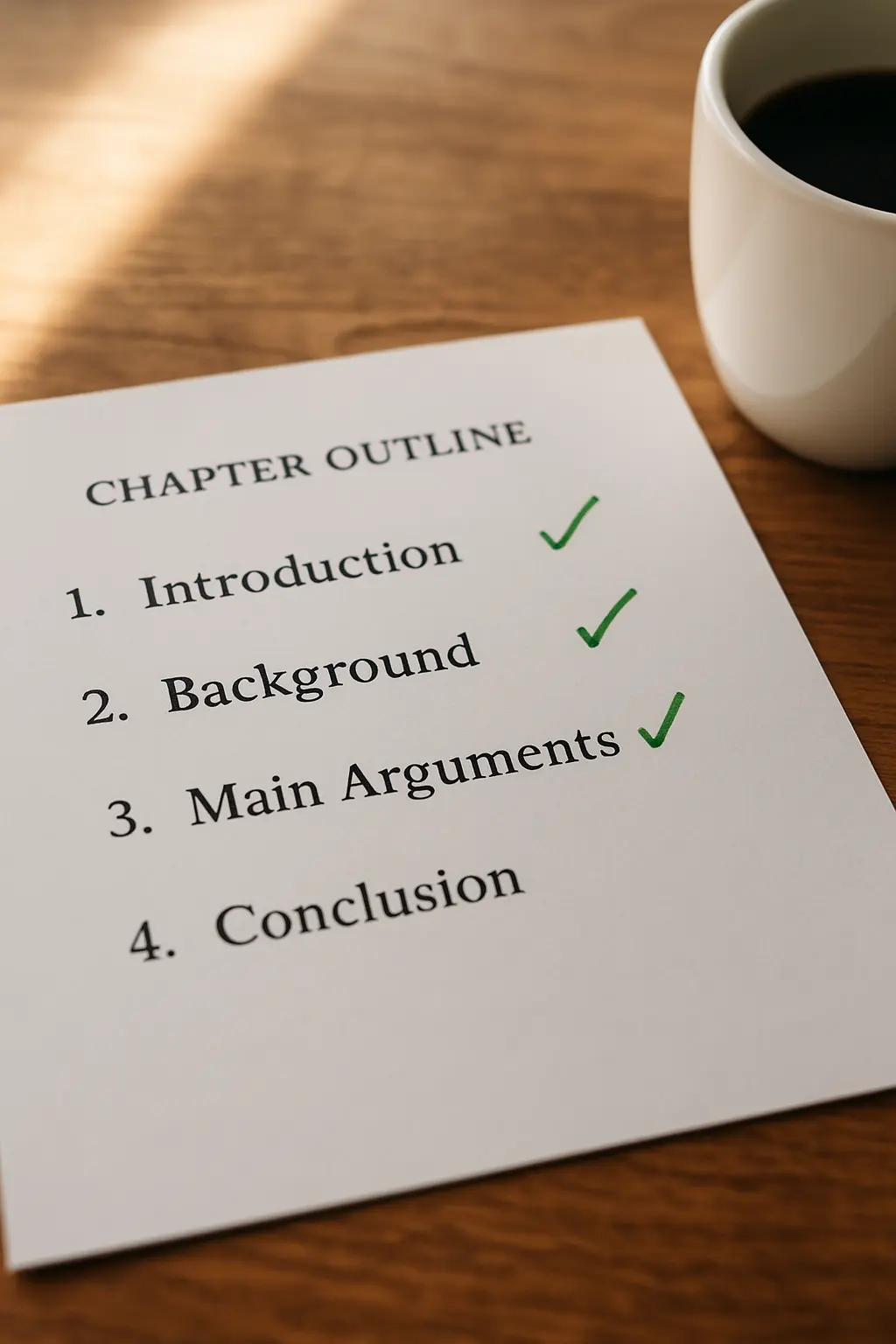
    A dissertation broken into a numbered chapter skeleton with each section's job noted
    Every section with a one-line statement of its job. This page is what turns six weeks of dread into thirty finishable pieces of work.

    Chapter by chapter: what you can hand over, and what you cannot

    Introduction

    Hand over: the conventional shape — context, problem, gap, aims, questions, structure — and a critique of whether your draft actually delivers each. Keep: the claim about why your question matters. Write this chapter last, whatever order the document is in.

    Literature review

    Hand over: reorganising a review you have drafted, checking whether topic sentences match their paragraphs, and suggesting thematic groupings for studies you have read and summarised. Keep, absolutely: deciding what the literature says, judging quality, choosing what matters, and every citation. Never accept a reference from a tool you have not opened and read. The full boundary, with a model declaration, is in our guide to writing a literature review with AI, honestly.

    Methodology

    Hand over: the architecture and the prompts — philosophy, approach, design, sampling, instruments, analysis, ethics — and whether you have justified each decision rather than merely described it. Keep: the justifications. Our walkthrough of the methodology chapter has the structure you can lift, and this is often the fastest chapter to finish because you already know what you did.

    Results

    Hand over: table and figure formatting, and the conventional reporting sentence for a given test — the exact APA construction is set out in our guide to running and reporting a t-test. Keep: the analysis, and every number. Never let a tool near your data values.

    Discussion

    Hand over: a structural check that each finding is interpreted against the literature and that your limitations are specific rather than boilerplate. Keep: the interpretation itself. This chapter is where the marks concentrate and where delegation is most visible, because generic discussion prose reads as generic immediately.

    Bibliography

    Hand over the lot. Formatting citations is clerical work nobody awards marks for and everybody deducts marks over. An automatic bibliography that generates from what your text actually cites removes the cited-but-not-listed problem entirely — see our guide to the AI Harvard referencing generator.

    The one test that settles every case

    Forget “is AI allowed” as your organising question, because the answer varies by institution, by department and sometimes by module. Ask this instead:

    Could you sit with your supervisor, be stopped at any paragraph, and explain why it says what it says?

    If yes, you wrote your dissertation, whatever tools were on the desk. If no, you did not, and no policy wording rescues that. This test also happens to be what a marker applies, which is why it is the one worth optimising for.
    A supervision meeting discussing a draft the student can explain and defend
    This meeting is the real assessment of authorship. Everything else is administration.

    How Tesify is built for this

    Tesify is a dissertation workspace rather than a chatbot, and the difference is that it holds the whole project. It builds the chapter structure for your project, works from your research questions, sources and findings, drafts with you section by section instead of producing a finished essay, maintains the bibliography in your citation style as you cite, and checks your drafts before your university does.

    The design commitment is the important part: everything stays 100% written by you. Tesify handles structure, formatting and momentum; the reading, the reasoning and the words are yours, which is the only configuration that survives the supervisor test. More than 9,000 students have used it across more than 15,000 chapters, and you can start free.

    It also does not need to be your only tool. A general chatbot is genuinely useful for explanation and critique, and a reference manager holds your library — the sensible combination is set out in our comparison of the best AI tools for dissertation writing.

    Tonight, if you are behind

    1. Build the skeleton. Every chapter, every section, one line saying what each section has to achieve. An hour, and the fog becomes a list.
    2. Write the methodology. You already know what you did and the structure is conventional. Having one finished chapter changes your relationship to the whole project more than any amount of planning.
    3. Spend the good hours where the marks are. Analysis and discussion outweigh a perfect introduction. Timebox by weight, not by document order.
    4. Fix the bibliography once, automatically, instead of five times by hand at 2am.
    5. Tell your supervisor where you actually are. Being three weeks behind is a solvable problem; being three weeks behind and silent for a month is a worse one.

    None of this requires you to be more disciplined than you have been. It requires the work to be broken into pieces small enough to start. Open your dissertation in Tesify and build the skeleton tonight — it is free to start, and the chapter you finish tomorrow is the one that changes the next six weeks.

    Frequently asked questions

    Can AI write my whole dissertation for me?

    It can generate text that looks like a dissertation, and that text will contain invented citations, no engagement with your data, and nothing you can defend in a supervision meeting. It cannot produce work that is honestly yours, which is what you are being assessed on.

    Is using AI to write a dissertation cheating?

    It depends entirely on what you use it for and what your institution permits. Structure, formatting, referencing and critique of your own writing are widely accepted; submitting generated text as your own work is not. Read your academic integrity policy and the assessment brief, and follow any declaration requirement.

    How much does Tesify cost?

    You can start free and build real chapters before deciding whether you need anything more. There is no charge to try the workflow on your actual dissertation.

    Will my university know I used Tesify?

    There is nothing to hide. Tesify supports your writing rather than replacing it, so what you submit is your own work. If your department asks you to declare tool use, declare it — a use you can state openly is a use you have already vetted.

    Is my unpublished research safe?

    Your work in Tesify is yours: it is not published or shared into any public database, and you can export it. Keep your own exported backup as a habit with any tool you use.

    What if I only have three weeks left?

    Three weeks of structured, prioritised writing produces far more than most students believe, and far more than any ghost-writer working without your data could. Build the skeleton, write the methodology first, and give the good hours to analysis and discussion.

    Can it help if I have not collected my data yet?

    Yes — the introduction, literature review and methodology can all be drafted before your results exist, and having them written is what makes the analysis period survivable. Check that your ethics approval is in place before you collect anything.

    Does it write in British English?

    Yes, and you should check the final draft for consistency regardless of what you write in. UK departments expect British spelling and conventions unless your handbook says otherwise.

    What if my supervisor has stopped replying?

    Chase once by email, then contact your department’s dissertation coordinator or postgraduate office — supervision is an institutional obligation, not a personal favour. Keep writing while you wait rather than treating silence as permission to stall.

    Will using AI make my writing sound generic?

    It will if you let a tool generate your prose. It will not if the tool handles structure and formatting while you write the sentences, which is the workflow described here and the reason it survives a supervision meeting.
  • How to Write a Dissertation Proposal: The UK Guide for Students Who Need One This Week (2026)

    How to Write a Dissertation Proposal: The UK Guide for Students Who Need One This Week (2026)

    The proposal is due Friday, the form wants a title, aims, objectives, a literature background, a methodology and a timetable, and you are not certain you have a research question yet. That is the standard position, not a failure — the proposal is the first piece of work in your degree where nobody hands you the question. Tesify builds the proposal’s structure with you and keeps drafting from there into the dissertation itself, free to start. Read the sections below first, though, because a proposal written to the wrong template wastes the one meeting where your supervisor could have redirected you.

    What a rejected or vague proposal actually costs

    Not usually marks — at most institutions the proposal is worth little or nothing on its own. It costs something worse: time at the only point in the project where time is still cheap. A proposal that says “I will investigate social media and wellbeing” gets approved, because it is not wrong, and then you spend six weeks discovering the question is unanswerable with the data you can get, the sample you can recruit, or the ethics clearance you will be granted. A proposal that says exactly what will be measured, in whom, and how, gets challenged in the supervision meeting — which is the cheapest challenge you will ever receive.

    The other cost is the supervisor relationship. Supervisors allocate attention to projects they can see. A specific proposal produces specific feedback; a vague one produces “sounds interesting, come back when you have narrowed it down”, and three weeks disappear.

    There is no single UK proposal template — find yours first

    Two named universities publish two different section lists, and both are entirely standard.

    The University of Westminster library guide lists a proposal’s possible elements as title, introduction or background, rationale, purpose, research question, hypothesis, aim, objectives, literature review, methods, significance or expected outcomes, plan of work, outline, and reference list — and notes that “word counts can vary from anywhere between 800 to 3,000 words at undergraduate, postgraduate and doctoral levels”.

    Coventry University‘s academic writing guide gives a leaner sequence: title, outline of the problem, aim, objectives, background, research methodology if appropriate, timetable, a provisional outline of the dissertation structure, conclusion, and references.

    Both are right. Yours is whichever your module handbook or proposal form prints, and the form is usually the template — if there is a proforma, fill in that, not this. What follows is what every version is asking for underneath the different headings.

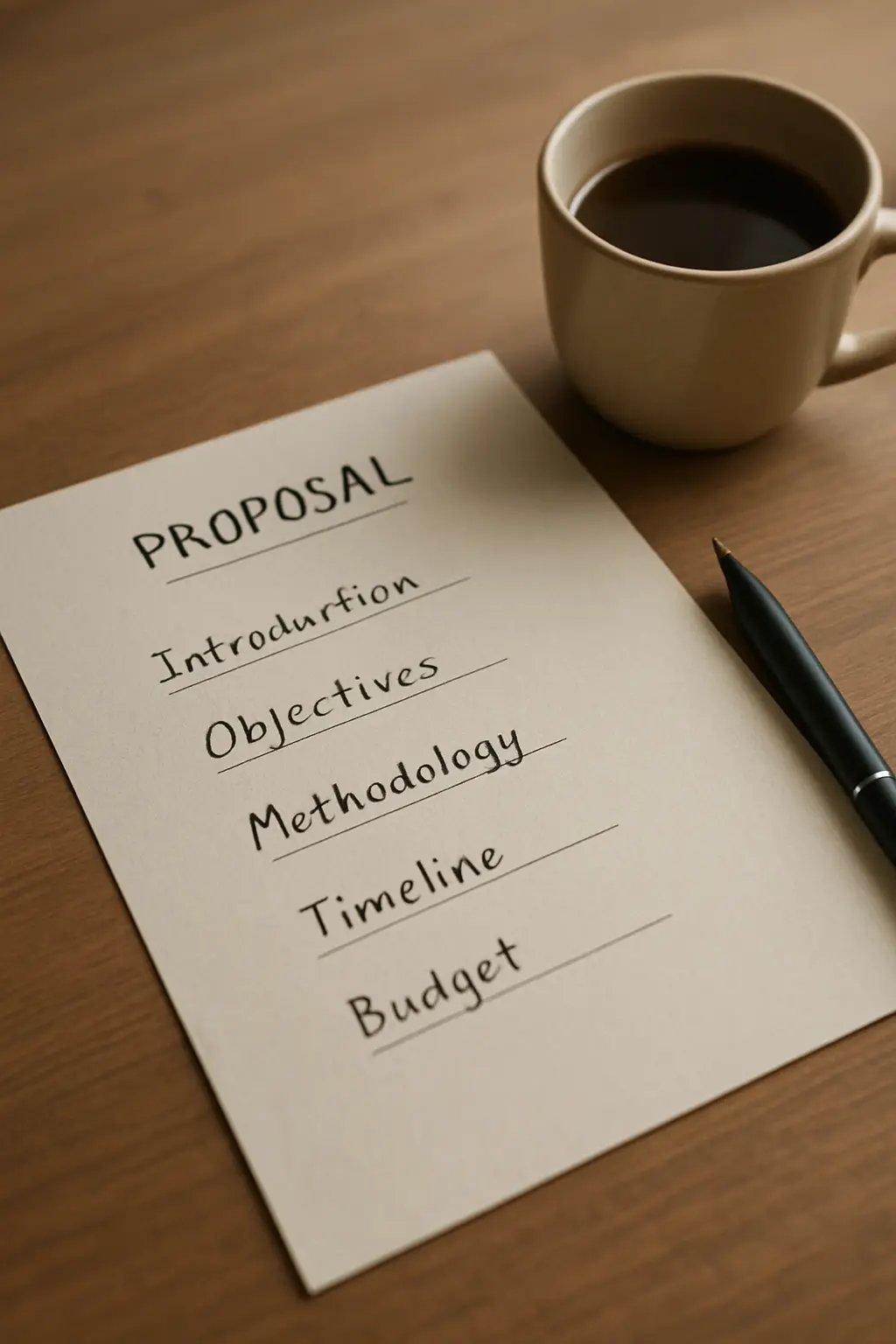
    A dissertation proposal broken into its sections with one line written under each heading
    One line under every heading before you write a paragraph anywhere. The proposal becomes writable the moment it stops being one blank page.

    Section 1: The problem, in three sentences

    Open with what is going on in the world that makes this worth studying, not with what is going on in the literature. Three sentences: the situation, why it matters, and the specific corner of it you are looking at. Save the citations for the background section; here you are establishing that a reasonable person would care.

    The test: could someone outside your discipline read these three sentences and say what your dissertation is about? If not, you have written a topic rather than a problem.

    Section 2: Aim and objectives — and they are not the same thing

    This is the distinction proposals most often blur, and it is the one supervisors most often correct. Westminster puts it cleanly: the aim “echoes” your research question but “uses an infinitive”, while the objectives are “the stepping stones to achieve your aim”.

    So an aim is one sentence beginning with a verb in the infinitive: To examine whether…, To compare…, To evaluate…. One aim, not three. If you have three aims you have three dissertations and time for none of them.

    Objectives are three to five things you will actually do, each one a task with a visible output: review the literature on X and identify the gap; design and pilot a questionnaire measuring Y; collect responses from a defined population; analyse the relationship between X and Y; interpret the findings against the reviewed literature. Write them so that at the end of the project you could tick each one, or not. An objective you cannot tick is a hope.

    Section 3: The research question, narrowed until it is answerable

    A good research question names the variables or concepts, the population and, where relevant, the context. “Does social media affect wellbeing?” is a research area. “Is there a relationship between daily social media use and self-reported sleep quality among first-year undergraduates at one UK university?” is a question you can answer in a single academic year with a questionnaire and no budget.

    Narrow it against four constraints, in this order: can you get the data, can you recruit the participants, will your ethics committee approve it, and can you analyse it with methods you already have or can learn by Christmas. Most unworkable proposals fail on the second or third. If your topic is still a direction rather than a question, our guide to dissertation topic ideas by subject is the right place to start, because a proposal cannot rescue a topic you have not chosen.

    Section 4: Background — and the one sentence that has to be in it

    The proposal’s literature section is not a literature review. It is enough reading to show that you know the territory and that your question has not already been answered. A few hundred words, grouped by theme rather than by paper, and it ends in the gap statement.

    Coventry gives the shape of that sentence almost as a fill-in-the-blank: “No previous study has examined […] in sufficient detail. The present study aims to address this gap within the literature, considering […]”. Use that structure, but earn it — the claim that nothing exists is only credible if the paragraphs above it show what does. If you are deciding how systematically to search in the first place, our comparison of a literature review and a systematic review sets out which your dissertation actually needs.

    Section 5: Methodology — justify, do not list

    The single most common weakness in undergraduate proposals is a methods section that describes without defending. Coventry’s guidance is explicit that you must “explain the methods you will use to collect information in your dissertation, and explain how they allow you to achieve your aims and objectives” — the second half of that sentence is the part students drop.

    Cover five things, briefly, each with a reason attached: your overall approach (quantitative, qualitative or mixed) and why the question demands it; your participants or data and how you will reach them; your instrument or procedure; roughly how many you need and on what basis, which our guide to sample size for an undergraduate dissertation covers properly; and how you will analyse the results. Naming your analysis at proposal stage is what stops you collecting data you cannot use — the full architecture, with worked justifications, is in our walkthrough of the methodology chapter.

    Section 6: Ethics — answer it now, because it gates everything

    Coventry asks you to “explain how you propose to address anticipated problems and ethical issues”, and this is not a box to tick at the end. In UK universities the ethics decision determines whether you may collect anything at all, and approval must be in place before you approach a single participant.

    State plainly whether your project involves human participants, what data you will hold and for how long, how consent will be obtained, and whether any group in your sample makes the project higher risk. Some categories — NHS patients, children, vulnerable adults — change the process entirely and some are closed to undergraduates outright. Read our guide to ethics approval for an undergraduate dissertation before you finalise the design, not after your proposal is approved.

    Section 7: The timetable markers actually read

    Westminster notes the timeline “can be presented using different formats such as bullet points, table, Gantt chart”, and that whichever you use “your plan of work should be realistic and should demonstrate awareness of the various elements”.

    Realistic is the operative word, and it means three things. Put the ethics application before data collection with a genuine gap for the committee to meet. Assume recruitment takes twice as long as you think. And leave the final two weeks free of new work, because they will be consumed by formatting, referencing and the things you did not plan for. A timetable that ends on the submission date with everything neatly filled tells a supervisor you have never done this before; one with visible slack tells them you have thought about it.

    A supervisor and student discussing a printed dissertation proposal in a university office
    The proposal’s real job is to produce this conversation while there is still time to change the design.

    Writing it this week, in order

    1. Day one: download the proforma and write one line under every heading, however bad. The blank page is the problem; a bad line is not.
    2. Day two: fix the question. Narrow it against data, recruitment, ethics and analysis until it survives all four.
    3. Day three: read enough to write the background and the gap sentence. Six to ten sources is normally plenty at this stage.
    4. Day four: write the methodology with a reason attached to every choice, and draft the ethics answer at the same time, because they constrain each other.
    5. Day five: aim, objectives, timetable, title. These are quickest once everything else exists, which is why they come last despite appearing first on the form.
    6. Day six: read it as your supervisor will — can they tell what you will measure, in whom, and how? Format the references properly using our Harvard referencing guide, because a proposal with a broken reference list starts the relationship badly.

    If the obstacle is not knowing what to write but getting anything on the page at all, that is precisely the problem Tesify was built for. It builds the structure of your proposal and then your dissertation, section by section, drafts with you from your own research questions and sources, and maintains the bibliography in your citation style as you cite. Everything stays 100% written by you — more than 9,000 students have used it across more than 15,000 chapters. Start your proposal in Tesify free and have something to take to your supervisor this week.

    Frequently asked questions

    How long should a dissertation proposal be?

    There is no standard length. Westminster’s guidance notes that proposal word counts “can vary from anywhere between 800 to 3,000 words at undergraduate, postgraduate and doctoral levels”. Your proforma or handbook sets yours, and most undergraduate proposals sit at the lower end.

    Is the dissertation proposal marked?

    At many UK institutions it carries little or no weight in the final mark, but it is normally a required gateway — approval unlocks supervision, ethics review and data collection. Treat it as a design document rather than an assessment.

    What is the difference between an aim and an objective?

    The aim is the single result the study seeks, written as an infinitive — “to examine whether…”. The objectives are the achievable activities that get you there, described by Westminster as “the stepping stones to achieve your aim”. One aim, three to five objectives.

    Can I change my research question after the proposal is approved?

    Usually yes, within reason, and refinement is normal. Substantial changes to design or participants often need to go back through ethics, so raise anything significant with your supervisor rather than quietly proceeding.

    Do I need ethics approval before I write the proposal?

    No — the proposal normally comes first and often triggers the ethics application. What you must not do is collect any data before approval is granted, which is why the proposal has to state honestly what your project involves.

    How many sources do I need in a proposal?

    Enough to establish the territory and the gap, which is usually a handful rather than a full review. Depth matters more than count: six sources you have read and can group thematically beat twenty you have only seen abstracts of.

    Is it acceptable to use AI to write my dissertation proposal?

    Your institution’s academic integrity policy governs this, and rules differ by department, so read yours and follow any declaration requirement. The line that matters is authorship: structure, formatting and feedback on your own writing are widely accepted; submitting generated text as your own work is not. Tesify is built for the first of those — it structures and drafts with you, and every word remains yours.

    How much does Tesify cost?

    You can start free and build a real proposal and real chapters before deciding whether you need more. There is no charge to try the workflow on your actual project.

    Is my work private if I write my proposal in Tesify?

    Your work is yours — it is not published or shared into any public database, and you can export it at any time. Keeping your own exported backup is a sensible habit with any tool you write in.

    My supervisor rejected my proposal. What now?

    Ask for the specific reason and treat it as design feedback rather than a verdict — the common causes are a question too broad to answer, a method that cannot deliver the aim, or a sample that cannot be recruited. Each has a fix, and finding it now costs a week rather than a term.

    Should I write the title first?

    Write a working title first and the real one last. The title has to match the question you finish with, not the one you started with, and rewriting it at the end takes five minutes.