Most dissertation plans fail in the same way. They allocate weeks to writing chapters, which is the part you control, and no time at all to ethics approval, participant recruitment, a supervisor’s annual leave or the print shop’s queue — which is where the weeks actually disappear. Then week six arrives, nothing has moved, and the plan gets abandoned rather than adjusted.
This is a twelve-week plan built the other way round: the fixed-duration external dependencies go in first, the writing flows around them, and the buffers sit where the delays really happen. If you would rather have the chapter structure built for you than build it yourself, Tesify does that free.
Three rules before the weeks
Work backwards from submission, not forwards from today. Put the deadline on the page first, then subtract binding and printing, then the final proofread, then the last supervisor read. What remains is your actual writing window, and it is always shorter than it felt.
Start the slowest thing first. Ethics approval and recruitment have durations you do not control. Everything you can do while waiting — literature, methods, instruments — should be scheduled into the waiting.
Plan in deliverables, not hours. “Work on lit review, Tuesday” is unfalsifiable and will not happen. “Draft the 600 words on measurement debates, Tuesday” either happened or it did not. This matters more than any other item on this page.
The twelve weeks
| Week | Main deliverable | Running in parallel |
|---|---|---|
| 1 | Question fixed and agreed with supervisor; chapter skeleton built | Start reading; set up reference manager |
| 2 | Ethics application submitted | Literature search run and logged |
| 3 | Literature review first draft (half) | Ethics under review; build instruments |
| 4 | Literature review first draft complete | Approval expected; recruitment materials ready |
| 5 | Data collection opens; methodology chapter drafted | Recruitment chasing |
| 6 | Data collection continues; methodology to supervisor | Analysis plan written before data arrives |
| 7 | Data collection closes; cleaning and preparation | Revise literature review on feedback |
| 8 | Analysis run; results drafted | — |
| 9 | Results chapter complete; discussion started | Results to supervisor |
| 10 | Discussion and conclusion drafted | Introduction written last |
| 11 | Buffer week — full draft assembled; abstract written | Bibliography and formatting check |
| 12 | Proofread, print, bind, submit two days early | — |
Why the plan front-loads the things that are not writing
Ethics goes in week two, not week five. Approval must be in place before you approach a single participant, retrospective approval is generally unavailable, and data collected without it is unusable however good your intentions. A low-risk departmental review often takes days to a few weeks, and every round of requested revisions restarts the clock. Our guide to ethics approval for an undergraduate dissertation covers what triggers review and what goes in the application — and note that if your project involves NHS patients or staff as participants, the answer is a redesign rather than a longer wait.
The literature review is drafted during the ethics wait. This is the single biggest efficiency in the plan. Those three weeks are otherwise dead time, and the review is the chapter least dependent on anything else. Run and log your searches properly at the start using the databases mapped in our guide to where to search for dissertation literature, because reconstructing a search log in week eleven is the most avoidable job in the whole project.
Data collection gets three weeks, not one. Recruitment is slower than everyone expects, and your target sample should have been decided in advance rather than discovered — the reasoning belongs in your methods, as set out in our guide to sample size for an undergraduate dissertation.
The analysis plan is written in week six, before the data exists. Deciding your analysis in advance stops you fishing through your results for something significant, and it means week eight is execution rather than decision-making.
The five things that break timelines
- Ethics revisions. Assume one round. If it comes back clean, you have gained a week.
- Recruitment stalling. Have a second recruitment route agreed with your supervisor before you need it.
- Supervisor availability. Ask in week one when they are away and what their turnaround time is. Two weeks of annual leave in August is normal and it is only a crisis if you did not know.
- Analysis surprises. An assumption fails, a variable is not what you thought. Week eight has slack for exactly this, and the fallback routes are in our guide to what to do when your statistical assumptions fail.
- Printing and binding. Print shops have queues in submission week, and a bound copy requirement discovered on the last afternoon has ruined otherwise finished dissertations. Check your submission format in week one.
The buffer rules
Week eleven is a buffer, and the rule is that you do not spend it in advance. A plan with no slack does not survive one bad week; a plan with a fortnight of slack invites the whole schedule to drift into it. One protected week plus a deliberate two-day early submission is about right.
Two more habits protect the plan. Schedule at most five working days a week — you will use the sixth, but it should be recovered time rather than allocated time. And if a deliverable slips, move it and re-plan the same evening rather than letting the plan quietly become fiction, which is how most abandoned schedules actually end.

If you are already behind: the six-week version
Compress by cutting scope, not by cutting stages, and talk to your supervisor before you commit to any of this.
Weeks 1–2: skeleton built, methodology written first because you already know what you did, data collection opened immediately if ethics is already approved. Weeks 3–4: literature review drafted to a narrower scope — fifteen sources understood properly beats forty skimmed — and analysis run as soon as collection closes. Week 5: results and discussion, which is where the marks are. Week 6: introduction, abstract, bibliography, proofread, submit.
If your project has not started at all and the deadline is close, the honest options are an extension through your institution’s extenuating circumstances process — which has evidence requirements and a deadline of its own — or a redesign to a literature-based project that needs no participants and no approval clock. Both are better than the third option, and if you are being tempted towards buying a dissertation, read what that actually costs in our guide to legitimate versus criminal dissertation help first.
Make the plan do some work for you
A timeline is only useful if it converts into tasks small enough to start on a tired Tuesday. That conversion — chapters into sections, sections into a one-line statement of what each has to achieve — is what turns a plan into progress.
Tesify builds that structure for your dissertation and drafts it with you section by section, keeping the bibliography formatted as you cite. More than 9,000 students have used it across more than 15,000 chapters, everything stays 100% written by you, and it is free to start. Which other tools are worth adding is covered in our comparison of the best AI tools for dissertation writing.
Frequently asked questions
How long does an undergraduate dissertation take?
Most UK undergraduate dissertations run across one or two semesters, and twelve concentrated weeks is a realistic working window for the bulk of it. The variable is not the writing but the approvals and data collection in front of it.
When should I start my dissertation?
As soon as you have a supervisor and a workable question. The specific thing to start early is the ethics application, because its duration is the one you cannot compress.
How many words a day should I write?
Between 500 and 1,000 words of drafting is sustainable for most students alongside other commitments, and two thirds of full-time undergraduates are also in paid employment. Plan by deliverable rather than by word count, and expect editing to take as long as drafting.
Should I write the chapters in order?
No. Write the methodology early because you already know what you did, and the introduction last because it has to describe a dissertation that exists. The literature review can be drafted before your data collection has even opened.
What if I miss my own deadlines?
Move them and re-plan the same evening. A plan that is adjusted stays useful; a plan that is quietly ignored stops being a plan. Tell your supervisor if you have slipped by more than a week.
Do I need a Gantt chart?
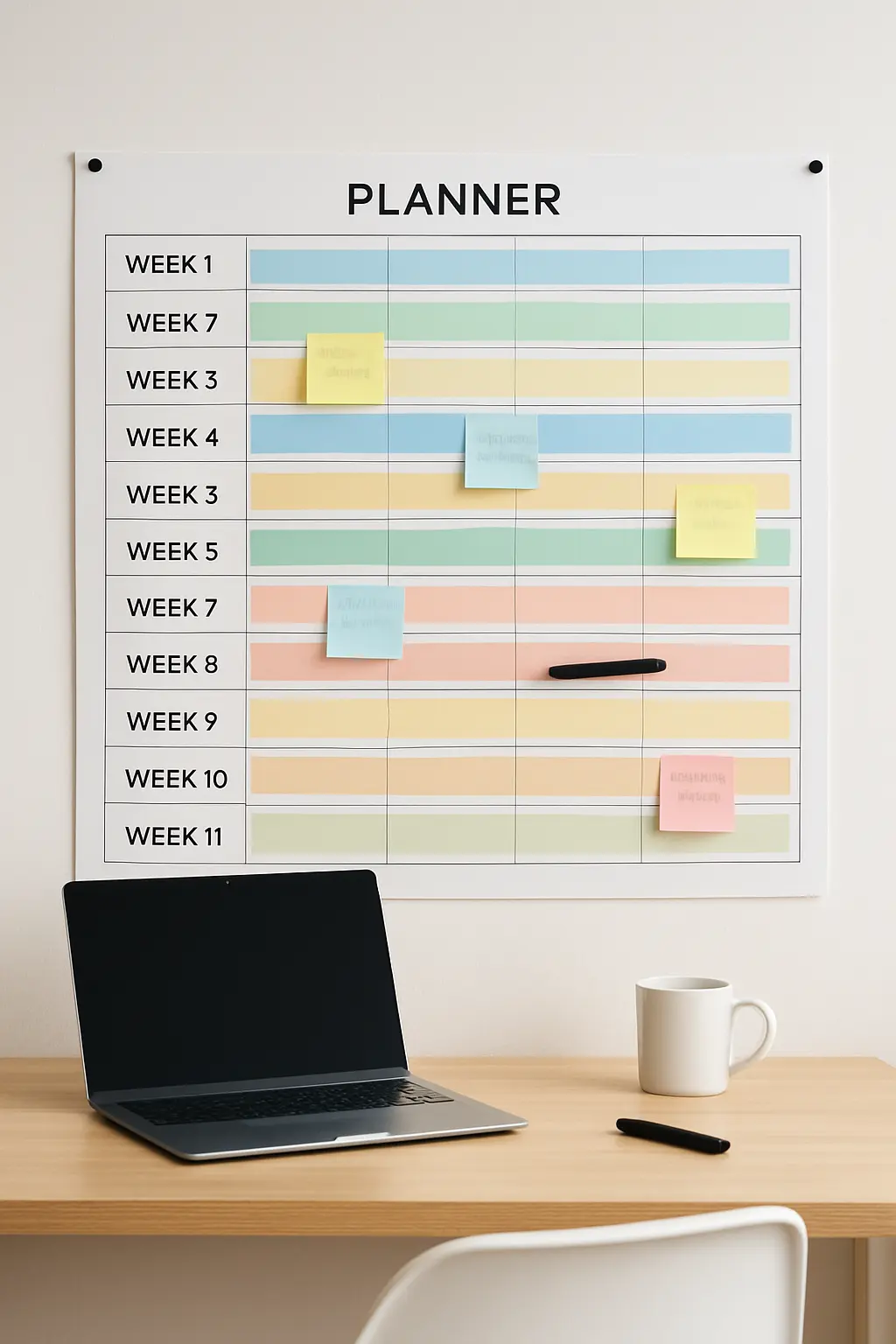
Only if your department asks for one, which some do as part of a proposal. A wall planner or a simple table works just as well for actually running the project.
How much time should I leave for proofreading?
At least a full week, and read the whole thing once on paper. Add a separate pass reading only the bibliography and citations, which is where the cheapest marks are lost.
Can I get an extension?
Extensions run through your institution’s extenuating circumstances process, which generally covers illness, bereavement and crisis rather than ordinary deadline pressure. It has evidence requirements and its own deadline, so read the policy before you need it.
What if my supervisor is on leave when I need feedback?
Ask in week one when they are away and plan around it. If you cannot reach them for an extended period, contact your department’s dissertation coordinator — supervision is an institutional obligation.
How early should I submit?
Two days early. Upload systems fail, files corrupt and print shops have queues, and none of those are accepted as reasons for a late submission.