
Tag: assessment

  • How Much of Your Dissertation Mark Is for Writing? The Published UK Criteria (2026)

    How Much of Your Dissertation Mark Is for Writing? The Published UK Criteria (2026)

    No UK university publishes a national standard for how much of a dissertation mark is awarded for writing, and at least three publish undergraduate criteria that contain no writing category at all. That is the finding. Below are the actual published band descriptors from named UK universities, what they reward, and the one thing they agree on — which is not grammar.

    What the published criteria actually say, band by band

    Every document in this table was opened and its undergraduate scope confirmed from the document itself. The wording is quoted as published.

    Institution and document First 2:1 2:2
    Royal Holloway, Criminology and Sociology dissertation handbook “have an incisive and fluent style, with no significant errors of spelling, punctuation or grammar” “have a fluent style, with few errors of spelling, punctuation or grammar” “have a straightforward style, and may include some errors of spelling, punctuation or grammar”
    University of Edinburgh, School of Social and Political Science “the discussion should move beyond a mainly descriptive account of the results, to develop its own comments, points and interpretations” “Referencing and the quality of the writing should be without major blemish” “The data will be presented accurately, if rather descriptively… The quality of writing, referencing and presentation should be acceptable”
    UCL, Institute of Archaeology “style and word choice show fluency with ideas & flashes of verve” “style & word choice rarely detract from conveying of ideas” “style and word choice sometimes detract from conveying of ideas”
    Newcastle University, English Literature, Language and Linguistics “Style and expression are of a high academic standard, polished and fluent, with a strong command of discipline-specific vocabulary” “May present some problems of style and expression, but these do not interfere with the communication of the argument” “may present problems of style and expression that affect the communication of the argument”
    University of Nottingham, School of Sociology and Social Policy “Source material is treated critically… The argument is well structured and clear, with no significant confusion” “critical appraisal is underdeveloped. Analysis lacks depth”

    The pattern: the band boundary is criticality, not correctness

    Read down those columns and one thing is consistent. The prose descriptors move in small increments — fluent, then fluent with few errors, then straightforward. The analytical descriptors move in jumps.

    Keele makes this unmissable. In its generic undergraduate assessment criteria, the writing clause is word-for-word identical in the first-class and upper-second bands: “Clearly structured, robust and persuasive arguments, lucidly written, uses clear and accurate expression”. The same sentence appears in both. Only the critical-analysis clause differs. On that rubric, prose quality cannot move you from a 2:1 to a first, because the rubric asks the same of both.

    Nottingham states the same logic explicitly, and it is the single most useful sentence in any of these documents: “It may be helpful to see the lower second class as the starting point… Achieving a higher result requires something extra — and this will usually be found in the quality of analysis and criticism, in the presentation of a sustained and coherent argument…”

    The word markers reach for when that something extra is missing is descriptive. It appears in band after band. Edinburgh’s 2:2: data “presented accurately, if rather descriptively”. Edinburgh’s fail band: “failure to analyse or discuss the implications of the data in anything more than a thin and descriptive way”. Newcastle’s 2:2: “more descriptive than analytical”. Nottingham’s third: “Source material is treated uncritically, and analysis is flawed or non-existent.” Nottingham’s geography criteria describe a 2:2 dissertation as “pedestrian or lacking in imagination and critical insight… Satisfactory, but not stylish or perceptive.”
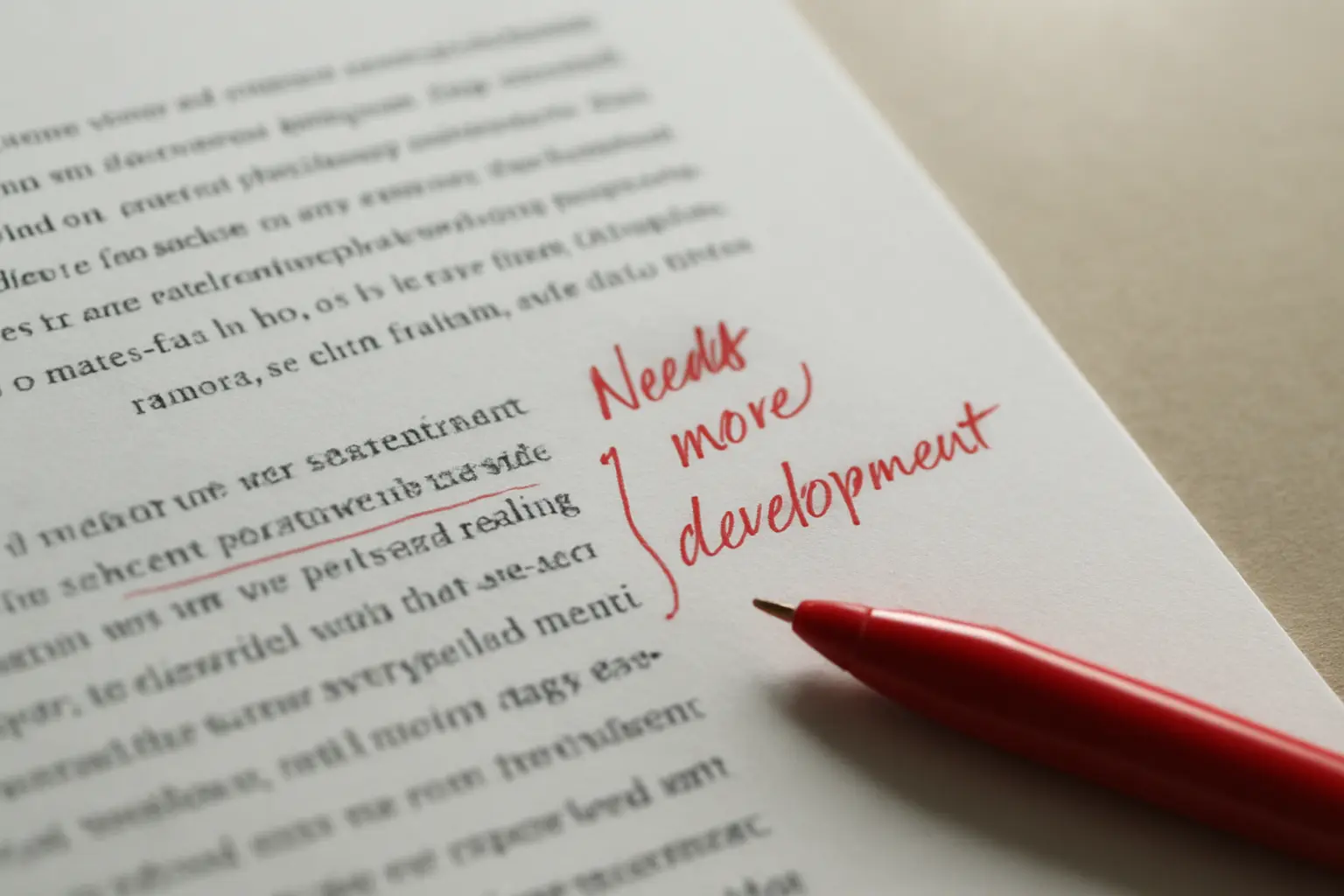
    A returned dissertation chapter carrying a marker's handwritten comment beside a descriptive passage
    The commonest single word in the 2:2 band descriptors examined is “descriptive”.

    The weightings, where any exist at all

    Almost no UK undergraduate dissertation rubric publishes a percentage for writing. Two that do something close:

    Institution and document What is published Effective weight for presentation
    University of Manchester, Department of Mathematics, Undergraduate Project Guide 2019/20 “there is a total of 90 marks for the dissertation. Half of these marks are allocated to communication of ideas (introduction, 10 marks; presentation, 15 marks and accuracy of argument, 20 marks) and half the marks awarded for comprehension (choice of content, 25 marks and understanding of material, 20 marks). The last 10 marks are for the oral presentation.” 15 of 90 marks
    University of Cambridge, Computer Science and Technology, Part II project assessment “Introduction and preparation (30 marks) / Implementation and contribution (45 marks) / Evaluation and conclusions (25 marks)” — with the rider that candidates “who fail to adhere to the prescribed structure… will not receive high marks for presentation.” No allocation; enforced by penalty

    Note what the Manchester breakdown really shows: half the available marks sit under the heading communication of ideas, of which presentation is one component alongside the introduction and the accuracy of the argument. Read carelessly, that looks like half the degree is for writing. Read properly, it means the department treats structuring and expressing an argument as inseparable from having one.

    The three that decline to mark writing at all

    This is where the sector genuinely splits, and it is not a matter of emphasis.

    SOAS excludes it by policy. Its marking criteria policy states that “The minimum core criteria intentionally do not include standards concerning the presentational aspects of the work, such as spelling and punctuation in written assignments… Such additional criteria are not standard to all modules”. That is a deliberate institutional decision, not an omission.

    Bristol’s level 6 criteria — level 6 being third-year undergraduate — contain no category for spelling, grammar, style, referencing or presentation. The only writing-adjacent row reads “High-level academic skills consistently applied” at 70 to 79 against “Academic skills consistently applied” at 50 to 59.

    Brunel’s undergraduate grade descriptors likewise carry no referencing, spelling or presentation bullet. Writing appears only as “an excellent ability to communicate clearly and concisely” at A against “an ability to communicate clearly and concisely” at B.

    Against those, UCL’s Institute of Archaeology scores three separate presentation dimensions — writing, visuals and referencing. Two published UK undergraduate rubrics, opposite decisions about whether presentation is assessable at all.

    Why there is no national figure, in the sector’s own words

    The absence is documented rather than merely observed. Three institutions state it directly.

    • Durham, on its Common Awards provision: the assessment guidance pages “do not provide distinct assessment guidelines or marking criteria for dissertations, pointing people instead to the generic guidance for ‘Essays and other written assignments’”, and institutions “are free… to design their own procedures for marking dissertations.”
    • Manchester, in its university marking scheme: “Faculties and Schools will publish more detailed marking criteria.”
    • Cambridge, in its project assessment guidance: “These marking guidelines are not a detailed mark scheme. Part II projects are different for every student, and so marking necessarily relies upon the informed judgement of the Examiners.”

    Edinburgh adds the warning that matters most to you as a student: “Not all assignments use these criteria… some assignments will instead use different, bespoke criteria developed by the Course Organiser.” The university-level document you find first may not be the one your dissertation is marked against.

    The divergence runs inside single institutions as well as between them. Nottingham’s own quality manual prints several incompatible schemes side by side as examples. Royal Holloway runs two unrelated undergraduate dissertation schemes in different departments. Edinburgh’s social and political science school uses a three-criterion rubric for undergraduate coursework and a different scheme for the undergraduate dissertation.
    Two universities' dissertation criteria side by side, weighting written communication differently
    Two published UK undergraduate rubrics can disagree about whether presentation is assessable at all.

    Even the scales do not match

    Among the documents examined, the marking instruments themselves differ in kind: continuous zero to 100 marking; categorical marking where only a few marks are available within each band; a 16-point letter scale; a 24-point scale; and letter grades with no percentages printed at all. Referencing expectations differ too — the rubrics examined variously mark against Harvard, against APA, against departmental guidelines, and against the standards set out in a specific handbook.

    The practical consequence: comparing your marking criteria with a friend’s at another university tells you almost nothing, and a mark of 68 does not mean the same thing in two places. Our guide to degree classification statistics covers what happens to those marks once they reach an exam board, and who marks your dissertation and how it is moderated covers who applies the criteria.

    What to do with this

    1. Get the criteria for your specific module, not the university-level scheme. Edinburgh’s warning above is the reason.
    2. Find the word that changes between the 2:1 and the first band. On most of these rubrics it is a word about analysis, not about prose. That tells you where the marks are.
    3. Take “descriptive” seriously as a diagnosis. If your chapter reports what was found and stops, it is sitting in the 2:2 band descriptor on four of the five rubrics above, however clean the sentences are.
    4. Do not conclude that writing does not matter because your rubric omits it. Criticality is realised in sentences — an interpretation that is not written down is not marked.

    Two sentence-level decisions that markers do notice, and that no rubric explains, are covered separately: whether you can use “I” and what tense each chapter takes. And on the question of how much reading your bibliography should show, our guide to how many references a dissertation should have works from the same kind of published criteria.

    Writing so the analysis is visible

    The gap these rubrics describe is not a vocabulary gap. It is the difference between a chapter that reports and a chapter that argues — and it is fixed at the point where you write the sentence after the evidence, not at the proofreading stage.

    Draft your dissertation in Tesify: keep your research questions beside the chapter so every section can be checked against what it is supposed to answer, and keep the bibliography formatting itself so the clerical marks look after themselves. The analysis stays 100% yours — that is the part no rubric will give you credit for outsourcing. There is a free tier.

    Frequently asked questions

    How many marks does writing quality carry in a UK dissertation?

    There is no sector-wide figure, and almost no UK department publishes one. The clearest published weighting found is the University of Manchester’s undergraduate mathematics project guide, which allocates 15 of 90 marks to presentation. Most rubrics assign no percentage to writing at all — they fold it into holistic band descriptors.

    Do all UK universities mark writing quality?

    No, and this is the sharpest disagreement in the data. SOAS excludes it by policy: its minimum core criteria “intentionally do not include standards concerning the presentational aspects of the work, such as spelling and punctuation in written assignments”. Bristol’s and Brunel’s undergraduate criteria contain no spelling, grammar, referencing or presentation category either.

    What actually separates a first from a 2:1?

    Across the rubrics examined it is criticality rather than prose. Keele is the clearest case: its writing clause is word-for-word identical in the first-class and upper-second bands — “Clearly structured, robust and persuasive arguments, lucidly written, uses clear and accurate expression”. Only the critical-analysis clause changes between the two.

    What does “descriptive” mean when a marker writes it?

    It means your sentences report what was found or said without stating what it means. Edinburgh’s social and political science criteria draw the line at exactly this point: a first-class dissertation “should move beyond a mainly descriptive account of the results, to develop its own comments, points and interpretations.”

    Where does the 2:2 band usually lose its marks?

    At analysis, not at grammar. Nottingham’s sociology criteria describe a 2:2 as work where “The treatment, however, is dependent on the sources, and critical appraisal is underdeveloped. Analysis lacks depth”. Newcastle’s language and linguistics criteria describe the same band as “more descriptive than analytical”.

    Do style and expression ever change the band on their own?

    Rarely alone, but they are described as a threshold effect. Newcastle’s bands turn on whether the prose gets in the way: a 2:1 “May present some problems of style and expression, but these do not interfere with the communication of the argument”, while a 2:2 “may present problems of style and expression that affect the communication of the argument.”

    Is there a national UK standard for dissertation marking?

    No. Durham’s Common Awards guidance states that its assessment pages “do not provide distinct assessment guidelines or marking criteria for dissertations”, and that institutions “are free… to design their own procedures for marking dissertations.” Manchester likewise devolves it: “Faculties and Schools will publish more detailed marking criteria.”

    Do two UK universities ever use the same marking scale?

    Often not even the same kind of scale. The documents examined use continuous 0 to 100 marking, categorical marking with only a few permitted marks per band, a 16-point letter scale, a 24-point scale, and letter grades with no percentages printed at all. Comparing your criteria with a friend’s at another university is close to meaningless.

    Which referencing style do the criteria assume?

    Whichever your department has chosen, and they differ. Among the rubrics examined, one marks against Harvard, another against APA, another against its own departmental guidelines, and another simply against the standards set out in its handbook. There is no default you can assume.

    Does presentation get its own marks in science and engineering?

    Sometimes it is enforced by penalty rather than by allocation. Cambridge’s computer science project assessment gives presentation no separate marks, but states that candidates “who fail to adhere to the prescribed structure… will not receive high marks for presentation.” The requirement is real even where the weighting is invisible.

    Should I ask my department for its marking criteria?

    Yes, and it is a reasonable request — these are published documents. Ask for the criteria for your specific dissertation module rather than the university-level scheme, because the two often differ and the module-level one is what your marker uses.

    If the criteria do not mention writing, can I stop worrying about it?

    No. Even rubrics with no writing category reward “an excellent ability to communicate clearly and concisely”, and the criticality that every band descriptor turns on is realised in sentences. Writing is how analysis becomes visible to a marker; a rubric that never names it still marks it indirectly.

  • Who Marks Your Dissertation, and How Is It Moderated? The Published UK Rules (2026)

    Who Marks Your Dissertation, and How Is It Moderated? The Published UK Rules (2026)

    No UK regulator requires your dissertation to be marked twice, or requires an external examiner to see it at all. The UK Standing Committee for Quality Assessment’s external examining principles state that they “are not mandatory under any of the UK regulatory systems”, and add that the Office for Students “does not impose any particular requirements in relation to external examining arrangements”.

    What governs your mark is your own institution’s marking and moderation policy. Those policies are published, they are readable, and on the questions students most want answered they contradict one another. Below are the rules three named UK universities actually publish, quoted, with the scope of each stated so you can judge whether it resembles your own.

    The published rules, side by side

    Question Institution and scope What the policy says
    Must a dissertation be second-marked? UCL, Academic Manual Chapter 4, taught programmes, 2025-26 “All dissertations / research projects must be subject to Full, Independent, second-marking” (4.5.1)
    Must a dissertation be second-marked? Oxford Brookes, Quality and Standards Handbook, all Schools and delivery locations “Dissertations should always be ‘blind’ second marked”
    Must a dissertation be second-marked? Durham University, Common Awards programmes “Double-marking is to be applied to all dissertations and major projects”
    Must second marking be blind? Durham, Common Awards “Where double marking is used, there is no University requirement that it must be carried out blind or unseen”
    What if my supervisor marks it? UCL, taught programmes Where the supervisor acts as a marker, “the assessment must be subject to full, independent and anonymous second-marking” (4.3.7)
    Moderation sample size UCL, taught programmes “at least 10% of assessments, or at least five assessments”, plus “All Fails”, “Mid-class examples for each class” and “all upper borderlines (39, 49, 59, 69)” (4.5.3.2)
    Moderation sample size Oxford Brookes “10%, whole cohort if it is less than 10”
    Moderation sample size Durham, Common Awards “the approved minimum sample size is 6 pieces of work or 10% of the pieces of work in a run (whichever is greater)”
    Is marking anonymous? UCL, taught programmes “All summative assessments should be carried out anonymously unless the nature of assessment makes this impossible” (4.3.1)
    Can an external examiner change my mark? UKSCQA External Examining Principles, August 2022 Student engagement with examiners must protect “the impartiality of the examiner” while “ensuring individual students’ marks remain unaffected”

    Double marking and moderation are not the same thing

    Durham’s policy opens by making the distinction that most confusion rests on: “Double-marking and moderation are two distinct mechanisms.”

    Double marking means a second marker reads and marks your work. Moderation means a moderator looks at a sample of the cohort’s work to check that the marking as a whole was applied consistently. Durham states the consequence explicitly: moderation “does not involve the moderator agreeing a revised mark for each individual piece of work”.

    The rule that follows from that is the most useful single fact in this article, and almost no student knows it. At Durham, “individual marks awarded by the first marker cannot be changed unless the second marker has marked all the other scripts in a run”. A moderator who reads your dissertation as part of a sample and disagrees with the mark cannot simply adjust yours. Either the whole run is remarked or nothing individual moves — because changing one sampled mark and not the unsampled ones would make the cohort’s marks incomparable.

    So if your dissertation was double-marked, two people formed a view of it. If it was moderated, it may well have been read by nobody but the first marker, and the second pair of eyes was checking the marking standard rather than your work.

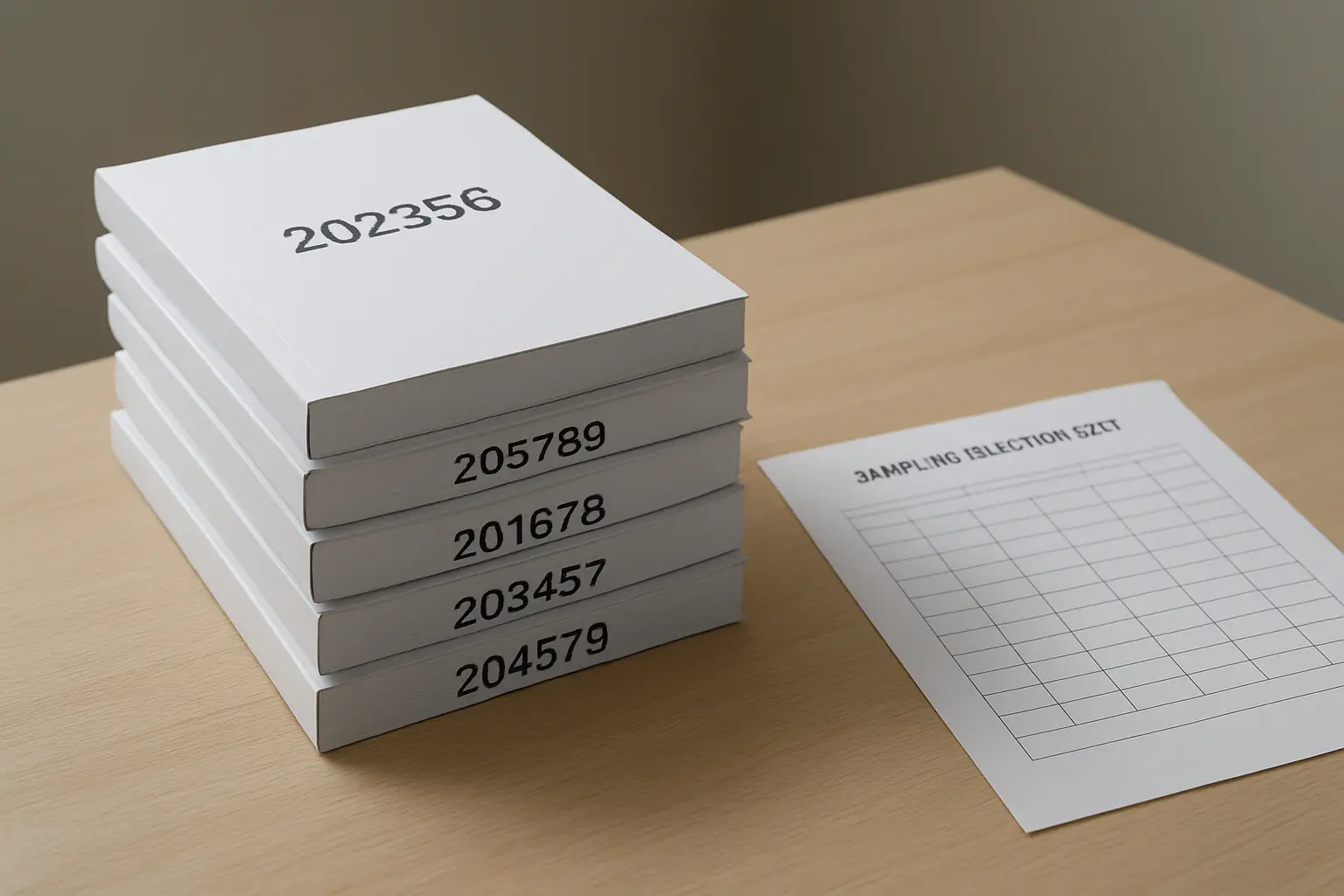
    A sample of anonymised dissertations selected for internal moderation
    Moderation reads a sample and checks the standard. It is not a second opinion on your dissertation.

    How the sample is chosen — and why it is not random

    A moderation sample is deliberately stratified. UCL’s minimum requires “All Fails”, “Mid-class examples for each class”, and “all upper borderlines (39, 49, 59, 69)” alongside the 10% floor. Durham adds a safeguard against a self-serving sample: the selection “should not depend entirely on the first marker’s identification of work which seems to them to be problematic”, and should include work from across the range.

    Two practical consequences for you. If your mark is 39, 49, 59 or 69 at UCL, your dissertation is in the sample by rule — borderlines are always looked at, which is a better answer than the folklore that borderline marks are quietly rounded. And if you failed, your work is looked at again by rule at that institution, before any of the machinery in our guide to what happens if you fail your dissertation is engaged.

    What happens when the two markers disagree?

    UCL sets a threshold and then bans the obvious shortcut. Where marks differ by 10% or more, or where they fall either side of a class boundary, “marks must be reconciled through discussion” and “mathematical averaging should not be used” (4.5.4.1). Smaller differences may be resolved “by discussion or by mathematical averaging” (4.5.4.2).

    That is a more consequential rule than it looks. A 58 and a 68 do not become a 63 by arithmetic; two academics have to talk until they agree what the piece is worth against the criteria. Oxford Brookes requires each department to have such a mechanism in place, stating that internal moderation policies “must be clear about the procedure to be followed in order to resolve any disagreement between first and second markers and assign a final mark”.

    Where discussion fails, a third marker may be used. UCL notes that externals do not third-mark to break deadlocks, but that “bringing third-marked work to the attention of the External Examiner is good practice” (4.5.5.2).

    What does the external examiner actually do?

    Less than students imagine, and something more important than remarking. The UKSCQA principles describe external examiners as assuring “the degree-awarding body that the qualifications it awards are comparable to those at other institutions”, which they do “by commenting impartially and informatively on academic standards, student achievement and assessment processes in the institution and their consistency with others”.

    They see samples, not cohorts. Durham requires that “raw marks, as well as reconciled marks, should be made available to external examiners” — so an external can see where two markers disagreed and how it was settled. Oxford Brookes states that where the external’s sample differs from the internal one, examiners “should be provided with additional information about the internal moderation process that has been followed”.

    And the limit is explicit in the principles: arrangements for students to engage with external examiners must ensure that “individual students’ marks remain unaffected”. An external examiner is not an appeal route and cannot lift your mark.

    The sector-level context is worth holding alongside this, because it is genuinely surprising: the principles themselves say they “are not mandatory under any of the UK regulatory systems”, and the footnote records that in England, “for the avoidance of doubt, the OfS does not impose any particular requirements in relation to external examining arrangements”. External examining is a 200-year-old sector convention operated voluntarily by autonomous institutions, not a statutory guarantee.

    An examination board table set with mark sheets before the meeting that ratifies results
    Until the board sits, every mark you have been shown is provisional. That is a statement about process, not about your work.

    Why your mark is provisional until the board meets

    The number your supervisor mentions, and often the number in the virtual learning environment, is a marker’s recommendation. It becomes your mark when a board of examiners ratifies it, in the presence of the external examiner’s report, alongside every other mark on the module.

    This is why a mark can move without anyone having reread your dissertation: a scaling decision applied to a whole run, a reconciliation after moderation showed the cohort was marked harshly, or a regulation about borderline classification. It is also why chasing an individual mark before the board is usually futile, while asking how the moderation and reconciliation process was applied is a legitimate question — and, at most institutions, a procedural ground for an appeal in a way that disagreement with academic judgement is not, as our guide to university procedures and appeal grounds sets out.

    What this means for how you write

    Three of these rules have a direct effect on your drafting, and it is not the effect students expect.

    Write for a reader who does not know you. UCL’s default is anonymity and Brookes requires blind second marking of dissertations, so at least one assessor is reading your work with no memory of your tutorials, your earlier drafts or the conversation in which you explained what you meant. Anything that depends on that context is not on the page.

    Write for a reader working against criteria. Moderation is a check that the criteria were applied consistently, which means the criteria really are the operative document. Marking descriptors reward synthesis over summary rather than counting sources — the evidence for that is in our guide to how many references a dissertation should have.

    Write to the length and the specification. Two markers applying the same criteria to a piece that breaches its word limit or omits a required page are both applying the same penalty. The published variation in limits and inclusion rules is set out in our survey of undergraduate dissertation word counts, and the classification arithmetic that eventually consumes your mark is in our degree classification statistics.

    If the structure is what is stopping the argument reaching a marker who cannot ask you what you meant, you can build the chapters out in Tesify from your own material — 100% written by you, and free to start.

    How to cite these rules

    Cite the institution, the document and its scope, and never generalise from one to the sector. “UCL requires full independent second marking of all dissertations on taught programmes (Academic Manual, Chapter 4, 2025-26)” is defensible; “UK universities double-mark dissertations” is not, because Durham’s Common Awards policy explicitly declines to require blind marking that Oxford Brookes requires. Where you need a sector-level statement, the UKSCQA principles are the right source, and their own non-mandatory status is part of what they say.

    Frequently asked questions

    Is my dissertation double-marked?

    It depends on your institution. UCL requires that “all dissertations / research projects must be subject to Full, Independent, second-marking”, Oxford Brookes says dissertations “should always be ‘blind’ second marked”, and Durham applies double-marking “to all dissertations and major projects” on its Common Awards programmes. No UK-wide rule requires it, so check your own assessment regulations.

    What is the difference between double marking and moderation?

    Durham states that they “are two distinct mechanisms”. Double marking means a second marker marks your work. Moderation means a moderator samples the cohort to check the marking standard, and “does not involve the moderator agreeing a revised mark for each individual piece of work”.

    How big is a moderation sample?

    Commonly a tenth, with a floor. UCL requires “at least 10% of assessments, or at least five assessments” plus all fails and all upper borderlines; Oxford Brookes uses “10%, whole cohort if it is less than 10”; Durham’s Common Awards minimum is “6 pieces of work or 10% of the pieces of work in a run (whichever is greater)”.

    Can a moderator change just my mark?

    Not at Durham, which states that “individual marks awarded by the first marker cannot be changed unless the second marker has marked all the other scripts in a run”. Changing one sampled mark while leaving unsampled ones alone would make the cohort’s marks incomparable.

    Does my supervisor mark my dissertation?

    Often, and where they do a safeguard applies. UCL requires that where the supervisor acts as a marker, the assessment “must be subject to full, independent and anonymous second-marking”.

    Is dissertation marking anonymous?

    Usually by default. UCL states that “all summative assessments should be carried out anonymously unless the nature of assessment makes this impossible”, with coursework marked by candidate number. Supervision inevitably erodes anonymity for the first marker, which is one reason the independent second marker matters.

    What happens if two markers give very different marks?

    At UCL, where marks differ by 10% or more or sit either side of a class boundary, “marks must be reconciled through discussion” and “mathematical averaging should not be used”. Smaller gaps may be averaged.

    Does the external examiner read my dissertation?

    Only if it is in the sample. Externals comment on standards, comparability and assessment processes rather than marking individual students, and the UKSCQA principles require that engagement with them leaves “individual students’ marks remain unaffected”.

    Is external examining legally required?

    No. The UKSCQA principles state that they “are not mandatory under any of the UK regulatory systems”, and note that the Office for Students “does not impose any particular requirements in relation to external examining arrangements”. It is a sector convention that institutions commit to voluntarily.

    Why did my mark change after I was told it?

    Because marks are provisional until an examination board ratifies them. Scaling across a run, reconciliation following moderation, and classification regulations can all move a number without anyone rereading your work.

    Can I ask who marked my dissertation?

    You can ask how it was marked and moderated, and that is the more useful question. Institutions publish their marking and moderation policies, and a request that references the relevant clause — how the sample was selected, whether reconciliation was required — will get a more precise answer than asking for a name.