Tag: academic misconduct

  • UK University Academic Misconduct Statistics 2026: What the Data Actually Shows

    UK University Academic Misconduct Statistics 2026: What the Data Actually Shows

    No UK body publishes national academic misconduct statistics. Not HESA, not the Office for Students, not the QAA — nobody counts cases across the sector. The most substantial recent evidence is a BBC Freedom of Information request to every UK university, published on 17 December 2025, which produced usable responses from 53 institutions.

    That absence is the first finding, and it matters more than any single number, because it means every “X thousand students caught cheating” headline you have read was built from a partial FOI exercise with a self-selected response rate. Below is what genuinely exists, attributed and dated, followed by the reasons the figures cannot be added together.

    The key figures

    Measure Value Source and year
    UK institutions publishing national misconduct case counts None No sector body collects the field (2026)
    Universities giving usable responses to a UK-wide FOI on essay-cheating investigations, year ending summer 2024 53 BBC News, 17 Dec 2025
    Of those, institutions reporting international students disproportionately represented in misconduct investigations 48 of 53 BBC News, 17 Dec 2025
    University of Lincoln: share of its 387 investigations involving non-UK students 78% BBC News, 17 Dec 2025
    — against a non-UK share of its student population of 22% BBC News, 17 Dec 2025
    Prosecutions under the essay-mill offence since April 2022 None — no recorded offence has reached a first hearing in a magistrates’ court Crown Prosecution Service and Department for Education, to BBC News, Dec 2025
    Institutions signed up to the QAA Academic Integrity Charter More than 200 QAA, charter launched 21 Oct 2020
    Institutions represented by Universities UK 141 Universities UK, via BBC News, Dec 2025
    Papers reviewed since 2023 in which Turnitin’s detector found AI wrote at least 20% of the material More than 1 in 10 Turnitin (vendor figure), via BBC News, Dec 2025
    Non-UK students enrolled at UK universities, 2023-24 730,000 — 25% of all students Reported by BBC News, Dec 2025

    Why is there no national dataset?

    Because academic misconduct is handled entirely inside each autonomous institution. A case is raised by a marker, investigated under that university’s own regulations, and resolved by its own panel. No return goes to a regulator, and no agency has ever been given the job of collecting one. The nearest thing to a sector-wide instrument is the QAA’s Academic Integrity Charter, launched on 21 October 2020, which more than 200 institutions have signed — but a charter is a set of commitments, not a statistical return.

    The consequence for anyone citing figures: national totals do not exist, and any that circulate have been assembled by journalists from FOI responses. That is legitimate evidence and it should be described as what it is.

    Institutional records held separately by each university rather than centrally
    Every case file sits inside one institution. There is no drawer marked “UK total”, which is why national misconduct statistics do not exist.

    Why can’t the institutional figures be compared?

    Three reasons, and they are the substance of any serious discussion of this data.

    Definitions differ. Universities categorise misconduct differently, and the same behaviour can be logged as poor academic practice at one institution and as misconduct at another. One university told the BBC that many of its cases concerned poor practice such as bad referencing rather than intentional cheating. A count that mixes a mis-formatted bibliography with a purchased dissertation is not measuring one thing.

    Detection effort differs. A high case count can mean an institution has a rigorous detection and reporting culture rather than more dishonest students. A low one can mean staff are not referring cases — the BBC’s investigation quotes a former lecturer saying colleagues “turned a blind eye”. Counts of detected cases measure detection at least as much as behaviour.

    The denominators differ. Comparing raw case numbers across institutions of wildly different size and subject mix tells you almost nothing without expressing them as a rate.

    How should the international-student finding be read?

    Carefully, because it is the figure most likely to be misused. Of the 53 institutions that responded usably, 48 reported that international students were disproportionately represented in misconduct investigations, and the University of Lincoln reported that 78% of its 387 investigations involved non-UK students who make up 22% of its student population.

    What that measures is who gets investigated, not who cheats. At least three explanations are consistent with the same numbers: differences in prior training in UK referencing conventions, which produces poor-practice cases rather than deliberate ones; the possibility that work written in a second language attracts more scrutiny; and genuine differences in behaviour. The data cannot distinguish between them, Universities UK declined to comment on the reasons, and one university offered the poor-practice explanation directly.

    If you cite this in a dissertation, cite it as a disparity in investigation rates with the explanations unresolved. Presenting it as a finding about who cheats is a claim the evidence does not support, and it is precisely the kind of overreach a marker will circle.

    What happened to the essay-mill law?

    Providing, arranging or advertising cheating services for financial gain to students in post-16 education in England became a criminal offence in 2022. As of December 2025, both the Crown Prosecution Service and the Department for Education told the BBC they had no recorded offences reaching a first hearing in a magistrates’ court under the Skills and Post-16 Education Act — no prosecutions at all.

    Meanwhile the BBC found dozens of companies still advertising essay-writing services to UK students, and interviewed an operator, based outside the UK, who said prices started at £200 and that larger doctorate or master’s orders could reach £20,000, while denying he broke English law on the grounds that his essays were “model answers”. The gap between a law on the books and an enforcement record of zero is itself the citable finding here. What the law actually says, and why the student side of the transaction is governed by university regulations rather than the courts, is set out in our guide to legitimate and criminal dissertation help.
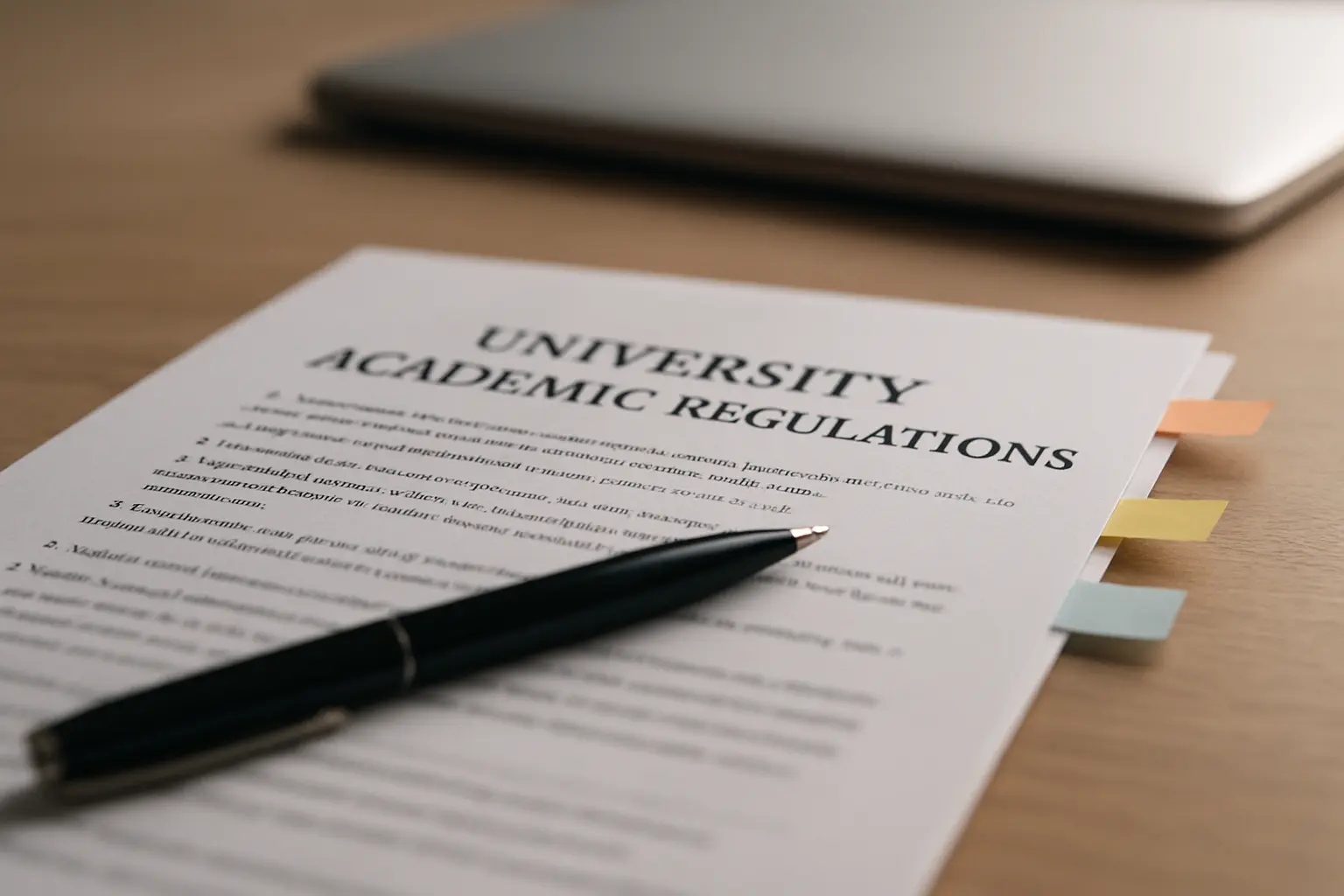
    A university's own academic regulations, the only authoritative source for its procedures
    With no national framework of penalties, your own institution’s regulations are the only document that describes what actually happens to you.

    What about AI detection figures?

    Turnitin’s chief product officer told the BBC that in more than one in ten papers reviewed since 2023, its detection tool found AI had written at least 20% of the material. Treat this as what it is: a vendor’s figure about its own product, generated by a detector whose accuracy is contested, reported without independent verification. It is quotable if you attribute it in exactly those terms and do not present it as a measurement of student behaviour.

    Self-reported behaviour is measured elsewhere and by an independent survey, and the two should not be blended — the figures on how many UK students actually use AI are in our roundup of UK student AI use survey data, and what similarity and detection software can and cannot establish is unpacked in our plagiarism checker comparison.

    What penalties do universities actually impose?

    There is no national tariff. Reported penalties range from a warning, through a mark of zero for the assessment, to suspension or exclusion from the institution. Universities UK states that all universities have codes of conduct including severe penalties for students submitting work that is not their own.

    The practical consequence is that no website can tell you what will happen in your case, because the answer lives in your own institution’s academic regulations. In regulated professional routes — nursing, medicine, law, teaching — a finding can additionally reach a fitness-to-practise process, which is a separate and more serious track.

    How to cite these figures

    Attribute the FOI findings to BBC News, naming the reporter and the publication date of 17 December 2025, and state the response base — 53 institutions providing usable responses to a request sent to every UK university, covering the academic year ending summer 2024. Attribute the prosecution figure to the Crown Prosecution Service and the Department for Education as reported in that investigation. Attribute the charter figure to the QAA with its launch date. Attribute the Turnitin figure to Turnitin.

    Then state the limitation once, plainly: these are not national statistics, the response base is partial, and definitions are not standardised across institutions. A sentence acknowledging that is worth more in a dissertation than a bigger number would be — the same discipline that applies to reading any published statistic, as we set out alongside the sector’s degree classification statistics.

    If you are here because you are worried about your own work rather than writing about the sector, the useful response is procedural rather than statistical: know your institution’s rules, keep your drafts and reading notes, and use tools that leave the authorship unambiguously yours. Tesify structures and drafts your dissertation with you — every word written by you, which is the only position that is safe in any regulatory climate.

    Frequently asked questions

    How many UK students are caught cheating each year?

    Nobody knows, because no UK body collects the figure. The most substantial recent evidence is a BBC FOI request to every UK university that produced usable responses from 53 institutions for the year ending summer 2024. Any national total you see has been estimated from partial data.

    Does HESA publish academic misconduct data?

    No. HESA collects student, staff and qualification data; academic misconduct is not among the fields it gathers. The same is true of the Office for Students and the QAA.

    Has anyone been prosecuted for running an essay mill?

    No. As of December 2025 the Crown Prosecution Service and the Department for Education both told the BBC there were no recorded offences reaching a first hearing in a magistrates’ court under the Skills and Post-16 Education Act, despite the offence having been in force since 2022.

    Are international students more likely to cheat?

    The data does not show that. It shows that 48 of 53 responding institutions reported international students being disproportionately represented in misconduct investigations, which measures who is investigated. Differences in prior referencing training, greater scrutiny of second-language writing, and genuine behavioural differences are all consistent with the same figures.

    What is the QAA Academic Integrity Charter?

    A set of sector commitments on protecting academic integrity, launched on 21 October 2020, which more than 200 UK institutions have signed. It is a statement of principles rather than a data collection or a regulatory requirement.

    What percentage of student work contains AI-generated text?

    Turnitin says its detector found AI wrote at least 20% of the material in more than one in ten papers reviewed since 2023. That is a vendor figure from a contested detection technology and should be attributed as such rather than quoted as a measurement of student behaviour.

    What punishment do UK universities give for plagiarism?

    There is no national tariff. Reported outcomes range from a warning or a mark of zero through to suspension and exclusion, and in professional programmes a case can also reach fitness to practise. Your own institution’s academic regulations are the only authoritative source for your situation.

    Why do misconduct numbers vary so much between universities?

    Because definitions, detection effort and student numbers all differ. A high count can indicate thorough detection rather than more cheating, and a low one can indicate under-reporting. Raw counts are not comparable without rates and shared definitions, neither of which exists.

    Can I use these figures in my dissertation?

    Yes, with full attribution and a stated limitation. Name the source, the date, the response base and the fact that these are FOI-derived rather than official statistics. Handled that way, the absence of a national dataset becomes a point you can make rather than a gap you have to hide.

    Where would national data come from if it existed?

    It would require a sector body to define misconduct categories consistently and mandate an annual return from every provider. No such requirement exists in any of the four UK nations, which is why the position has not changed despite repeated calls for better sector-level evidence.
  • What Happens If You Are Accused of Academic Misconduct on Your Dissertation?

    What Happens If You Are Accused of Academic Misconduct on Your Dissertation?

    You are notified in writing and given the evidence, you are offered a meeting at which you can respond, and a decision is taken on the balance of probabilities — whether something is more likely than not to have happened — rather than beyond reasonable doubt. Outcomes range from guidance and a mark reduction to exclusion, and you can appeal, on limited grounds.

    Everything after that first paragraph is institution-specific, and the differences are large. What follows is the shape of the process, illustrated with the published procedures of two named UK universities, so you can read your own regulations knowing what to look for. Your own institution’s rules are the only ones that govern your case.

    What actually happens first?

    A notification, in writing, with the evidence attached. The University of Portsmouth’s student guide sets out the sequence in three lines: “Notification: You’ll be informed in writing about the concerns and given the evidence”; “Meeting: You’ll have an opportunity to explain your side and provide evidence”; “Outcome: You’ll be informed of the decision and any actions to be taken.”

    You are entitled to see what is being put to you before you respond — if the letter refers to evidence you have not been sent, ask for it. And the meeting is your opportunity, not a formality; the account you give there is the main thing the decision is made on.

    What standard of proof does a university use?

    The civil standard, not the criminal one. Portsmouth states it directly: “Under the University’s Student Conduct Policy, the burden of proof is the ‘balance of probabilities’. This means that following an investigation into misconduct, the University can decide whether it believes that something is more likely to have happened than not.” And, explicitly: “There is no expectation for reported misconduct to be proven beyond reasonable doubt (as happens in a criminal court).” UCL’s Academic Manual says the same — adjudicators “should apply ‘on the balance of probabilities’”.

    This is the thing students most often misjudge. A university does not have to prove anything to a criminal standard; it has to conclude that your explanation is less likely than the alternative. That makes the specificity of your account decisive, because a vague denial loses to a detailed allegation, while a documented account frequently beats a thin one.

    How many stages are there, and how long do they take?

    Two published examples, both with indicative timescales, and they are structured differently.

    Portsmouth runs three phases. Early Resolution is “supported locally, typically through the reported student’s school” with an indicative timeframe of “between 5 to 10 working days”, and outcomes limited to “support and guidance to improve academic practices, warnings and reductions in marks”. Investigation follows where early resolution is not possible or the matter is more serious, at “between 15 to 20 working days but this may be exceeded in some more complex cases”. The Panel phase runs “between 25 to 40 working days”, and at that level “a reduction of marks for entire modules or years of study, and permanent exclusion is a possibility in the most serious cases”.

    UCL instead routes cases by how much of the assessment is affected: a Module Leader adjudicates where the misconduct affects up to 10% of a component, an Exam Board Chair between 10% and 33%, a Departmental Panel above 33% or on a second offence, and an Academic Misconduct Panel handles the most serious and repeat cases. Its time limits are procedural rather than phase-length: notification within 10 working days at the lower levels, and a panel “organised within 4 working weeks”. Severity determines who decides, so being routed to a panel is a statement about scale rather than a verdict.

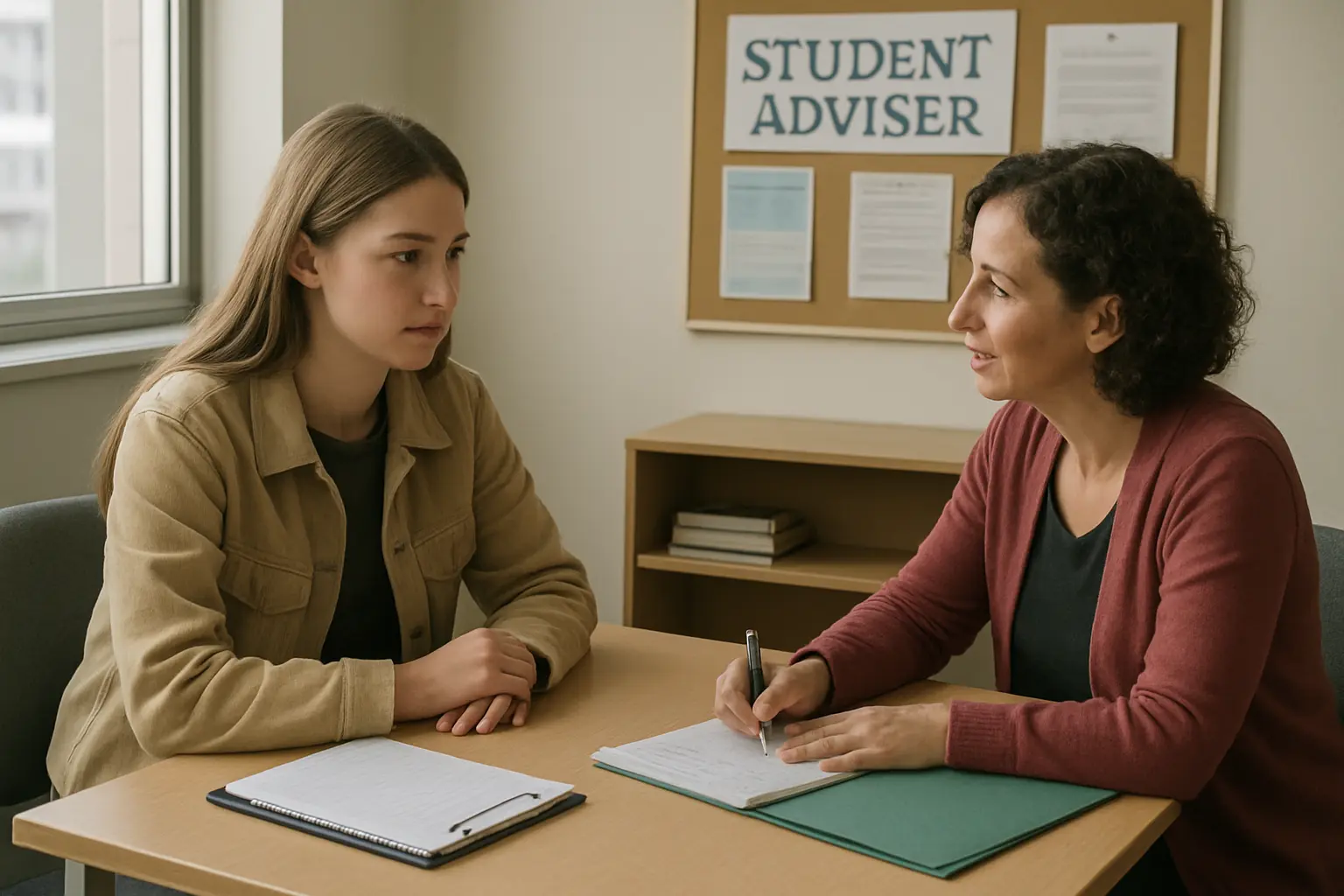
    A student meeting a students union academic adviser before a misconduct panel hearing
    The advice service is independent of the university and does this every week. You will do it once.

    Who decides, and who is allowed to be in the room with you?

    Decision-makers are meant to be people who have not touched the case before. Portsmouth specifies that its Investigator “has not been involved in the case before the investigation stage” and that its Escalation Panel “has not been involved in the case before the Panel Stage”.

    On accompaniment, UCL is precise and restrictive: a student may bring a “friend” who “must be a member of staff at UCL, a Students’ Union Advisor or student representative, or a student currently registered at UCL”, and that person “may be legally qualified but will not act in a legal capacity”. In other words, you can bring a solicitor as a supporter, and they cannot represent you.

    Portsmouth recommends the independent route explicitly: “We also recommend that students consider accessing independent advice and support from the Students’ Union Advice Service.” Take that seriously. An SU adviser has read your institution’s procedure many times, knows what a panel does with a given kind of explanation, and is not employed by the department bringing the case.

    What should you do in the first 48 hours?

    Portsmouth’s own list is short: “Respond promptly and honestly to any correspondence and in meetings”; “Seek support from the Students’ Union Advice Service or your personal tutor”; “Ask questions if there is anything you do not understand.”

    Add one practical step, because it is the one that changes outcomes: preserve your working record before anything is overwritten. Document version history, search history and database exports, reading notes, annotated PDFs, supervisor emails, drafts in a cloud folder. A dissertation written normally leaves a long trail, and a panel deciding which account is more likely is answered better by eight months of drafts than by any assertion.

    Do not edit, tidy or delete anything. Do not submit a “corrected” version unless asked. Both look worse than the thing you were worried about.

    Drafts, version history and reading notes kept as evidence of how a dissertation was written
    Version history, notes and annotated sources are the record of how the work was made. Keep them from day one, not from the day you need them.

    What penalties can a university actually impose?

    There is no national tariff, so the honest answer is a published ladder from one institution. UCL’s runs, in ascending order of who is deciding: a mark reduction of 10 percentage points or one letter grade, or resubmission with the offending material removed, at Module Leader level; a mark capped at the pass threshold, a mark within the condonable range, or a mark of 0.00% / Grade F at Exam Board Chair level; and at panel level, suspension for the remainder of the academic year, or exclusion from UCL with or without an interim qualification.

    Two definitions from Portsmouth are worth knowing precisely, because the words are used loosely in conversation and exactly in regulations. Suspension “is a temporary break in your studies” during which “you will not have access to any University resources such as the Library or your computer account”, though the university email account remains available. Exclusion “permanently ends your studies with us and means that you are no longer a student at the University”, with access to university resources including email withdrawn.

    Is poor academic practice the same thing as misconduct?

    Not in principle, and the difference is usually where the case is actually won or lost. Portsmouth’s list of offences separates deliberate acts — “Falsifying Data: Fabricating evidence or results for an assignment”, “Impersonation: Having someone else take an exam or complete work on your behalf”, “Fraudulent claims: submitting false claims or evidence in support of extenuating circumstances claims” — from the referencing failures that produce most first-year cases.

    If what happened is a mishandled citation rather than an attempt to deceive, say so plainly and show the mechanism: the note that lost its source, the quotation marks that did not survive a copy-paste, the reference manager set to the wrong style. That is an argument about intent and process, and it is the argument that moves a case down the severity ladder. It also has to be true — a fabricated explanation is a second offence.

    Preventing the honest version of this is mostly mechanical: cite as you draft, and know your department’s variant of Harvard referencing before the final week. A reference list that does not match the text is a common trigger, as our guide to how many references a dissertation should have explains from the marking side.

    Can you appeal, and on what grounds?

    Yes, and the grounds are narrow — and they differ between institutions, which matters because an appeal that does not fit a listed ground is usually rejected without being considered on its merits.

    UCL lists four: that “the decision or panel process was not conducted in accordance with the procedures”; that “fresh evidence has become available which was not available and could not reasonably be available for consideration during the decision or panel process”; that “the judgement of misconduct was not reasonable given the circumstances of the case”; or that “the penalty will have a significant impact on the student given their specific circumstances”. Appeals must be submitted within 10 working days of formal notification.

    Portsmouth lists two: administrative error, “if the university or assessment organization made a mistake or didn’t follow proper procedures when making their decision, and you can provide evidence of this”; and personal circumstances, “if personal issues prevented you from completing part of the process, and you had valid reasons for not disclosing these earlier”. It adds that an appeal failing these criteria “may instead be treated as a complaint”.

    Notice what is missing from both lists: simple disagreement with the finding. “I did not do it” is an argument for the original hearing, not for an appeal. If you believe the finding is wrong, the ground you need is procedural error, fresh evidence, or unreasonableness — and you have to say which.

    What is a Completion of Procedures Letter, and what is the OIA?

    The Completion of Procedures Letter is the document that says the university’s internal process is finished. Portsmouth explains its function: “At the end of your appeal, the University will provide you with a Completion of Procedures letter. This letter will enable you to make a complaint to the Office of the Independent Adjudicator for Higher Education (OIA) if you are still unhappy with the outcome.”

    Three of the OIA’s published expectations are worth knowing while you are still inside the internal process. It considers it “good practice for providers to complete consideration of a formal complaint or academic appeal and any associated review within 90 calendar days”. It expects a Completion of Procedures Letter at review stage to be issued “as soon as possible and within 28 days”. And “the time limit for bringing a complaint to the OIA is 12 months” from the date of that letter. The OIA reviews whether a provider followed a fair procedure and reached a reasonable decision; it does not remark your dissertation.

    Where does AI fit into this?

    Where your institution’s rules put it, and those rules are now explicit rather than implied. Portsmouth’s position is permissive with a condition: AI tools “are permitted to assist your learning, as a tool to assist and inform research and generation of ideas, planning and output but their use must be transparent”, with the instruction to “always cite when AI tools are used” and the warning that “failing to acknowledge AI assistance may lead to misconduct charges”.

    That locates the offence in non-disclosure rather than in use. The method that keeps you clearly inside the line is set out in our guides to honest AI use in a literature review and to what separates legitimate dissertation help from contract cheating, and what similarity software can and cannot establish is covered in our comparison of plagiarism checkers.

    If you are reading this before anything has happened and want the version of your dissertation that leaves an unambiguous trail, Tesify structures and drafts it with you — the bibliography built from what your text cites, and every word written by you. It is free to start.

    Frequently asked questions

    What standard of proof is used in a university misconduct case?

    The balance of probabilities. Portsmouth states that this means the university “can decide whether it believes that something is more likely to have happened than not”, and that there is “no expectation for reported misconduct to be proven beyond reasonable doubt”. UCL applies the same standard.

    Can I bring a lawyer to an academic misconduct hearing?

    Usually only as a supporter, not as an advocate. UCL permits a “friend” who must be UCL staff, a Students’ Union Advisor or student representative, or a registered UCL student, and states that this person “may be legally qualified but will not act in a legal capacity”. Check your own regulations, because the permitted list varies.

    How long does an academic misconduct case take?

    It depends on the stage. Portsmouth publishes indicative timeframes of 5 to 10 working days for Early Resolution, 15 to 20 for Investigation and 25 to 40 for the Panel phase. The OIA regards 90 calendar days as good practice for completing a formal process and any review.

    Will academic misconduct show on my transcript or references?

    That is set by your institution’s regulations rather than nationally, and it differs. Ask the caseworker directly what is recorded, for how long, and what a reference request would disclose — get the answer in writing rather than inferring it.

    What is the difference between suspension and exclusion?

    Portsmouth defines suspension as “a temporary break in your studies” with library and computer account access withdrawn but the university email account retained, and exclusion as permanently ending your studies so that “you are no longer a student at the University”.

    Can I appeal simply because I disagree with the decision?

    No. Appeal grounds are listed and narrow: procedural error, fresh evidence that could not reasonably have been available earlier, an unreasonable judgement, or disproportionate impact of the penalty, depending on your institution. UCL’s deadline is 10 working days from formal notification, so diarise it the moment your outcome letter arrives.

    What evidence helps me most?

    The record of how the work was made: document version history, dated drafts, reading notes, database search exports, annotated PDFs and supervisor correspondence. On a balance-of-probabilities test, a documented process is the strongest thing you can produce.

    Is using AI on a dissertation automatically misconduct?

    No. Portsmouth permits AI tools for research, idea generation, planning and output provided use is transparent and cited, and warns that “failing to acknowledge AI assistance may lead to misconduct charges”. The offence is undeclared use where declaration is required, not use in itself.

    Can I complain to someone outside the university?

    Yes, once internal procedures are exhausted and you hold a Completion of Procedures Letter. The OIA reviews complaints from students about providers in England and Wales, and its time limit is 12 months from the date of that letter. It examines process and reasonableness rather than remarking your work.