
| Framework | Sub-field | What it explains | Watch for |
|---|---|---|---|
| Beck’s Cognitive Model | Clinical | How distorted thinking patterns maintain distress | Needs a clinical or sub-clinical sample to apply meaningfully |
| Attachment Theory | Developmental | How early caregiver relationships shape later behaviour | Retrospective attachment measures are a real limitation to name |
| Social Identity Theory | Social | Intergroup bias and behaviour from group membership | Needs a genuine intergroup comparison, not one group alone |
| Health Belief Model | Health | Why people do or do not take a health-protective action | Six-construct model — measure all of them, not just perceived barriers |
| Five-Factor Model | Personality/individual differences | Trait structure of personality across five dimensions | Needs a validated instrument (NEO-PI-R or similar), not an ad hoc scale |
| Theory of Planned Behaviour | Applied/health | How attitudes, norms and control predict intended behaviour | Intention–behaviour gap is a standard, expected limitation |
| Broaden-and-Build Theory | Positive | How positive emotion widens thought-action repertoires | Best with a within-person, repeated-measures design |
| Dual-Process Theory | Cognitive | Fast, automatic vs slow, deliberate reasoning | Contested boundary between the two systems — say so |
A UK psychology dissertation needs a named theoretical framework, not a loose collection of prior findings — the framework is what turns your literature review into a structure your hypotheses can be derived from. Here are eight frameworks that recur across UK undergraduate psychology dissertations, what each explains, the data it needs, and one clear recommendation for how to choose between them.

Beck’s Cognitive Model — for clinical and mental health topics
Beck’s cognitive model, developed through his work on depression in the 1960s and 70s, explains psychological distress through distorted automatic thoughts, dysfunctional underlying beliefs, and the cognitive triad of negative views about the self, the world and the future. It fits dissertations on anxiety, depression, or the cognitive mechanisms behind a specific clinical presentation particularly well, because it generates directly testable hypotheses about specific thought patterns rather than vague “negative thinking”. The common weakness examiners flag is applying a clinically-derived model to a general, non-clinical undergraduate sample without acknowledging that the model’s evidence base is largely clinical — state this as a scope limitation rather than ignoring it.
Attachment Theory — for relationships, wellbeing and developmental topics
Bowlby’s attachment theory, with Ainsworth’s later empirical classification of attachment styles through the Strange Situation procedure, explains how early caregiver-infant bonds shape internal working models that influence relationships and emotional regulation later in life. It fits dissertations on adult relationships, wellbeing, parenting or emotional regulation, but a genuine methodological constraint is worth naming upfront: most undergraduate dissertations measure adult attachment retrospectively via self-report rather than observing infant attachment directly, which is a real limitation on what the design can actually claim about causation.
Social Identity Theory — for intergroup and social-behaviour topics
Tajfel and Turner’s social identity theory (1979) explains intergroup bias and behaviour as arising from people’s tendency to categorise themselves into groups and favour their own group’s status. It is the natural framework for dissertations on prejudice, discrimination, group conflict, or identity-based behaviour, but it needs a design that actually compares behaviour across or between groups — a single-group study cannot test an intergroup theory, however well it is described in the literature review.
Health Belief Model — for health-behaviour topics
The Health Belief Model, developed by Rosenstock in the 1960s, explains health-related behaviour through perceived susceptibility, perceived severity, perceived benefits, perceived barriers, cues to action and self-efficacy. It fits dissertations on vaccination uptake, screening attendance, dietary behaviour or medication adherence well, and its six-construct structure gives you a ready-made set of measurable variables for a questionnaire — but a genuinely common weakness is measuring only perceived barriers and dropping the other five constructs, which is not really testing the model at all.
The Five-Factor Model — for personality and individual-differences topics
The Five-Factor Model (Costa and McCrae) structures personality along five broad trait dimensions — openness, conscientiousness, extraversion, agreeableness and neuroticism — and underpins most personality-and-outcome dissertations (personality and academic performance, personality and job satisfaction, personality and wellbeing). Use a validated instrument such as the NEO-PI-R or a short-form equivalent rather than an unvalidated ad hoc trait scale, since the model’s whole value rests on the psychometric validity of the instrument measuring it.
Theory of Planned Behaviour — for applied and health-behaviour topics
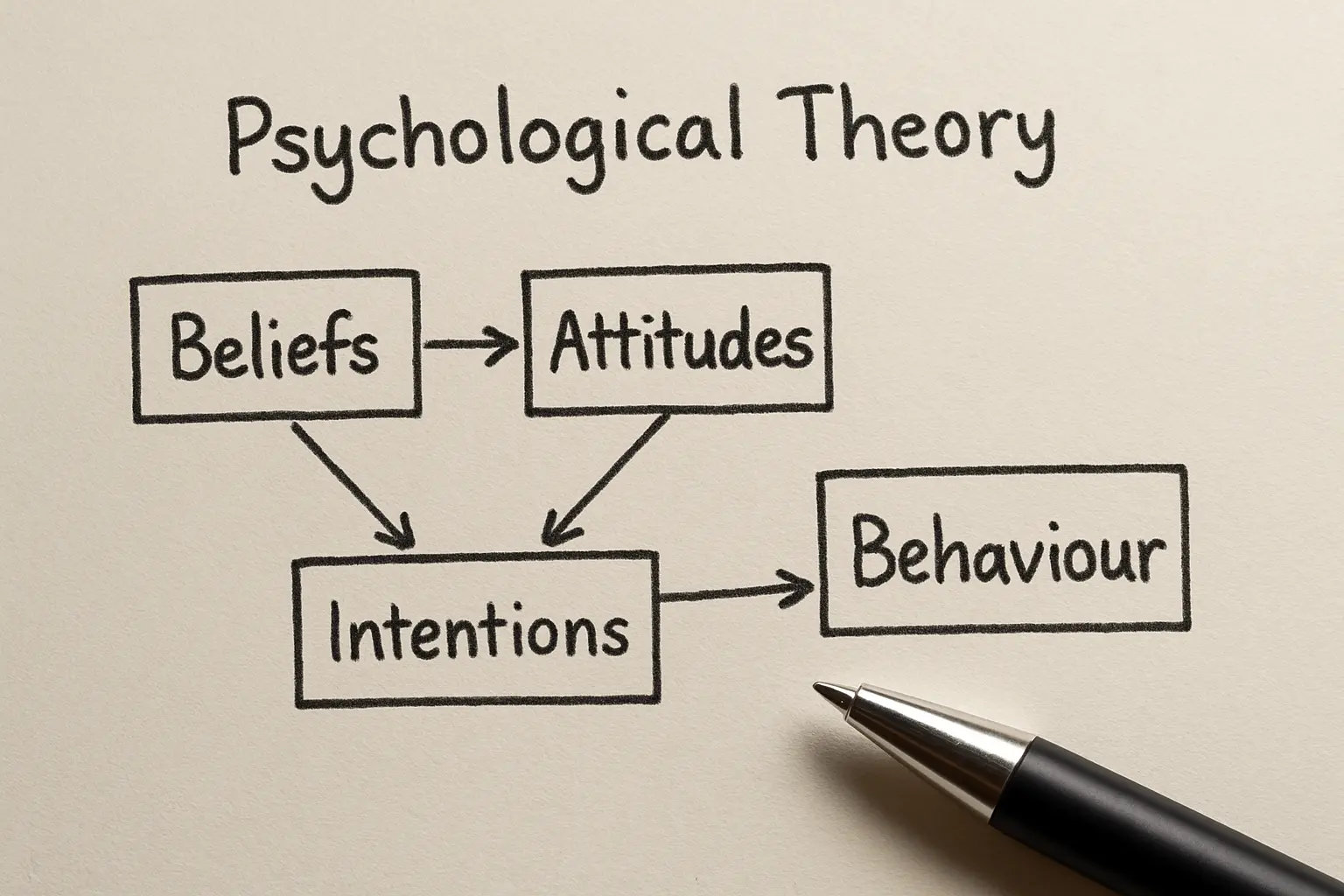
Ajzen’s Theory of Planned Behaviour (1991) explains intention to perform a behaviour through attitude toward the behaviour, subjective norms, and perceived behavioural control, and remains one of the most widely applied frameworks across applied and health psychology dissertations — exercise intention, safe-sex behaviour, sustainable behaviour, study habits. Its best-documented limitation is the intention–behaviour gap: the theory predicts intention well but intention does not reliably predict actual behaviour, and naming this gap explicitly, rather than treating a strong intention finding as equivalent to a behaviour finding, is what a psychology marker expects to see addressed.
Broaden-and-Build Theory — for positive-psychology and emotion topics
Fredrickson’s broaden-and-build theory (2001) proposes that positive emotions broaden a person’s momentary thought-action repertoire and, over time, build lasting personal resources — a natural fit for dissertations on wellbeing interventions, resilience, or the function of specific positive emotions. It works best with a within-person, repeated-measures design that can actually track change over time, since the theory’s central claim is about a building process, which a single cross-sectional snapshot cannot demonstrate.
Dual-Process Theory — for cognitive and judgement/decision-making topics
Dual-process accounts of cognition, popularised for a general audience by Kahneman’s distinction between fast, automatic “System 1” thinking and slow, deliberate “System 2” reasoning, explain judgement and decision-making errors as a product of over-relying on fast heuristic processing. It suits dissertations on cognitive biases, heuristics, or reasoning under time pressure, but the exact boundary between the two systems is genuinely contested in the literature — acknowledging that dual-process theory is a useful heuristic framework rather than a settled, universally accepted architecture of the mind reads as more sophisticated than presenting it as uncontested fact.
How to choose between them
Start from your research question, not from a framework you already like the sound of — a question about why people avoid a health screening points to the Health Belief Model or Theory of Planned Behaviour; a question about why a specific group is more hostile to another points to Social Identity Theory; a question rooted in individual variation across people points to the Five-Factor Model. The recommendation that holds across all eight: pick the single framework whose named constructs map most directly onto the variables your design can actually measure, state that mapping explicitly in your literature review, and resist the temptation to blend two frameworks unless your question genuinely needs both — a dissertation that names one framework and applies it rigorously outperforms one that name-drops three and tests none of them properly.
What examiners actually look for in the framework section
Three things recur across UK psychology marking criteria for the theoretical framework section specifically. First, that the framework is named and cited to its original source, not paraphrased from a textbook summary with no primary citation — a dissertation that writes “the theory of planned behaviour states that attitudes, norms and control predict intention” without citing Ajzen (1991) directly reads as secondhand knowledge rather than genuine engagement with the theory. Second, that the framework’s constructs are operationalised — turned into something you can actually measure — rather than left as abstract concepts discussed only in the literature review and never mentioned again in the methodology. Third, that the discussion chapter returns to the framework explicitly at the end, stating whether your findings supported, partially supported or challenged it, rather than ending on a general summary of results with no link back to the theory that structured the whole dissertation.
A worked example of moving from framework to hypothesis
Take the Health Belief Model applied to a dissertation on HPV vaccination uptake in university students. The construct “perceived susceptibility” becomes a measured variable via a validated item set asking how at-risk students believe themselves to be; the hypothesis becomes “students reporting higher perceived susceptibility to HPV-related illness will report higher vaccination intention than students reporting lower perceived susceptibility” — a single construct, one directional prediction, and a stated population. Repeating this exercise for each construct you intend to measure, before data collection begins, is what turns a named framework into an actual testable design rather than a decorative citation in chapter two.
Frequently asked questions
Can a psychology dissertation use more than one theoretical framework?
It can, but only where the research question genuinely needs both perspectives to be fully explained — combining frameworks for breadth alone usually dilutes the analysis rather than strengthening it, and most UK undergraduate dissertations are marked more favourably for depth on one framework than breadth across several.
Do you need to test the whole framework, or just part of it?
State explicitly which part you are testing and why the rest is out of scope — a dissertation using only two of the Health Belief Model’s six constructs is legitimate provided it says so, rather than implying the full model was tested when it was not.
What if your data does not support the framework you chose?
Report it as a genuine finding — a framework failing to fit your data is itself informative and markable, provided your discussion engages seriously with why the mismatch occurred rather than quietly minimising it.
Is it acceptable to critique the framework you have used?
Yes, and a dissertation that applies a framework while also noting its documented limitations (such as the Theory of Planned Behaviour’s intention–behaviour gap) reads as more critically engaged than one that treats the framework as beyond question. Examiners specifically look for this critical distance because it distinguishes a student who understands a theory’s boundaries from one who has simply memorised its constructs.
How do you turn a framework into testable hypotheses?
Take each named construct in the framework and state a specific, directional or non-directional prediction about how it relates to your outcome variable — see our guide to writing psychology dissertation hypotheses for twelve worked examples across common undergraduate designs.
Which statistical test fits data collected under these frameworks?
It depends on your specific design and the level of measurement of your variables, not on which framework you used — see our guide to choosing a statistical test for a psychology dissertation for the decision procedure.
Do you need a validated scale to measure a framework’s constructs?
Strongly preferred — an unvalidated, self-written scale undermines the credibility of testing an established framework; check whether the scale you plan to use is free for student use before committing, since some psychology measures are restricted to qualified clinicians or carry a per-use licence fee — see our comparison of which psychology scales UK undergraduates can actually use for the licensing detail by instrument.
Can you propose your own framework instead of using an established one?
This is rare and generally reserved for postgraduate or doctoral work — undergraduate dissertations are expected to apply and critically evaluate an established framework rather than construct a new one from scratch.
Does the theoretical framework affect how the dissertation is marked?
Yes, indirectly — most UK psychology marking criteria assess “engagement with theory” as a distinct criterion from methodology or analysis, so a well-chosen, well-cited framework applied consistently through the whole dissertation earns marks in its own right, separate from whether your results turn out significant.
How old can a framework be and still count as current?
Age alone is not the issue — Bowlby’s original attachment work dates to the 1950s and 60s and is still the standard citation, because it remains the foundational source. What matters is citing the original or a recognised authoritative source for the theory itself, alongside recent empirical applications of it, rather than relying only on very old secondary summaries for how the theory is currently understood and tested.
Tesify’s dissertation builder can help you map a chosen framework’s constructs onto your own variables and keep your citations for each theory consistent as your literature review develops. Start your dissertation with Tesify — free to try.