
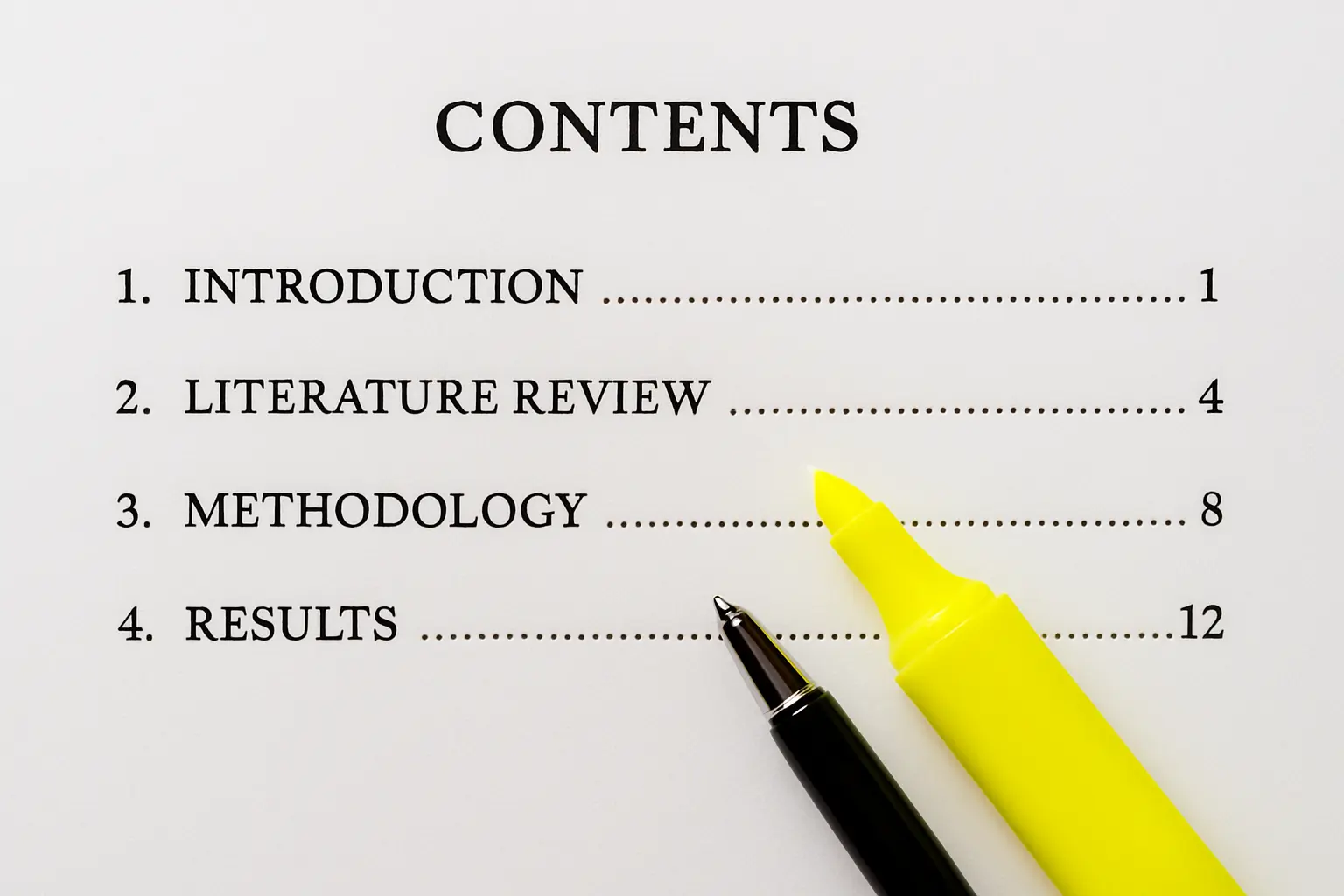
A UK psychology dissertation runs through nine fixed sections in the same order every time: title page, abstract, introduction, literature review, methodology, results, discussion, references and appendices. What varies by study is the content inside each one — the design, the statistics, the ethics considerations. Below is a complete annotated model, built around one illustrative study, showing what a marker expects to find in each section.
What Chapters Does a UK Psychology Dissertation Actually Contain?
Most UK psychology departments follow a fixed skeleton because it mirrors how a journal article in the field is structured, and it is the shape your marking criteria are written against. The nine sections below are near-universal; word allocation varies, but the order does not.
| Section | Typical share of the word count | What it must do |
|---|---|---|
| Title page | — | State the exact research question in the title |
| Abstract | ~1–2% | Summarise aim, method, key result and one implication in around 200–250 words |
| Introduction | ~10% | Move from the broad topic to your specific, testable hypothesis |
| Literature review | ~20–25% | Build the theoretical case for your hypothesis from prior findings |
| Methodology | ~15–20% | Give enough detail that another student could replicate the study exactly |
| Results | ~10–15% | Report the statistics without interpreting them |
| Discussion | ~20–25% | Interpret the results against the literature, and state what the study cannot show |
| References | — | Every in-text citation present, correctly formatted |
| Appendices | — | Materials, raw output, ethics approval, consent form |
The worked example running through this guide is entirely illustrative: a fictional study on the relationship between sleep quality and self-reported academic procrastination in undergraduates. No participant, data point or result described below is real — the numbers exist only to show what a complete write-up looks like in practice.
What Does the Title and Abstract Actually Say?
The title states the variables and the population, not a vague theme: “Sleep Quality and Academic Procrastination in UK Undergraduates: A Correlational Study” tells a reader exactly what was measured, on whom, and how. A title like “Sleep and Student Wellbeing” would lose marks for vagueness.
The abstract then compresses the whole dissertation into one paragraph: aim, design, sample, key statistic, and the one-sentence implication. A worked example, illustrative:
“This study examined the relationship between sleep quality and academic procrastination in 118 UK undergraduates using a correlational design. Participants completed the Pittsburgh Sleep Quality Index and a procrastination self-report measure. Poorer sleep quality was associated with higher procrastination scores. The finding supports sleep-focused interventions as a route to reducing academic delay behaviours.”
Notice what the abstract does not do: it never says “this dissertation will discuss” or “this study looks at.” Every sentence states a fact about what was done and found, in the past tense, because by the time anyone reads the abstract the study is already finished.
How Is the Introduction Built, Paragraph by Paragraph?
The introduction moves through a funnel: the general phenomenon, why it matters, what is already known, the gap, and then the specific hypothesis. Four to six paragraphs is typical for an undergraduate dissertation, ending on an explicit, testable statement such as: “It was hypothesised that poorer self-reported sleep quality would be associated with higher levels of academic procrastination.” Our guide to writing hypotheses for a psychology dissertation covers directional versus non-directional wording and how to operationalise each variable before you get this far.
A frequent structural fault at this stage is starting too broad and never narrowing: a paragraph on “sleep is important for health” that never connects to procrastination, or academic outcomes specifically, wastes word count a marker will notice is missing later when the discussion needs it.
What Goes Into the Literature Review, and How Is It Organised?
A psychology literature review is normally organised thematically, not chronologically: one theme per sub-heading, moving from the broadest relevant theory down to the specific gap the study fills. For the sleep–procrastination example, a plausible structure is: (1) what procrastination is and how it is measured, (2) the self-regulation literature that links sleep deprivation to reduced executive control, (3) prior correlational work linking sleep and academic outcomes, and (4) the gap — most existing UK samples are small or single-institution, which the present study’s larger sample partly addresses. Each theme closes by stating what it implies for the hypothesis, not just summarising the sources.
A useful test before moving on to methodology: read the closing paragraph of the literature review on its own. If it does not end in a sentence that could plausibly be the first line of your introduction’s hypothesis statement, the review has not actually built an argument — it has only described one.
How Is the Methodology Chapter Structured, With BPS Ethics in Mind?
The methodology has five standard sub-sections: design, participants, materials, procedure, and ethical considerations. UK psychology dissertations are expected to show ethical reasoning against the British Psychological Society’s Code of Human Research Ethics (updated April 2021) — informed consent, the right to withdraw without penalty, debriefing, and data protection are the points markers look for explicitly, not just a line stating “ethics was approved.”
| Sub-section | What it must state (illustrative example) |
|---|---|
| Design | Correlational design, two continuous variables, cross-sectional |
| Participants | 118 undergraduates, opportunity sample, inclusion/exclusion criteria stated |
| Materials | Pittsburgh Sleep Quality Index; named procrastination self-report scale, with citation |
| Procedure | Online consent, questionnaire order, average completion time, debrief screen |
| Ethics | Departmental ethics approval reference, informed consent process, right to withdraw, anonymisation method |
Every instrument named in the methodology needs a citation to the original validation study, and a note on whether permission or a licence was required — our guide to which psychology scales you can actually use in an undergraduate dissertation covers which measures are free to use and which are restricted. Where a study collects any personal or health-related data, the methodology should also state how data was stored and anonymised, since this is a standard reviewer question at departmental ethics panels, not an optional extra.
What Does the Results Chapter Actually Show?
Results report the statistics and nothing else — no interpretation, no discussion of what the finding “means” for the theory. A results paragraph for the worked example would state the descriptive statistics, confirm the assumption checks, then report the inferential test:
“A Pearson correlation was conducted to examine the relationship between sleep quality and procrastination scores. There was a significant positive correlation, r(116) = .34, p < .001, indicating that poorer sleep quality was associated with higher procrastination.”
Choosing the correct test before you collect data, not after, is the single biggest cause of an unusable results chapter — our guide to choosing the right statistical test for a psychology dissertation walks through the decision procedure by design and level of measurement. A short table of descriptive statistics (mean, standard deviation, range for each variable) should always precede the inferential test itself, since a marker cannot judge whether the effect is meaningful without seeing the raw scale the numbers sit on.
How Is the Discussion Different From the Results?
The discussion does four things in order: restate the finding in plain language, relate it back to the specific theories named in the literature review, state the study’s limitations honestly, and suggest one concrete direction for future research. A common mark-losing habit is restating results-chapter statistics instead of interpreting them — the discussion should read as though the numbers are no longer on the page.
A worked limitations paragraph, illustrative, shows the level of specificity expected: “The cross-sectional design means no causal claim can be made about sleep quality causing procrastination; a bidirectional or even reversed relationship remains plausible. The opportunity sample was drawn from a single institution, which limits generalisability to the wider UK undergraduate population. Both self-report measures are also subject to social desirability bias, which future work could address with objective sleep-tracking data.” Naming the specific mechanism of each limitation, rather than a generic “sample size was small,” is what separates a competent limitations paragraph from a token one. Grounding the interpretation in a named theoretical framework, rather than a general claim, is what separates a 2:1 discussion from a first — our guide to theoretical frameworks for a psychology dissertation compared covers eight of the frameworks UK markers expect to see used correctly.
What Goes in the References and Appendices?
Psychology dissertations in the UK are referenced almost universally in APA style. Every source cited in the text must appear in the reference list and vice versa — a mismatch is one of the most common, entirely avoidable errors markers report. Appendices hold the materials a reader would need to replicate the study but that would clutter the main text: the full questionnaire, the ethics approval letter or reference number, the participant information sheet, the debrief form, and any raw statistical output (e.g. full SPSS tables) referenced only in summary in the results chapter.
How Do Markers Actually Grade These Sections?
Marking criteria differ by department, but four qualities recur across almost every UK psychology dissertation rubric: structural clarity (does the argument follow the funnel described above), critical engagement (does the literature review evaluate sources rather than list them), methodological rigour (is the design and analysis appropriate and correctly justified), and academic writing (is the argument built in the reader’s order, not the writer’s). A dissertation can report a genuinely interesting finding and still lose marks heavily on the second and fourth of these if the literature review reads as a summary rather than an argument. Check your own department’s specific marking grid before treating any generic breakdown, including this one, as a guarantee of where the marks fall.
What Mistakes Cost the Most Marks in a Psychology Dissertation?
- A hypothesis that isn’t actually testable. “Sleep affects student life” cannot be tested; “poorer sleep quality is associated with higher procrastination scores” can.
- Ethics described generically. “Ethical approval was obtained” without naming the process, the consent procedure or the right to withdraw reads as a box-ticking afterthought.
- Interpreting results inside the results chapter. Save every “this suggests” sentence for the discussion.
- A discussion with no named limitation. Sample size, self-report bias, cross-sectional design (no causal claim) — state at least one explicitly rather than leaving it implicit.
- Adapting a published scale without saying so. Dropping or reording items on a validated measure without disclosing the change and its implications is treated as a methodological flaw, not a shortcut.
- A reference list built at the end instead of alongside the writing. Reconstructing citations from memory after the chapters are finished is where most in-text/reference-list mismatches come from.
If the structure is clear and what remains is turning your own design into a full first draft, Tesify drafts your dissertation chapter by chapter from the study you specify. Everything stays 100% written by you, and it is free to start.
Frequently Asked Questions
How long is a typical UK psychology dissertation?
Most undergraduate psychology dissertations in the UK run 6,000–10,000 words excluding references and appendices; check your own department’s handbook, since the exact limit varies by institution.
Does a psychology dissertation have to be quantitative?
No. Qualitative and mixed-methods psychology dissertations are increasingly common; the chapter order stays similar, but the methodology, results and discussion sections are restructured around themes rather than statistics.
What referencing style do UK psychology dissertations use?
Almost universally APA style, though some departments specify Harvard — check your own module handbook before you start building your reference list.
Do I need ethics approval for an undergraduate psychology dissertation?
Nearly always yes, even for low-risk designs like the correlational survey used in this example. Approval is usually granted at departmental level rather than through a full institutional review board.
Can I use a published psychological scale for free?
Some are freely available for student research; others require a licence fee or restrict use to qualified clinicians. Check the scale’s own permissions page before you build your methodology around it.
What is the difference between the results and discussion chapters?
Results report what the statistics show, without interpretation. Discussion explains what the finding means in relation to existing theory, and what it does not prove.
How many references does a psychology dissertation need?
There is no fixed number; markers look for a literature review that is thorough enough to justify the hypothesis, typically drawing on 30–50 sources for an undergraduate project, though this varies by topic and department.
What should go in the appendices?
Materials a marker would need to verify or replicate the study but that would clutter the main text: the full questionnaire or measures, ethics approval reference, participant information sheet, debrief script, and any raw statistical output referenced only in summary elsewhere.
Is a correlational design enough for an undergraduate dissertation?
Yes — correlational designs are common and accepted, provided the discussion is explicit that a correlation does not establish causation.
How is a psychology dissertation actually marked, in general terms?
Most UK departments weigh structural clarity, critical engagement with the literature, methodological rigour and academic writing quality, though the exact grid and weighting varies by institution — always check your own.