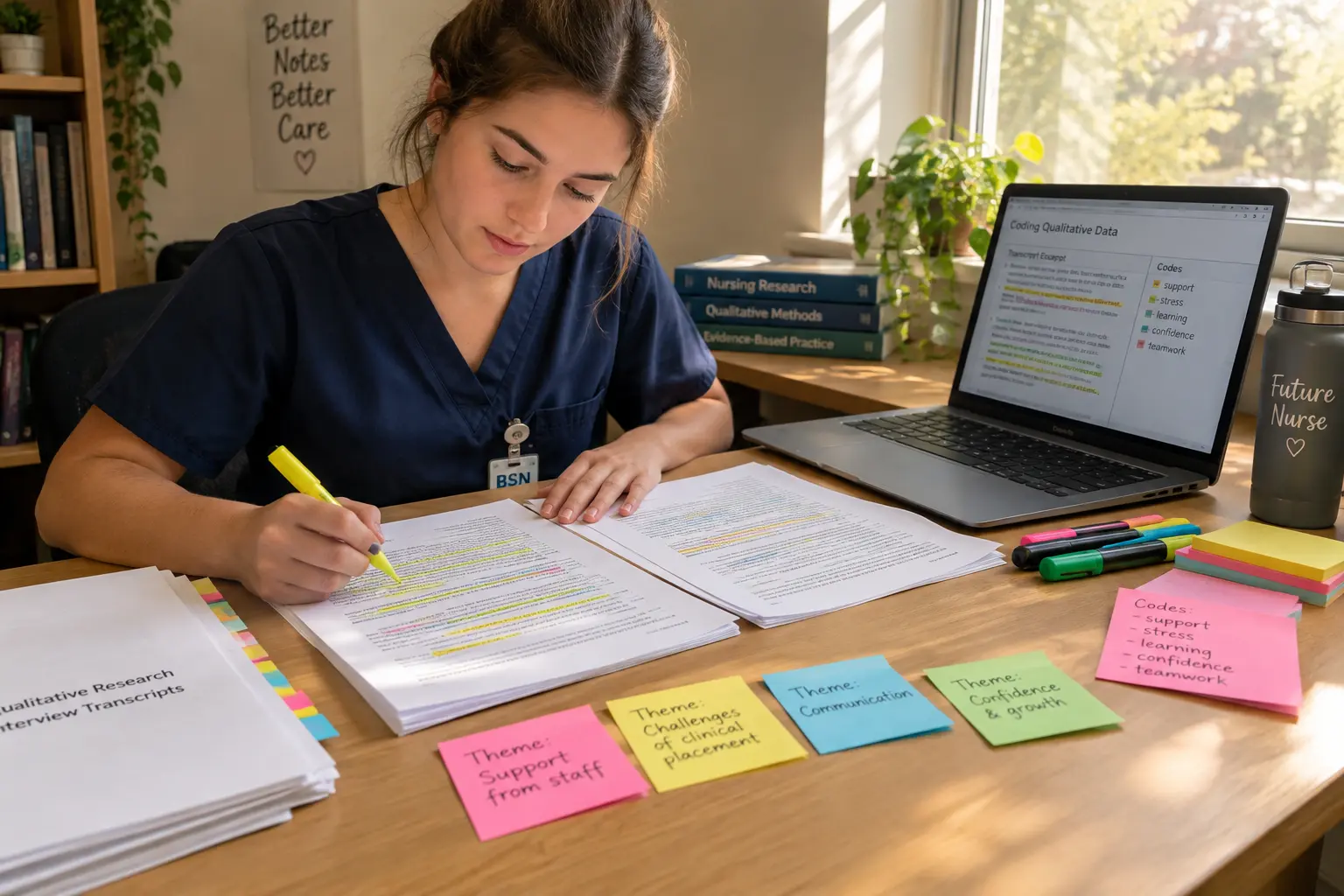
To run a thematic analysis for a nursing dissertation: familiarise yourself with the whole dataset, generate initial codes across it, search for candidate themes, review them against the coded extracts and the full dataset, define and name each theme precisely, then write up with data extracts as evidence — following Braun and Clarke’s six phases. The worked example below applies each phase to an illustrative nursing topic, built around data you can realistically access as a UK undergraduate or taught master’s student.
Why thematic analysis suits nursing research questions
Thematic analysis is well suited to nursing dissertations that ask how patients, carers or nurses experience something — living with a long-term condition, adjusting to a new diagnosis, coping with a demanding clinical role — because it is flexible across theoretical positions and does not require the more specialised training that grounded theory or interpretative phenomenological analysis expects. It produces themes a marker can trace directly back to the data, provided you keep an honest audit trail from raw transcript to final theme, which is exactly what the phase-by-phase process below is built to show.
Where your qualitative data can realistically come from
Before the analysis method, the more decisive question is where the data comes from, because direct recruitment of current NHS patients through a clinical service is not normally available to standalone undergraduate research: the Health Research Authority has not accepted such applications for NHS ethics review since 1 September 2021, and even at taught master’s level this route is slow and requires NHS Research and Development approval most dissertation timelines cannot accommodate. That does not rule out real, primary qualitative data — it means the access route has to be one your university’s own departmental ethics committee can approve directly, such as:
- Participants recruited through a patient charity, support group or public advertisement, entirely outside NHS premises and NHS staff time, with your own university’s ethics approval.
- Nursing, healthcare or social care staff (not patients) reflecting on their own professional experience, recruited independently of any NHS research governance process.
- Publicly available, already-published qualitative accounts (patient blogs, forum posts, published first-person narratives) treated as documentary data, with careful attention to consent, anonymity and the terms under which the material was originally shared.
- Secondary analysis of an anonymised transcript set your supervisor already holds ethical approval and data-sharing permission to reuse for a new research question.
Whichever route you take, state it plainly in your methodology chapter and explain why it was chosen over direct NHS-patient recruitment — markers read this as evidence you understand the ethical landscape of nursing research, not as a weakness in your design.

The six phases, applied to a worked illustrative example
The worked example below concerns an illustrative dataset of ten semi-structured interviews with adults managing type 2 diabetes, recruited through a diabetes support charity (not an NHS clinic) with university ethics approval. Every extract and code below is invented for illustration and does not represent a real participant or a real study.
Phase 1: Familiarisation
Transcribe every interview verbatim (including hesitations and false starts, since tone matters for nursing-relevant themes like distress or resignation), then read the full dataset at least twice before coding anything. Illustrative note made at this stage: “Several participants shift from clinical language (‘my HbA1c’) to everyday language (‘my sugar levels’) depending on who they are talking to — worth watching for a code about this.”
Phase 2: Generating initial codes
Code systematically across the whole dataset, not just the parts that look interesting, and code inductively (from the data) rather than forcing extracts into codes you expected in advance. Illustrative codes generated: “fear of hypoglycaemia in public,” “shame around dietary lapses,” “trust in the diabetes nurse specialist,” “family as both support and pressure,” “normalising the condition over time.”
Phase 3: Searching for themes
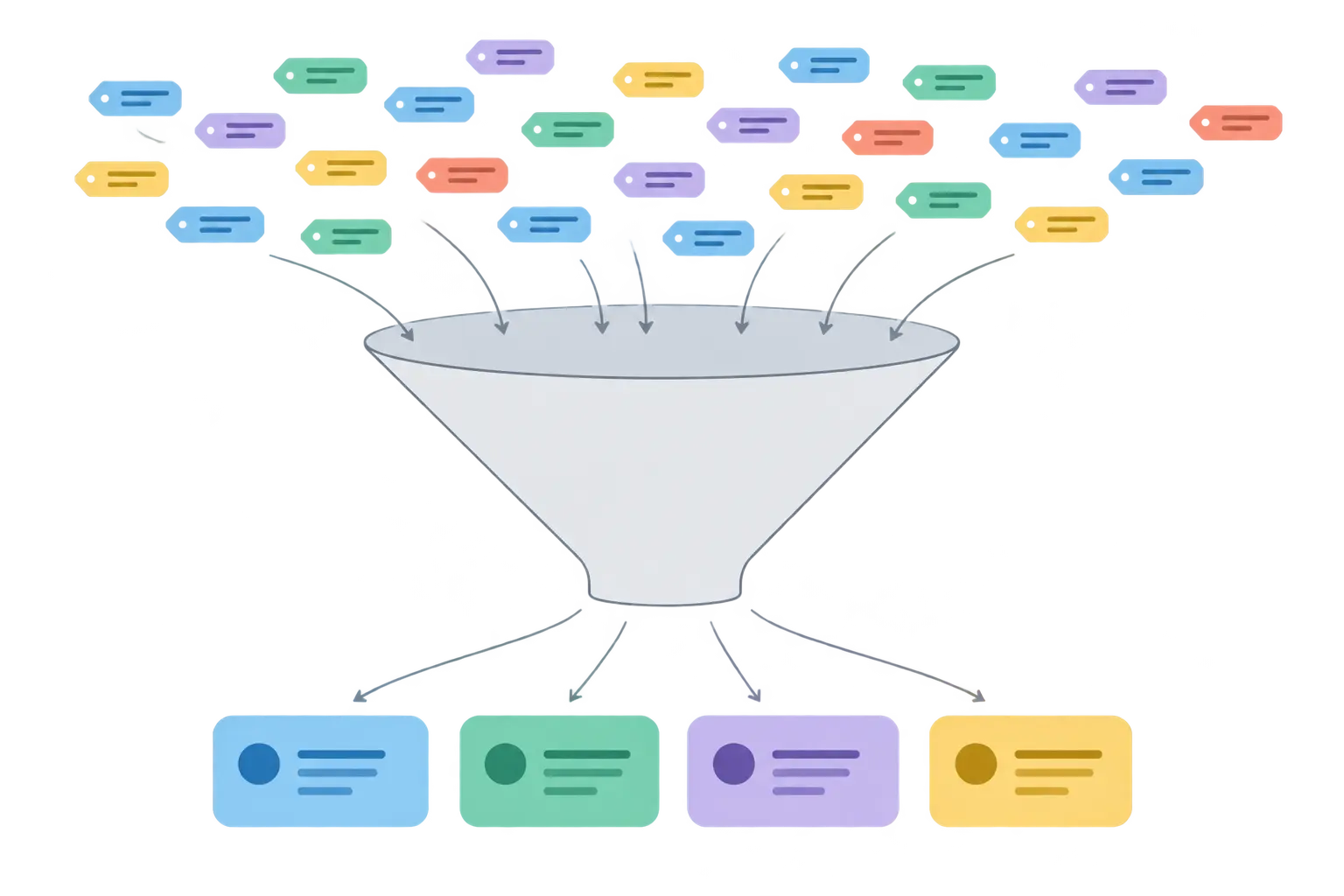
Group related codes into candidate themes at a broader level of abstraction. Illustrative grouping: the codes “fear of hypoglycaemia in public” and “shame around dietary lapses” are drawn together under a candidate theme of “managing diabetes in front of other people,” while “trust in the diabetes nurse specialist” stands provisionally alone pending phase 4.
Phase 4: Reviewing themes
Check each candidate theme against its own coded extracts (does every extract actually fit?) and then against the whole dataset (does the theme hold across participants, or only one or two?). This is the phase where themes get split, merged or dropped. Illustrative outcome: “managing diabetes in front of other people” is retained; a separate candidate theme built from only one participant’s account is downgraded to a sub-theme rather than a main theme, since it did not hold across the dataset.
Phase 5: Defining and naming themes
Write a clear, one- or two-sentence definition of what each theme captures and does not capture, and give it a name that says something, not just a topic label. Illustrative theme name and definition: “The public performance of a private condition — participants described actively managing how visible their diabetes was to colleagues, friends and strangers, distinct from how they managed it when alone.”
Phase 6: Producing the write-up
Present each theme with its definition, two or three illustrative (anonymised) data extracts as evidence, and your own analytic commentary connecting the theme back to the research question and, where relevant, to existing nursing literature. A theme presented with no supporting extract reads as an assertion, not a finding.
Rigour and trustworthiness: the language nursing markers expect
Nursing qualitative work is usually judged against Lincoln and Guba’s trustworthiness criteria rather than quantitative validity and reliability: credibility (does the analysis genuinely reflect participants’ accounts — supported by keeping an audit trail and, where feasible, checking themes with a second coder or your supervisor), transferability (describing your sample and context in enough detail that a reader can judge whether the findings might apply elsewhere, without claiming statistical generalisability), dependability (a clear, documented decision trail so another researcher could follow how you moved from data to themes), and confirmability (a reflexivity statement acknowledging your own position, e.g. as a nursing student, and how it might have shaped your interpretation). Include a short reflexivity paragraph in your methodology chapter naming your own position in relation to the topic — its absence is one of the more common reasons markers query a qualitative nursing methodology chapter.
Common mistakes examiners flag
- Coding for a theme you already expected to find, rather than letting themes emerge from the data. This is defensible if you are explicit about using a theoretical (deductive) approach from the outset; it is a problem if you claim an inductive approach but code selectively toward a predicted conclusion.
- Themes that are really just topics. “Diet” is a topic; “the public performance of a private condition” is a theme with an argument inside it. If a theme name could be a section heading in a textbook, it probably needs sharpening.
- No visible audit trail from data to theme. A marker should be able to see how a specific extract led to a specific code and, eventually, a specific theme — without this, the analysis reads as asserted rather than demonstrated.
- Skipping phase 4 (reviewing themes). Presenting the first candidate themes as final, without checking them against the whole dataset, is the most common shortcut that weakens a nursing thematic analysis.
- Implying an NHS-patient sample without a feasible access route. If your methodology implies direct recruitment through a clinical service, a marker will expect to see how you obtained the necessary NHS ethics and R&D approvals — state your actual, non-NHS access route clearly instead if that is what you used.
Where this fits with the rest of your dissertation
If you have not yet fixed your recruitment route and sampling strategy, our guide to planning a nursing dissertation timeline and budget covers the ethics-approval lead times that shape how much time a design like this one realistically needs. For the generic, cross-subject version of the six phases without the nursing-specific access-route material above, see our piece on how to do a thematic analysis for your dissertation. If you are still deciding between a qualitative design like this one and a literature-based systematic review, our guide to writing a systematic review as your nursing dissertation lays out that alternative route in full, and our annotated example of a complete nursing dissertation shows how a chapter like this one sits inside the whole structure.
Writing this section with Tesify
Tesify helps you keep an honest, traceable audit trail from code to theme as you write up your analysis, and helps draft the reflexivity statement nursing markers expect to see. Over 9,000 students have used Tesify across more than 15,000 dissertation chapters, and every dissertation on the platform is 100% written by you.
Frequently asked questions
Can I use thematic analysis with a small sample?
Yes — qualitative thematic analysis does not aim for statistical generalisability, so a sample of eight to fifteen participants is common for an undergraduate or taught master’s dissertation, provided you can show the themes hold reasonably consistently across your specific sample.
Do I need a second coder?
Not always required at undergraduate level, but check your department’s expectations. Where a second coder is not feasible, discussing your emerging codes and themes with your supervisor and documenting that discussion is a reasonable, commonly accepted alternative.
What software should I use to code my transcripts?
Dedicated qualitative software (such as NVivo, where your university provides a licence) can help manage larger datasets, but manual coding with a spreadsheet or coloured highlighting is entirely acceptable for a typical undergraduate sample size — the analytic process matters more than the tool.
Can I recruit participants through social media?
This is often possible with your university’s ethics approval, provided you follow the platform’s own terms and your ethics committee’s guidance on public recruitment, consent and data storage — check with your supervisor before advertising a study this way.
How is thematic analysis different from a systematic review of qualitative studies?
Thematic analysis of your own primary or documentary data generates new themes directly from participants’ own words; a qualitative systematic review instead synthesises the findings that other published studies have already reported, without collecting any new data yourself.
Should I include participant quotes in my results chapter?
Yes — anonymised illustrative quotes are the evidence for each theme; a results chapter with themes but no supporting extracts reads as unsupported assertion rather than analysis.
What if my themes do not fit neatly into a tidy final structure?
That is normal and often a sign of honest analysis rather than a problem — overlapping or messy candidate themes at phase 3 are expected; phase 4’s job is to work through that overlap deliberately, not to force a false tidiness at phase 3.
Is thematic analysis considered rigorous enough for a nursing dissertation?
Yes, provided you demonstrate the trustworthiness criteria above (credibility, transferability, dependability, confirmability) explicitly, rather than assuming rigour is self-evident from having followed the six phases alone.
Can I combine thematic analysis with a small amount of quantitative data?
Yes, this is a recognised mixed-methods approach (for example, brief demographic data alongside qualitative interviews), but check with your supervisor early, since it changes what your methodology chapter needs to justify and typically needs more word count than a single-method design.