
Direct answer: The Roper–Logan–Tierney (RLT) model organises a nursing dissertation’s assessment, framework or discussion around 12 Activities of Living, a dependence–independence continuum, and five influencing factors. Cite the model to the edition you actually use: the 1980 first edition of The Elements of Nursing, the 1996 fourth edition, or the authors’ 2000 monograph on the model.
What is the Roper–Logan–Tierney model, and where does it come from?
The model was developed by three UK nurse academics, Nancy Roper, Winifred W. Logan and Alison J. Tierney, and first published in 1980 in The Elements of Nursing (Churchill Livingstone). Later editions carried the subtitle A Model for Nursing Based on a Model of Living, including the fourth edition of 1996, and in 2000 the authors published a dedicated monograph, The Roper–Logan–Tierney Model of Nursing: Based on Activities of Living. The model was refined across these editions, so when you cite it in your dissertation, name the edition you are actually drawing on rather than citing “Roper, Logan and Tierney” as if only one version existed.
The five components of the model
RLT is built from five interlocking parts, and a dissertation that only lists the 12 activities without the other four has not actually applied the model:
- The 12 Activities of Living (ALs) — the domains of everyday life the model organises assessment around (see below).
- The lifespan continuum — the idea that a person moves along a continuum from birth to death, with each activity of living affected differently at different life stages.
- The dependence–independence continuum — for each activity, a person sits somewhere between total dependence and total independence, and nursing intervention aims to support movement toward independence where possible.
- Five factors influencing the activities of living — biological, psychological, sociocultural, environmental and politicoeconomic factors that shape how a person carries out each activity.
- Individuality in living — the model’s insistence that the same activity (e.g. eating and drinking) is carried out differently by every individual, which is what keeps RLT from reducing assessment to a checklist.
The 12 Activities of Living
The model’s full list: maintaining a safe environment, communication, breathing, eating and drinking, elimination, washing and dressing, controlling body temperature, mobilising, working and playing, expressing sexuality, sleeping, and death and dying. A dissertation applying RLT to a specific clinical scenario should work through the activities that are actually relevant to the case, not force all 12 into equal-length paragraphs regardless of relevance — markers notice when a student pads out an irrelevant activity to hit a structure rather than to say something true about the patient or population being discussed.
How do you actually use RLT in a nursing dissertation?
Three genuinely different jobs get called “using a theoretical framework”, and RLT can do all three, but your methodology chapter should say which one you are doing:
- Structuring an illustrative case study or vignette — organising a written patient scenario around the 12 activities, most common in undergraduate nursing dissertations that use a case-based or reflective design.
- Framing a literature review or discussion chapter — using the dependence–independence continuum or the five influencing factors as the organising logic for how you group and discuss existing research (for example, grouping barriers to a client group’s independence under the five influencing factors).
- Justifying an assessment tool or care-planning approach — where your dissertation critiques or applies an RLT-based assessment document used in UK clinical practice, and you need the model’s own logic to explain why the document is structured the way it is.
Whichever job you are doing, state it explicitly in your methodology or theoretical framework section: “This dissertation uses the Roper–Logan–Tierney model (1996) to structure the illustrative case discussed in Chapter 4” is a defensible sentence; simply listing the 12 activities in a table without saying what work they are doing is not. Our annotated nursing dissertation example shows how a theoretical framework connects to the case chapter that follows it.
A worked example (illustrative)
An illustrative, labelled example: a dissertation on post-stroke rehabilitation uses RLT to structure a single illustrative case. Under mobilising, the case notes a move from total dependence (hoist transfer) toward assisted independence (walking frame) over six illustrative weeks. Under communication, expressive aphasia is discussed using the sociocultural and psychological influencing factors — family involvement, and the emotional impact of losing fluent speech. Under washing and dressing, the case discusses adaptive equipment recommended by an occupational therapist, cross-referencing the dependence–independence continuum to show incremental progress. The activities not directly relevant to the illustrative case (expressing sexuality, working and playing) are named briefly, with a one-line justification for why they are not developed further, rather than silently dropped — this shows the marker you applied the whole model deliberately, not selectively by accident.

Common criticisms of RLT you should acknowledge
A dissertation that applies RLT without acknowledging its limitations reads as uncritical, which costs marks at the upper classifications. The criticisms most commonly raised in UK nursing scholarship include: the model’s activities-of-living structure can encourage a task-focused, checklist style of assessment if used mechanically rather than holistically; it was developed before significant developments in person-centred and recovery-focused care, and some critics argue it under-emphasises the psychosocial and spiritual dimensions of care compared with newer models; and, because it is a UK-developed model rooted in a particular era of nursing practice, its fit with community, mental health or paediatric nursing (where it was not originally designed) needs justifying rather than assumed. If your dissertation instead reviews the published literature on a client group, our guide to writing the search strategy section of a nursing dissertation covers how a theoretical framework shapes your search terms.
RLT vs other nursing theories — why choose it?
RLT is not the only model available, and your dissertation should say briefly why you chose it over alternatives such as Orem’s Self-Care Deficit Theory (which centres on the patient’s capacity for self-care) or Roy’s Adaptation Model (which centres on physiological, self-concept, role-function and interdependence modes). RLT’s advantage for many undergraduate dissertations is its direct alignment with how UK clinical documentation and care planning are already structured in many settings, which makes it easier to connect theory to observed or illustrative practice; its disadvantage is the activities-focused, potentially task-oriented framing noted above. State your reason for choosing RLT specifically, rather than treating it as the automatic default. If your dissertation is a systematic or literature-based review rather than a case study, our CASP checklist guide for a nursing dissertation covers how to appraise the studies you use to populate an RLT-organised discussion.
| Model | Organising logic | Best fit | Watch out for |
|---|---|---|---|
| Roper–Logan–Tierney | 12 Activities of Living + dependence–independence continuum | Case studies, care planning, adult and general nursing | Can read as task-focused if used mechanically |
| Orem’s Self-Care Deficit Theory | Self-care requisites and self-care deficits | Rehabilitation, chronic-condition management, patient-education-focused dissertations | Less structured around a fixed list of everyday activities |
| Roy’s Adaptation Model | Four adaptive modes (physiological, self-concept, role function, interdependence) | Dissertations focused on coping, adjustment or psychosocial adaptation to illness | More abstract; needs more work to operationalise for a case study |
Naming this comparison, even briefly, is what separates a theoretical framework section that shows genuine choice from one that defaults to whichever model a lecture happened to cover first.
Where RLT sits in UK clinical documentation
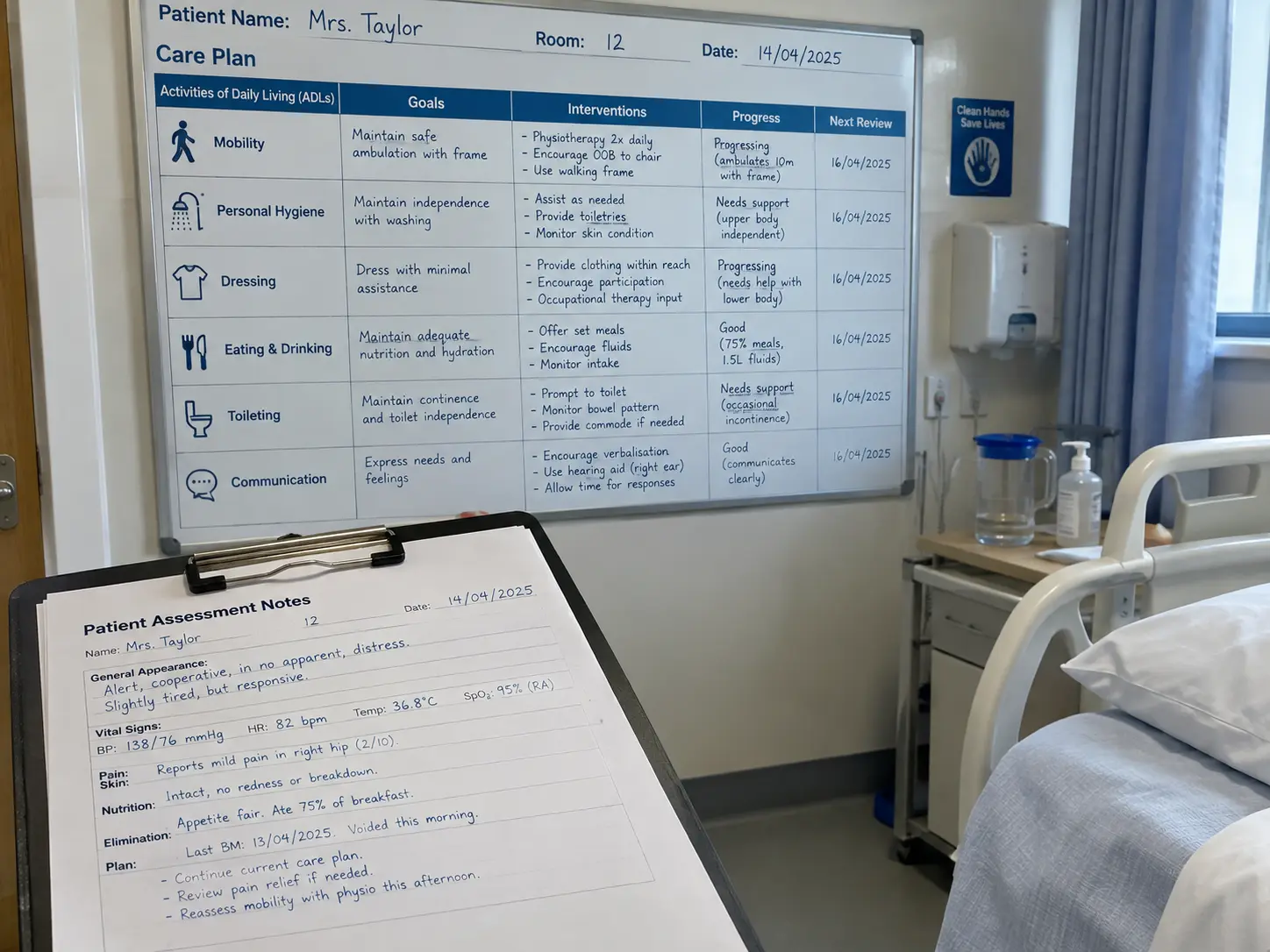
Part of RLT’s continued use in UK undergraduate nursing dissertations is that its activities-of-living structure maps closely onto how many NHS trusts still organise admission assessment documentation and care plans, even where the trust does not name RLT explicitly. If your dissertation discusses a care-planning tool, an assessment proforma, or a ward-level documentation process, it is worth checking whether that document’s structure implicitly follows an activities-of-living logic — naming this connection, where it genuinely exists, strengthens the link between your theoretical framework chapter and any practice-based discussion later in the dissertation. Where the connection does not exist, say so rather than forcing it; a mismatch between your stated framework and your discussed practice is a more common examiner objection than the framework choice itself.
Referencing RLT correctly in your bibliography
Reference the specific edition you cite in-text. A Harvard-style reference for the original model reads: Roper, N., Logan, W.W. and Tierney, A.J. (1980) The Elements of Nursing. Edinburgh: Churchill Livingstone. For the fourth edition: Roper, N., Logan, W.W. and Tierney, A.J. (1996) The Elements of Nursing: A Model for Nursing Based on a Model of Living. 4th edn. Edinburgh: Churchill Livingstone. For the authors’ later monograph: Roper, N., Logan, W.W. and Tierney, A.J. (2000) The Roper–Logan–Tierney Model of Nursing: Based on Activities of Living. Edinburgh: Churchill Livingstone. If your module handbook uses a different citation style, check its own worked example rather than assuming Harvard applies by default — our full guide to referencing in Harvard style covers the general rules for books with three named authors and multiple editions.
Frequently asked questions
Do I need to use all 12 Activities of Living in my dissertation?
No — work through the activities relevant to your case or discussion in depth, and note briefly why any omitted activities are not developed further, rather than force equal treatment of all 12.
Which edition should I cite: 1980 or 1996?
Cite the edition you are actually drawing on: the 1980 first edition of The Elements of Nursing, the 1996 fourth edition, or the authors’ 2000 monograph The Roper–Logan–Tierney Model of Nursing: Based on Activities of Living. Your module reading list usually names the version your course expects.
Is RLT the same as a nursing process model?
No. The nursing process (assess, plan, implement, evaluate) is a generic care-delivery cycle; RLT is a content model that can be used to structure what you assess and discuss within that cycle.
Can I use RLT for a mental health or community nursing dissertation?
Yes, but justify the fit explicitly — RLT was not developed specifically for those fields, and a strong dissertation names this limitation and explains why the model’s structure is still useful for the specific question being asked.
What is the difference between the dependence–independence continuum and the lifespan continuum?
The dependence–independence continuum describes how much support a person needs for a given activity at a given moment; the lifespan continuum describes how a person’s position on that continuum typically shifts across the life course.
Do markers expect a diagram of the model?
Check your own department’s expectations, but a labelled diagram showing the five components and the 12 activities is a common, useful way to demonstrate you understand the model’s structure before applying it. See how another discipline compares its own competing frameworks in our guide to theoretical frameworks for an education dissertation for a sense of what a comparative justification looks like.
Can I critique RLT and still use it as my framework?
Yes — acknowledging a model’s limitations while still justifying its use for your specific question is exactly the critical engagement markers look for at the upper classifications.
How is RLT different from Orem’s model?
RLT organises assessment around 12 activities of daily living and a dependence–independence continuum; Orem’s Self-Care Deficit Theory centres on whether a patient can meet their own self-care needs and where a nursing deficit exists. Choose based on which framing fits your research question.
Can Tesify help me apply RLT to my dissertation case study?
Tesify is used to write dissertations end to end, including theoretical framework and case-study sections, with every draft 100% written by you through the platform — it does not verify a specific clinical scenario’s accuracy for you, but it can help you structure an RLT-based discussion once you have decided which activities and influencing factors your case needs.
What is the single biggest mistake in RLT dissertations?
Listing the 12 activities as a checklist without applying the dependence–independence continuum or the five influencing factors — markers are checking whether you used the whole model, not just its most memorable part.
Tesify has helped over 9,000 students write more than 15,000 dissertation chapters, and every draft is 100% written by you, guided section by section. Start your nursing dissertation with Tesify and work through your theoretical framework chapter with the model applied properly from the start.