
A law dissertation that is factually correct but written in the wrong register still loses marks, because examiners read register as a proxy for whether you have actually absorbed the discipline, not just its content. Register is learned largely by imitation — reading judgments, law reports and academic commentary until the conventions become instinctive — but that takes years most undergraduates do not have before a dissertation deadline. These six steps cover the conventions that separate legal academic writing from general essay prose, so you can apply them deliberately rather than waiting for them to become second nature.
Step 1: Understand what “legal register” actually means
Register is not the same as correctness. A sentence can state the law accurately and still read as wrong for a law dissertation if it uses the wrong voice, the wrong level of formality, or informal hedging where the discipline expects a stated position. Legal academic writing is formal, precise, third person, and comfortable with long, subordinate-clause sentences that general undergraduate essay style avoids — because legal reasoning often needs to hold several conditions in view at once (“where X applies, unless Y, the court will generally Z”), and a law marker expects you to manage that complexity cleanly, not to break it into short sentences that lose the conditional structure. This matters as much in a doctrinal dissertation’s structural chapters as in its analytical ones — see our guide to structuring a doctrinal law dissertation for how register interacts with the discipline’s characteristic argument shape.
Step 2: Master the core conventions
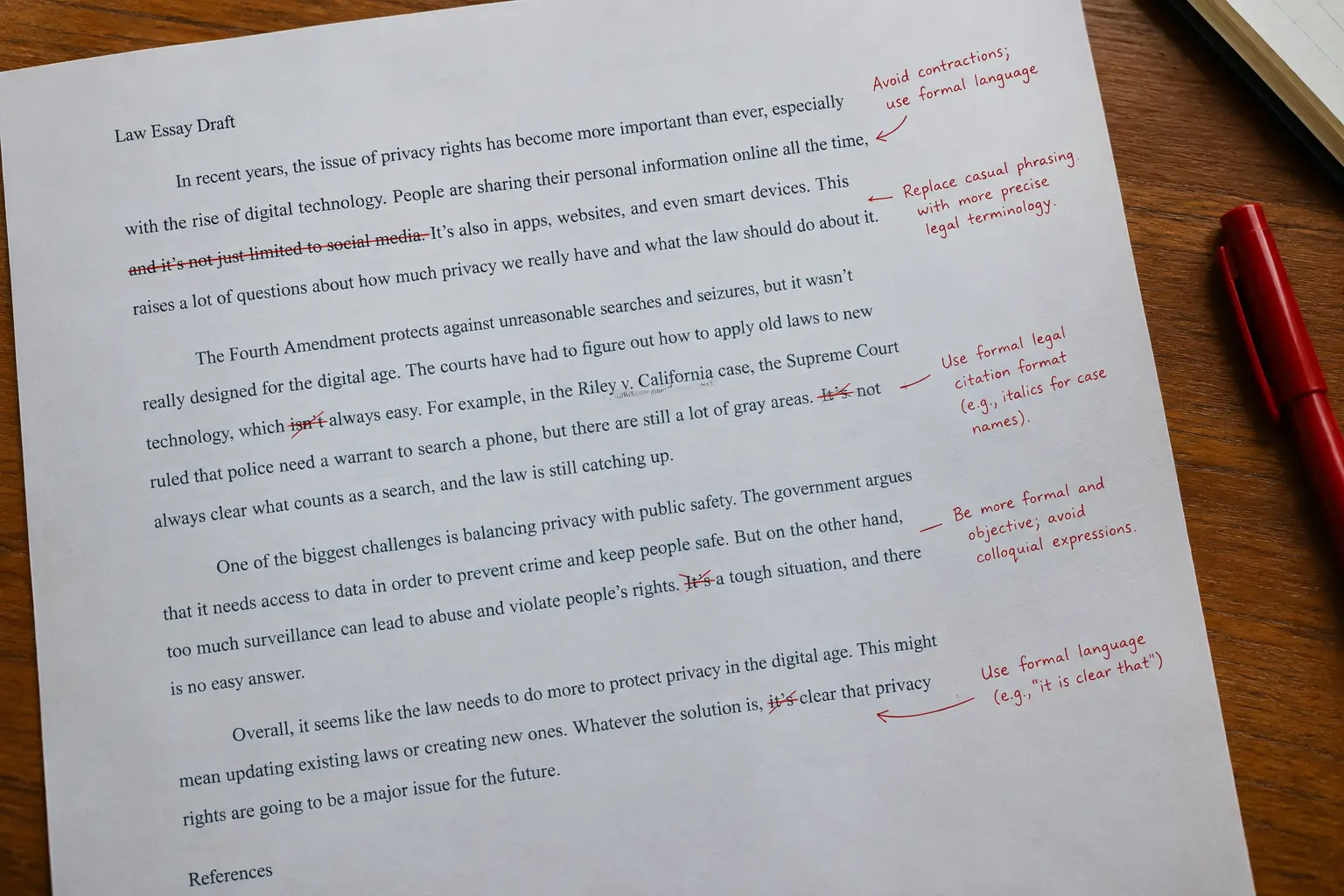
- Avoid contractions entirely. “Does not”, not “doesn’t”; “cannot”, not “can’t”. This is a harder rule in law than in most disciplines — check every paragraph before submission.
- Write in the third person. “This dissertation argues” or “it is submitted that”, not “I think” or “I believe”. Some departments now permit limited first person in a reflective introduction — check your own handbook, but default to third person in the analytical chapters regardless.
- Capitalise defined terms consistently. Once you define “the Claimant” or “the 2010 Act”, capitalise it every time thereafter, exactly as a piece of legislation or a judgment would.
- State your position directly, then support it. “It is submitted that the court’s reasoning in [case] is unpersuasive because…” is stronger and more idiomatic than “I personally feel this might not be quite right because…”.
- Use “shall” and “will” carefully. When quoting or paraphrasing statutory language, preserve the original modal verb precisely — “shall” in a statute is not interchangeable with “will” or “must” even though they can look similar in ordinary prose.
Step 3: Handle case names and citations correctly within prose
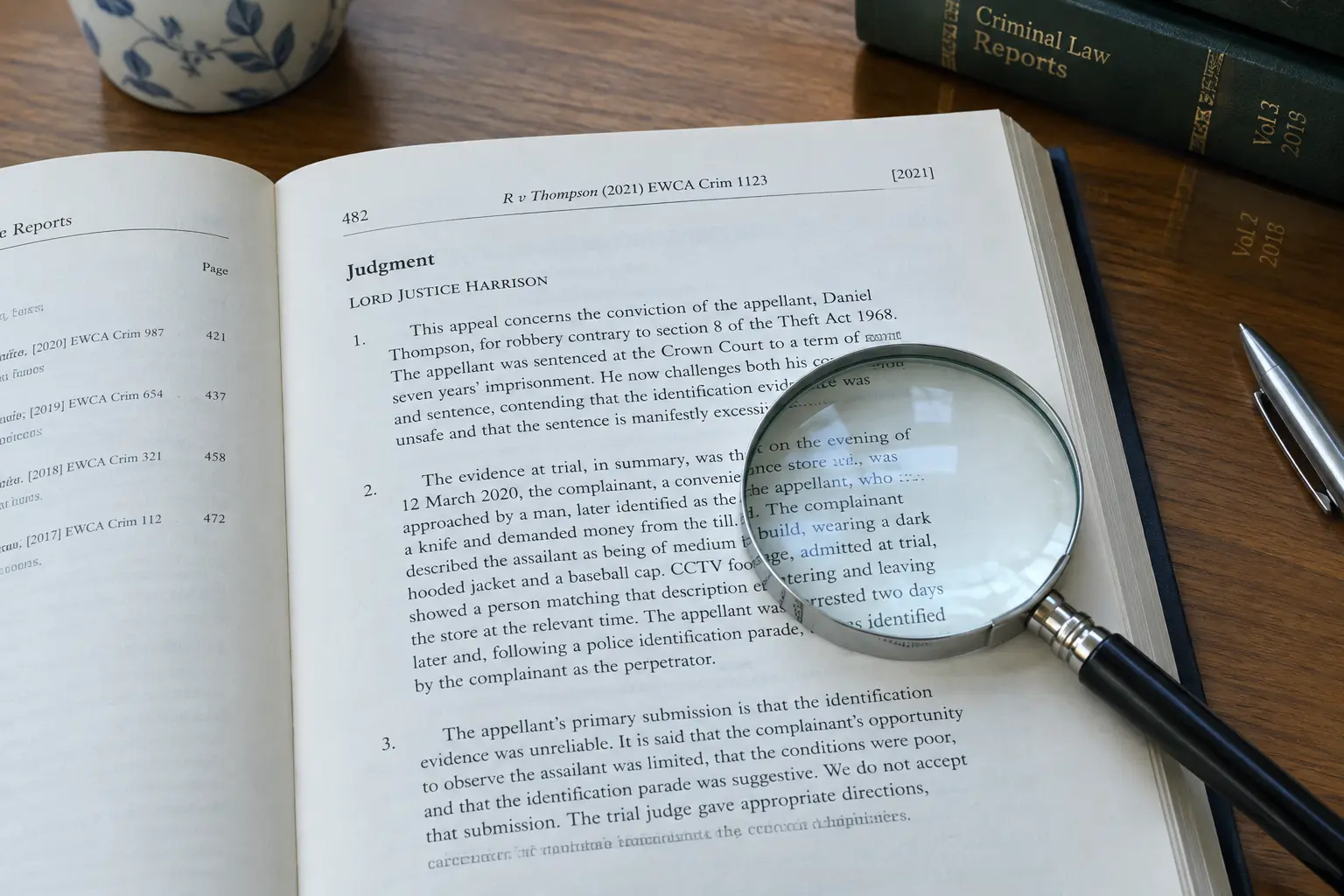
Case names are italicised every time they appear in the body text, not just on first mention: Donoghue v Stevenson, not Donoghue v Stevenson in plain text. The “v” between party names is not followed by a full stop in the standard UK convention. When you cite a case in a sentence, the citation itself (neutral citation or law report reference) goes in a footnote under OSCOLA, not inline in the sentence — the sentence should read cleanly as prose, with the case name doing the work: “The House of Lords in Donoghue v Stevenson established the modern neighbour principle,1” not “The House of Lords in Donoghue v Stevenson [1932] AC 562 established…”. See our full guide to OSCOLA referencing for a law dissertation for the footnote format itself, and our guide to citing UK legislation and cases in Harvard if your department uses Harvard rather than OSCOLA for a non-doctrinal law module.
Step 4: Use Latin and legal terminology correctly, sparingly
Latin terms in common use in English legal writing (obiter dicta, ratio decidendi, ultra vires, mens rea) are not italicised under OSCOLA, which reserves italics for foreign words and phrases that are not in common legal usage. Use them only where the English equivalent would genuinely lose precision — not as decoration to sound more legal. A dissertation that overuses Latin phrases where plain English would do just as well reads as performing formality rather than possessing it; a dissertation that avoids Latin terms the discipline actually needs (like ratio vs obiter when discussing precedent) reads as under-informed. The test: could you explain the term’s meaning precisely if asked? If not, either look it up properly or use the English phrase instead.
Step 5: Avoid the most common informal slips
- Vague intensifiers. “Very unclear”, “really important”, “quite significant” — replace with a precise claim about what makes the point significant.
- Rhetorical questions. “But is this really fair?” reads as essay style, not legal analysis. State the question as a proposition and argue it: “This raises the question of whether the outcome is consistent with the principle in…”.
- Starting sentences with “And” or “But”. Conventional in journalistic or conversational writing, but avoided in formal legal academic prose — use “However”, “Moreover”, or restructure the sentence.
- Hedging without committing. “It could maybe be argued that perhaps…” stacks three hedges in one clause. Pick one level of certainty and state it: “It is arguable that…” is a single, defensible hedge.
Step 6: A worked example (illustrative)
Informal register: “I think the case of Caparo is pretty important because it kind of changed how courts look at duty of care, and it’s not really clear if the three-part test always works.”
Legal register: “Caparo Industries plc v Dickman is a leading authority on the scope of the duty of care and is commonly associated with a three-stage approach: foreseeability, proximity, and whether it is fair, just and reasonable to impose a duty.2 It is submitted that the third stage, in particular, has been criticised for its indeterminacy, a point developed further below.”
Note what changed: contractions removed, first person removed, the case name italicised and cited in a footnote rather than inline, vague intensifiers (“pretty”, “kind of”) replaced with precise claims, and the uncertain closing hedge turned into a stated position (“it is submitted that…”) that the dissertation can then go on to support with authority.
Does register change across different chapters?
The core conventions — no contractions, third person, italicised case names — hold throughout, but the tone shifts slightly by chapter, and a strong dissertation manages the shift deliberately rather than by accident:
| Chapter | Typical register shift | Watch out for |
|---|---|---|
| Introduction | Slightly more expansive; some departments permit limited first person here to frame the research question | Overclaiming the significance of the topic before the analysis has earned it |
| Literature review | Descriptive-analytical; synthesising rather than simply listing sources | Slipping into pure summary (“X says… Y says…”) without synthesis |
| Analytical/doctrinal chapters | Most formal register in the dissertation; sustained argument with stated positions | Hedging every claim instead of committing to a defensible position |
| Conclusion | Slightly more direct and evaluative; can state implications plainly | Introducing new arguments or evidence that the analysis chapters have not already made |
A dissertation that reads as consistently formal throughout, with only these deliberate, small shifts in tone rather than random drift, is what markers mean when they praise a “confident academic voice”.
Register also matters when you are choosing your topic
The register conventions covered here apply from your very first draft, including the proposal stage — a proposal or title written in essay-style register signals to a supervisor that the discipline’s conventions have not yet been absorbed, before a single analytical chapter has been marked. Our guide to undergraduate law dissertation topics shows researchable titles phrased in the discipline’s own idiom, which is worth studying for register as much as for topic ideas.
Common mistakes in legal register
- Mixing registers within a paragraph. One formal sentence followed by a conversational one reads as inconsistent rather than deliberately varied — markers notice the mismatch more than either register alone.
- Over-Latinising. Using Latin terms to sound authoritative rather than because the English equivalent genuinely loses precision.
- Citing inline instead of in the footnote. Breaking the flow of a sentence with a full law report citation instead of using OSCOLA’s footnote convention.
- Treating register as separate from argument. The clearest legal writing states its position first, then supports it — a dissertation that buries its argument under hedged, tentative language is not actually more balanced, just harder to mark.
Frequently asked questions
Can I ever use the first person in a law dissertation?
Some departments permit limited first person in a reflective introduction or conclusion — check your own module handbook, but default to third person throughout your analytical chapters regardless of what the introduction allows.
Do I italicise statute names as well as case names?
No — statute and statutory instrument titles are not italicised (the Human Rights Act 1998, not the Human Rights Act 1998); only case names take italics in standard UK legal writing convention.
Is it acceptable to use “shall” in my own analytical writing?
Reserve “shall” for quoting or closely paraphrasing statutory or contractual language where the original uses it — in your own analytical sentences, “will” or “must” usually reads more naturally and avoids implying you are quoting a legal instrument when you are not.
How formal is too formal?
Formality that obscures your actual argument behind unnecessary complexity is too formal — the goal is precision and appropriate register, not maximum syllable count. A clear, well-structured formal sentence beats a convoluted one every time.
Should I avoid all rhetorical devices?
Avoid rhetorical questions and vague intensifiers specifically; structured argumentative devices (signposting, explicit counter-argument and rebuttal) are expected and rewarded in legal academic writing.
What about writing about non-UK or comparative law — does register change?
The formal register conventions stay the same; what changes is citation format for foreign sources, which OSCOLA also covers — check the specific jurisdiction’s own citation convention alongside OSCOLA’s guidance on foreign materials.
Does register matter as much as legal accuracy?
No — accuracy always matters more, and a dissertation with impeccable register but weak legal reasoning will still score poorly. Register is what separates a good dissertation from an excellent one once the underlying analysis is sound.
Can I check my own register before submitting?
Read your draft aloud and flag every contraction, every first-person claim outside a permitted reflective section, and every case name not in italics — a focused pass for these mechanical issues catches most register problems quickly.
Can Tesify help me write in the correct legal register?
Tesify is used to write dissertations end to end, including law dissertations, with every draft 100% written by you through the platform, guided by the conventions of your specific discipline — it does not replace checking your own department’s style guide for anything genuinely department-specific.
What is the single biggest register mistake law dissertations make?
Stacking hedges (“it could maybe perhaps be argued…”) instead of stating a position clearly and then supporting it with authority — confidence in the claim, not certainty about the outcome, is what legal register actually asks for.
Should I use the passive voice in a law dissertation?
Use it where the discipline conventionally does — “it was held that…”, “the appeal was dismissed” — but do not default to passive voice throughout, since it can obscure who is making an argument (you, or the court) at exactly the moments a marker needs that distinction to be clear. A useful check: if replacing a passive sentence with an active one makes the agent clearer without sounding informal, make the change.
Tesify has helped over 9,000 students write more than 15,000 dissertation chapters, and every draft is 100% written by you, guided section by section. Start your law dissertation with Tesify and work through your analytical chapters with the register handled correctly from the start.