Imperial College London’s Department of Electrical and Electronic Engineering does not set a word count for its individual research project report at all — its published course handbook sets a page range instead, 50 to 150 pages, and requires a mandatory sustainability and societal impact section that many other UK engineering programmes do not. This is one named department’s rules, opened directly from its own handbook, not a UK-wide standard; check your own handbook before assuming any of it applies to you, and use what follows as a model for the level of detail your own department’s document is likely to specify.
| Requirement | What Imperial EEE’s handbook states |
|---|---|
| Length | Typically 50–150 pages, not a word count |
| Mandatory section | Sustainability and societal impact — required in the final submission |
| Referencing style | Numeric [1] or Author-Date [Cla06] keys, not Harvard prose citation |
| Cover | Imperial College logo required — not the College crest |
| Plagiarism declaration | Mandatory online Plagiarism Awareness course, deadline 31 October |
| Large code listings | Two CD copies required if the project includes substantial program listings |
What the report must contain, chapter by chapter
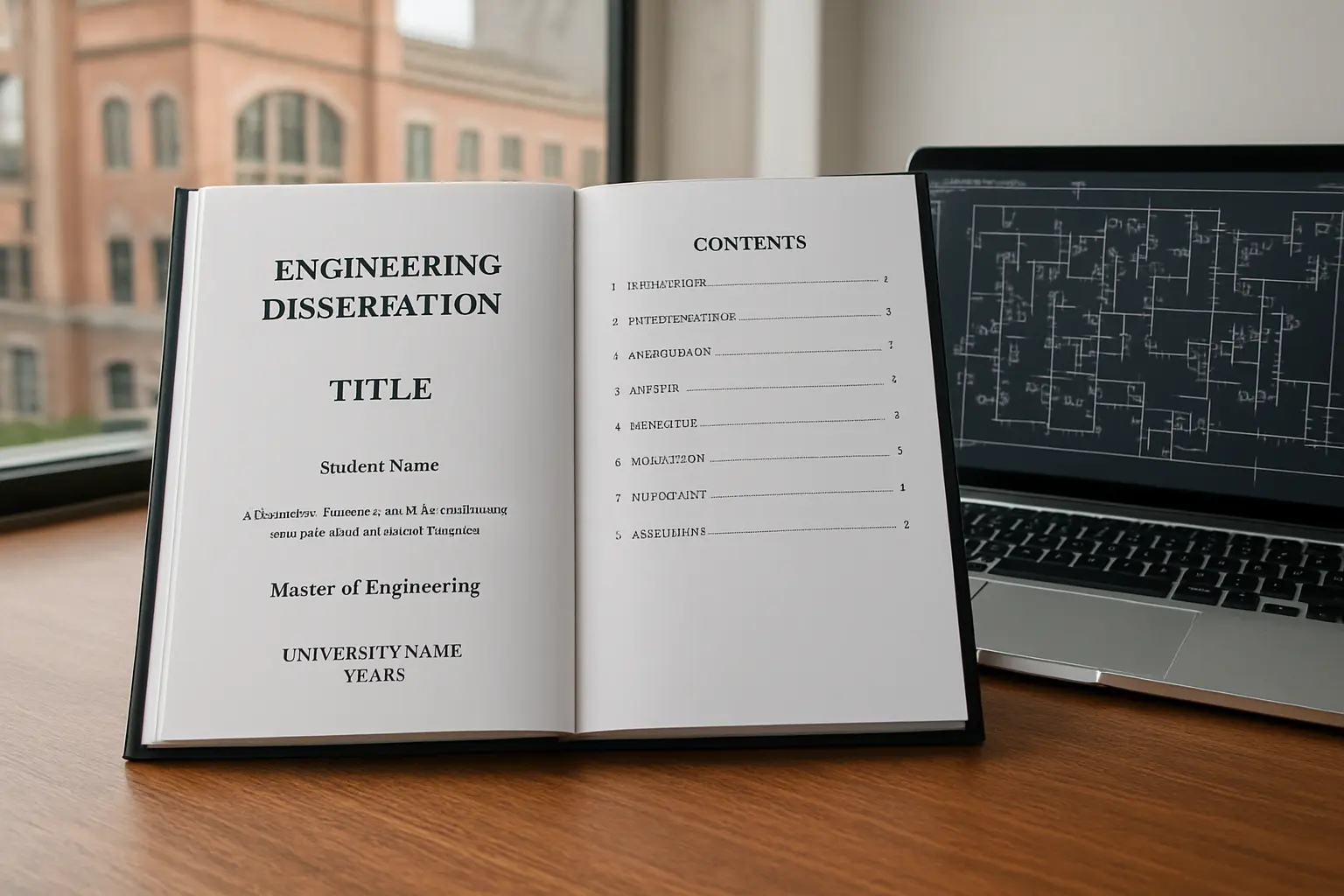
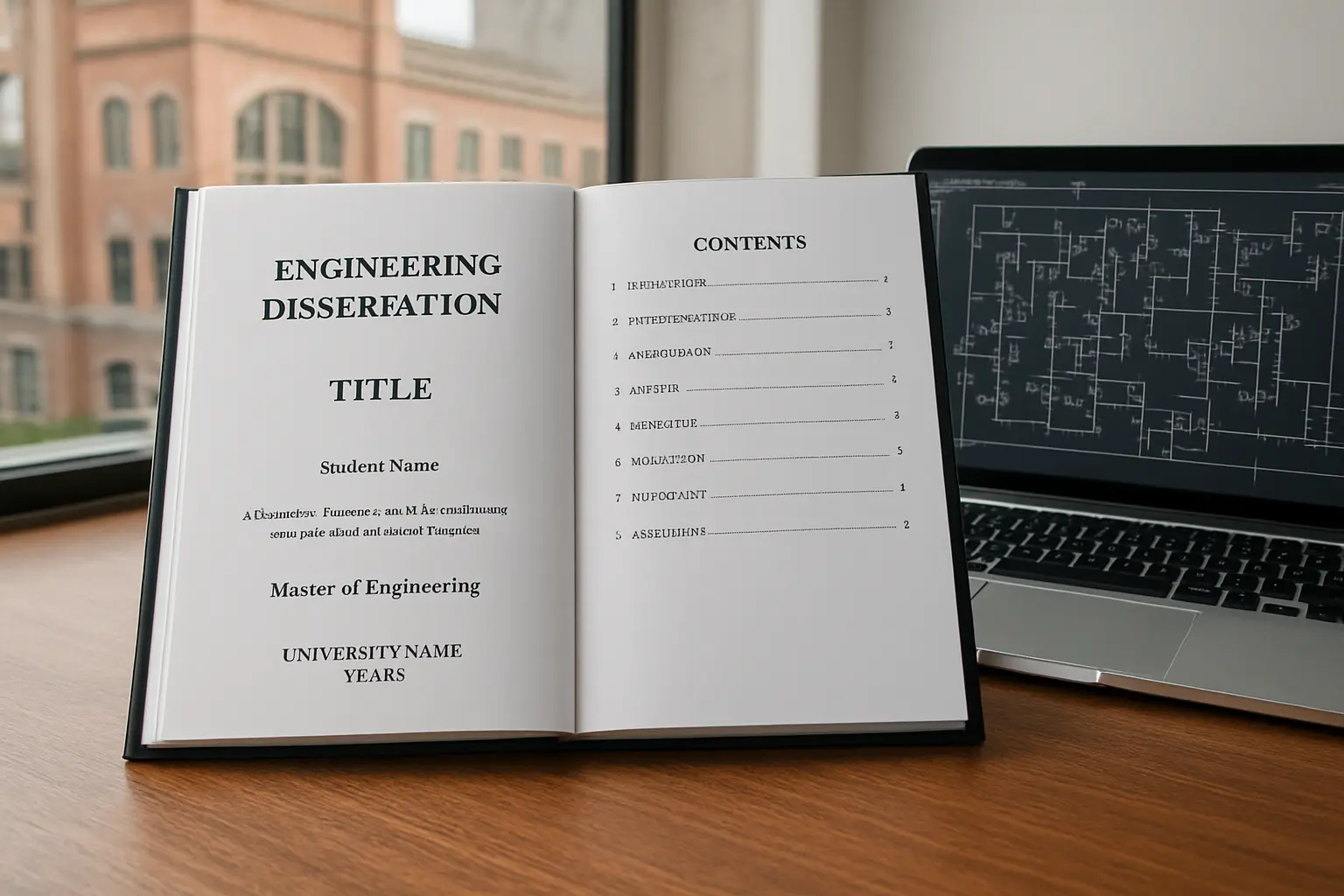
The handbook lays out an expected structure: a title page naming the year, project title, MSc programme and supervisor; an abstract of roughly half a page; acknowledgements; a contents page with section numbering, set in double spacing; an introduction; a background or literature review section; three to four body chapters covering the technical work itself; a conclusions and future work chapter; a bibliography; appendices where needed; and, for projects producing software or hardware, a user guide explaining how to operate what was built. Each chapter title is expected to be self-explanatory on its own, and the handbook explicitly limits subheadings to sections and subsections — it does not want a document fragmented into deeper heading levels than that.
Why pages, not words
Measuring by page count rather than word count reflects how uneven an engineering report’s content density actually is — a page of circuit diagrams, equations or code listings carries a fraction of the words a page of prose does, but takes just as long to read and assess properly. A strict word count would either force padding into the prose sections or penalise a project that is genuinely diagram- and equation-heavy, so the handbook’s page range is a more honest measure of the document’s real length for this kind of work. The trade-off is that “quantity does not automatically guarantee quality” is stated explicitly in the same handbook — hitting 150 pages with restated background material earns no credit the content itself does not support.
The sustainability and societal impact section is not optional
This is the most distinctive requirement in the handbook, and one that a student transferring expectations from a different engineering department is likely to miss entirely: a dedicated section addressing the sustainability and societal impact of the project is described as mandatory for the final submission, not an optional extra. If your own project does not have an obvious environmental angle, the section still needs to exist and engage seriously with the question — what resources the work consumes or could save, who is affected by the technology, and what the broader implications are — rather than being satisfied with a token paragraph bolted onto the conclusion.
Referencing: numeric or author-date keys, not Harvard prose
The handbook specifies numeric citation keys (such as [1]) or short author-date keys (such as [Cla06]) rather than the Harvard-style “(Smith, 2021)” format common across most other UK dissertation guidance, including much of the general advice on this site. This is a genuinely engineering-specific convention, closer to IEEE-style referencing than to Harvard, and it matters for a reference manager’s configured output style — check that whatever tool you use is set to the format your own department actually wants, since a correctly-formatted reference list in the wrong citation style still reads as a formatting error to a marker.

Submission mechanics worth knowing in advance
Two administrative requirements are easy to miss because they sit outside the report itself: a mandatory online Plagiarism Awareness course with its own separate deadline (31 October in the handbook as published), and — for projects that include substantial program listings — a requirement to submit two CD copies alongside the written report, a detail that reflects how some engineering submission processes still handle large code artefacts separately from the main document upload. Check your own current handbook for whether this specific mechanism is still in place by the time you submit, since administrative processes like this are the most likely detail to be updated between academic years.
What the assessment actually weighs
The handbook names four assessment dimensions: demonstrating understanding of the technical context, applying appropriate theoretical techniques correctly, critical self-appraisal of the work’s own limitations, and professional-standard documentation. Notably, “critical self-appraisal” is assessed as its own dimension, separate from the technical execution — a report that presents only successes and never critically examines what did not work as expected, or what a more rigorous approach would have required, is missing marks that have nothing to do with whether the underlying engineering succeeded. A project that hit every objective with no setbacks worth discussing is, in practice, rarer than a report that pretends this was the case; naming a genuine technical dead end and explaining why it was abandoned is stronger evidence of engineering judgement than omitting it entirely.
This is one department’s rules — do not generalise from it
Every fact above describes Imperial College London’s Department of Electrical and Electronic Engineering’s individual research project specifically, opened directly from its own published course handbook. Engineering departments across the UK vary meaningfully on exactly these points — some set a strict word count instead of a page range, some do not require a sustainability section at all, some expect Harvard referencing throughout. Our general guide to undergraduate dissertation word counts by subject shows just how much length requirements already diverge across UK departments even before engineering’s page-based convention is added into the mix — use Imperial’s example as a worked illustration of how detailed and specific a real handbook gets, then go and read your own department’s equivalent document with the same level of attention, rather than assuming any single named example generalises.
How this compares with the citation style used elsewhere on a dissertation
Most UK dissertation guidance, including our own general guide to Harvard referencing, assumes the author-date-in-prose Harvard convention that dominates the humanities and social sciences. Engineering’s numeric and short-key styles are a genuinely different citation family, closer to how journal articles in electronics and computing are conventionally referenced — if you are moving between an engineering module and a joint-honours or general-studies module with different referencing expectations, keep the two styles clearly separated rather than defaulting to whichever one you used most recently.
What “professional-standard documentation” means in practice
The fourth assessment dimension — professional documentation — is often the least explained in a handbook and the easiest to underestimate. In practice it covers consistent formatting throughout the document (the same heading style, the same figure-caption format, the same citation style applied without exception from the first page to the last), figures and tables that are legible and properly labelled rather than screenshots pasted at low resolution, and a level of proofreading that would be expected of a professional technical report submitted to a client or manager, not a draft submitted for peer feedback. A technically excellent project that loses marks here is a genuinely common and avoidable outcome — the fix is a dedicated formatting and proofreading pass in the final week, treated as separate work from finishing the technical content itself, not squeezed into the same session as the last few paragraphs of writing.
Frequently asked questions
Does this apply to undergraduate engineering dissertations, or only postgraduate?
The handbook referenced here describes Imperial’s MSc individual research project specifically — a taught postgraduate submission. Undergraduate final-year project requirements at Imperial, and at any other university, may differ and should be checked in your own department’s own undergraduate handbook.
Do other UK engineering departments use a page count instead of a word count?
Practice varies — some engineering departments set a word count in line with other subjects, others use a page range as Imperial’s EEE department does. Check your own handbook rather than assuming either convention.
Is a sustainability section common across UK engineering dissertations?
It is becoming more common as engineering accreditation bodies increasingly expect ethical and sustainability awareness to be demonstrated, but it is not universal — confirm with your own module handbook whether it is required, and if it is, what specifically it needs to address.
What reference manager works with numeric or author-date engineering citation styles?
Most major reference managers, including Zotero and Mendeley, support IEEE-style numeric citation and various author-date formats — see our comparison of Zotero, Mendeley and EndNote for how each handles style switching. The key step is selecting the correct output style in the tool’s settings before you start citing, not after your reference list is already built in the wrong format.
Can you ask your supervisor for a copy of the current handbook if you cannot find it?
Yes, and this is a normal, expected request — course handbooks are sometimes only accessible through a student intranet portal rather than the public website, and a supervisor or course administrator can point you to the current version rather than an out-of-date public copy.
How does critical self-appraisal differ from the limitations section other dissertations write?
The underlying idea is similar — acknowledging what the work did not achieve or could not fully test — but engineering self-appraisal often extends to evaluating specific technical decisions and trade-offs made during implementation, not only the overall study design, since the project itself is usually a built or engineered artefact rather than a purely observational study.
Should you follow this Imperial example if your own department’s handbook is silent on a point?
Only as a general illustration of the level of detail expected, never as a substitute for your own department’s actual rules — where your handbook is genuinely silent on a specific point, ask your supervisor directly rather than importing another university’s requirement.
Does a user guide count toward the page limit?
Check your own handbook’s wording specifically — Imperial’s structure lists the user guide as a distinct expected component for software or hardware projects, but whether it counts inside or outside a stated page range is exactly the kind of detail that varies and is worth confirming directly rather than assuming either way.
What if your project does not produce software or hardware at all?
A purely theoretical, simulation-based or analytical engineering project simply omits the user guide component — the remaining structure (introduction, background, technical chapters, conclusions) still applies, adjusted to the nature of the work rather than forced to include a section that does not fit.
Tesify’s dissertation builder can hold your own department’s specific formatting rules — page or word limits, citation style, mandatory sections — alongside your draft chapters, so nothing gets missed between the handbook and the final submission. Start your dissertation with Tesify — free to try.