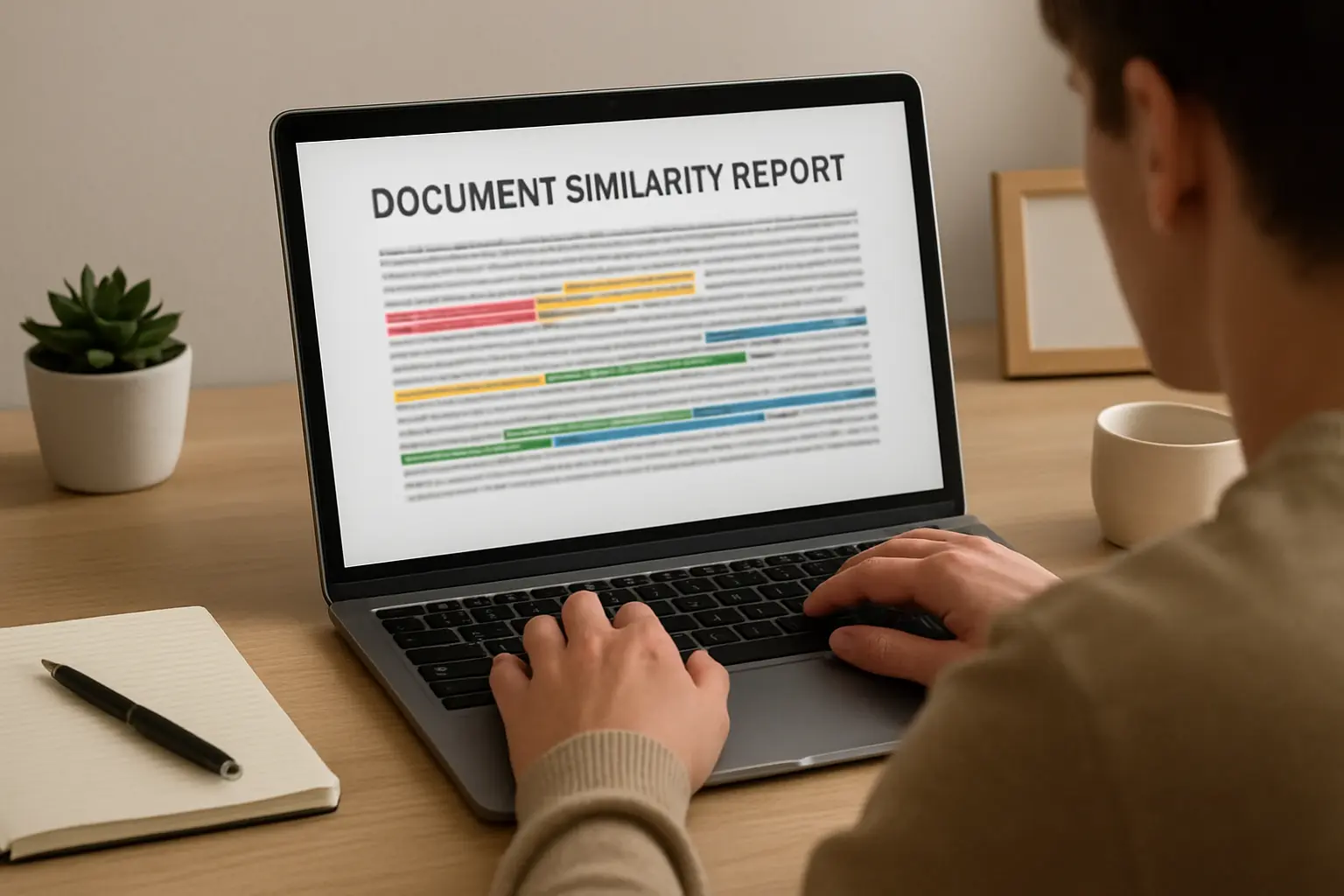
Start with the sentence that should govern this whole purchase: no consumer plagiarism checker can tell you what Turnitin will say, and no tool on this page — or any other — helps you “beat” detection. What a self-check does is legitimate and useful: it finds the quotation you forgot to mark, the paraphrase that stayed too close to its source, and the citation that fell out during editing, while there is still time to fix them honestly. Judged on that purpose, here is the comparison.
| Tesify Plagiarism Checker | Scribbr | Turnitin (via your university) | Free web checkers | |
|---|---|---|---|---|
| How you get it | Inside the Tesify workspace, on your draft as you write | Pay per document | Institutional only — no personal accounts | Browser, ad-funded |
| Price | Included with your Tesify workspace; start free | £13.95 / £22.95 / £31.95 by document length (one-time) | Free to you, via submission portals your course provides | Free, with limits and ads |
| Database quality | Web and published sources | Very large web + publication database (own technology) | The reference standard, including student paper archives | Varies wildly; often web-only |
| Stores your text in a shared database? | No — your draft stays yours | States submissions are not published to any public database | Depends on institutional settings | Often unclear — read the terms before pasting a dissertation in |
| Best for | Continuous checking while drafting | One-off pre-submission check of a finished document | The check that actually counts | Short, low-stakes pieces |
The shortlist, ranked for the actual job
1. Tesify Plagiarism Checker — check while you write, not after
The structural advantage is timing. A checker bolted onto the end of your process tells you about problems when they are most expensive to fix — the night before submission, in a finished document. Tesify’s checker runs on the draft inside the same workspace where you are writing, so a too-close paraphrase gets caught in week six, in context, next to the source you were working from. It will not tell you your university’s Turnitin score — nothing will — but it systematically removes the accidental-similarity class of problem before it accumulates. You can start free and check your own chapters as you draft them.
2. Scribbr — the strongest one-off check
Scribbr’s checker runs on its own detection technology — which the company describes as similar to the software most UK universities use — against a very large database of web pages and publisher content, and it is clear that your submission is not published to any shared database, so a later university check will not match against your own upload. Pricing is per document by length: £13.95 up to 7,499 words, £22.95 to 49,999, £31.95 above that, with a free tier that flags overall risk and top sources. For a one-off check of a finished dissertation, this is the serious consumer option. Where it falls short: per-document pricing punishes the redraft cycle — check, fix, re-check quickly costs more than the fix deserved.
3. Turnitin — not a consumer option, and that matters
Turnitin sells to institutions, not students; there is no legitimate personal subscription. Its practical relevance to your decision is different: many UK courses give students a draft-check submission point or similarity report access inside the VLE. If yours does, that is the single most authoritative check available to you, because it is the same system with the same database that will assess the real submission. Ask your module leader whether a draft check exists before spending anything — the best tool on this page may already be free to you.
4. Free web checkers — know what you are pasting where
Free checkers vary from adequate-for-an-essay to actively risky. Two screening questions before you use one on work that matters: what database does it actually check against (many are web-only, missing all published literature), and what happens to your text after you paste it (some free services retain submissions — the terms page, not the homepage, tells you). Never paste an unpublished dissertation into a service whose retention policy you have not read.
How to read a similarity report like a marker
The percentage is the least informative number on the page. Quoted material with correct citations produces matches that are perfectly fine; a bibliography matches by design; boilerplate phrasing in a methodology chapter matches everywhere. What matters is the character of each highlight: an unquoted sentence that tracks a source’s wording is a real problem however low the overall score, and a 25 per cent score made of properly attributed quotation can be healthier than an 8 per cent score hiding one stolen paragraph. Work highlight by highlight: quote it properly, paraphrase it genuinely — which means re-expressing the idea from your own understanding, not swapping synonyms — or cite what is missing. Citation mechanics are the cheapest fixes of all, and an automatic bibliography removes the missing-reference class of match entirely.
A pre-submission routine that actually works
Six weeks out, check your longest analytical chapter — the one with the most sources — and fix what surfaces; the habits you correct there improve every later chapter for free. Two weeks out, run the full document once, resolve every highlight deliberately, and record what you changed. Submission week, re-check only if you made substantial edits after the full pass; final-week rewording to chase a lower percentage is how well-cited work gets worse. And through all of it, keep your notes and drafts: if a marker ever queries a passage, the version history showing the work developing in your own hands is better evidence than any report.
What self-checking cannot do
Three honest limits. It cannot predict your university’s score: different databases, different settings, different archives — treat any consumer number as directional only. It cannot make ghost-written or AI-generated work safe: similarity tools measure text overlap, and universities assess authorship through other means, including your ability to discuss your own work; the line between legitimate AI assistance and misconduct is about authorship, not detectability, as we set out in our guide to using AI honestly in a literature review. And it cannot replace understanding what plagiarism is: patchwriting — light rewording with the source’s structure intact — survives many checkers and fails with markers, because markers read for voice, not just overlap.
The recommendation
If your course offers a Turnitin draft check, use it — it outranks everything you can buy. For continuous protection while drafting, use Tesify’s built-in checker as you write. For a final one-off pass on a finished document where your course offers nothing, Scribbr is the strongest consumer option at a fair one-time price. Use free web checkers only for low-stakes work, and never for an unpublished dissertation without reading their retention terms.
Frequently asked questions
What similarity percentage is acceptable for a dissertation?
There is no UK-wide threshold, and most universities deliberately avoid publishing one, because the number is meaningless without reading the matches. Markers assess what the matches are, not what they sum to. Fix the character of the highlights and the percentage looks after itself.
Can I buy Turnitin as a student?
No — Turnitin is institutional software. Services claiming to sell you “a Turnitin check” are reselling access in ways that may breach the service’s terms; treat them with caution. Ask your course whether it provides a draft-check point instead.
Will checking my dissertation with Scribbr make my university’s check flag it?
Scribbr states that submissions are not published to any public database, so a later institutional check should not match against your own upload. This is exactly the property to verify before using any other checker.
Do plagiarism checkers detect AI-generated text?
Similarity checking and AI detection are different technologies. Some services bundle both, but AI detectors are probabilistic and contested — no tool, in either direction, settles the authorship question. The reliable protection is work you genuinely wrote and can defend in a conversation.
Is a high match on my bibliography a problem?
No. Reference lists match by design, and university configurations commonly exclude them. If a consumer checker inflates your score with bibliography matches, discount them when reading the report.
Can I check someone else’s work for them?
Do not upload work that is not yours — you would be processing someone else’s unpublished text through a third-party service without standing to accept the terms. Point them at the tool instead.
Why did my checker miss something my university found?
Databases differ. Institutional systems match against archives consumer tools cannot see, including previously submitted student work. This is why a clean consumer report is reassurance, not clearance.
Is paraphrasing with synonyms enough to avoid plagiarism?
No. Synonym-swapping with the source’s sentence structure intact is patchwriting, which is plagiarism whether or not software catches it. Genuine paraphrase reconstructs the idea in your own structure and still cites the source.
Should I check every chapter or the whole document at once?
Both have uses: chapter-level checks while drafting catch problems early and cheaply; one whole-document pass before submission catches anything introduced in final editing. Per-document pricing makes the first pattern expensive with pay-per-check tools, which is where a built-in checker earns its keep.
Does quoting a source too much count as plagiarism?
Properly attributed quotation is not plagiarism, but over-quotation is weak scholarship — the marker wants your synthesis, not an anthology. If quotes carry your argument, the fix is analytical, not clerical.