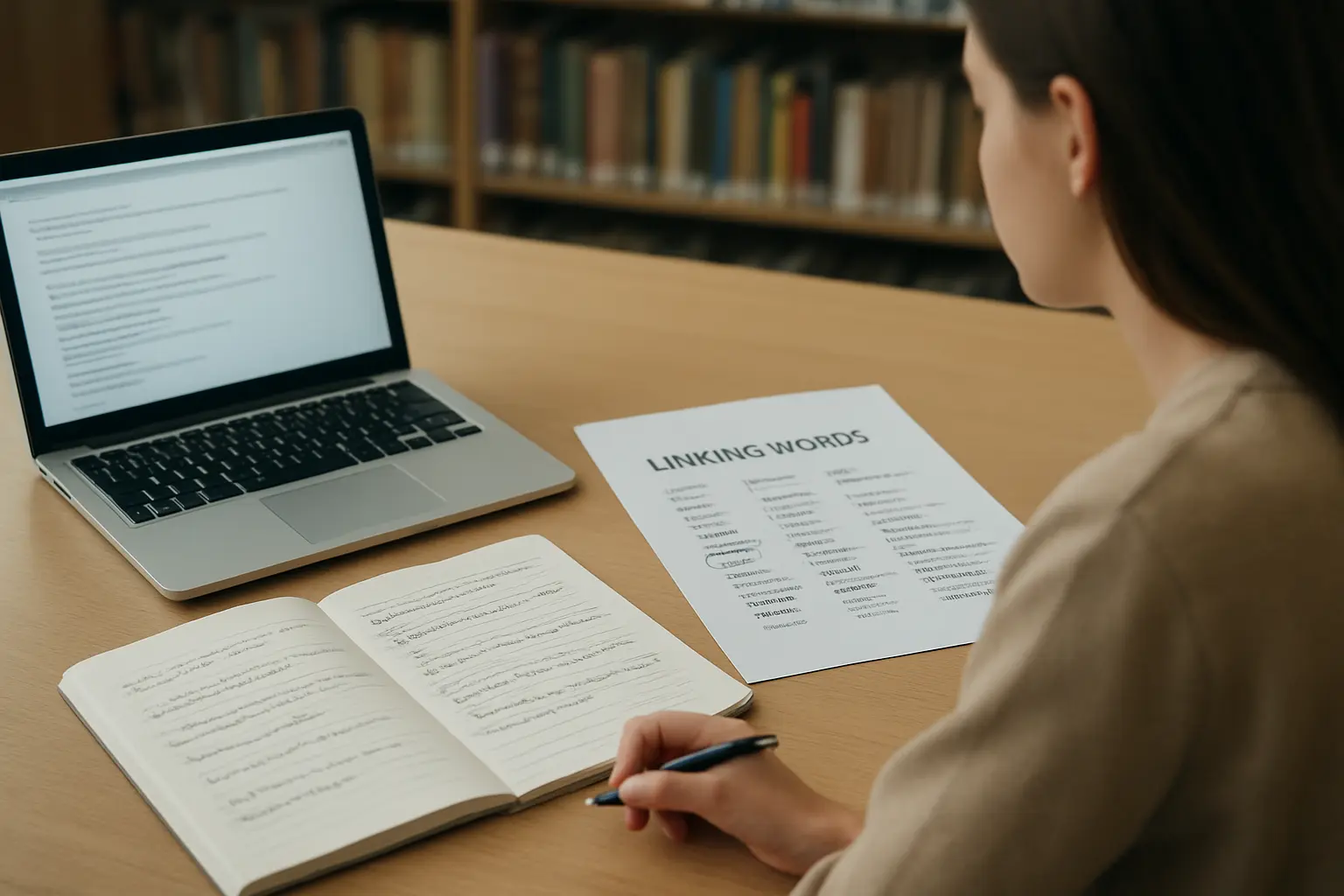
Your paragraphs do not connect, and you have gone looking for the words that will connect them. There are five places UK students get signposting language from, and they are not equally safe — one of them is a named academic-misconduct risk at several universities. Here they are compared, with a verdict.
The comparison
| Source | Cost | What it actually gives you | Where it falls short | Safe? |
|---|---|---|---|---|
| Academic Phrasebank (University of Manchester) | Free on the web; paid PDF and Kindle editions | Categorised model phrases by rhetorical function, with an explicit statement that reuse is not plagiarism | Harvested from postgraduate dissertations, so some phrasing is grander than an undergraduate document needs | Yes, with adaptation |
| Your own university’s signposting guidance | Free | A categorised list plus, usually, a warning about overuse in the same document | Shorter than the Phrasebank; quality varies a great deal between institutions | Yes |
| Generic linking-word lists (open web) | Free | A long undifferentiated list of words | No categorisation by function, no guidance on when not to use one; encourages sprinkling | Yes, but low value |
| AI paraphrasing and rewriting tools | Free tiers and paid plans | Rewritten sentences, sometimes with connectors inserted | Named as academic misconduct in several UK regulations; alters your meaning without telling you | Check your regulations first |
| Published articles in your own field | Free via your library | The conventions your markers actually read, at the right level and in the right discipline | Slow, and you have to notice the moves rather than just read past them | Yes |
The verdict, stated plainly
Use the Academic Phrasebank as your default, cross-checked against your own university’s guidance, and read three articles in your field to calibrate. Do not use a paraphrasing tool to generate connective tissue — the risk is real and asymmetric, and it does not solve the problem you actually have.
The rest of this page explains why, and why the fix for disconnected paragraphs is usually not a word at all.
1. The Academic Phrasebank — the default, and it licenses its own reuse
The Academic Phrasebank is the most widely recommended academic phrase resource in UK higher education, and its signposting page is the single most useful thing on it. It opens with the best available description of what signposting is for:
“Previewing what is to follow in a paper or dissertation is like showing a map to a driver; it enables them to see where they are going. So it is useful to think of a preview section as a ‘road map’ for the reader. It must be accurate, but it must be easy to follow.”
The phrases are grouped by the job they do rather than dumped in a list. Reintroducing a topic: “As discussed above, …”, “As previously stated, …”, “As was mentioned in the previous chapter, …”. Moving between sections: “Turning now to …”, “Having defined what is meant by X, I will now move on to discuss …”, “So far this paper has focused on X. The following section will discuss …”. Summarising a section before you leave it: “The previous section has shown that …”, “Thus far, the thesis has argued that …”.
Crucially, it settles the plagiarism question about itself. The Phrasebank states that its items “are mostly content neutral and generic in nature; in using them, therefore, you are not stealing other people’s ideas and this does not constitute plagiarism.” It attaches one condition, and it matters: “In most cases, a certain amount of creativity and adaptation will be necessary when a phrase is used.”
It also publishes the boundary, drawn from a survey of 45 academics at two British universities. A phrase you can safely reuse “should not have a unique or original construction; should not express a clear point of view of another writer; may be up to nine words in length; beyond this ‘acceptability’ declines”. That nine-word ceiling is the most concrete guidance on borrowed phrasing published anywhere in UK higher education.
One caveat for undergraduates. The corpus the phrases came from “consisted of 100 postgraduate dissertations completed at the University of Manchester”. The material transfers, but it was harvested a level above you, and a few formulations will sound inflated in a 10,000-word undergraduate dissertation. Adapt down.
2. Your own university’s guidance — and the warning it prints next to the list
Most UK universities publish a signposting page, and the good ones do something the open-web lists never do: they categorise by function, and then they tell you to stop.
Newcastle University publishes the most complete taxonomy encountered — two families, signposting of order (listing, referring forward, referring backward, transitioning) and signposting of relations (addition, similarity, illustration, contrast, cause and effect, summary, reformulation, emphasis) — each with a gloss on what the category is for. Its framing is the clearest statement of why this matters: “These words may not seem important, but they’re really the glue that holds a piece of writing together. Without signposting language, writing can lose direction, become confused and read like a series of unrelated points.” And then the instruction that the category structure exists to serve: “There are different kinds of links and relationships, so you need to choose a signposting word that does the right job.”
York divides the same territory by scale, into “major signposting” and “linking words and phrases”. Portsmouth separates connectives from transition signals: “Connectives link sentences, phrases and ideas, in order to take your reader through what you are saying. Transition terms are a type of connective, but they are used more specifically for indicating some kind of change or development.” Hull states the purpose: “By making explicit how points are connected to each other you make it easier for your reader to follow your arguments.”
3. Why the lists come with their own warning attached
Here is the structural point that most advice on this topic misses. The same institutions that publish the big connector lists publish, in the same document, the warning not to work through them mechanically.
Hull runs a long categorised list and then closes it: “Don’t overdo it. Only use signposts when they add clarity to your work. Some students try to put a signposting word into every sentence which can actually obscure meaning.” It gives the test that actually works: “Only use a word like ‘consequently’ if you really mean that the following sentence is a true consequence of the previous one!”
Newcastle, having published the most exhaustive taxonomy of the lot, ends with: “Use deliberately — You don’t need to use a signposting word in every sentence, so before you do ask yourself if it helps make the meaning clearer, or just bogs down the writing.”
Portsmouth is blunter about the motive: “You should not try too hard to make your writing look more academic by using words and phrases purely to appear more academic.” Bradford College reduces it to a line: too many signposts and linking words “can be almost as bad as having none.”
The underlying distinction, from a UK EAP teaching resource, is the one worth carrying: “a text is cohesive if its elements are linked together, and coherent if it makes sense. These are not necessarily the same thing. That is, a text may be cohesive (i.e. linked together), but incoherent (i.e. meaningless).” And the consequence: “a text which is poorly organised is not going to be made more coherent simply by ‘peppering it’ with discourse markers.”
That is why a source that only emits connectors — which is exactly what a generic list and a rewriting tool both do — cannot fix the problem. It supplies cohesion where you needed coherence.
There is one measured pattern worth knowing about yourself. Loughborough University London summarises published research by Granger and Tyson, Lei, and Appel and Szeib finding that second-language writers tend to overuse connectors while first-language writers tend to underuse them. If you are writing in your second language, the sprinkling failure is statistically the one to watch for; if English is your first language, you may need more signposting than instinct suggests, not less.
4. AI paraphrasing tools — where the real risk sits, and where UK policy splits
Students reach for a rewriting tool when a paragraph will not flow, and this is the one option on the table that can cost you a degree rather than a mark.
Several UK universities name it directly. Sheffield Hallam: “It is also an act of plagiarism to use paraphrasing software to reword the work of others without clear attribution of the original source.” Swansea: “If a student submits a software-generated paraphrase as part of their work, they are claiming that they were the author of that paraphrase. This is considered Academic Misconduct.” Loughborough’s Regulation XVIII lists paraphrasing and translation software alongside generative AI as a misconduct category. Nottingham comes closest to naming the specific move students make — rewording text specifically so it stops matching in similarity software — and names products, QuillBot and Wordtune among them.
But UK universities are not uniform on this, and pretending otherwise would be false. Warwick’s library publishes a page about QuillBot that carries no prohibition at all, describing it neutrally as helping with paraphrasing text. Two UK universities, one product, opposite postures. Your own institution’s regulations are the only ones that govern you — read them before you open the tool, not after.
If you are unsure where the line sits generally, our guides to what happens if you are accused of academic misconduct and to the AI tools a UK dissertation writer can actually use cover the wider question.
5. Published articles in your field — the slow option that calibrates the other four
Open three articles from the journals your literature review cites most and read only the first sentence of each section and each paragraph. You are looking for what those writers do at the joints, and you will find that the moves are narrower and plainer than any list implies.
This is also the only source that tells you what your discipline expects, which no general resource can. It settles related register questions at the same time — whether your field writes in the first person, for instance, which we cover in can you use “I” in a UK dissertation.
Two places where this advice does not apply
Everything above concerns your chapters. Two sections run on different rules.
- The abstract. Signposting comes out. An abstract that says the first chapter reviews the literature and the second sets out the methodology describes the document rather than the research, and the contents page already does that job — see how to write a dissertation abstract.
- The results chapter. Its conventions are about reporting numbers, not about connecting arguments, and the Phrasebank has a separate set of moves for it; our results chapter guide works through those.
Where Tesify fits
The honest position: no tool supplies coherence, because coherence is a property of your argument rather than of your vocabulary. What a tool can do is stop you losing the thread across 10,000 words written over four months.
Write your dissertation in Tesify: hold the whole structure in one workspace so you can see whether section two actually follows from section one, draft the transitions in place rather than bolting them on at the end, and keep the bibliography formatting itself. It is a drafting workspace, not a rewriter — the words stay 100% yours, which is precisely the distinction the regulations quoted above turn on. There is a free tier.
Frequently asked questions
Where should I get signposting phrases from?
The University of Manchester’s Academic Phrasebank first, then your own university’s signposting guidance. The Phrasebank gives categorised model phrases and states plainly that using them “does not constitute plagiarism”, because the items are “mostly content neutral and generic in nature”.
Is using phrases from the Academic Phrasebank plagiarism?
No, and it says so itself: the items “are mostly content neutral and generic in nature; in using them, therefore, you are not stealing other people’s ideas and this does not constitute plagiarism.” It does add a condition — “In most cases, a certain amount of creativity and adaptation will be necessary when a phrase is used.”
How long a borrowed phrase is acceptable?
The Phrasebank’s own guidance, drawn from a survey of 45 academics at two British universities, sets the ceiling at about nine words: a reusable phrase “may be up to nine words in length; beyond this ‘acceptability’ declines”. It should also “not have a unique or original construction” and “not express a clear point of view of another writer”.
Was the Academic Phrasebank built from undergraduate writing?
No, and it is worth knowing. The corpus the phrases were taken from “consisted of 100 postgraduate dissertations completed at the University of Manchester”. The phrases transfer well to undergraduate work, but they were harvested at a level above yours, so some will sound grander than your document needs.
Can I use QuillBot or a paraphrasing tool for connectors?
This is genuinely risky and UK universities disagree about it. Sheffield Hallam states that “It is also an act of plagiarism to use paraphrasing software to reword the work of others without clear attribution of the original source.” Warwick’s library, by contrast, describes QuillBot neutrally with no prohibition attached. Check your own regulations before you touch one.
Why does my writing sound worse after I add linking words?
Because cohesion and coherence are different things. As one UK EAP teaching resource puts it, “a text is cohesive if its elements are linked together, and coherent if it makes sense. These are not necessarily the same thing.” Connectors create cohesion; only a real logical sequence creates coherence.
How many signposting words should a paragraph have?
Fewer than you think. Hull warns that “Some students try to put a signposting word into every sentence which can actually obscure meaning.” Newcastle asks you to “ask yourself if it helps make the meaning clearer, or just bogs down the writing.” Bradford College puts it most sharply: too many “can be almost as bad as having none.”
Do second-language writers use more connectors than native speakers?
The published research suggests so. Loughborough University London summarises work by Granger and Tyson, Lei, and Appel and Szeib finding that second-language writers tend to overuse connectors while first-language writers tend to underuse them. If English is your second language, the overuse pattern is the one to watch for.
What is the difference between signposting and linking words?
Scale. York divides them into “major signposting” and “linking words and phrases” — the first orients the reader to whole sections, the second joins sentences. Newcastle splits the same territory into signposting of order and signposting of relations.
Should my abstract contain signposting?
No — the abstract is the one place where it should come out. An abstract that lists what each chapter does describes the document rather than the research, and a contents page already does that job. Everything on this page applies to the chapters, not to the abstract.
Is it enough to just vary my connectors?
No. Swapping “however” for “nevertheless” changes nothing if the logical relationship is wrong in the first place. Hull gives the real test: “Only use a word like ‘consequently’ if you really mean that the following sentence is a true consequence of the previous one!”
What should I do if a paragraph will not connect to the next one?
Treat it as a structural signal rather than a vocabulary problem. If no connector honestly fits between two paragraphs, they are usually in the wrong order, or a third paragraph is missing between them. Reaching for a stronger linking word hides the gap instead of closing it.