Tag: secondary data

  • NHS and Public Health Datasets for a UK Health Dissertation: What You Can Actually Use in 2026

    NHS and Public Health Datasets for a UK Health Dissertation: What You Can Actually Use in 2026

    The most important fact about NHS data for a UK health dissertation is a rule, not a dataset: since September 2021 the Health Research Authority no longer accepts undergraduate applications for NHS ethics review, so standalone undergraduate research that needs NHS approval “cannot take place”. The published datasets below are how undergraduate and many master’s students in nursing, health sciences, public health and allied health professions do a real project anyway, because every one of them is already collected, already anonymised and already public.

    This guide names the datasets, says what each holds, how you get it, what questions it answers and where it fails. It is the health-specific companion to our catalogue of UK data sources for a dissertation by subject, whose health section is two paragraphs long; this is that section, expanded.

    The rule first: what the HRA position means for your design

    The Health Research Authority’s student research page, last updated on 1 September 2021 and still the published position in August 2026, states that “standalone research at undergraduate level that requires ethics review and/or HRA and HCRW Approval (or devolved administration equivalent) cannot take place”, that undergraduate applications “are no longer being accepted for Research Ethics Committee (REC) review”, that master’s applicants must complete the student research toolkit to check eligibility, and that “arrangements for doctoral research remain unchanged”. The consequence for a taught dissertation is that primary research with NHS patients, NHS staff recruited through the NHS, or identifiable NHS records is off the table at undergraduate level and conditional at master’s level. Secondary analysis of published, anonymised data needs university ethics approval only, through the departmental route described in our guide to ethics approval for an undergraduate dissertation. That is why the datasets below matter.

    The National Centre for Social Research on what the Health Survey for England collects; it is the individual-level route in the table below.

    The datasets

    Dataset Custodian What it holds Access Typical dissertation question
    Fingertips public health profiles Office for Health Improvement and Disparities (DHSC) Indicators by local authority and ICB: smoking, obesity, mental health, inequalities, mortality Free, downloadable, API How does childhood obesity prevalence vary with deprivation across English local authorities?
    GP Patient Survey NHS England, run by Ipsos Annual survey of patient experience by practice, PCN and ICB Free, practice-level results published Is access satisfaction lower in practices with larger list sizes?
    NHS Staff Survey NHS England Annual survey of NHS staff by trust: burnout, bullying, intention to leave Free, trust-level results and benchmark reports Which trust characteristics predict nurse intention to leave?
    Hospital Episode Statistics NHS England Admitted patient care, outpatient and A&E activity Published aggregates free; record-level data requires a data access request Have emergency readmissions within 30 days changed by region?
    Health Survey for England NHS England, with NatCen Annual household survey with measured height, weight, blood pressure Microdata via UK Data Service What is the association between physical activity and self-rated health by age group?
    Prescribing data NHS Business Services Authority Monthly prescriptions dispensed by practice and drug Free statistical collections; OpenPrescribing for analysis How has antibiotic prescribing varied across practices since 2019?
    CQC inspection data Care Quality Commission Ratings and inspection reports for every registered provider Free, downloadable Do care home ratings relate to ownership type?
    ONS health and social care statistics Office for National Statistics Mortality, life expectancy, avoidable deaths, health inequalities Free How has the life expectancy gap between the most and least deprived areas moved since 2015?
    Understanding Society health modules UK Data Service Household panel with GHQ-12, self-rated health, long-term conditions Free registration via university Does financial strain predict later psychological distress?

    Fingertips: the source most health dissertations should start with

    Fingertips describes itself as “a large public health data collection” organised “into themed profiles” that show “local area data alongside relevant comparators”; the site’s own citation line credits the Office for Health Improvement and Disparities, Public health profiles, with the year and the URL under Crown copyright, and the data are released under the Open Government Licence. For a dissertation it offers hundreds of indicators at local authority, region and integrated care board level, each with confidence intervals, deprivation deciles and trend markers, downloadable as CSV or through an API. Who it suits: any question of the form “does outcome X vary with characteristic Y across areas”, which covers most undergraduate public health and nursing projects. Where it fails: it is ecological data, so it cannot tell you anything about individuals, and a dissertation that reads an area-level correlation as an individual-level cause will lose marks for the ecological fallacy. Say the word in your limitations.

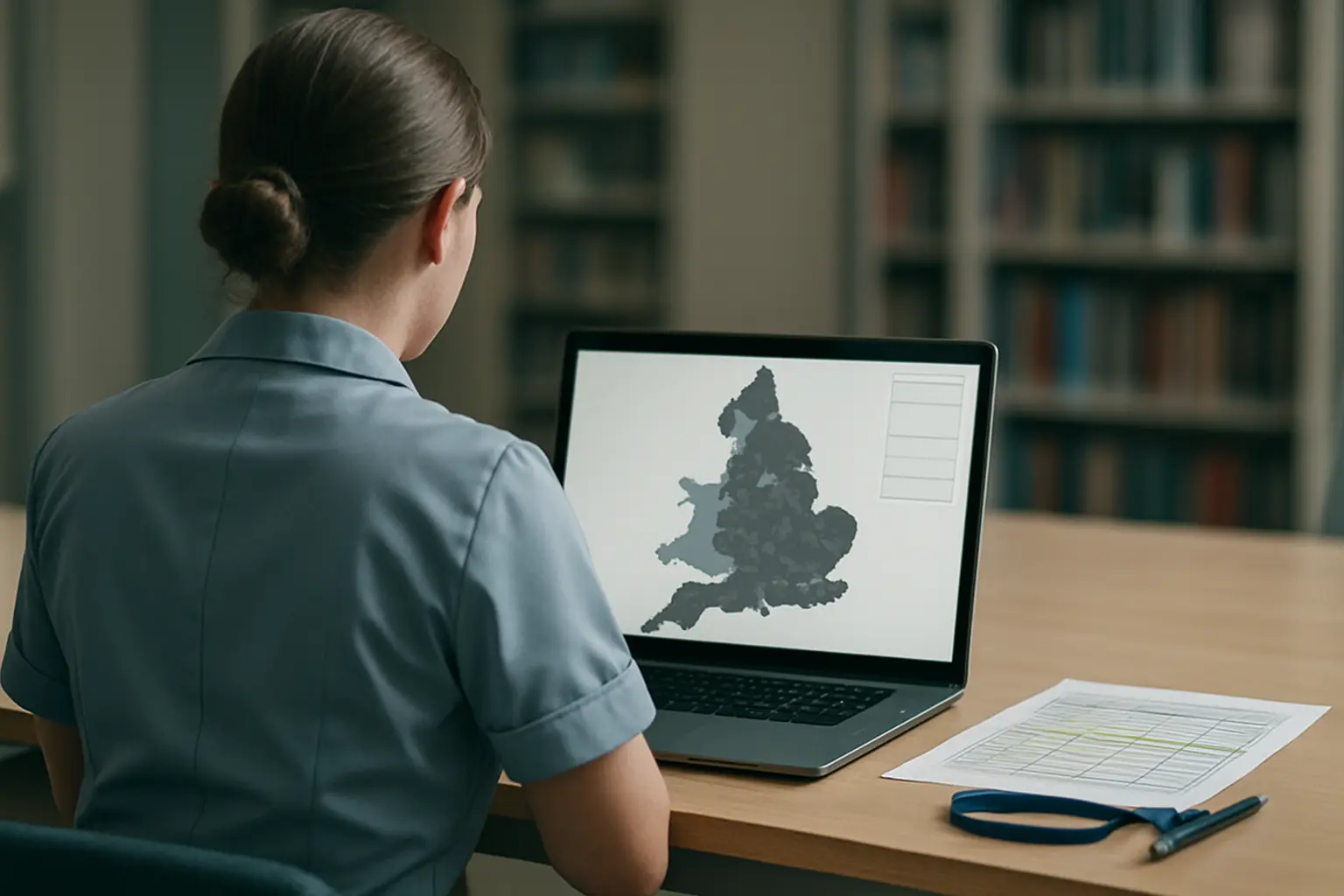
    A public health student comparing local authority indicator charts on a laptop beside a printed map of English regions
    Area-level indicators answer area-level questions. The ecological fallacy is the limitation markers expect you to name.

    The two surveys nobody uses enough

    The GP Patient Survey publishes results for every practice in England each year, and the NHS Staff Survey publishes results for every trust. Both are free, both go back more than a decade, and both can be joined to other published characteristics: practice list size and deprivation from Fingertips, trust size and CQC rating from the CQC data. A nursing dissertation asking which organisational factors are associated with staff burnout or intention to leave can be built entirely from the Staff Survey benchmark tables without a single participant being recruited, which is exactly what the HRA position pushes taught students toward. The limitation to state is response bias: the surveys report the views of those who answered, and response rates vary by trust and practice.

    Prescribing, inspections and mortality

    NHS Business Services Authority publishes monthly prescribing statistics by practice, which a student comfortable with a spreadsheet can use to compare, for example, opioid or antibiotic prescribing across practices or over a policy change, and which the OpenPrescribing tool from the University of Oxford makes explorable without downloading anything. CQC publishes ratings and inspection findings for every registered hospital, care home and GP practice, which supports governance and quality questions across the social care sector that no other source covers. ONS health statistics supply mortality, life expectancy and avoidable mortality by area and deprivation, and are the right source for a health inequalities dissertation that wants a trend over time.

    Which dataset for which question: five worked matches

    The table is easier to apply when the question comes first. Five questions taught health students actually propose, and the dataset each one needs.

    • Is smoking in pregnancy more common in more deprived local authorities? Fingertips: the smoking status at time of delivery indicator by upper-tier local authority, read against the deprivation decile the site already attaches to each area. An ecological design; say so in the first line of the methods.
    • Do nurses in trusts rated Inadequate or Requires Improvement report more burnout? NHS Staff Survey benchmark tables by trust for the burnout and intention-to-leave items, merged with CQC ratings by provider on the trust code. Two free downloads and one join.
    • Has antibiotic prescribing per patient fallen since the 2019 antimicrobial resistance action plan? NHS Business Services Authority prescribing data by practice, monthly, expressed per registered patient; OpenPrescribing supplies the denominators so you do not build them by hand.
    • Is physical activity associated with self-rated health in adults over 65? Health Survey for England microdata through the UK Data Service, at the individual level, which makes it the only design on this list that escapes the ecological fallacy altogether.
    • Has the life expectancy gap between the most and least deprived areas widened since 2015? ONS health state life expectancy by deprivation decile for England, published as a repeated cross-section, so the trend is a table rather than a model.

    Notice that four of the five never touch a patient record, and the fifth uses an anonymised survey a student registers for in a week. That is the shape of a taught health dissertation after September 2021: the question is the same one a clinical study would ask, and the data are the published version of the answer.

    Record-level data: what a taught student can and cannot get

    Hospital Episode Statistics at record level, and any identifiable NHS data, require a data access request and a lawful basis that a taught dissertation almost never has. Use the published aggregates instead; NHS England publishes HES summaries by provider, diagnosis and procedure, and they are enough for most descriptive and comparative questions. For individual-level analysis, the Health Survey for England and Understanding Society through the UK Data Service are the routes: both hold measured or self-reported health variables at the individual level, both are anonymised and both are available to students by registration, using the process in our guide to getting UK Data Service data. Note that NHS England, the custodian of HES and the Health Survey for England, absorbed the former NHS Digital in 2023, so older reading lists cite a name that no longer exists.

    A nursing student reviewing a downloaded survey results table with confidence intervals on a laptop in a hospital library
    Every published dataset carries its own limitation: ecological data, response bias, aggregation. Name it before the marker does.

    How to write the methods section for a secondary-data health dissertation

    1. Design. Name it: secondary analysis of published, anonymised data; cross-sectional or repeated cross-sectional; ecological where it is.
    2. Data source. Custodian, dataset, release date, date accessed, and the exact indicators or tables used, with their definitions copied from the metadata rather than paraphrased.
    3. Population and units. Local authorities, practices, trusts or individuals; the year or years; exclusions and the final count.
    4. Ethics. State that the data are published and anonymised, that no participants were recruited, and which university committee approved the project. Cite the HRA position if a reader might wonder why you did not go to the NHS.
    5. Quality appraisal. If the dissertation is a literature-based project rather than a data analysis, the appraisal tools are in our guide to the CASP checklist for a nursing dissertation and the search is built with the method in our guide to the nursing dissertation search strategy.
    6. Analysis. The test, the software, and the sensitivity check; the sample-size logic for area-level regressions is the same as in our guide to sample size for an undergraduate dissertation.

    Where health students lose marks on data

    On two sentences. The first names the custodian and the release; the second names the limitation the dataset carries. A dissertation that says “data were obtained from the NHS” has written neither. If the indicators are downloaded and the methods chapter is still blank, Tesify can draft the data and methods sections from your own source notes, your own indicator definitions and your own counts, in the order a health marker checks them. Every sentence is 100% written by you; what you get is a chapter that exists before the deadline.

    Frequently asked questions

    Can an undergraduate do research with NHS patients for a dissertation?

    Not as a standalone project. Since September 2021 the Health Research Authority no longer accepts undergraduate applications for NHS ethics review, so primary research needing NHS approval cannot take place at that level. Secondary analysis of published data needs only university ethics approval.

    What is the best free NHS dataset for a nursing dissertation?

    The NHS Staff Survey for workforce questions and Fingertips for population health questions. Both are free, published every year and available at trust or local authority level without any application.

    Do I need ethics approval to use published NHS data?

    Not NHS ethics approval. You need your university’s departmental approval, and the methods chapter should state that the data are published and anonymised and that no participants were recruited.

    Can I get Hospital Episode Statistics for my dissertation?

    Published aggregates, yes, free from NHS England. Record-level HES requires a formal data access request and a lawful basis that a taught dissertation almost never has.

    What is the ecological fallacy and why do markers mention it?

    It is the error of reading an association between areas as an association between individuals. Fingertips and ONS area data can show that deprived areas have worse outcomes, not that deprived people do; the limitation must be stated.

    Is NHS Digital still the right name to cite?

    No. NHS Digital merged into NHS England in 2023; cite NHS England as the custodian of Hospital Episode Statistics and the Health Survey for England, and note the former name if your sources use it.

    Can master’s students do primary NHS research?

    Sometimes. The HRA asks master’s applicants to complete its student research toolkit to check eligibility, and some master’s applications are no longer accepted. Check the toolkit before designing a primary study.

    How do I cite Fingertips?

    Use the site’s own line: Office for Health Improvement and Disparities, Public health profiles, the year and the URL, then add the profile, the indicator and the date you downloaded it, in whatever referencing style your department requires.


  • How to Get UK Data Service Data for Your Dissertation: Registration to Download (2026)

    How to Get UK Data Service Data for Your Dissertation: Registration to Download (2026)

    Secondary analysis is the quiet powerhouse of undergraduate dissertations: professionally collected national survey data, no recruitment, no fieldwork risk, and — done properly — a far lighter ethics burden than primary research. The UK Data Service is the main gateway to that data for UK students. What most guides skip is the part that actually decides your timetable: how access works. This is the procedure, tier by tier.

    Step 1: Understand the three access levels before you fall in love with a dataset

    Every UK Data Service collection carries an access condition, and the condition — not the topic — determines whether the data can be in your hands this week or after a formal application. The service distinguishes three levels:

    1. Open data — no registration at all. These collections sit under open licences such as the Open Government Licence, and anyone can download them immediately.
    2. Safeguarded data — the standard tier for the big social surveys. You register, agree to the End User Licence, and download. Some safeguarded collections carry additional special conditions, such as requiring the depositor’s permission or publication clearance.
    3. Controlled data — detailed, potentially disclosive microdata available only through the SecureLab environment to accredited researchers with an approved project. The service describes this route in terms of experienced researchers, and the application machinery is built accordingly.

    Expected output of this step: you can say which tier your candidate dataset sits in, read from its catalogue record’s access section — never assumed from how sensitive the topic sounds.

    Step 2: Register — through your university, not around it

    For safeguarded data, UK higher education students register using their institutional login, which authenticates you through your university and links your account to it. Registration itself is quick; what it commits you to is the licence.

    Practical notes that save trouble later: use your university identity rather than a personal email, because the account — like most research services — is anchored to your institutional affiliation; and note that your access ends when your enrolment does, so export your working files before you graduate.

    Step 3: Read the End User Licence as a set of promises you are making

    The End User Licence is short and its obligations are concrete: use the data for the stated purpose, do not attempt to identify individuals, do not pass the files to anyone else — your coursemate downloads their own copy — store them appropriately, and acknowledge the data producers when you write up. Where a collection carries special conditions, they arrive here too. Treat the licence text as material for your methods chapter: stating how you complied is exactly the kind of detail that makes a methodology chapter concrete rather than ceremonial.

    Locked archive symbolising controlled-access research data
    The tiers exist because detail identifies people: the more disclosive the microdata, the heavier the door in front of it.

    Step 4: Know what the controlled tier really involves — and plan around it

    SecureLab data never lands on your laptop. Access requires completing accreditation training, submitting a project application that demonstrates public good, and your institution countersigning a Secure Access User Agreement; even then, analysis happens through the secure environment from an approved device or a designated SafePod, with outputs checked before release. Each stage exists for good reasons, and each takes time an undergraduate timetable does not have.

    The honest planning rule: if the analysis you want genuinely requires controlled microdata, talk to your supervisor early about whether the safeguarded version of the same study answers a slightly coarser version of your question — it very often does. Major surveys frequently exist in both forms, with the safeguarded release carrying broader categories (age bands instead of ages, regions instead of local areas). Losing a little granularity to gain twelve weeks is nearly always the right trade at this level.

    A realistic timeline for a one-semester project

    Week one: shortlist candidate datasets from the catalogue and read their access conditions and documentation summaries. Week two: register, accept the licence, download, and confirm — before committing your research questions — that the variables you need exist in the form you imagined, because this is the point where projects quietly change shape. Weeks three to six: cleaning, recoding and exploratory analysis, alongside the literature review. The midpoint of term is the honest deadline for discovering that a special-condition permission has not arrived or a variable does not exist; after that, changing dataset costs more than changing question. Students who follow this order spend the second half of term analysing and writing; students who reverse it spend it waiting.

    Step 5: Download, document, and version

    Once a safeguarded dataset is yours, do three unglamorous things immediately. Record the exact study number, edition and citation from the catalogue record — datasets are versioned, editions matter for reproducibility, and the acknowledgement you owe under the licence needs these details. Keep the untouched original files separate from your working copies. And skim the accompanying documentation — questionnaires, codebooks, user guides — before touching the data: knowing how a variable was asked and coded is the difference between analysis and numerology. Which variables you actually need should already be visible from your research questions, and your target sample — cases after filtering — should comfortably clear the thresholds discussed in our guide to sample size for an undergraduate dissertation.

    Step 6: Analyse in the tool your course supports

    UK Data Service downloads typically come in formats that load directly into SPSS, Stata or R. If your department teaches SPSS, use it; if you have a choice, our comparison of SPSS, R and jamovi covers the trade-offs for a social science dissertation. Budget real time for the unglamorous middle step — recoding, filtering, handling missing values — because national surveys are built for many purposes, and shaping them to yours is where secondary analysis earns its marks.

    Step 7: Acknowledge and cite the data properly

    The licence requires acknowledgement, and good practice is precise: cite the dataset itself (depositor, title, edition, distributor, study number and DOI from the catalogue record), name the original data producers, and state the standard disclaimer that they bear no responsibility for your analysis. If you are unsure where datasets sit in your citation style, the catalogue record’s suggested citation is the safe template. Choosing between candidate datasets in the first place — and what else is available by subject — is covered in our companion piece on UK data sources for dissertations by subject; this guide is the procedure once you have chosen.

    With the data in hand, the writing becomes the constraint. Tesify can structure and draft your dissertation with you around your own analysis — 100% written by you, from research question to reference list.

    Frequently asked questions

    Is the UK Data Service free for students?

    Yes — open data requires nothing, and safeguarded data requires only registration and licence acceptance for users at UK institutions. Cost is not the barrier; conditions and time are.

    Can an undergraduate access safeguarded data?

    Yes. Registration through a UK university plus acceptance of the End User Licence is the standard route, and undergraduate dissertations are a normal use. Collections with special conditions may need an extra permission step — check the access section of the catalogue record.

    Can an undergraduate use SecureLab controlled data?

    Realistically, no — not within a dissertation timetable. The route requires accreditation training, an approved project demonstrating public good and an institutional agreement, and the service frames it for experienced researchers. Design around the safeguarded tier instead.

    Do I need ethics approval to analyse UK Data Service data?

    Usually a light-touch process rather than a full application, because participants are not being approached — but departments differ, and some require a declaration for all projects. Check your handbook; the answer is about your department’s process, not the Data Service’s.

    Can I share the downloaded files with my project group?

    No. The licence is personal: each user registers and downloads their own copy. Sharing files — even within a group project — breaks the agreement you signed.

    What happens to my access when I graduate?

    It is tied to your institutional affiliation, so plan for it to end. Export your syntax, outputs and write-up before you lose the login; check the licence for what you may retain, and delete data files when your stated purpose ends.

    How long does access take?

    Open data: minutes. Safeguarded data: typically the same day, once registered — special-condition collections add whatever the permission step takes. Controlled data: a multi-stage application process measured in months, which is exactly why it is the wrong foundation for a one-semester project.

    Can I publish results from safeguarded data in my dissertation?

    Yes — analysis and reporting are the purpose, subject to the licence conditions and any special conditions on the specific collection, such as publication clearance requirements. Aggregated results are normal; reproducing record-level data is not.

    What if the dataset I need requires depositor permission?

    Build the wait into your plan and apply early, with a clear one-paragraph description of your project. If the timeline looks risky, ask your supervisor about the nearest alternative collection without the condition.

    Where do I find what was actually asked in the survey?

    In the documentation attached to the catalogue record — questionnaires, codebooks and user guides. Read them before analysis: variable names tell you almost nothing about question wording, routing or coding decisions, and those decide what your results mean.

  • Where to Find UK Data for Your Dissertation: Free Sources by Subject (2026)

    Where to Find UK Data for Your Dissertation: Free Sources by Subject (2026)

    Secondary data analysis is the most underused route through a UK undergraduate dissertation. It removes the recruitment problem, removes most of the ethics burden, and gives you sample sizes no student survey will ever reach. The obstacle is not availability — it is knowing which sources an undergraduate can actually get into.

    That is the organising principle here. Every source below is real, currently live, and free at the point of use. What differs is the access tier, and one of those tiers is effectively closed to you.

    First, understand the three access tiers

    The UK Data Service — the UK’s largest collection of economic, population and social research data, funded by UKRI through the Economic and Social Research Council — operates a three-tier model that most other UK data holders mirror in some form.

    • Open. Neither login nor registration is required. Published under the Open Government Licence or Creative Commons. Download and go.
    • Safeguarded. You register and accept an End User Licence, agreeing not to share the data with unregistered users, not to attempt to identify individuals, and to cite the data correctly. This is the undergraduate route, and for students at UK institutions registration usually runs through your university login.
    • Controlled. Accessed only in a secure environment, requiring a detailed project application, accredited researcher status, training and an institutional legal agreement. The UK Data Service states directly that these data “are not suitable for use by inexperienced researchers, such as undergraduates, and should only be used if absolutely necessary.”

    Read that last line before you build a project around a controlled dataset. Students lose weeks discovering this at the application stage. Plan for open and safeguarded data, and treat anything controlled as out of scope.

    A related trap: the Office for National Statistics Secure Research Service provides access to de-identified unpublished data under the Five Safes framework, but full accredited researcher status requires an undergraduate degree or higher including a significant proportion of maths or statistics, or several years of quantitative research experience. It is not an undergraduate route either.

    Psychology, sociology and social policy

    UK Data Service is your first stop. It holds the major UK social surveys, and its safeguarded tier is designed for exactly the kind of secondary analysis an undergraduate project needs. Register through your institution, accept the End User Licence, and you have access to survey data with sample sizes in the thousands.

    UK Data Archive, based at the University of Essex, is the lead partner of the UK Data Service and has curated the UK’s social, economic and population data for over fifty years. It was the first academic department in a university to be awarded ISO 27001 certification, and was accredited in 2020 by the UK Statistics Authority under the Digital Economy Act 2017. In practice you will usually arrive at its holdings through the UK Data Service catalogue.

    Office for National Statistics publishes population, labour market, wellbeing and social survey outputs, all under the Open Government Licence v3.0. No registration, no licence negotiation.

    Politics and international relations

    The British Election Study has been explaining Britain’s electoral behaviour for sixty years and releases its data openly to researchers. Its two main strands are a large internet panel, currently released through Wave 30, and a random probability survey following the 2024 general election. For a dissertation on voting behaviour, partisanship or turnout, this is the field’s standard evidence base, and using it puts you on the same data as published political science.

    Check the study’s own data pages for the current registration requirements before planning around it, as access conditions differ between the panel and the probability survey.

    Criminology

    data.police.uk publishes street-level crime data, outcome data, and stop and search records, alongside police force and neighbourhood-level information and the Police Annual Data Requirement covering matters such as arrests and 101 call handling. It is released under the Open Government Licence v3.0 and offers an API as well as bulk downloads.

    For a criminology dissertation this is unusually good material: it is geographically granular, it is longitudinal, and it needs no ethical approval because it concerns recorded incidents rather than identifiable individuals. Be careful with the well-known limitation, though — recorded crime measures what was reported and recorded, not what occurred, and your analysis should say so.

    Education

    Explore Education Statistics, operated by the Department for Education and regulated by the Office for Statistics Regulation, is the single best entry point. It provides statistical summaries, an open data catalogue, a custom table builder and an API. The table builder matters for undergraduates: it lets you construct exactly the extract you need without writing code.

    This is also the appropriate source for attainment, absence, workforce and school-characteristics data — figures that circulate widely in secondary form but should be cited from the publisher.

    Health and nursing

    NHS England is now the custodian of England’s national health and social care datasets. Note the organisational change, because citing the wrong body dates your work immediately: NHS Digital legally merged into NHS England on 1 February 2023, and the regulations that effected the merger transferred NHS Digital’s functions to NHS England and abolished NHS Digital. The digital.nhs.uk domain still resolves, now branded NHS England Digital, which is why the old name persists in student bibliographies.

    A hard constraint sits alongside this for health students. The Health Research Authority states that standalone research at undergraduate level requiring ethics review or HRA approval cannot take place, and that undergraduate applications are no longer accepted for Research Ethics Committee review. Published aggregate NHS statistics are unaffected — you can analyse them freely — but a project involving NHS patients or staff as participants is not available to you. Secondary analysis is the HRA’s own suggested alternative, which makes this section the pragmatic route rather than the consolation prize. Our guide to choosing a survey platform and getting ethics right sets out that restriction in full.

    Economics, business and geography

    Nomis, a service provided by the Office for National Statistics, is the specialist labour market and census portal. It holds census data from 1921 onwards, labour market profiles, employment figures, population estimates and claimant counts, and most of the site can be used without registering. For any dissertation with a local or regional dimension — comparing labour markets across local authorities, mapping deprivation, tracking employment change — Nomis will do in minutes what would otherwise take days.

    data.gov.uk is the general catalogue of UK public data, published under the Open Government Licence v3.0. It is broad rather than deep: use it to discover that a dataset exists, then go to the publishing body for the authoritative version and the documentation.

    How to choose a dataset without wasting a fortnight

    Work in this order.

    1. Find the documentation before the data. Read the user guide and the questionnaire. If you cannot tell from the documentation which variable answers your research question, the dataset is not the right one.
    2. Check the access tier immediately. Open or safeguarded means you can proceed. Controlled means choose a different dataset.
    3. Check the unit of analysis. Individuals, households, schools, police force areas and local authorities are not interchangeable, and a mismatch between your research question and the unit will not be fixable later.
    4. Check the years available. A question about change over time needs comparable measures across waves, and survey questions get reworded more often than students expect.
    5. Download and open it before committing. Confirm the file format works with your software and that the variables you need are actually populated rather than missing for most respondents.

    Whichever package you plan to use, check it can read the file format — most UK archives distribute in formats that all the mainstream options handle, but confirming early avoids an unpleasant surprise. Our comparison of SPSS, R and jamovi covers the trade-offs if you have not settled on one.

    Open government datasets displayed as tables and charts on a monitor
    Read the documentation before the data — the variable list decides whether a dataset can answer your question.

    The advantage nobody mentions: your sample size problem disappears

    A student survey that reaches sixty people is powered to detect only large effects. A national social survey gives you thousands of cases, which means your project can address questions a primary-data undergraduate study genuinely cannot.

    That changes what you should write in your methods chapter. With secondary data you are not justifying a small convenience sample; you are justifying your analytic sample — the cases you retained after applying inclusion criteria and handling missing data — and explaining any weighting the survey requires. Our guide to sample size for an undergraduate dissertation covers how to frame that argument, and the same chapter-level discipline described in our guide to writing a methodology chapter applies: describe the decision, then defend it.

    Cite the data properly

    Datasets are citable objects with their own reference formats, and the End User Licences you accept normally require correct citation as a condition of access. Cite the data creator, the year, the title, the edition or wave, the distributor and the persistent identifier. Most archives publish the exact citation string on the dataset’s landing page — use theirs rather than composing your own.

    Also cite the version. Survey datasets are revised, and a reader who cannot tell which edition you analysed cannot reproduce your results.

    Once the data are in hand, the remaining work is writing the analysis up so the argument is legible. If that is where you are stuck, you can draft those chapters in Tesify from your own output and your own interpretation — 100% written by you.

    Frequently asked questions

    Do I need ethical approval for secondary data analysis?

    Usually a lighter process rather than none. Many departments require a short ethics form even for anonymised secondary data, and analysing existing data does not exempt you from your institution’s review procedures. Ask your supervisor before assuming you are exempt.

    Can undergraduates register with the UK Data Service?

    Yes, for open and safeguarded data, normally through your institutional login. Controlled data is a different matter — the service states explicitly that it is unsuitable for inexperienced researchers such as undergraduates.

    Is secondary data analysis seen as an easier dissertation?

    No, and it is marked on the same criteria. What you save in recruitment you spend on data management: understanding a complex dataset, handling missing values, deriving variables and applying weights correctly are substantial analytical tasks in their own right.

    Should I cite NHS Digital or NHS England?

    NHS England, for anything current. NHS Digital was abolished when it merged into NHS England on 1 February 2023. Cite NHS Digital only for material it published before that date, under the name it carried at the time.

    What does the Open Government Licence let me do?

    Broadly, it permits you to copy, adapt and use the information, including commercially, provided you acknowledge the source with the required attribution statement. For a dissertation this means you can analyse and reproduce the data freely as long as you cite it.

    Can I combine two different datasets?

    Sometimes, and it can produce a genuinely original project — for example joining local-authority-level crime and education data. Check that the geography, time period and definitions genuinely match, and note that some licences restrict linking datasets, so read the terms before you merge.

    What if the dataset I want is controlled?

    Redesign around an open or safeguarded alternative. Applications for controlled access involve accreditation, training and institutional agreements on timescales that do not fit an undergraduate project, and the holders themselves advise against it at this level.