Tag: research ethics

  • Writing Your Dissertation on Your Placement Company: Access, NDAs, Ethics and the Write-Up (UK, 2026)

    Writing Your Dissertation on Your Placement Company: Access, NDAs, Ethics and the Write-Up (UK, 2026)

    You spent a placement year inside a company, you have a dissertation due in the spring, and the obvious topic is the firm you already know. Then the questions start: will they let you, what can you write down, who has to sign what, and how do you write a chapter about a company that can read it. This guide answers those questions in the order they arise for UK business, management, marketing and HR students, from the first email to your line manager to the embargo form you file with the finished dissertation.

    The short version is that a placement-company dissertation is one of the strongest projects an undergraduate can run, because access is the scarcest resource in business research and you already have it. It is also the project most likely to stall in March, because the access was never formalised, the data turned out to be confidential, or the student discovered too late that being an insider is a methodological position that has to be argued, not just admitted. Tesify can build the chapters around your own access story, your own data and your own analysis once the decisions below are made; it cannot make them for you.

    Is a dissertation on your placement company a case study?

    Usually, and you should call it one. A single-organisation study of a real problem, using more than one source of evidence, is a case study in the sense set out by Robert Yin’s Case Study Research and Applications, now in its sixth edition, and by Kathleen Eisenhardt’s 1989 paper in the Academy of Management Review on building theory from case study research. Naming the design matters because it tells the marker what standard to apply: a case study is judged on the quality of its evidence chain and the honesty of its boundaries, not on whether the findings generalise to every firm in the sector. Say early, in the introduction and again in the methodology, that the study is a single instrumental case and that its purpose is depth.

    The alternative framings are a consultancy-style diagnostic, where the deliverable is a recommendation to the firm, and an action research project, where you changed something during the placement and are evaluating it. Both are legitimate on many UK business programmes; both need to be declared, because a marker who expects a case study and receives a consultancy report will mark the missing theory.

    A short primer on case study design; the placement-specific questions of access, confidentiality and insider position follow below.

    How do you get formal access, and from whom?

    Informal access is not access. The line manager who said “of course, use anything you like” in July is not the person who can authorise a study in October, and may have left. You need a named gatekeeper with the authority to say yes: typically an HR business partner, a head of department or, in a small firm, the owner. Ask for a short written permission, on company letterhead or from a company email address, stating that the organisation agrees to participate in a student research project, what the project is, what data or people you may approach, and any conditions. Your university ethics form will ask for exactly this document, and most business school ethics committees will not approve a firm-based study without it.

    Ask in the placement, not after it. Access negotiated while you have a badge and a desk is granted in an afternoon; access requested by a former placement student from a university email takes weeks and is often refused by default. The single most useful thing you can do in the last month of a placement is to leave with a signed access letter and a named contact.
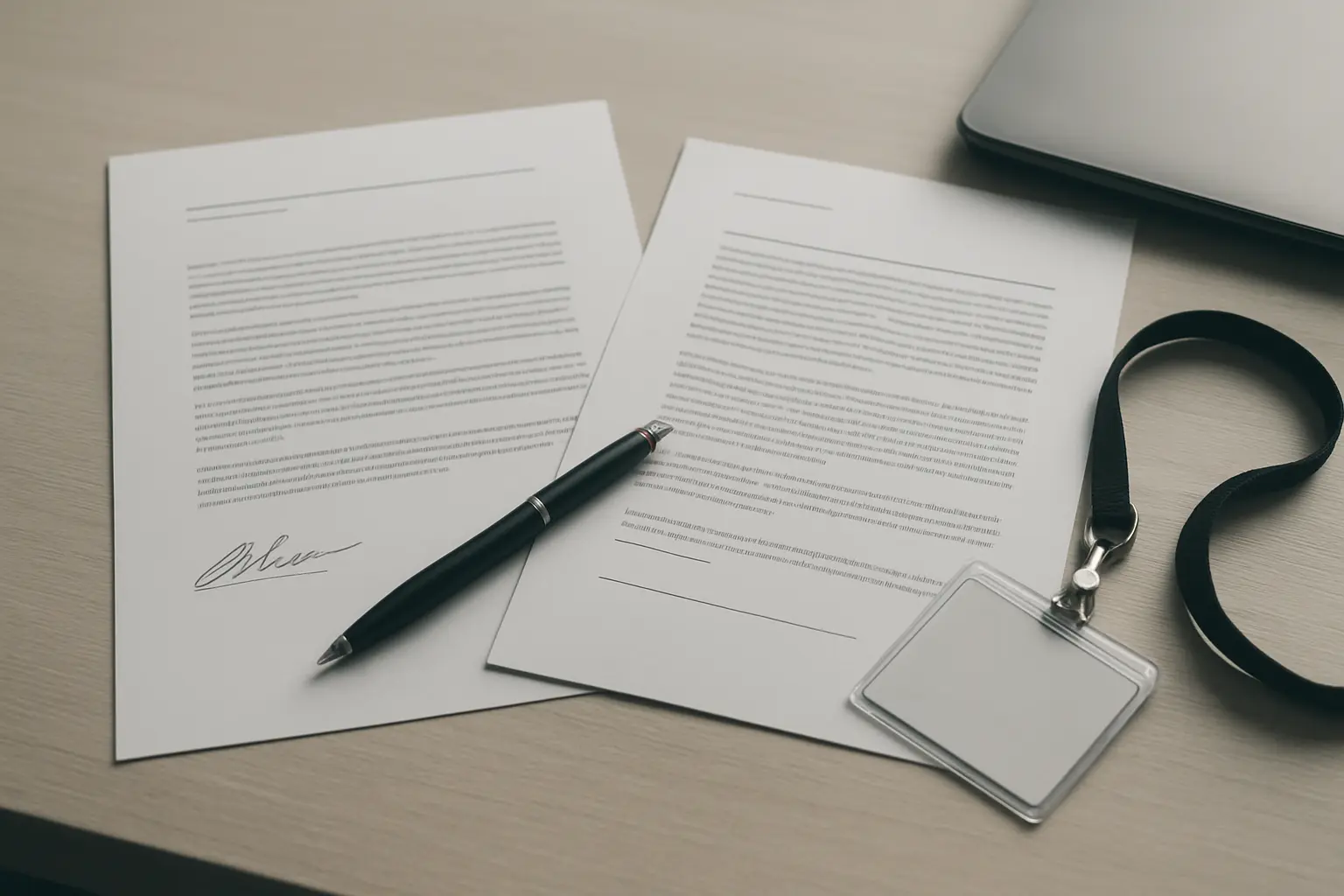
    A signed company access letter and an NDA laid on an office desk beside a laptop and a lanyard
    Leave the placement with three things: a written access letter, a named contact, and a clear list of what you may not use.

    What does the NDA you signed actually cover?

    Almost every placement contract contains a confidentiality clause, and many firms add a separate non-disclosure agreement. Read it before you write a word. Most clauses prohibit disclosure of confidential business information to third parties; a dissertation submitted to a university and read by two markers is a disclosure, and the clause applies unless the company waives it for the project. The access letter should therefore either state that the dissertation is permitted under the confidentiality agreement, or list what remains off limits: customer names, pricing, financial figures below a stated level of aggregation, product roadmaps, anything covered by a client’s own NDA.

    Three practical rules follow. Never use documents you were not explicitly given for the project, even if you still have them. Aggregate or index any figure the firm considers sensitive (report a 12 per cent change, not the two revenue numbers behind it). And agree the anonymisation up front: a pseudonym for the company, a description by sector and size rather than name, and job titles generalised enough that a colleague cannot be identified. A dissertation that says “a mid-sized UK logistics firm” and is internally consistent about it loses nothing academically.

    Do you need ethics approval, and what will the committee ask?

    Yes, on every UK business programme we know of, and the process is the same departmental one described in our guide to ethics approval for an undergraduate dissertation. The committee will ask four questions specific to a firm-based study. First, organisational consent: the access letter. Second, individual consent: colleagues you interview or survey must consent as individuals, and the letter from the head of department does not consent on their behalf; they must be told they can refuse without it reaching their manager. Third, power: if you supervised anyone during the placement, or if a participant could believe their answers will reach their line manager, the committee will want to know how you prevented coercion, usually by recruiting through a general invitation rather than a personal ask and by keeping raw data away from the firm. Fourth, data protection: interview recordings and survey responses that identify employees are personal data under the UK GDPR and the Data Protection Act 2018, so you need a lawful basis (consent, for a student project), a storage plan on university systems rather than a personal laptop, and a deletion date.

    Build the participant information sheet so that it answers all four, and send the draft to your contact at the firm before submitting it to the committee. Companies rarely object to research; they object to being surprised.

    How do you handle being an insider?

    This is the part most placement dissertations get wrong, and the part that separates a 2:1 from a first. You are not a neutral observer of the company; you worked there, you have opinions about it, and your participants know you. The methodological literature treats this as a position to be argued rather than a contamination to be hidden. Brannick and Coghlan’s 2007 paper in Organizational Research Methods, “In Defense of Being ‘Native’”, sets out the case: insider researchers have pre-understanding that outsiders cannot buy, and the price is a duty of reflexivity about role duality and access to politics.

    Write a positionality section in the methodology of 300 to 500 words. State your role, your dates, who you reported to, and what you knew before the study began. Then state what you did about it: interview protocols written before fieldwork and followed; a research diary distinguishing what you observed as a researcher from what you remembered as an employee; a supervisor or peer who read your coding for signs of prior belief; and a deliberate search for evidence against your own expectation. Markers reward this; they penalise the dissertation that never mentions the student worked there.

    What data can a placement dissertation actually use?

    More than most students realise, provided each source was cleared. The typical single-case design triangulates three:

    • Interviews with six to twelve colleagues across levels, recorded with consent, analysed thematically. Recruit by open invitation; do not interview your own former manager unless the power question has been answered.
    • Documents: process maps, internal reports, policy documents, meeting minutes, training material, cleared item by item in the access letter. Documentary evidence is what makes a case study more than a set of opinions.
    • Quantitative internal data: sales, churn, absence, complaint or productivity figures, provided in aggregated form. If the firm will release a monthly series, a before-and-after comparison around a change you observed is a legitimate quantitative strand, and the methodology chapter conventions for it are set out in our guide to the methodology chapter of a business dissertation.

    A survey of all staff is usually the weakest option: response rates inside a single firm are low unless the firm pushes it, and if the firm pushes it the consent problem returns. The response-rate evidence in our analysis of business dissertation surveys is worth reading before you promise a questionnaire in the proposal.
    Printed interview transcripts, internal reports and a coded spreadsheet spread across a desk for a single-company case study
    Three sources, each cleared in writing: interviews, documents and aggregated internal figures. Triangulation is what makes it a case study.

    How do you write up a company that will read it?

    Assume the firm will ask for a copy, and write so that you can give them one. That means the findings chapter reports what the evidence shows, including the uncomfortable parts, in language that is evidential rather than evaluative: “four of nine interviewees described the onboarding process as inconsistent between sites” rather than “onboarding is chaotic”. Recommendations, if your programme requires them, go in their own chapter and are framed as options with costs. Anonymise consistently from the first page: the pseudonym, the sector description and the generalised job titles must not slip, and a find-and-replace pass on the final draft is not optional. If a finding cannot be reported without identifying an individual, drop it and say in the limitations that some material was withheld for confidentiality; markers accept that, and it reads as ethical maturity.

    Should you embargo the dissertation?

    Most UK universities allow a dissertation to be marked without being deposited in an open repository, and many have a formal restricted-access or embargo option for work containing commercially sensitive material, typically for one to five years. Ask your programme office for the form early, because some require the company to countersign. An embargo does not affect the mark; it affects who can read the work afterwards. If the firm insists on reading the dissertation before submission, agree a factual-accuracy check with a deadline, and make clear in writing that they may correct facts but not findings. Keep the correspondence.

    The timeline that works

    1. Last month of placement: agree the topic with your contact, obtain the access letter, list the cleared documents, confirm the anonymisation.
    2. First month of the final year: proposal, with the design named and the insider position declared, using the structure in our guide to writing a dissertation proposal.
    3. Before Christmas: ethics approval, participant information sheet reviewed by the firm, interview protocol written.
    4. January to February: fieldwork, remotely if you have left the firm; documents analysed alongside.
    5. March: analysis, findings, and the positionality section written from the research diary.
    6. April: write-up, anonymisation pass, embargo form, factual check by the firm if agreed.

    When the access is sorted and the chapters are still blank

    The hardest part of a placement dissertation is not the writing; it is the six decisions above, and once they are made the material is richer than any other undergraduate project. What stalls students at that point is turning a year of knowledge, a folder of transcripts and a set of cleared documents into chapters in the right order. Tesify builds the dissertation section by section from your own case, your own evidence and your own analysis, keeps the pseudonym consistent across every chapter, and formats the references in Harvard as you go. The judgement, the findings and every sentence are 100% written by you; what you get is a chapter that exists.

    Frequently asked questions

    Can I write my dissertation about the company I did my placement with?

    Yes, on almost every UK business programme, provided the company gives written permission, your ethics committee approves the design and you declare your insider position in the methodology. It is one of the strongest projects an undergraduate can run because access is already solved.

    What if the company says no?

    Ask what specifically they object to; often it is a named dataset rather than the study. Offer stronger anonymisation, an embargo, or a document-free design based on interviews. If the answer is still no, keep the sector and the problem and study a different organisation, or use published data; the sector sections in our dissertation topic ideas by subject are the fallback.

    Do I have to name the company?

    No, and usually you should not. A pseudonym with a description by sector, size and region is standard, satisfies most confidentiality clauses, and costs nothing academically as long as it is applied consistently from the first page.

    Can I use documents I still have from the placement?

    Only those explicitly cleared in the access letter. Material you kept without permission is covered by your confidentiality clause and by data protection law, and using it is both a breach of contract and a potential academic misconduct finding.

    Is being an insider a weakness the marker will penalise?

    Not if you argue it. Insider research is a recognised position with its own literature; the penalty is for ignoring it. A positionality section that states your role and the steps you took to manage it earns marks.

    Does Tesify see my company’s confidential data?

    You decide what goes in. Work from the anonymised, aggregated material you have already cleared for the dissertation itself, exactly as you would with any writing tool, and keep raw data on university systems as your ethics approval requires.

    Is using Tesify on a placement dissertation academic misconduct?

    No, provided your university permits AI assistance and you follow its declaration rules. Tesify structures and drafts around your own evidence and analysis; the findings, the argument and the final text are yours, and you should declare its use where your handbook asks you to.

    How much does it cost?

    There is a free tier that covers the core drafting and bibliography features, so you can build the first chapter before deciding whether the paid plan is worth it for the rest of the project.
  • Do You Need Ethics Approval for an Undergraduate Dissertation? (2026)

    Do You Need Ethics Approval for an Undergraduate Dissertation? (2026)

    You need ethics approval whenever your dissertation involves human participants, their identifiable data or their tissue — interviews, surveys, focus groups, observations, experiments. You do not usually need it for research built entirely on published literature or properly anonymised public datasets. Approval must come before you collect anything, and at undergraduate level it is normally handled inside your own department.

    That is the short answer. The longer answer matters because the ethics process is where more undergraduate timelines quietly collapse than anywhere else: students design a project in October, discover in February that it needed approval they never sought, and lose data they cannot use. This guide covers what triggers review, who actually reviews it, what goes in the application and how long to allow.

    What kinds of dissertation actually need ethics approval?

    The trigger is not whether your topic is sensitive. It is whether your method involves people. A dissertation on a highly charged subject built entirely from published sources typically needs no approval; a cheerful ten-question survey of your coursemates almost certainly does. Lancaster University’s guidance for its humanities and social science departments puts the rule plainly: undergraduate coursework and dissertations “that involve the generation of data with human participants need to be ethically approved before human participants are approached and before any data is generated”.

    In practice, expect to need approval for interviews and focus groups, questionnaires and online surveys, experiments and usability tests, systematic observation of identifiable people, and any reuse of data that could identify someone. Expect not to need it — or to need only a declaration form — for literature-based projects, doctrinal legal analysis, work with genuinely anonymous published statistics, and textual or historical analysis of public documents. Every institution draws these lines slightly differently, which is why the first document to read is not a website like this one but your own module handbook.

    Who reviews an undergraduate application?

    Almost never a grand university committee. UK universities run tiered systems, and undergraduate projects sit at the bottom tier, reviewed close to where they are supervised. At Lancaster, responsibility for reviewing undergraduate and taught master’s projects “lies within the Departments”. Many institutions run a two-track system inside that tier: a light-touch or proportionate route for low-risk projects, often reviewed by the supervisor plus one other member of staff, and a full committee route for anything involving vulnerable participants, sensitive topics, deception or identifiable personal data.

    The practical consequence is good news: a low-risk undergraduate application is usually reviewed by people who know your course and can turn it around in days or a few weeks — not the months a full university committee cycle can take. The equally practical consequence is that the definitions of “low-risk” vary between departments in the same university, so the label on your project is decided by their form, not your intuition.

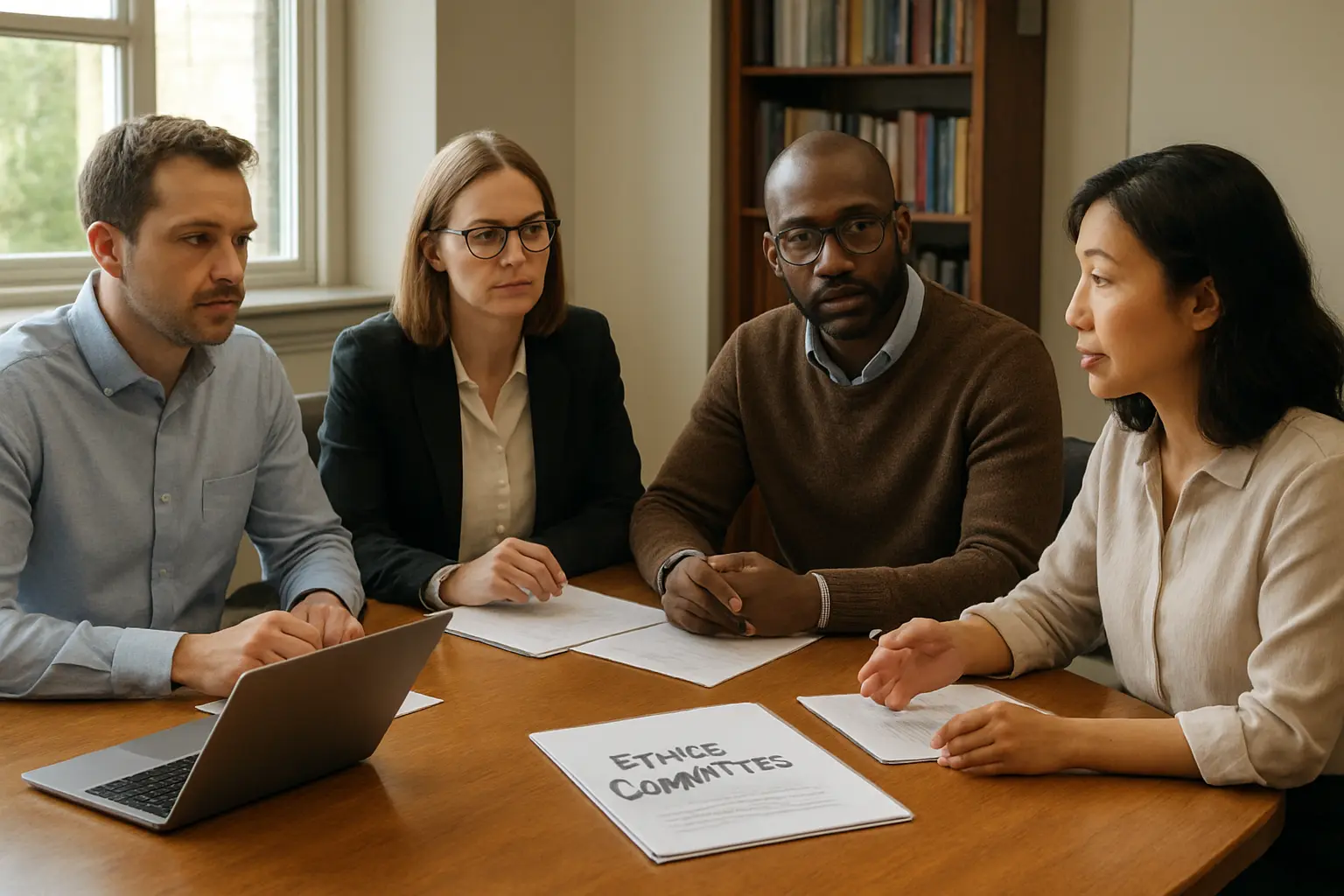
    A university ethics committee reviewing student applications
    Most undergraduate applications never reach a full committee — they are reviewed at departmental level, close to the supervision.

    What goes into the application?

    Names and forms differ; the anatomy barely does. A typical undergraduate ethics application contains:

    1. The application form itself — your research question, methods, who your participants are, how you will recruit them, and what you will do with the data. Your supervisor normally has to review or countersign it before it goes anywhere.
    2. A participant information sheet (PIS) — plain-English answers to what the study involves, that participation is voluntary, how data will be stored and for how long, and who to contact with concerns.
    3. A consent form — tick-box statements the participant signs, mirroring the information sheet.
    4. Your instruments — the questionnaire, interview schedule or task description, because a committee cannot assess risk in the abstract.
    5. Recruitment materials — the poster, email or message you will actually send.

    Two details are worth stating because they generate most of the rejections. First, the data-management answers have to be specific: where files will live, who can see them, when they will be deleted. “On my laptop” is a wrong answer everywhere. Second, if you recruit friends and coursemates, the application should address the pressure-to-participate problem directly rather than hoping nobody asks.

    When should you apply, and how long does it take?

    Work backwards from your data-collection window. A proportionate departmental review commonly takes one to a few weeks; anything routed to a fuller review takes longer, and every round of requested revisions adds another cycle. Submitting in the same week you hoped to start interviewing is how a fortnight of recruitment disappears.

    The one rule with no exceptions: approval comes before data collection, and retrospective approval is generally unavailable. Data collected without approval is unusable, however good your intentions were. Getting the design settled early — including how many participants you actually need — is what makes an early application possible, because the committee is approving a specific plan, not an aspiration.

    Does a supervisor’s approval count as ethics approval?

    No. Your supervisor’s sign-off is a required step in the process, not the process. Equally, ethics approval is not a quality judgement on your research design — a committee can approve a study that is methodologically weak, and your marker will not treat the approval letter as evidence that the design was good. The design still has to be defended in your methodology chapter, where the ethics section describes what you did and why, not merely that a form was signed.

    What about research involving the NHS?

    Here the rule is national, and it is absolute. The Health Research Authority states that “standalone research at undergraduate level that requires ethics review and/or HRA and HCRW Approval (or devolved administration equivalent) cannot take place”. Standalone means a project you design, submit and conduct yourself, even with supervision — and the HRA is explicit that for undergraduate courses the supervisor should take the chief investigator role, which does not rescue an ineligible project. If your plan involves NHS patients, service users or staff as participants, it needs redesigning, not persistence.

    The HRA’s own suggested alternatives are secondary research such as literature, scoping or systematic reviews, and health research that does not involve patients, service users or NHS staff as participants or their identifiable data. Group projects led by a course leader are treated differently. The compliance side of this — including which survey tools your university will even let you use for health-adjacent topics — is covered in our guide to survey platforms for UK student dissertations.

    What can you do with no approval at all?

    A great deal, and choosing it deliberately is a legitimate design decision rather than an evasion. A literature-based dissertation, a documentary or policy analysis, work with published aggregate statistics — these routes carry no participant risk and no approval clock. If ethics timing threatens your schedule, it is worth an honest conversation with your supervisor about whether a review-based dissertation answers a question you care about just as well. Weigh it while you are still choosing and narrowing your topic, because the method decides the ethics burden, and the topic decides the method.

    Practical next step

    Draft the ethics documents in the same week you draft your research questions — the information sheet and consent form force you to describe your study concretely, which improves the design itself. If the writing around it is the bottleneck, you can plan and draft your dissertation in Tesify around your own approved design — 100% written by you, with the structure handled.

    Frequently asked questions

    Do I need ethics approval for an anonymous online survey?

    Almost always yes. Approval attaches to research with human participants, not to whether you record names. Note also that a survey collecting several demographic details from a small population may not be genuinely anonymous, and your application should say how you have handled that.

    Do I need approval for a literature-based dissertation?

    Usually not, though some departments ask every student to complete a short ethics declaration confirming that no participants are involved. Check the handbook rather than assuming silence means exemption.

    Can I start recruiting participants while my application is under review?

    No. Approval must be in place before participants are approached, not merely before data is recorded. Advertising the study is part of the research activity your application covers.

    What happens if I collected data before approval?

    Tell your supervisor immediately. In most institutions the data cannot be used and retrospective approval is not available. The honest recovery is a redesign, and supervisors have seen it before.

    How long does undergraduate ethics approval take?

    Low-risk proportionate review at departmental level often takes days to a few weeks; fuller review takes longer, and revisions restart the clock. Build a month of slack in front of your data-collection window and you will rarely regret it.

    Does interviewing my own family or friends still need approval?

    Yes. They are human participants, and the closeness of the relationship raises its own issues — perceived obligation to take part, difficulty refusing — that your application is expected to address.

    Do I need a DBS check to interview adults for my dissertation?

    Not for research with adults who are not in a vulnerable situation. Projects involving children or vulnerable adults raise safeguarding requirements and usually a higher tier of review; many departments steer undergraduates away from such designs entirely.

    Does using social media posts as data need ethics approval?

    Very often yes, and departments differ sharply on it. Public visibility is not the same as consent to be studied, and identifiable posts are personal data. Ask before you scrape anything.

    Is ethics approval the same as GDPR compliance?

    No. The ethics review checks your plan against research-ethics principles; data-protection law applies to you separately whenever you process personal data. In practice the application forces you to answer the main data-protection questions, which is one reason committees ask them.

    My ethics application was rejected. Is my dissertation over?

    No — rejection at this level nearly always means revise and resubmit, with the reviewer telling you exactly what to fix. Treat the feedback as free supervision on your research design and turn the revision around quickly.

  • Which Survey Platform Can You Actually Use for a UK Student Dissertation? (2026)

    Which Survey Platform Can You Actually Use for a UK Student Dissertation? (2026)

    This is not really a features comparison. Every platform below will build you a questionnaire with branching logic and export a spreadsheet. The decision is made somewhere else entirely: your university has almost certainly already decided which tools you are permitted to use, and using the wrong one can invalidate your ethical approval.

    So the criterion here is compliance first, convenience second.

    Jisc Online Surveys Qualtrics Microsoft Forms Google Forms
    Built for UK academic research Research and enterprise General purpose General purpose
    How students get it Institutional licence (self-service tiers also exist) Institutional licence, via university sign-in Your university’s Microsoft 365 tenant Personal account, or a Google Workspace university
    Where data is stored AWS, Republic of Ireland Varies by tenant; UK institutions commonly on an EU data centre Your institution’s tenant Google infrastructure
    Typically permitted for research? Yes, often the mandated option Yes, where licensed Often, but frequently restricted by study level Institution-dependent; banned outright at some
    Question logic and piping Strong Strongest Basic Basic

    Start here: read your own university’s rule, not a general guide

    UK universities differ sharply on this, and the differences are not cosmetic. A few real examples, quoted from institutional guidance:

    • Solent University is prescriptive: staff and students collecting data via online surveys must use the University’s licence for Jisc Online Surveys, and it states that it will be considered a breach of ethical regulations if any other survey tool is used.
    • The University of Liverpool splits by study level and names tools to avoid: Microsoft Forms is recommended for undergraduate and postgraduate taught students, while Jisc Online Surveys licences go to research staff and postgraduate researchers. Its guidance places Google Forms and SurveyMonkey on a “do not use” list, stating they “are not suitable for research purposes nor do they meet data protection requirements”.
    • The University of Glasgow’s School of Social and Political Sciences also splits by level, but the other way around — Qualtrics is available to undergraduates and postgraduate taught students, while its Online Surveys licence may be used by postgraduate taught but not undergraduate students. It states that SurveyMonkey, Google Surveys and other commercial survey tools are not supported for University work.
    • The University of St Andrews recommends Qualtrics, adds that Microsoft Forms via a University Office 365 account is acceptable, and requires you to check with its Data Protection team before using any other platform to process participants’ personal data.
    • The University of York, a Google Workspace institution, names Google Forms and Qualtrics as its two main survey tools — the opposite of Liverpool’s position.

    The lesson is blunt: a rule you read on a general study-skills site is worthless here. Liverpool bans the tool York recommends. Glasgow permits for postgraduates what it withholds from undergraduates. Find your own institution’s research data management or ethics page before you build anything.

    The correction most students need: Jisc Online Surveys is not UK-hosted

    Online Surveys, run by Jisc, is the closest thing UK higher education has to a default research survey platform, and it is often assumed to keep data in the UK. It does not. Its own security documentation states that all account and survey data is stored within Amazon Web Services in the Republic of Ireland, with backups stored securely within the EU.

    This is not a problem — it is simply a fact you should state accurately if your ethics application asks where data will be held. Ireland is in the European Economic Area, and the Information Commissioner’s Office confirms that all EEA countries have full UK adequacy, so the transfer is lawful. But writing “data will be stored in the UK” on your ethics form when it will sit in Dublin is an inaccuracy in a document you signed.

    One further correction worth knowing: Online Surveys is no longer institution-only. Jisc publishes self-service tiers, including a single-user option aimed at individuals conducting their own research. If your university does not hold a licence, the door is not necessarily closed — though check with your supervisor before paying for anything.

    A participant information sheet and consent form prepared for a student survey
    The platform is only half the compliance question — your information sheet and consent mechanism are the other half.

    What UK GDPR actually requires of you

    Your survey responses are personal data whenever they can be linked to an identifiable person — and that includes indirect identification through a combination of demographic answers, not just names and email addresses. A survey of a small department asking for age band, role and years of service can identify people even with no name field.

    The framework is the UK GDPR alongside the Data Protection Act 2018. Sending personal data outside the UK is a “restricted transfer” that needs a lawful route: UK adequacy regulations covering the destination, appropriate safeguards, or a specific exception. That is precisely why universities are prescriptive about platforms — the institutional licence has already resolved the transfer question, and a personal account has not.

    Note also that this area is moving. The ICO has flagged that its guidance on the research provisions is under review following changes made by the Data (Use and Access) Act, so a two-year-old handbook may be out of date. When it matters, ask your institution’s data protection team rather than relying on a document.

    The account rule students trip over

    Several universities require that a research survey be owned by a named individual institutional account, not a shared or generic one. The University of York states plainly that surveys require an individual owner and cannot be made with non-personal or shared accounts.

    The practical consequences: do not build your survey on a personal Gmail account; do not share one login across a project group; and be aware that if the platform is tied to your student account, your access — and your data — may end when your enrolment does. Export your responses well before you graduate.

    If your research involves the NHS, stop and read this

    There is a hard rule here that catches out nursing, midwifery, allied health and psychology students every year, and no survey platform will rescue you from it.

    The Health Research Authority states that standalone research at undergraduate level which requires ethics review and/or HRA and Health and Care Research Wales Approval cannot take place, and that applications from students working at undergraduate level are no longer being accepted for Research Ethics Committee review. “Standalone” means research the student designs, submits for approval and conducts on their own with supervision. Arrangements for doctoral research are unchanged, and master’s-level eligibility is conditional rather than open.

    Note that having a supervisor does not solve it. The HRA is clear that for undergraduate and master’s courses the supervisor should always take the role of chief investigator — and a standalone undergraduate project is still ineligible.

    The HRA does point to legitimate alternatives: research outside health and social care; health or social care research that does not involve patients, service users or NHS staff as participants; secondary research such as literature, scoping or systematic reviews; and group projects, which are eligible at any level provided the course leader or academic supervisor takes responsibility as chief investigator. If your project is heading towards NHS participants, redesign it early rather than late — and if a review-based project is the pragmatic pivot, our guide to choosing between a literature review and a systematic review sets out what each route demands.

    The recommendation

    1. Use whatever your university mandates. This overrides every other consideration on this page.
    2. Where you have a genuine choice and the survey collects personal data, prefer Jisc Online Surveys or Qualtrics. Both are built for research, both are covered by institutional agreements that have already answered the data protection questions, and both produce output your supervisor will recognise.
    3. Use Microsoft Forms via your institutional account for low-risk, non-sensitive surveys where your university permits it — it is widely available and sits inside your institution’s own tenant.
    4. Avoid personal-account Google Forms and SurveyMonkey for research involving personal data unless your institution explicitly supports them, as York does for Google Forms. Several universities name them as unsuitable.

    Get the sequence right

    Ethical approval comes before data collection, without exception. Institutional guidance is emphatic on this — the University of the West of England states that you cannot start collecting data until you have full ethical approval for that activity, and that its urgent route cannot be used to support retrospective approval. Data collected before approval is generally unusable, and no amount of good faith recovers it.

    So the order is: settle your design, calculate the number of participants you need, choose a permitted platform, get approval, then launch. Working out that number first matters, because it determines how long recruitment will take — our guide to sample size for an undergraduate dissertation covers how to arrive at a figure you can defend. Every one of these decisions then needs writing up and justifying, which is what the methodology chapter is for.

    If the fieldwork is done and the write-up is the bottleneck, you can draft your chapters in Tesify around your own approvals and your own data — 100% written by you.

    Frequently asked questions

    Can I use Google Forms for my dissertation survey?

    It depends entirely on your university. Some, such as York, name it as a supported tool. Others, such as Liverpool, state that it is not suitable for research purposes and does not meet data protection requirements. Check your own institution’s guidance — there is no UK-wide answer.

    Is Jisc Online Surveys free for students?

    Where your university holds a licence, you access it at no personal cost. There is no free public tier, though Jisc publishes self-service paid tiers including a single-user option and offers a trial period.

    Does an anonymous survey still count as personal data?

    Only if it is genuinely anonymous — meaning no one, including you, can re-identify a respondent. Surveys that collect no names but do collect a combination of demographic details from a small population are pseudonymous at best, and remain personal data under UK GDPR.

    Can I collect email addresses for a prize draw?

    Usually yes, with care. Keep the prize draw entry separate from the response data so the two cannot be linked, explain the arrangement in your participant information sheet, state how long you will keep the addresses, and delete them once the draw is done. Your ethics committee will want to see this described.

    What happens if I collected data before ethical approval?

    Tell your supervisor immediately. In most institutions that data cannot be used and retrospective approval is not available. It is far better to lose a fortnight of recruitment than to submit a dissertation built on data you were not authorised to collect.

    Do I need ethical approval for a survey of my own coursemates?

    Almost certainly yes. Approval requirements attach to research involving human participants, not to how well you know them. Recruiting friends and classmates also raises a specific issue your application should address: whether participants may feel pressured to take part.

    How long should I keep my survey data after submitting?

    Follow the retention period you stated in your ethics application and participant information sheet — that is a commitment you made to participants. If you did not specify one, ask your supervisor, and store the data in the institutional location your approval named rather than on a personal device.