
Tag: dissertation style

  • Can You Use “I” in a UK Dissertation?

    Can You Use “I” in a UK Dissertation?

    Sometimes — and no national rule decides it. UK universities publish flatly opposite defaults. The University of Leeds tells students that academic arguments are “not usually presented in the first person”. The University of Cambridge’s Computer Laboratory tells its dissertation writers that “Writing in the first person singular is preferred.” Your department’s handbook is the tie-breaker, and this page explains how to read it.

    Why do two UK universities give opposite answers?

    Because the convention is genuinely moving, and different disciplines are at different points on the journey. This is not a case of one institution being out of date and another being current. Both statements are live guidance, published now, by named UK universities.

    The University of Leeds, in its library guidance on tense and voice, states the traditional position and the reason behind it: “Academic arguments are not usually presented in the first person (using I, me or we), but use the third person (it is, they are, etc). This sounds more objective, using logic and reasoning to persuade, rather than using emotional or personal perspectives.”

    The University of Cambridge’s Computer Laboratory, in its guidance on writing a dissertation, states the opposite default just as plainly: “The general preference nowadays is to write in the first person, although there is still some debate.” It then commits: “Writing in the first person singular is preferred, but remember that you are writing a scientific document not a child’s diary.”

    The University of Hull’s library guidance explains why both can be true at once, and gives the variable that actually predicts the answer: “There is considerable academic debate about whether the first or third person should be used in when writing up research projects. The move is towards more use of the first person — after all, the work, analysis and conclusions are your own and taking yourself out of those processes can sometimes make for awkward writing. This varies by discipline however, with the hard sciences mostly resisting the move to write in the first person and the humanities and social sciences being more accepting.”

    Nor are these two outliers. The University of Reading tells students that “For most subject areas the writing is expected to be objective. For this the first person (I, we, me, my) should be avoided.” The University of Nottingham is more specific about the mechanism: “Try to avoid using the words ‘I/me’ or ‘we/us’. You can usually avoid these by using the passive voice rather than the active voice.” On the other side, the University of Aberdeen tells its students plainly that a blanket prohibition is a myth: “Some students are told (and we have also seen this advice on some websites): Never Ever Use the First Person. People who believe this categorically are probably unaware of the wide variety of academic writing styles that exist.” Aberdeen also cites the evidence — in Ken Hyland’s study of 240 published journal articles, “most of them used the first person – although there were differences in how various disciplines used it.”

    So the honest answer to “can I use I?” is: your discipline has a default, your department may override it, and neither is a universal rule you can look up once.
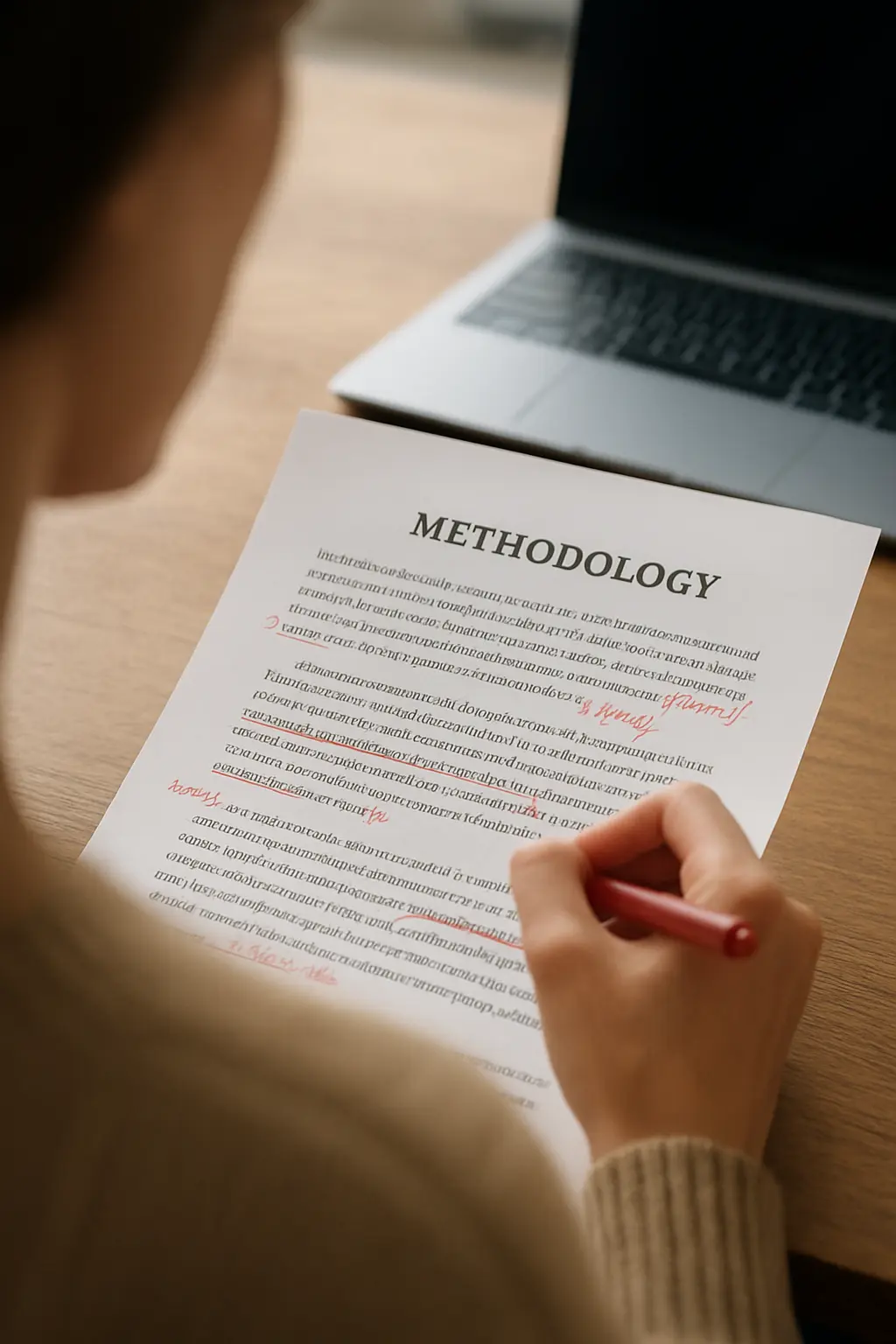
    A methodology page annotated where an agentless passive has been changed to an active sentence
    The pronoun question and the voice question are related but separate, and the methodology chapter is where they come apart.

    What does your own department actually require?

    Work through these in order and stop at the first one that gives you an answer.

    1. The dissertation module handbook. Not the general university writing guide — the handbook for the specific module the dissertation is assessed under. Where a rule exists, this is where it lives.
    2. The marking criteria for the module. Occasionally the band descriptors name a register expectation directly.
    3. Recent journals in your field. Open three articles from the journals your literature review cites most. Count how many use “I” or “we” in the introduction. This is the best proxy for your discipline’s default.
    4. Your supervisor, in writing. Leeds gives exactly this instruction about voice, and it applies equally to person: “Always check with your department to see what form of writing would be most appropriate for your subject area.” Ask by email so the answer is on record.

    One warning. Guidance written for research degrees is not guidance for you — a thesis presentation policy and an undergraduate module handbook are different documents with different audiences, and the first is not evidence about the second.

    Which sections normally take the first person, and which do not?

    Even departments that discourage “I” across the dissertation usually carve out exceptions. Leeds states one explicitly: the third-person rule “may not apply, however, if you are asked to write a reflective report based on your own thoughts and experiences. This is a more personal style of writing and can usually be written using the first person.”

    The practical pattern in UK undergraduate dissertations looks like this.

    • Reflexivity and positionality statements — first person, nearly always. These sections exist to state who you are in relation to your participants, and they cannot be written impersonally without becoming absurd. If you are writing one, see our guidance on thematic analysis, which sets out what a positionality paragraph has to do beyond listing your identity.
    • Methodology — passive by convention. This is covered below, and it is the strongest convention on this page.
    • Results — impersonal, because the data is the subject. “Attendance declined across the three conditions” needs no pronoun. Our guide to the results chapter covers the reporting conventions in detail.
    • Introduction and discussion — the contested ground. This is where “I argue” versus “it is argued” actually gets decided, and where your department’s default matters most.
    • Abstract — follow the abstract’s own conventions, which are tighter than the rest of the document; see how to write a dissertation abstract.

    If not “I”, then what?

    Departments that forbid the first person rarely say what to use instead, and students fill the gap badly. There are three substitutes, and only two of them are any good.

    The impersonal construction. “It is argued that…”, “This dissertation examines…”, “The analysis presented here suggests…”. The Academic Phrasebank models this directly with “In the section that follows, it will be argued that …”. Note the trick in the second and third examples: the document or the analysis becomes the grammatical subject, so the sentence stays active and readable without a pronoun.

    The agentless passive. “Twelve interviews were conducted.” Correct, conventional in methods, and the subject of the next section.

    “The researcher”, or “the present author”. Contested, and our advice is to avoid it — but you should know that some UK departments require exactly this. The University of Sunderland’s academic register guidance instructs students to “Use the 3rd person e.g. ‘the author’, ‘the student’, ‘the researcher’”. Against that, APA’s seventh edition rules it out in terms: “Do not refer to yourself or your coauthors in the third person as ‘the author(s)’ or ‘the researcher(s)’.”

    So this is a third live disagreement, not a settled point of style. Where you have a free choice, prefer one of the first two constructions: “The researcher conducted twelve interviews” is a first-person act wearing a third-person costume, it adds two words, and it adds no objectivity. Where your department names “the researcher”, use it — a handbook instruction beats a style manual you are not being marked against.

    Is the passive voice the same question as the first person?

    No, and conflating them is the commonest confusion on this topic. Hull notes the correlation while treating them separately: “generally, 1st person = active, 3rd person = passive”. But “The data show a marked decline” is active and contains no pronoun at all, so the two decisions come apart.

    Leeds gives the balanced position on voice: “Most verbs can be used in either an active or passive form. It is usually appropriate to use a mixture of passive and active forms within academic writing.” On why the passive persists: “The passive voice is more formal than the active voice. It is often used in academic writing as it is seen as more impersonal and therefore more objective. However, it is not always easy to read and it may add unnecessary words.” Hull is more directive: “our advice is to use the active voice whenever you can.”

    The methodology chapter is the exception that everyone agrees on. The University of Manchester’s Academic Phrasebank gathers its methods material under the heading “Describing the process: verbs used in the passive”, and every model it gives is an agentless passive — “Data were collected using semi-structured interviews in …”, “Ethical approval was obtained from …”, “The procedures of this study were approved by …”. If you write your methods this way you are following the mainstream UK convention, whatever your department says about “I” elsewhere. Our methodology chapter guide works through the section in full.

    A reflective research diary kept alongside a dissertation draft, where first person is expected
    Reflective and reflexive writing is the one place where UK guidance converges on the first person.

    What does the most-used UK phrase resource actually model?

    Worth knowing, because it undercuts the idea that “I” is inherently unacademic. The University of Manchester’s Academic Phrasebank is the most widely recommended academic phrase resource in UK higher education, and its own signposting models are written in the first person: “In the following pages, I will present …” and “Having defined what is meant by X, I will now move on to discuss …”.

    It offers impersonal alternatives alongside them — “In the section that follows, it will be argued that …” — but it does not treat the first person as an error. A resource that UK universities point their own students towards models both. That is the clearest available evidence that this is a convention question, not a correctness question.

    How do you use “I” without sounding like a diary?

    Cambridge’s warning — “you are writing a scientific document not a child’s diary” — is the real risk, and it is easy to manage. Three rules.

    1. Use “I” for research acts and argumentative moves, not for feelings. “I selected a purposive sample” and “I argue that the effect is confined to first-year students” are fine. “I was really surprised by the results” is not, unless you are in a reflective section that asks for it.
    2. Do not open every paragraph with it. A first-person dissertation should still have the data, the literature and the argument in subject position most of the time. If “I” is the first word of six consecutive paragraphs, the chapter has become a narrative of your process rather than an argument.
    3. Keep the hedging. First person does not license stronger claims. “I found that X causes Y” overclaims in exactly the way “It was found that X causes Y” does. The pronoun changes who is speaking, not how much the data supports.

    And whichever you choose, be consistent. Switching between “I”, “we”, “the researcher” and the passive across five chapters is far more visible to a marker than any single choice among them, and it is one of the things a second marker picks up immediately — see who marks your dissertation and how it is moderated.

    Fixing it across a whole draft

    If you have written 9,000 words and then discovered your handbook rules one way or the other, the repair is a single deliberate pass, not a find-and-replace. Converting “I” into an impersonal construction changes sentence structure, and a careless conversion leaves sentences that are vague about who did what — which is worse than the pronoun ever was.

    Draft and revise your dissertation in Tesify: keep one register decision applied across every chapter, run a consistency pass over person and voice before submission, and let the bibliography look after itself while you concentrate on the argument. The words stay 100% yours — Tesify handles the clerical layer, not the thinking. There is a free tier, so you can test the consistency pass on one chapter before committing.

    Frequently asked questions

    Can I use “I” in a UK dissertation?

    Sometimes, and it depends on your department rather than on any national rule. UK universities publish opposite defaults: Leeds says academic arguments are “not usually presented in the first person”, while Cambridge’s Computer Laboratory says “Writing in the first person singular is preferred.” Your module handbook outranks both.

    Is using “I” unprofessional or informal?

    No. Formality lives in vocabulary, hedging and sentence structure, not in pronouns. “I argue that the effect is confined to first-year students” is more formal than “Basically the effect was only really there in first years.” A dissertation can be entirely first-person and entirely formal.

    Should I write “the researcher” instead of “I”?

    It depends on your department, and UK practice is split. Sunderland instructs students to “Use the 3rd person e.g. ‘the author’, ‘the student’, ‘the researcher’”, while APA’s seventh edition says “Do not refer to yourself or your coauthors in the third person as ‘the author(s)’ or ‘the researcher(s)’.” Where you have a free choice, an impersonal construction reads better than inventing a character.

    Can I use “we” if I am the only author?

    Avoid it. Cambridge’s Computer Laboratory is blunt: “The use of “we” by a single author is outrageously pretentious.” The exception is the inclusive “we” that means writer and reader together, which some disciplines accept in reasoning steps.

    Which sections most often allow the first person?

    Reflective and reflexive sections, wherever they appear. Leeds makes the exception explicit: the third-person rule “may not apply, however, if you are asked to write a reflective report based on your own thoughts and experiences.” Qualitative positionality statements are the commonest place a UK undergraduate is required to write as “I”.

    Does the first person weaken objectivity?

    That is the traditional argument, and Leeds states it: the third person “sounds more objective, using logic and reasoning to persuade.” The counter-argument is Hull’s: “the work, analysis and conclusions are your own and taking yourself out of those processes can sometimes make for awkward writing.” Both are published UK positions.

    Is the first person the same question as the active voice?

    No, though they are related. Hull notes the correlation — “generally, 1st person = active, 3rd person = passive” — but you can write actively without “I”: “The data show a decline” is active and impersonal. Treat them as two separate decisions.

    Should my methodology chapter use the passive?

    By convention, largely yes, and this is the one section where the passive is genuinely the norm. The Academic Phrasebank’s methods material is built on agentless passives under the heading “Describing the process: verbs used in the passive”, with models such as “Data were collected using semi-structured interviews in …” and “Ethical approval was obtained from …”.

    Does my discipline decide this?

    Largely. Hull records the pattern: the move towards the first person “varies by discipline however, with the hard sciences mostly resisting the move to write in the first person and the humanities and social sciences being more accepting.” Check published articles in your own field as well as your handbook.

    What if my handbook says nothing at all?

    Then follow your discipline’s journals and ask your supervisor in writing, so the answer is on record. Leeds gives the same instruction for voice: “Always check with your department to see what form of writing would be most appropriate for your subject area.” A one-line email prevents a whole-draft rewrite.

    Will I lose marks for getting this wrong?

    Rarely on its own, but inconsistency is penalised. Switching between “I”, “we”, “the researcher” and the passive across five chapters reads as carelessness, and it is the kind of thing a second marker notices immediately. Pick one and hold it.

    Can I change my mind late in the draft?

    Yes, but do it as a deliberate pass rather than chapter by chapter. Converting “I” to an impersonal construction changes sentence structure, not just pronouns, so budget an afternoon and re-read for sentences that have become vague about who did what.
  • How to Choose the Right Tense for Each Dissertation Chapter (2026)

    How to Choose the Right Tense for Each Dissertation Chapter (2026)

    There is no single tense for a dissertation, and the UK guidance genuinely conflicts. The working rule is simple — the past for what you did and found, the present for what is still true — but four separate sections have named UK universities publishing opposite instructions. Here is the rule per chapter, where the disagreements are, and how to settle them for your own document.

    Step 1: Learn the one rule that covers most of the dissertation

    Before the chapter-by-chapter detail, there is a single question that resolves most sentences: is this something that happened, or something that is still true?

    Things that happened take the past. You collected the data, you ran the analysis, Smith conducted a study in 2019. Things that are still true take the present. A theory holds, a table shows, a finding implies something for practice.

    The University of Hull states the resulting default: “The majority of your dissertation or research report will be written in the past tense.” That is your baseline. Expected output of this step: you can classify any sentence in your draft in under two seconds.

    Hull is also unusually candid about why the rest of this page is necessary at all: “Tenses can be tricky to master. Even well respected journals differ in the guidance they give their authors for their use.” That is a UK university telling you, in its own guidance, that no settled answer exists.

    Step 2: Set the tense for your literature review — the section where guidance actually conflicts

    This is the hardest section, and it is hard because two named UK universities give opposite instructions.

    1. The University of Warwick states that in a thesis “the literature review usually describes research in the present tense (unless it is based on historical information, which is usually recounted in the simple past).”
    2. The University of Suffolk publishes a per-section table that assigns the past simple to the literature review “To discuss the findings of earlier studies.”

    Both are live guidance from UK universities. Neither is wrong. The way out is to stop asking “what tense does a literature review take?” and start asking a better question, which the University of Manchester’s Academic Phrasebank supplies:

    “For general reference to the literature, the present perfect tense (have/has + verb participle) tends to be used. For reference to specific studies carried out in the past, the simple past tense is most commonly used. This is normally the case where a specific date or point in time in the past forms a part of the sentence.”

    So the variable is not the chapter — it is the scope of the claim. Three tenses, three jobs:

    • Present perfect for the state of a whole field. “Several studies have examined the relationship between commuting time and attendance.”
    • Simple past for one study at one point in time. “Ahmed (2021) surveyed 340 first-year students at two post-1992 universities.”
    • Present for what a writer argues, and for knowledge treated as current. The Phrasebank adds the rule that surprises most students: “When referring to the words or ideas of writers, the present tense is often used if the ideas are still relevant, even if the author is no longer alive.” “Durkheim argues” is correct.

    Expected output: a literature review in which the tense changes with the scope of each sentence, deliberately, rather than drifting. Warwick’s warning applies: “Try not to flit back and forth between past and present tenses, however, and keep the tense used broadly consistent.” If you are still deciding what kind of review you are writing, our guide to literature reviews and systematic reviews settles that first.

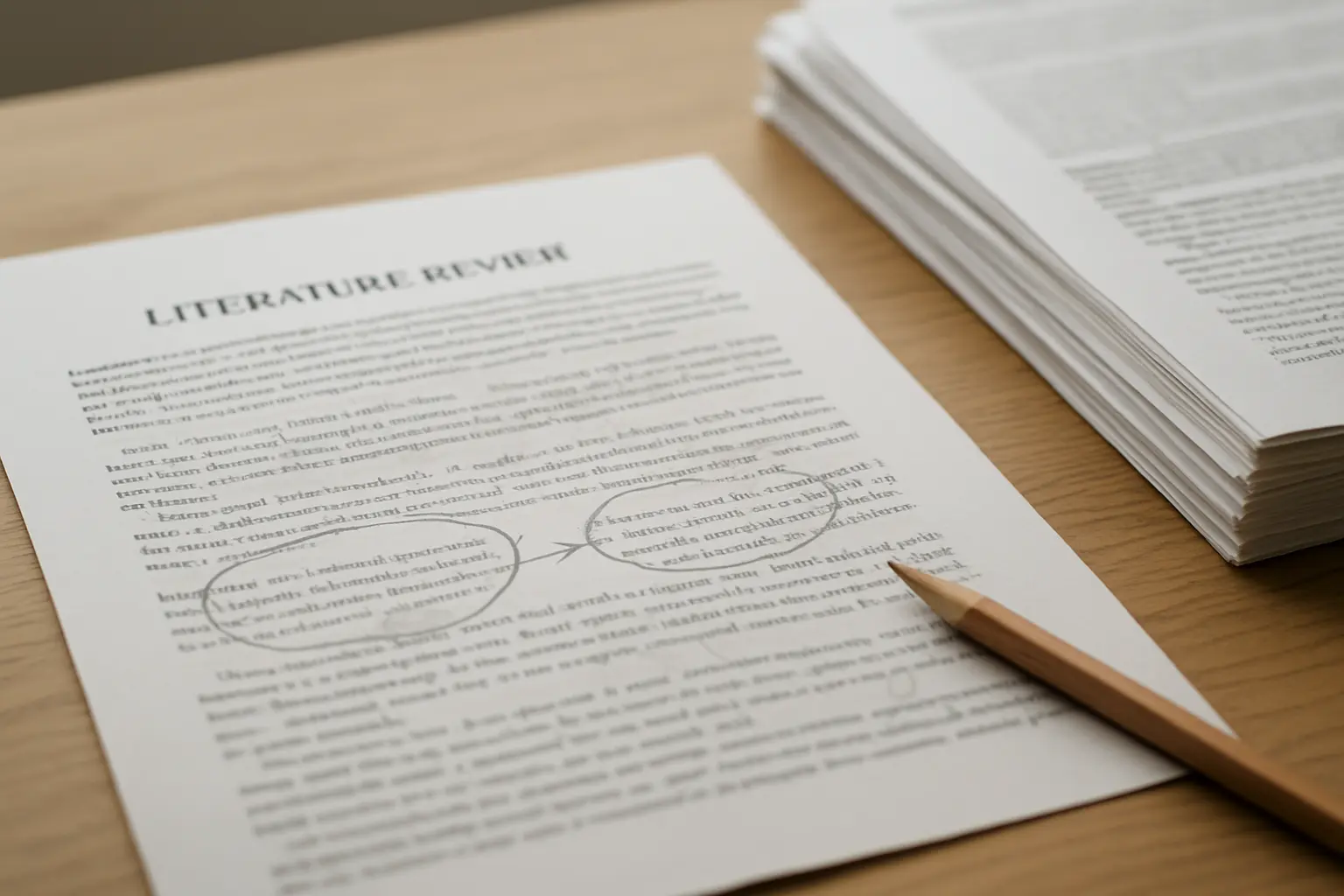
    A literature review page being corrected where a general claim and a specific study need different tenses
    In a literature review the tense is set by the scope of the claim, not by the chapter it sits in.

    Step 3: Put the methodology in the simple past

    This is the easiest section and the one with the most agreement behind it.

    Hull: the methodology “is one of the easiest sections when it comes to tenses as you are explaining to your reader what you did. This is therefore almost exclusively written in the past tense.” Leeds: “If you are writing about an experiment you carried out or a method you used then use the past tense.” Suffolk assigns the past simple “To detail your research”.

    The Academic Phrasebank confirms it from the other direction, noting of its own methods material that “for most of the functional categories in this section, the verbs are written in the simple past tense” — and every model phrase it gives is a past-tense agentless passive: “Data were collected using semi-structured interviews in …”, “Ethical approval was obtained from …”.

    Expected output: a methodology chapter with no present-tense verbs except where you are describing an instrument that still exists. Our methodology chapter guide covers the section’s content; this step covers only its tense.

    Step 4: Report results in the past, and point at tables in the present

    Your findings happened, so they take the past. But the table is on the page in front of the reader right now, so it takes the present. Hull captures both halves: results “should be written in the past tense”, and yet “you will occasionally switch to present tense to write things like ‘Table 3.4 shows that …’ but generally, stick to the past tense.”

    Warwick puts the emphasis differently, calling analysis of results “a combination of past and present tenses”, and Suffolk assigns the present simple specifically “To refer to figures, charts, tables, or other sections of the paper”.

    In practice the split runs along one line:

    • Past — what the participants did and what you measured. “Attendance declined across all three conditions.”
    • Present — what the document does. “Table 4 shows the distribution by year group.”

    Our guide to the results chapter works through what goes in the chapter and in what order; the tense split above is the only grammatical rule it needs.

    Step 5: Move to the present for the discussion

    At the discussion the document changes job — from reporting what happened to arguing what it means — and the tense changes with it.

    Hull: the discussion “will primarily be written in the present tense as you are generally discussing or making conclusions about the relevance of your findings at the present time.” Warwick agrees: the discussion chapter “adopts the present tense to talk about the significance of the findings.”

    You will still reach back into the past to name a specific finding before interpreting it, and that is correct: “Attendance declined most sharply among commuting students. This suggests that timetabling, rather than motivation, drives the effect.” Past for the finding, present for the claim. Expected output: a discussion in which every interpretive sentence is present-tense.

    Step 6: Decide the abstract and the conclusion, knowing that UK guidance disagrees

    These are the two sections where you will find flatly contradictory instructions, so decide deliberately rather than by instinct.

    The abstract. Hull: “Mostly use the present tense, i.e. ‘This is the current state of affairs and this is why this study is needed.’” Leeds Beckett, in its undergraduate dissertation guidance: “Write in the past tense.” Two UK universities, one short section, opposite instructions. The workable answer is a deliberate mixture rather than either extreme, and because the abstract has several other conventions attached to it, we treat it separately in how to write a dissertation abstract.

    The conclusion. Hull groups it with the discussion in the present tense. Warwick states the opposite: “In the conclusion, the simple past tense is used to describe what was done in the essay.” Both defensible — a conclusion that summarises what the dissertation did leans past; a conclusion that states what the findings mean leans present. Pick according to which your conclusion actually is, and hold it.

    Worth knowing before you go looking for a tie-breaker: the Academic Phrasebank’s pages on reporting results, discussing findings and writing conclusions name no tense at all. The most-recommended UK phrase resource declines to rule on the three sections where universities disagree most. That is a reasonable signal that no authority is going to settle it for you.

    A final consistency pass through a dissertation draft checking that each chapter holds one tense
    Tense is checked section by section, because the correct answer changes at every chapter boundary.

    Step 7: Run a consistency pass, section by section

    Markers rarely penalise a single tense slip. They do notice a chapter that drifts. Run this pass late, once the content is stable.

    1. Take one section at a time, not the whole document. The correct tense changes at chapter boundaries, so reading straight through hides the switch you are looking for.
    2. Ask the Step 1 question of every verb. Did it happen, or is it still true?
    3. Check your citing sentences separately. These drift most, because you wrote them over several months.
    4. Delete the rare tenses. Warwick: “The present perfect continuous, past perfect simple/continuous and future perfect tenses are very rarely used in academic writing.” If a sentence needs one, it is usually doing too much and should be split.
    5. Read the first sentence of every paragraph in one pass. If the tense jumps between neighbouring paragraphs without the topic changing, you have found the drift.

    Expected output: each section holds one dominant tense, with deliberate exceptions you could justify aloud.

    A worked paragraph, with the citation formatted correctly

    All three literature-review tenses in one paragraph, with a Harvard in-text citation and its reference-list entry formatted to the version most UK departments mean:

    “Research on commuting and attendance has developed considerably over the past decade (present perfect: the state of the field). Ahmed (2021) surveyed 340 first-year students across two post-1992 universities and found that journey time predicted seminar attendance more strongly than prior attainment (simple past: one study, one point in time). Ahmed argues that this reflects a structural constraint rather than a motivational one (present: the writer’s position, still current).”

    The matching reference-list entry: Ahmed, S. (2021) ‘Commuting distance and seminar attendance in UK higher education’, Journal of Further and Higher Education, 45(3), pp. 312–328.

    If your citations are not yet in this shape, fix that before the tense pass — our complete Harvard referencing guide covers the version UK departments actually ask for.

    Holding it consistent across 10,000 words

    Tense drift is not a knowledge problem. You know the rule by now. It is a problem of writing five chapters over four months and losing the thread of which decision you made in October.

    Draft your dissertation in Tesify: keep the whole document in one workspace so a chapter written in March reads consistently with one written in December, run the consistency pass section by section, and let the bibliography format itself while you concentrate on the argument. The writing stays 100% yours — Tesify handles the clerical layer. There is a free tier, so you can run the pass on one chapter first.

    Frequently asked questions

    What tense should a dissertation be written in?

    There is no single tense. The working default across UK guidance is the simple past for what you did and found, and the present for what is still true — established knowledge, what your tables show, and what your findings mean. Hull puts the default plainly: “The majority of your dissertation or research report will be written in the past tense.”

    What tense should the literature review use?

    This is the one section where UK guidance openly conflicts. Warwick says the literature review “usually describes research in the present tense”; Suffolk’s table assigns the past simple “To discuss the findings of earlier studies.” The Academic Phrasebank splits the difference by scope rather than by section, and that is the most useful rule of the three.

    What is the present perfect for?

    General reference to a body of work rather than to one study. The Academic Phrasebank states it directly: “For general reference to the literature, the present perfect tense (have/has + verb participle) tends to be used. For reference to specific studies carried out in the past, the simple past tense is most commonly used.”

    What tense should the methodology chapter be in?

    The simple past, with more agreement behind it than any other section. Hull calls it “almost exclusively written in the past tense”, Leeds says “If you are writing about an experiment you carried out or a method you used then use the past tense”, and the Academic Phrasebank notes of its own methods material that “the verbs are written in the simple past tense”.

    What tense should the results chapter use?

    Past tense for what you found, present tense for what the table does. Hull says the results section “should be written in the past tense”, while noting you “will occasionally switch to present tense to write things like ‘Table 3.4 shows that …’”. Warwick disagrees on emphasis, calling it “a combination of past and present tenses”.

    What tense should the discussion chapter use?

    Mostly the present. Hull explains why: the discussion “will primarily be written in the present tense as you are generally discussing or making conclusions about the relevance of your findings at the present time.” Warwick agrees that the discussion “adopts the present tense to talk about the significance of the findings.”

    What tense should the conclusion use?

    UK guidance contradicts itself here. Hull groups the conclusion with the discussion in the present tense. Warwick states the opposite: “In the conclusion, the simple past tense is used to describe what was done in the essay.” Follow your handbook, and if it is silent, pick one and stay consistent.

    Can I write about a dead author in the present tense?

    Yes, and it is the convention. The Academic Phrasebank: “When referring to the words or ideas of writers, the present tense is often used if the ideas are still relevant, even if the author is no longer alive.” “Durkheim argues” is correct in 2026.

    Should I ever use the future tense?

    Rarely, and mainly in a proposal rather than a dissertation. A proposal describes work not yet done; a dissertation reports work that is finished. Signposting is the common exception — “the following section will discuss …” is standard.

    Which tenses should I simply avoid?

    Warwick names them: “The present perfect continuous, past perfect simple/continuous and future perfect tenses are very rarely used in academic writing.” If a sentence needs one, it is usually a sign the sentence is doing too much and should be split.

    Do markers actually penalise tense errors?

    A single slip, almost never. Inconsistency across a chapter, yes — it reads as carelessness and it is exactly what a second marker notices. Marking criteria rarely name tense, but they routinely name fluency and accuracy of expression, which is where it lands.

    How do I check tense consistency before submission?

    Read one section at a time asking a single question of every verb: is this something that happened, or something that is still true? Do it section by section rather than page by page, because the correct answer changes at chapter boundaries and reading straight through hides the switch.